


I watched my screen in disbelief.

Olumide Adeyemi
Pelopor Trading Afrika Barat ·  Nigeria
☕ 11 mnt baca
Yang akan Anda pelajari:
- 1The Market Order: Your Instant (and Sometimes Painful) Ticket In
- 2Pending Orders: Limit and Stop Entry (Your Strategic Advantage)
- 3Stop-Loss & Take-Profit: The Non-Negotiables
- 4Advanced Tools: Trailing Stops & OCO Orders
- 5The Naija Factor: Local Realities & Broker Choices
- 6Building a Trade: A Practical Example from Start to Finish
- 7Mistakes I've Made (So You Don't Have To)
I watched my screen in disbelief. EUR/USD was tanking, and my supposed 'stop-loss' at 1.0850 hadn't saved me. The order filled at 1.0825. That 25-pip slippage turned a planned $150 loss into a $400 nightmare. It was 2018, during a surprise ECB announcement, and I learned the hard way that just clicking 'sell' isn't enough. You need to know exactly how your broker executes different forex order types, especially when the market goes haywire. In Nigeria, where volatility is our middle name and internet speeds can be a prayer point, understanding these tools isn't just smart, it's survival.
A market order is the simplest forex order type. You tell your broker to buy or sell right now at the best available price. It's like yelling 'buy!' in a crowded market. Execution is usually instant, which is why beginners love it.
But here's the Nigerian reality check. During major news events (think CBN MPC announcements or US NFP), liquidity dries up. The 'best available price' can be miles away from where you clicked. I've seen spreads on USD/NGN non-deliverable forwards blow out to 50 pips during liquidity crunches. Using a market order then is financial suicide.

Warning: Never use a market order right before or during high-impact news unless you're deliberately trying to catch a volatile move and accept the slippage risk. Your 5-pip stop-loss can easily become a 30-pip disaster.
Use market orders when you need immediate entry or exit and the market is calm. For everything else, especially in our sometimes-janky connectivity environment, there are better options. Always check the live spread before hitting that button. If it's wider than normal, pause. That wider spread is your first commission, paid before the trade even moves.

💡 Tips Winston
Your stop-loss isn't a prediction of where price will go. It's the price that proves your trade idea is wrong. Place it there and don't move it unless you're trailing profits.
“A stop-loss isn't a suggestion. It's a law.”
This is where you start trading with a plan, not just a reaction. Pending orders let you set trades to execute automatically at a future price.
Buy Limit & Sell Limit Orders
A Buy Limit is an order to buy at or below a specified price. You use it when you think price will dip to a support level and then bounce. A Sell Limit is an order to sell at or above a specified price. You use it at a resistance level.
Example: GBP/USD is trading at 1.2700. You believe 1.2650 is strong support. You place a Buy Limit at 1.2650. If price falls to that level, your order becomes a market order and fills. I used this perfectly on XAU/USD (gold) last month. Price was at $2030, I set a Buy Limit at $2015. It dipped to $2014.80, triggered my order, and rallied to $2040. Entry was pristine.
Buy Stop & Sell Stop Orders
A Buy Stop is an order to buy at or above a specified price. You use it to enter a breakout. A Sell Stop is to sell at or below a specified price, for a breakdown.
Example: USD/JPY is consolidating around 150.00. Resistance is at 150.50. You place a Buy Stop at 150.55. If price breaks out and hits 150.55, you're in.

Pro Tip: When setting pending orders, add 2-3 pips beyond the key level (support/resistance). This helps avoid false breakouts where price just kisses the level and reverses. That wasted 2 pips is cheaper than a losing trade.
The beauty for Nigerian traders? You set these orders and walk away. No need to babysit the charts during unstable light or work hours. They automate your strategy. Most brokers, like the ones in our Exness review or IC Markets review, offer these on MT4/MT5 with no extra cost.
“Using a market order during a Nigerian internet drop is like throwing money into a lagoon.”
If you take nothing else from this guide, take this: Never, ever trade without a stop-loss order. A stop-loss (SL) is an order attached to an open trade to close it at a predetermined loss level. A take-profit (TP) closes it at a profit target.
Your stop-loss isn't a suggestion. It's a law. In 2020, I broke my own law. I went long on EUR/USD at 1.1250 with no SL, 'just watching it.' I got distracted. Came back to find it at 1.1050. A 200-pip loss on a standard lot. That was $2000 gone because of ego and distraction. I funded that loss with my own money, not a prop firm's. The pain was real.
How to Set Them
Don't just pick random numbers. Your SL should be based on technical analysis: below a swing low for a long trade, above a swing high for a short trade. Your risk (the distance from entry to SL) determines your position size. Use a position size calculator every single time.
Let's say you have a $1000 account and risk 2% per trade ($20). You go long on EUR/USD at 1.0850, with your SL at 1.0820 (30 pips risk). $20 risk / 30 pips = $0.666 per pip. Since a standard lot is ~$10/pip, you'd trade a 0.07 lot size. This math is non-negotiable.
A TP is your profit target, based on a risk-reward ratio. Aim for at least 1:1.5. In the trade above, a 45-pip TP (1.0895) gives a 1:1.5 ratio.

Example: Trade: Buy EUR/USD at 1.0850. SL: 1.0820 (30 pips). TP: 1.0895 (45 pips). Risk: $20. Potential Reward: $30. Risk/Reward: 1:1.5.
These orders work while you sleep. They enforce discipline, which is the only thing separating consistent traders from gamblers at the betting shop.
“Using a market order during a Nigerian internet drop is like throwing money into a lagoon.”
Once you're comfortable with the basics, these tools can seriously level up your game.
Trailing Stop Order
This is a dynamic stop-loss. It follows the price at a fixed distance (in pips or percentage) as the trade moves in your favor. If price reverses by your trailing distance, the trade closes.
Why it's golden: It locks in profits without you manually moving your SL. Say you buy BTC/USD at $60,000 with a 1000-pip trailing stop. It rallies to $65,000. Your SL automatically moves to $64,000. If it drops to $64,000, you exit with a $4000 profit. If it rockets to $70,000, your SL trails up to $69,000.
The catch? Not all brokers offer 'true' trailing stops that move in real-time on the server. Some only trail on your local platform. If your app crashes, the trail stops. Check your broker's specs. This is a key feature where a powerful terminal can help.
One-Cancels-the-Other (OCO) Order
An OCO order links two pending orders. When one is triggered, the other is automatically canceled.
Classic use: You identify a symmetrical triangle on USD/CAD. You don't know if it will break up or down. You place a Buy Stop above resistance and a Sell Stop below support as an OCO pair. Whichever break happens first triggers its order and cancels the other. You're ready for the move without risking two opposite trades.
You can also use it for exit management. Link a take-profit and a stop-loss to an open trade? That's standard. But you can get creative, like setting a partial TP and a trailing stop as an OCO pair. These orders require a platform that supports them natively or through a plugin. Manual management is a headache.
💡 Tips Winston
If you find yourself constantly moving your stop-loss further away, you're not trading. You're praying. Close the trade, re-analyze, and re-enter with a clear plan.
“Your order types are your soldiers. Deploy them with a strategy, not in a panic.”
Trading theory is one thing. Executing it from Lagos, Port Harcourt, or Abuja is another. Here’s what matters for us.
Connectivity & Slippage
Our internet can be 'glorious' one second and gone the next. This makes certain order types riskier. A market order during a disconnection can result in massive slippage. Pending orders (limits, stops) are safer because they live on the broker's server. Once set, they'll execute even if your light goes out, provided the broker's server is stable.
Broker Execution & Regulations
You need a broker with reliable order execution. Many Nigerian traders use internationally regulated brokers that accept NGN deposits. Look for:
- Fast, reliable order execution (check reviews for complaints about requotes or slippage).
- Support for all major order types, especially trailing stops and OCOs.
- Local payment methods for deposits/withdrawals (bank transfer, USSD, fintech apps).
Brokers like XM and HFM are popular here for a reason. They offer micro accounts (so you can practice with real money but small stakes), local payment options, and generally stable platforms. A broker with a physical presence or dedicated African support can be a plus when you have issues.
Costs in Naira Terms
Understand the costs. Spreads are your main enemy. A 1.5 pip spread on EUR/USD might not sound like much, but if you're scalping for 5-10 pips, it eats half your profit. Commission-based accounts (like raw spreads from Pepperstone) can be cheaper for high-volume traders. Do the math based on your style.
Also, factor in bank charges for currency conversion and transfers. Sometimes, funding in USD directly via a domiciliary account can be cheaper than multiple NGN-USD conversions by the broker and your bank.
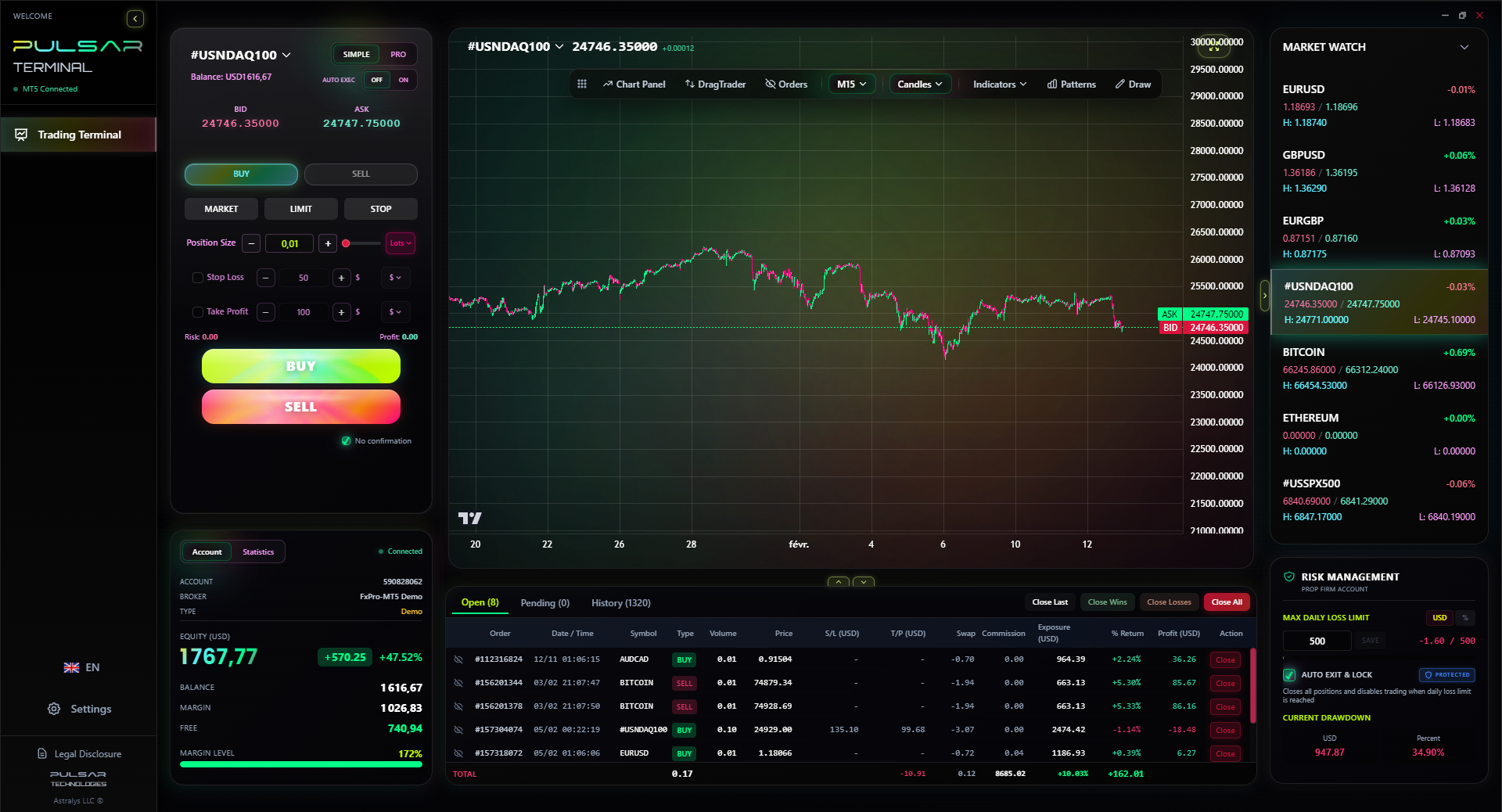
Managing complex order setups like OCOs and trailing stops manually is a headache, but tools like Pulsar Terminal automate them directly on your MT5, letting you trade your strategy, not your platform.
Pulsar Terminal
Alat MT5 all-in-one: order drag-and-drop, multi-TP/SL, trailing stop, grid trading, Volume Profile, dan perlindungan prop firm. Digunakan 1.000+ trader setiap hari.
“Your order types are your soldiers. Deploy them with a strategy, not in a panic.”
Let's walk through a real scenario using multiple forex order types. This is how I might structure a swing trading idea on GBP/JPY.
Step 1: Analysis & Plan Timeframe: 4-hour chart. GBP/JPY has pulled back to a key support zone at 183.00. The daily trend is still up. My plan: Buy on a confirmation of a bounce from 183.00.
Step 2: Order Entry I don't want to buy blindly at 183.00. I want proof of a bounce. I'll use a Buy Stop Limit order (a combo order some brokers offer).
- I set a Buy Stop at 183.50 (above the immediate resistance of the pullback).
- I set a Limit Price for that order at 183.20. What does this do? If price rallies strongly and hits 183.50, it triggers a Buy Limit at 183.20. I get filled on a retest of the breakout level, not at the peak. If price just slides past 183.00, my order never triggers.
Step 3: Risk Management My stop-loss goes at 182.65, just below the swing low at 182.80. That's a 55-pip risk from my 183.20 entry (183.20 - 182.65). My first take-profit target (TP1) is at 184.50, a previous resistance. That's a 130-pip reward. Risk/Reward > 1:2. Good.
Step 4: Advanced Exit Management Instead of a single TP, I'll use a partial close and a trailing stop.
- I set a Take-Profit for half my position at 184.50.
- For the remaining half, I set a Trailing Stop of 40 pips. When TP1 hits, I bank profit on half and let the rest run with the trail. This way, I secure some profit and give the trade room to potentially run much further.
This entire setup is automated. Once the orders are placed, I don't need to stare at the screen. This is the power of mastering forex order types. It turns emotional reactions into systematic processes.
“The spread is your first commission, paid before the trade even moves.”
We learn more from losses than wins. Here are my costly blunders with order types.
- Placing Stops Too Tight: Early on, I'd put my stop-loss 5 pips from entry because I hated losing money. The market's normal noise would wipe me out, then the trade would go my way. I was right on direction, but wrong on market rhythm. Give your trade room to breathe. Place stops beyond obvious technical levels.
- Using Market Orders for Breakouts: I'd see a breakout, frantically hit 'buy market,' and get filled 8 pips higher as the spike happened. The pullback would then stop me out. Use a Buy Stop Limit or accept that you might miss the very first spike. Chasing is for amateurs.
- Forgetting About Spread on Pending Orders: A Buy Limit order is filled at your specified price or better. But 'or better' means lower. If you set a Buy Limit at 1.0850 and the ask price gaps down to 1.0840, you get 1.0840. Great. For a Sell Stop, 'or better' means higher. If you have a Sell Stop at 1.0800 and price gaps down to 1.0790, you get 1.0790 - a worse fill. Understand the fill logic.
- Ignoring the News Calendar: Placing tight pending orders right before the US Non-Farm Payrolls or a CBN meeting is asking for trouble. Volatility will likely trigger them with massive slippage. Know when to be in the market and when to be on the sidelines.
- Not Checking Order Confirmation: Always double-check your ticket before submitting. I once accidentally entered a 1.0 lot size instead of 0.1. The panic when it moved against me was unforgettable. Use a calculator, confirm the details, then submit. Slow is smooth, smooth is fast.
💡 Tips Winston
The most important order you'll ever place is the first one: the one that gets you out of a losing trade. Master the stop-loss before you dream about take-profits.
FAQ
Q1What is the best forex order type for beginners in Nigeria?
Start with limit and stop-loss orders. They force you to plan your entry and exit points before you trade, which builds discipline. Avoid market orders for everything except exiting trades quickly in calm markets. Using a stop-loss from day one is non-negotiable, no matter what any 'guru' says.
Q2Can I use all these order types on my mobile phone?
Mostly, yes. Popular apps like MT4, MT5, and broker-specific apps support market, limit, stop, and stop-loss/take-profit orders. More advanced types like trailing stops and OCO orders might be limited or harder to set up on a small screen. For complex order management, a desktop platform is usually better and more reliable.
Q3Why did my stop-loss order fill at a worse price than I set (slippage)?
Slippage happens during high volatility when there aren't enough buyers/sellers at your exact price. If you set a stop-loss at 1.0850 and news hits, the next available sell price might be 1.0840. Your order fills at that worse price. It's common during major news events. To minimize it, avoid trading right before big news or use a guaranteed stop-loss (if your broker offers it, usually for a fee).
Q4What's the difference between a Sell Stop and a Stop-Loss?
A Sell Stop is a pending order to open a new short trade when price falls to a level. A Stop-Loss is an order attached to an existing long trade to close it if price falls to a level. They both sell, but one starts a trade, the other ends one. Mixing them up can lead to accidentally opening the opposite position you intended!
Q5Are there any extra fees for using different order types?
Generally, no. Brokers don't charge extra for placing a limit vs. a market order. However, the cost is in the execution. Market orders may suffer wider spreads. Stop and limit orders might not get filled if price doesn't reach your level (an opportunity cost). The only explicit fee might be for a 'guaranteed stop-loss,' which protects against slippage for a premium.
Q6Is a trailing stop better than a fixed take-profit?
Not better, just different. A fixed take-profit secures a known profit. A trailing stop lets profits run further in a strong trend but can give back more in a choppy market. I often use both: take partial profit at a fixed TP, then let the rest ride with a trailing stop. It's about balancing certainty and potential.
Q7My broker doesn't offer OCO orders. What can I do?
You can manually manage two pending orders, but you must cancel one if the other triggers. This requires you to watch the market. Alternatively, some advanced trading platforms or plugins (often called 'Expert Advisors' on MT4/5) can automate this OCO logic for you. Check if your broker offers any advanced trading tools or consider a platform that supports it natively.
Pelajaran Prof. Winston
Poin Penting:
- ✓Always use a stop-loss order. No exceptions.
- ✓Place stops beyond market noise, not inside it.
- ✓Use pending orders (limit/stop) for planned entries.
- ✓Trailing stops lock in profits in trending markets.
- ✓Understand slippage risks before major news events.
Seberapa bermanfaat artikel ini?
Klik bintang untuk menilai
Wawasan Trading Mingguan
Analisis & strategi mingguan gratis. Tanpa spam.
Tentang Penulis
Olumide Adeyemi
Pelopor Trading Afrika Barat
Salah satu edukator trading forex paling aktif di Nigeria. 8 tahun pengalaman trading dari Lagos. Spesialis strategi modal rendah dan tantangan prop firm untuk trader Afrika.
Komentar
Peringatan Risiko
Perdagangan instrumen keuangan mengandung risiko signifikan dan mungkin tidak cocok untuk semua investor. Kinerja masa lalu tidak menjamin hasil di masa depan. Konten ini hanya untuk tujuan edukasi dan tidak boleh dianggap sebagai nasihat investasi. Selalu lakukan riset Anda sendiri sebelum trading.
Anda mungkin juga suka

Cara Trading Forex Sukses: 7 Prinsip dari Trader Profesional
Cara trading forex sukses dengan 7 prinsip trader pro: manajemen modal, disiplin, journal trading, backtest. Data nyata, bukan janji profit palsu.
Jam Trading Forex Terbaik untuk Trader Indonesia: Panduan Lengkap dengan Tabel Waktu
Panduan jam trading forex untuk trader Indonesia. Tabel 4 sesi dunia, jam emas 20:00-00:00, sesi mana yang harus dihindari. Data akurat + tips dari trader berpengalaman.
Top 5 Sàn Forex Uy Tín Nhất 2026: Review Jujur dari Trader Indonesia
Top 5 sàn forex uy tín 2026 untuk trader Indonesia. Review jujur: spread, deposit, withdraw, dukungan lokal. Exness, XM, IC Markets & lebih.
Dapatkan Pulsar Terminal
Semua kalkulator ini terintegrasi dalam Pulsar Terminal dengan data real-time dari akun MT5 Anda.
Dapatkan Pulsar Terminal