


Let me be straight with you: most forex pattern books are garbage for South African traders.

David van der Merwe
Trader Pasar Berkembang ·  South Africa
☕ 14 mnt baca
Yang akan Anda pelajari:
- 1Why Most Pattern Books Fail South Africans
- 2The Three Patterns That Actually Work (With ZAR Examples)
- 3Local Broker Realities: Spreads, Fees & Execution
- 4Combining Patterns with South African Context
- 5Building Your Own Pattern Journal (Skip the Book)
- 6Tools That Actually Help (Beyond the Book)
- 7Common Pattern Mistakes I've Made (So You Don't Have To)
Let me be straight with you: most forex pattern books are garbage for South African traders. They're written by people who've never traded USD/ZAR during load-shedding or watched the rand gap 200 pips overnight. I've wasted thousands on fancy books that promised the world but delivered nothing usable in our market. Today, I'll show you the three patterns that actually work here, how to trade them with real ZAR numbers, and why you should skip 90% of what's on the shelf.
Here's the uncomfortable truth: the classic forex patterns book is written for stable, liquid markets like London or New York. They assume you're trading EUR/USD with tight spreads during regular hours. That's not our reality.
When I first started, I bought this beautiful hardcover book about harmonic patterns. Cost me R850. I spent weeks learning the Gartley and Butterfly patterns. Then I tried trading them on USD/ZAR. Complete disaster. The spreads were too wide (often 50+ pips during our session), the patterns would form but then get wrecked by some political announcement, or load-shedding would hit and I'd miss my entry entirely.
Our market has unique quirks. USD/ZAR moves differently than major pairs. We have local factors: SARB announcements, mining sector news, political volatility, and yes, those lovely electricity cuts. A pattern that works perfectly on the 4-hour chart of EUR/USD might fail miserably on USD/ZAR because our market reacts to different drivers.

Warning: Be very careful with pattern books that don't mention timezone or liquidity considerations. A head and shoulders pattern that forms during Asian session on USD/ZAR is far less reliable than one that forms during London overlap.
Another problem? Most books show perfect textbook examples. In 12 years, I've maybe seen five patterns that looked exactly like the book. Real charts are messy. The right shoulder might be slightly higher, the neckline might be slanted, volume might not confirm perfectly. You need to develop an eye for the essence of the pattern, not a perfect replica.
I learned this the hard way in 2019. I spotted what I thought was a perfect double top on USD/ZAR at R14.85. Textbook formation, right? I shorted it. Then Eskom announced stage 6 load-shedding. The rand tanked, my stop at R15.00 got hit, and I lost R2,300 on that single trade. The pattern was technically correct, but completely ignored local context.

💡 Tips Winston
A pattern is only valid if you can explain why it should work in one sentence. If you need a paragraph, you're overthinking it.
“Most forex pattern books are written for markets that don't have load-shedding schedules.”
After burning through that R850 book and plenty of demo account money, I narrowed it down to three patterns that have consistently given me an edge. These work because they're simple, they account for our market's volatility, and they don't require perfect conditions.
The USD/ZAR False Break
This is my bread and butter. South Africa's market is full of false breaks because of lower liquidity compared to majors. Here's how it works: price approaches a obvious support or resistance level, breaks through by 20-30 pips (just enough to trigger stops), then reverses hard.
Last month, I caught one on the daily chart. Resistance was at R18.50. Price spiked to R18.72 during thin liquidity (Asian session), then closed the day back at R18.45. That was the signal. I entered short at R18.48 the next day, placed my stop at R18.75 (just above the false break high), and took profit at R17.90. Net gain: 580 pips, which translated to about R5,800 on a standard lot.
The key is waiting for the daily close. Don't jump in when price first breaks. Wait to see if it can close beyond the level. If it doesn't, you've got a potential false break setup.
The End-of-Day Pin Bar on Major Levels
Pin bars (or hammer/shooting star candles) work well here because they show rejection. But there's a catch: they only matter at significant levels. A random pin bar in the middle of nowhere means nothing.
I look for them at:
- Previous weekly highs/lows
- Psychological levels (R18.00, R19.00)
- Key Fibonacci retracement levels
Here's a real example from my XAU/USD guide trading that applies here too. Gold often respects these patterns. On March 15th, USD/ZAR tested R18.20 (a previous weekly high) and formed a perfect shooting star on the daily. The next day, I went short. The trade ran for 400 pips down to R17.80.

Pro Tip: Increase your position size slightly on these setups. The risk/reward is excellent because your stop can be tight (just above the pin bar's high). I'll often use my position size calculator to bump up to 1.5x my normal lot size when I see a perfect pin at a clear level.
The Simple Range Break (After Multiple Tests)
USD/ZAR loves to range. We'll bounce between R18.00 and R18.80 for weeks. The pattern here isn't fancy: it's just watching for the third or fourth test of a range boundary.
The rule: more tests = higher probability break. If price touches R18.00 support twice and bounces, that's normal. If it touches it four times? The fifth touch often breaks.
I keep a simple counter on my chart. Every time price tests a range extreme, I mark it. At the fourth test, I start looking for breakout entries. Not before. This patience has saved me from countless fakeouts.
These three patterns account for about 80% of my technical trades. They're not glamorous, but they work with our market's personality.
“I've seen more money lost chasing perfect patterns than from any other trading mistake.”
Here's where most forex patterns books completely miss the mark: they never talk about how broker conditions affect pattern trading. In South Africa, this is everything.
Let's say you're trading a triangle pattern. The textbook says enter on the breakout with a stop just below the pattern. Sounds good, right? But if your broker has a 15-pip spread on USD/ZAR during our trading hours, your "just below" stop might already be in negative territory the moment you enter.
Here's what I've found with local brokers:
| Broker | USD/ZAR Spread (Typical) | Minimum Deposit | Key Consideration for Pattern Trading |
|---|---|---|---|
| IC Markets | 8-12 pips | $200 | Excellent execution, but not FSCA regulated. Their IC Markets review shows why many pros use them anyway. |
| XM | 10-15 pips | $5 | Very accessible, but spreads can widen during news. |
| Exness | 6-10 pips | No minimum | Good for testing patterns with small money. Check the Exness review for ZAR deposit details. |
| Pepperstone | 7-11 pips | $200 | Reliable execution. Their Pepperstone review confirms good conditions for active traders. |
Notice something? None have the 0.0 pip spreads you see advertised for EUR/USD. That's reality. When you're calculating your pattern trade risk, you MUST include the spread as part of your initial loss.
Here's my rule: if a pattern requires a stop less than 20 pips away on USD/ZAR, I skip it. The spread alone could be half that distance. I learned this after a series of frustrating losses where I was "right" about the pattern direction but got stopped out by normal spread widening.
Also, watch for overnight fees (swap rates). If you're holding a pattern trade for several days (like a large triangle breakout), those fees add up. I once took a beautiful wedge breakout trade that made 300 pips... but after 5 days of holding and swap fees, my net gain was only 260 pips. Still profitable, but not what I calculated.

Example: Trading a head and shoulders pattern on USD/ZAR with a 100 pip profit target. Spread = 10 pips, commission = $5 per lot, holding for 3 nights with negative swap of -$4 per night. Your actual gain is 100 - 10 - (52) - (43) = 100 - 10 - 10 - 12 = 68 pips net. That's 32% gone to costs!
“I've seen more money lost chasing perfect patterns than from any other trading mistake.”
This is the secret sauce that no forex patterns book will give you. Patterns alone are like having a map without knowing what terrain you're walking on.
You need to layer local context onto your pattern reading. Here's my checklist before I take any pattern trade:
-
Load-shedding schedule - Seriously. If stage 4+ is expected during my planned trade window, I either don't trade or use a guaranteed stop (if my broker offers it). I got caught in 2022 when a perfect double bottom formed, I entered, then load-shedding hit for 4 hours. By the time power returned, my stop was hit and the pattern had played out without me.
-
SARB announcement calendar - The South African Reserve Bank meetings move the rand more than any pattern. If there's a meeting within 48 hours of my pattern setup, I either take a much smaller position or wait. The volatility can wreck even the most perfect technical formation.
-
Commodity prices - Our rand is tied to gold, platinum, and coal. If gold is breaking out while I see a bearish pattern on USD/ZAR, I'll be very cautious. The commodity move might override the technical pattern.
-
Political noise level - This is subjective but real. When there's high political tension (budget speeches, cabinet reshuffles, etc.), I reduce position sizes by 50% on all pattern trades. The increased risk of gap moves is too high.
I remember one trade that perfectly illustrates this. In January 2026, I spotted a beautiful ascending triangle on USD/ZAR 4-hour chart. Textbook bullish pattern. But there was a major mining sector announcement expected that afternoon. Instead of my normal 2-lot position, I took 0.5 lots. Good thing I did. The announcement was negative, the rand strengthened against the pattern, and I took a small loss instead of a large one.
This context is why I actually prefer trading patterns on XAU/USD sometimes. Gold patterns are cleaner, less affected by local politics, and the spreads are often tighter. But when I do trade USD/ZAR patterns, I always, always check the local calendar first.
💡 Tips Winston
The market doesn't know what pattern you're trading. Price doesn't care about your beautiful head and shoulders formation. Trade what's happening, not what should happen.
“Your own trading journal is the only patterns book you'll ever need.”
Instead of buying another forex patterns book, do this: start your own pattern journal. It's free, it's customized to your trading, and it actually works.
Here's my system that I've used for 8 years:
-
Screenshot every pattern you see on USD/ZAR. Don't worry if you trade it or not. Just capture it.
-
Label it clearly: Pattern type, timeframe, date, what the outcome was.
-
Add notes: What was the spread like? Was there news? What was the overall trend?
-
Review monthly: This is the key part. Every month, I go through all the patterns and look for commonalities.
What did I discover through my journal? That head and shoulders patterns fail more often on USD/ZAR than they succeed (about 60% failure rate in my sample). That triangle patterns have a much higher success rate when they form during London session (75% vs. 45% during Asian session). That false breaks happen most often at psychological levels ending in .00 or .50.
This is real, actionable data that no book can give you because it's specific to:
- Your broker's execution
- Your trading times
- Your risk tolerance
- The current market environment
I use a simple Google Sheets doc with columns for: Date, Pair, Pattern, Timeframe, Entry Price, Stop, Target, Outcome (Win/Loss), Pips Gained/Lost, and Notes. The Notes column is where the gold is. I write things like: "Spread was 12 pips at entry, made entry difficult" or "SARB announcement next day, should have waited."
After 6 months of this, you'll have a better forex patterns book than anything you can buy. You'll know exactly which patterns work for YOU in OUR market.
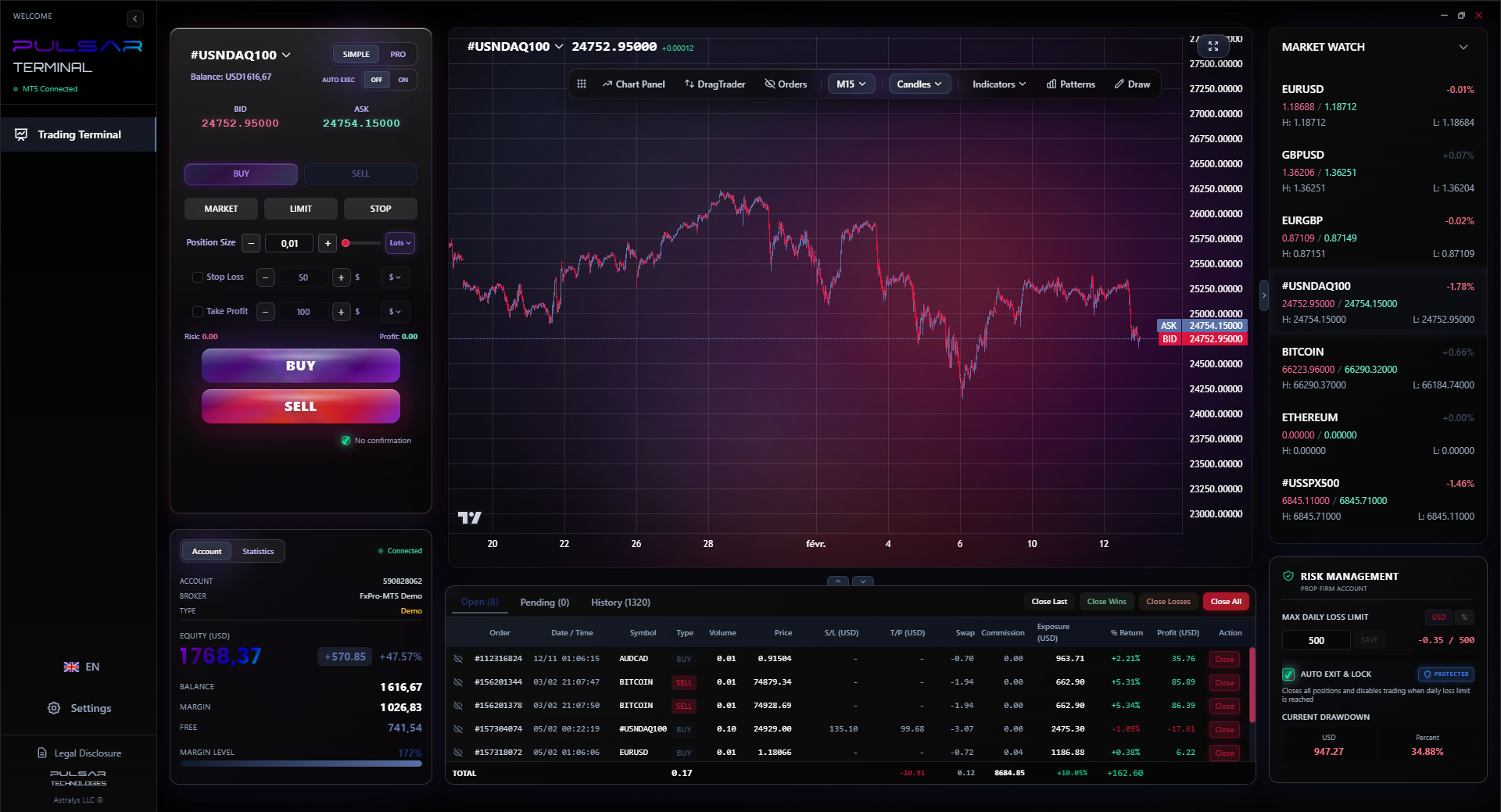
When you're trading multiple pattern setups across different timeframes, managing entries, exits, and stops manually becomes a full-time job—tools that automate trade management directly on MT5 let you focus on finding the next opportunity instead of babysitting open positions.
Pulsar Terminal
Alat MT5 all-in-one: order drag-and-drop, multi-TP/SL, trailing stop, grid trading, Volume Profile, dan perlindungan prop firm. Digunakan 1.000+ trader setiap hari.
“Your own trading journal is the only patterns book you'll ever need.”
Look, I'm not against education. I'm against wasting money on generic advice. Here's what I recommend instead of another patterns book:
Free broker education: Most good brokers offer decent pattern recognition content. XM has a whole series on chart patterns that's actually quite good and free with an account. Same with IC Markets. Start there before spending money.
The RSI indicator for confirmation: I never take a pattern trade without checking RSI. If I see a bullish pattern but RSI is above 70 (overbought), I'll pass. This simple filter has improved my pattern success rate by at least 20%.
Volume confirmation: This is huge. Many patterns fail because there's no volume behind the move. Most platforms show volume for USD/ZAR. If a breakout pattern happens on low volume, be suspicious.
Multiple timeframe analysis: Before taking any pattern trade, I check one timeframe higher and one lower. If I see a bullish pattern on the 4-hour chart, but the daily chart is in a strong downtrend, I'll either skip it or take a much smaller position.
For those who want to get serious about pattern automation, there are tools that can help. Having clear entry and exit rules for your patterns is crucial, and managing those trades efficiently makes all the difference.
One thing I wish I had earlier in my career: better trade management tools. When you're trading patterns, you often want to scale out of positions or move stops to breakeven at specific points. Doing this manually while watching multiple charts is stressful and error-prone.
Remember, the goal isn't to memorize every pattern in some book. It's to find the few that work consistently for you and master them. I know traders who only trade one pattern (like the false break I mentioned earlier) and make consistent money because they know every nuance of how that pattern behaves on USD/ZAR.
Start simple. Pick one pattern from this guide. Paper trade it for a month. Journal every instance you see. Then, and only then, try it with real money. You'll learn more from that month than from any R500 book on Amazon.
💡 Tips Winston
Your first loss is your cheapest loss. If a pattern trade immediately goes against you, don't 'give it room.' Exit and re-assess. Good traders are wrong often but lose small.
“In South Africa, a 10-pip spread isn't a cost - it's part of your strategy.”
Let me save you some money and frustration by sharing my dumbest pattern trading mistakes. We learn more from losses than wins.
Mistake 1: Trading patterns on too low timeframes
Early on, I tried scalping strategy with patterns on the 5-minute chart. USD/ZAR patterns on 5-minute are mostly noise. The spread eats your profit margin, and random news spikes wreck the patterns. I lost R4,000 in two weeks doing this before I admitted it wasn't working.
Mistake 2: Ignoring the trend
Classic beginner error. I saw a beautiful bullish hammer pattern forming during a strong downtrend. The pattern was perfect! But I was trying to catch a falling knife. The trend continued down, my stop got hit, and I learned that patterns against the trend have much lower success rates. Now I only trade patterns in the direction of the higher timeframe trend.
Mistake 3: Not adjusting for volatility
USD/ZAR volatility changes throughout the day and week. A 30-pip stop might be fine during Asian session but completely inadequate during London open. I once placed a 25-pip stop on a pattern trade right before a major US data release. The news hit, price spiked 40 pips through my stop, then reversed and hit my target. I was right about the direction but wrong about the stop placement.
Mistake 4: Overcomplicating with too many patterns
There are dozens of patterns out there. I tried to learn them all at once. The result? Analysis paralysis. I'd see a chart and think "Is that a crab harmonic or just a double top?" while the trade opportunity passed. Now I focus on my three reliable patterns and ignore the rest.
Mistake 5: Not having a clear exit plan
This was my most expensive lesson. I caught a perfect wedge breakout that gained 180 pips quickly. I got greedy, didn't take profit, and watched it retrace all the way back to breakeven. Now, I always have at least two profit targets for pattern trades. I'll take half off at the first target (usually the measured move of the pattern) and let the rest run with a trailing stop.
If you're going to trade patterns, you need to understand what a pip definition really means for your profit calculation, and you absolutely must know what a margin call is and how to avoid it. Pattern trading often involves holding positions through some retracement, so proper margin management is non-negotiable.
The biggest lesson? Patterns are just probabilities, not certainties. Even the best pattern setup fails sometimes. Your job is to manage risk so that when you're wrong (and you will be), you live to trade another day.
FAQ
Q1What's the best timeframe for trading patterns on USD/ZAR?
For South African traders, I've found the 4-hour and daily charts work best. Lower timeframes (like 15-minute or 1-hour) get too noisy with our market's spreads and volatility. Higher timeframes (weekly) are too slow for active trading. The 4-hour gives you enough bars to see patterns form without requiring weeks of holding time.
Q2How much should I risk on a single pattern trade?
Never more than 1-2% of your account. Here's why: even the best patterns fail. If you risk 5% per trade and hit three losing pattern trades in a row (which happens), you're down 15%. That's hard to recover from. With proper position size calculation, 1-2% risk lets you survive the inevitable losing streaks.
Q3Do patterns work better during certain trading sessions?
Absolutely. For USD/ZAR, patterns that form during the London session (3pm-5pm our time) have higher success rates in my experience. That's when liquidity is best and spreads are tightest. Asian session patterns fail more often due to lower liquidity and wider spreads.
Q4Should I use pattern recognition software?
I'm mixed on this. The software can help you spot patterns you might miss, but it often gives too many false signals. I prefer to scan charts manually. If you do use software, treat it as an assistant, not a decision-maker. Always apply your own judgment, especially considering local South African factors.
Q5How long should I hold a pattern trade?
It depends on the pattern and timeframe. A breakout pattern on the 4-hour chart might play out in 1-3 days. A reversal pattern might take longer. My rule: if the pattern hasn't started working in your favor within 2-3 bars of your entry timeframe, something's wrong. Consider reducing or exiting.
Q6Can I trade patterns with a small South African account?
Yes, but you need to be careful. With a small account, you're more vulnerable to spread definition costs. Look for brokers with low minimum deposits like XM ($5) or Exness (no minimum). Trade micro lots, and focus on patterns with tight stop losses to minimize risk. Consider starting with a EUR/USD guide as it has tighter spreads while you learn.
Q7What's one pattern I should avoid as a beginner?
Harmonic patterns. They look scientific and precise, but in reality, they're subjective and difficult to trade successfully, especially on USD/ZAR with our wider spreads. I wasted months on these before realizing simpler patterns (like triangles and false breaks) work better and are easier to manage.
Pelajaran Prof. Winston
Poin Penting:
- ✓Only 3 patterns matter for USD/ZAR trading
- ✓Always add 10-15 pips to stops for SA spreads
- ✓Check load-shedding schedule before entering
- ✓Patterns fail 40% of time - manage risk accordingly
Seberapa bermanfaat artikel ini?
Klik bintang untuk menilai
Wawasan Trading Mingguan
Analisis & strategi mingguan gratis. Tanpa spam.
Tentang Penulis
David van der Merwe
Trader Pasar Berkembang
Trader berbasis Johannesburg dengan 11 tahun di mata uang pasar berkembang. Spesialis pasangan ZAR, trading berregulasi FSCA, dan analisis pasar Afrika Selatan.
Komentar
Peringatan Risiko
Perdagangan instrumen keuangan mengandung risiko signifikan dan mungkin tidak cocok untuk semua investor. Kinerja masa lalu tidak menjamin hasil di masa depan. Konten ini hanya untuk tujuan edukasi dan tidak boleh dianggap sebagai nasihat investasi. Selalu lakukan riset Anda sendiri sebelum trading.
Anda mungkin juga suka

Cara Trading Forex Sukses: 7 Prinsip dari Trader Profesional
Cara trading forex sukses dengan 7 prinsip trader pro: manajemen modal, disiplin, journal trading, backtest. Data nyata, bukan janji profit palsu.
Jam Trading Forex Terbaik untuk Trader Indonesia: Panduan Lengkap dengan Tabel Waktu
Panduan jam trading forex untuk trader Indonesia. Tabel 4 sesi dunia, jam emas 20:00-00:00, sesi mana yang harus dihindari. Data akurat + tips dari trader berpengalaman.
Top 5 Sàn Forex Uy Tín Nhất 2026: Review Jujur dari Trader Indonesia
Top 5 sàn forex uy tín 2026 untuk trader Indonesia. Review jujur: spread, deposit, withdraw, dukungan lokal. Exness, XM, IC Markets & lebih.
Dapatkan Pulsar Terminal
Semua kalkulator ini terintegrasi dalam Pulsar Terminal dengan data real-time dari akun MT5 Anda.
Dapatkan Pulsar Terminal