


You're searching for a 'forex solution,' aren't you? That magic system, indicator, or guru that finally makes it all click and the money starts flowing.

David van der Merwe
Trader Pasar Berkembang ·  South Africa
☕ 9 mnt baca
Yang akan Anda pelajari:
You're searching for a 'forex solution,' aren't you? That magic system, indicator, or guru that finally makes it all click and the money starts flowing. I get it. I spent years and a good chunk of my own capital looking for it too. Here's the hard truth I learned: the solution isn't a thing you find. It's a process you build. And for us trading from South Africa, with the rand doing its own chaotic dance, that process has some very specific, non-negotiable rules.
Most traders, especially when starting, confuse a tool with a solution. They think the solution is a perfect 100% win-rate strategy. It's not. The market is probabilistic, not deterministic. No strategy wins every time.
The real forex solution is a framework that keeps you in the game long enough for your edge to play out. It's about survival first, profits second. I learned this the expensive way. Back in 2015, I was convinced I'd cracked the code on USD/ZAR with a complex RSI divergence setup. I risked 5% of my account on one trade. It went my way initially, then the SARB made an unexpected comment and the pair reversed 300 pips in an hour. I didn't have a stop-loss because I was 'sure' of my analysis. I watched my screen, paralyzed, as it took out a month's profits. That wasn't a strategy failure. It was a complete lack of a risk management solution.

Warning: The biggest lie in forex marketing is the promise of a simple, one-size-fits-all system. If it was that easy, everyone would be rich. The solution is always personal and built on discipline.
Your search should shift from 'What strategy?' to 'How do I manage my strategy?' This is where you need a reliable position size calculator and an iron-clad rule on your maximum risk per trade. For South Africans, this is doubly important because our brokers often have wider spreads on ZAR pairs, which eats into your risk calculations from the get-go.
Any lasting forex solution rests on three pillars. Miss one, and the whole structure collapses.
1. A Quantifiable Edge
This is the closest thing to a 'strategy' in the solution. It's a clear, rules-based approach to entering and exiting trades. It must be back-tested (even roughly) and have a logical reason for existing. Is it a breakout play? A reversal based on support? Don't just follow a signal. Understand why it might work more often than not. For example, trading the EUR/USD during London overlap based on price action is a methodology. Flipping a coin is not.
2. Impeccable Risk Management
This is the engine of your solution. It's non-negotiable. It answers: How much do I lose if I'm wrong? Your risk per trade should be a fixed percentage of your current capital, not a fixed rand amount. I never, ever risk more than 1% of my trading account on a single idea. For a R10,000 account, that's R100. It sounds small, but it means you can be wrong 20 times in a row and still have 80% of your capital to fight another day. This single habit is the difference between an amateur and a professional.
3. Psychological Discipline
This is the glue. It's your ability to follow pillars 1 and 2 when you're scared, greedy, or bored. It's clicking the buy button when your setup is there, even after three losing trades. It's not moving your stop-loss further away hoping the market will turn. This pillar is built through routine, checklists, and brutally honest trading journals.

Example: Let's say your edge wins 55% of the time with an average win of R200 and an average loss of R150. With a 1% risk rule on a R10k account (R100 risk), you'd need to adjust your position size so your stop-loss distance equals a R100 loss. Over 100 trades, even with this modest edge, the math works in your favour. Without the risk management, a string of losses destroys you before the edge plays out.

💡 Tips Winston
A 'solution' that requires you to watch the screen all day is a trap. A real solution lets you set your trade and walk away, knowing your rules are handling the risk.
“The real forex solution is a framework that keeps you in the game long enough for your edge to play out.”
Trading from SA isn't the same as trading from London or New York. We face unique hurdles that must be part of your solution.
The ZAR Volatility Problem: USD/ZAR, EUR/ZAR – these pairs can move 2-3% in a day on local political news or SARB decisions. That's huge. A 500 pip move on USD/ZAR is common. If you're used to the 50-80 pip ranges of major pairs, you will get blown up. My solution? I treat ZAR pairs with twice the caution. My stop-losses are wider in pips, but my position size is smaller so the rand risk remains at my 1% limit.
Broker and Platform Reality: Not all international brokers accept South Africans easily, and local brokers might have less favourable conditions. You need a broker with solid execution, clear regulation, and a platform that doesn't fail during load-shedding. I've had good experiences with IC Markets for their raw spreads and Pepperstone for their reliability. Always test with small amounts first.
Tax Confusion: SARS and forex is a grey area for many. Is it capital gains? Revenue? Your solution must include a simple record-keeping process from day one. Note every trade, the rand value at entry and exit, and the profit/loss. Trust me, trying to reconstruct this a year later is a nightmare.

Let's get practical. Here's how to assemble your solution, starting today.
- Define Your Timeframe. Are you checking charts daily (swing trading) or every five minutes (scalping)? Your personality dictates this. I'm a swing trader. I can't sit and scalp; I make impulsive mistakes.
- Choose ONE Setup. Pick one reliable price action or indicator setup. Maybe it's a pullback to a moving average on the 4-hour chart. Maybe it's a specific MACD indicator crossover. Just one. Learn every nuance of it.
- Write Down Your Rules. This is your trading plan. It must include:
- Exact entry conditions.
- Exact stop-loss placement (e.g., below the recent swing low).
- Exact take-profit target (e.g., 1.5x your risk distance).
- Maximum risk percentage (I recommend 0.5%-1%).
- Paper Trade or Trade Micro Lots. Follow your plan for at least 20-30 trades. Don't skip a single one. Record the result and how you felt. This tests your psychology.
- Analyze and Refine. After 30 trades, look at the data. Did you follow the rules? Did the edge appear? Only adjust the rules based on hard data, not a feeling.
This process is the forex solution. It's boring. It's unsexy. But it's the only thing that works long-term.
💡 Tips Winston
If you can't explain your edge in one simple sentence, you don't have one. Complexity is the enemy of execution.
“Your risk per trade should be a fixed percentage of your current capital, not a fixed rand amount.”
Tools can enhance your solution, but they can't be the solution itself. A hammer doesn't build a house; a carpenter does.
Use a platform like MT5 for its charts and execution. Use a position size calculator to remove emotion from your math. Indicators like RSI or MACD can help confirm your ideas, but they shouldn't be the sole reason for a trade.
The danger is in becoming a tool collector, constantly adding more indicators hoping for clarity. You end up with a chart so cluttered you can't see the price action. My cleanest charts have just price, one moving average, and horizontal support/resistance lines. All the fancy tools in the world won't save you from a margin call if your risk is out of control.
The right technology automates the boring, error-prone parts of your system. Think about automating your stop-loss and take-profit placement every single time, so you never 'forget.' Or using a tool that helps you visualize where the market has found value in the past (like Volume Profile). The tool executes the rule; you made the rule.
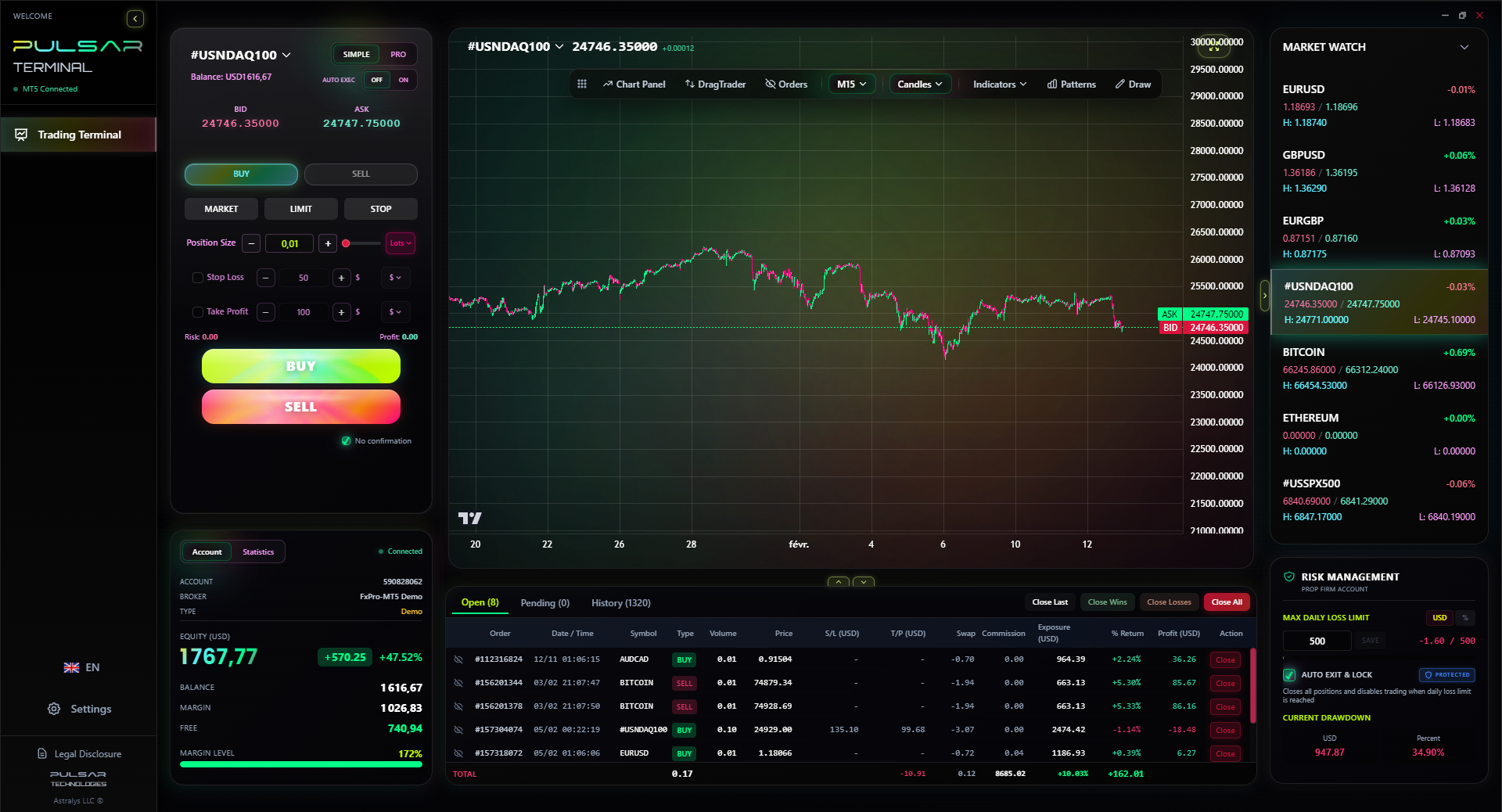
Manually calculating position size and placing stops for every trade is where errors creep in; Pulsar Terminal automates this directly on your MT5 chart, enforcing your risk rules without emotion.
Pulsar Terminal
Alat MT5 all-in-one: order drag-and-drop, multi-TP/SL, trailing stop, grid trading, Volume Profile, dan perlindungan prop firm. Digunakan 1.000+ trader setiap hari.
I want to share a specific, painful loss because it cemented my understanding of the real solution.
It was 2018. I had a great run of 8 winning trades in a row on GBP/JPY, using a swing trading approach. My account was up about 25%. Ego kicked in. I thought I was invincible. The next setup came along. It was okay, not great, but my confidence was sky-high. Instead of my usual 1% risk, I thought, 'Let's make this count,' and risked 5%.
I entered at 148.50, stop at 147.90 (60 pips, but a huge rand amount due to my oversized position). Almost immediately, it went against me. At 148.20, down 30 pips, I remember thinking, 'It'll come back.' I broke my first rule: I moved my stop-loss to 147.50, doubling my initial risk to nearly 10%. The trade continued south. It hit my new stop. I lost over 9% of my entire account in one trade.
I felt physically sick. I didn't trade for two weeks. That loss wasn't about analysis. It was a total failure of my risk management and psychological pillars. The 'solution' I thought I had (my strategy) was meaningless because I abandoned the framework that made it viable. I learned that the solution isn't about making money on the good trades; it's about strictly limiting damage on the bad ones. Every rule in my plan now exists to prevent a repeat of that day.
💡 Tips Winston
The rand's volatility isn't your enemy; it's your teacher. It will punish sloppy risk management faster than any other pair. Respect the lesson.
“The forex solution is a journey of self-discipline more than market prediction.”
If you take one thing from this guide, let it be this: stop searching for the holy grail and start building your fortress.
- Downsize Immediately. If you're live trading, cut your position sizes by 75% right now. Trade so small that a loss feels like a 'meh' instead of a crisis. This is the single fastest way to improve your decision-making.
- Open a Trading Journal. Use a Google Sheet. For every trade, note: Date, Pair, Long/Short, Entry, Stop, Target, Position Size, Risk (Rands), Outcome, and most importantly, 'Did I follow my plan?' Yes/No.
- Backtest One Idea. Pick the one setup you use most. Go back on your chart and mark every instance of it over the last 3 months. Don't cherry-pick. Note every win and loss. What's the win rate? This is the beginning of knowing your edge.
- Choose a Broker That Fits. Don't get hung up on bonuses. Look for tight spreads, stable execution, and a platform you understand. For many South Africans, XM or Exness offer accessible starting points, but do your own research.
The forex solution is a journey of self-discipline more than market prediction. It's about creating a system so strong that your worst enemy - your own psychology - can't sabotage it. Build that, and you've found the only solution that matters.
FAQ
Q1What is the most important part of a forex trading solution?
Risk management, full stop. A mediocre strategy with excellent risk management will survive. A brilliant strategy with poor risk management will blow up your account. It's the non-negotiable core of any real solution.
Q2How much money do I need to start implementing this in South Africa?
You can start with a few thousand rand, but the amount is less important than the percentage risk. With a R5,000 account and a 1% risk rule, you're risking R50 per trade. You'll need to trade micro lots (0.01) to make that work with sensible stop-losses. The goal is to learn the process, not get rich from the first deposit.
Q3Is automated trading or using a robot the best solution?
Almost never. A robot is just a strategy (Pillar 1) automated. It still needs risk management (Pillar 2) and oversight for when market conditions change (Pillar 3). Most traders buy EAs hoping to skip the work of building a solution. They usually end up losing money when the EA's specific conditions disappear.
Q4How do I handle the high volatility of USD/ZAR?
Respect it. Use wider stop-losses to avoid being stopped out by noise, but crucially, reduce your position size proportionally so that the wider stop still represents your fixed percentage risk (e.g., 1%). Also, be extra cautious around SA budget speeches, SARB meetings, and major political events.
Q5How many pairs should I trade as part of my solution?
Fewer is better. Start with one major pair. Master it. Understand its daily range, what moves it, and how it reacts to news. Adding pairs too quickly dilutes your focus and makes it impossible to develop a deep, intuitive understanding of any of them.
Q6What should I do after a big losing streak?
Stop trading. Seriously. Go back to your journal and check if you were following your plan. If you were, and it was just statistical probability, your system is working - the solution is doing its job by limiting each loss. If you weren't following your plan, you need to identify the psychological break and address it before trading again, perhaps by returning to paper trading.
Q7Can I make a living from forex trading in South Africa?
It's possible, but it's a marathon, not a sprint. Don't even consider it until you have at least 2-3 years of consistent, documented profitability with a significant capital base. The 'solution' for making a living is the same as for growing an account, just scaled up with extreme caution. Most people should view it as a way to generate supplemental income, not replace their salary.
Pelajaran Prof. Winston
Poin Penting:
- ✓Risk a maximum of 1% of capital per trade.
- ✓Master one pair before adding more.
- ✓A trading journal is non-negotiable.
- ✓Wider stops on ZAR pairs, smaller positions.
Seberapa bermanfaat artikel ini?
Klik bintang untuk menilai
Wawasan Trading Mingguan
Analisis & strategi mingguan gratis. Tanpa spam.
Tentang Penulis
David van der Merwe
Trader Pasar Berkembang
Trader berbasis Johannesburg dengan 11 tahun di mata uang pasar berkembang. Spesialis pasangan ZAR, trading berregulasi FSCA, dan analisis pasar Afrika Selatan.
Komentar
Peringatan Risiko
Perdagangan instrumen keuangan mengandung risiko signifikan dan mungkin tidak cocok untuk semua investor. Kinerja masa lalu tidak menjamin hasil di masa depan. Konten ini hanya untuk tujuan edukasi dan tidak boleh dianggap sebagai nasihat investasi. Selalu lakukan riset Anda sendiri sebelum trading.
Anda mungkin juga suka

Cara Trading Forex Sukses: 7 Prinsip dari Trader Profesional
Cara trading forex sukses dengan 7 prinsip trader pro: manajemen modal, disiplin, journal trading, backtest. Data nyata, bukan janji profit palsu.
Jam Trading Forex Terbaik untuk Trader Indonesia: Panduan Lengkap dengan Tabel Waktu
Panduan jam trading forex untuk trader Indonesia. Tabel 4 sesi dunia, jam emas 20:00-00:00, sesi mana yang harus dihindari. Data akurat + tips dari trader berpengalaman.
Top 5 Sàn Forex Uy Tín Nhất 2026: Review Jujur dari Trader Indonesia
Top 5 sàn forex uy tín 2026 untuk trader Indonesia. Review jujur: spread, deposit, withdraw, dukungan lokal. Exness, XM, IC Markets & lebih.
Dapatkan Pulsar Terminal
Semua kalkulator ini terintegrasi dalam Pulsar Terminal dengan data real-time dari akun MT5 Anda.
Dapatkan Pulsar Terminal