


I remember the first tax season after I started making consistent profits.

David van der Merwe
Trader Pasar Berkembang ·  South Africa
☕ 10 mnt baca
Yang akan Anda pelajari:
- 1How SARS Sees Your Forex Profits: Trader or Investor?
- 2Crunching the Numbers: Tax Rates, Deductions, and Real Examples
- 3Provisional Tax: The Twice-Yearly Reality Check
- 4Record-Keeping: Your Best Defence Against an Audit
- 5Legal Tax-Saving Strategies (Not Loopholes)
- 6Common Pitfalls (And How I Stepped in Them So You Don't Have To)
- 7Putting It All Together: Your Tax Year Checklist
I remember the first tax season after I started making consistent profits. I'd turned R15,000 into about R85,000 over a few months, mostly from scalping EUR/USD. I was feeling pretty clever. Then my accountant asked for my trading logs. The reality hit: SARS doesn't care about your clever trades, only your taxable income. I hadn't kept a single record of my hundreds of trades. Untangling that mess, figuring out what was income versus capital, and facing a hefty bill taught me more about risk management than any losing trade ever did. Let's make sure you don't learn the hard way.
This is the million-rand question (literally). SARS doesn't have a special 'forex trader' category. They slot you into one of two boxes based on your behavior, and the tax difference is massive.
The 'Revenue' Box (Income Tax) If you're in this box, SARS sees you as running a business. All your trading profits are considered ordinary income. Think of it like a spaza shop owner's daily sales. This applies if you trade frequently, systematically, and with the clear intention of making short-term profits. We're talking about active strategies like scalping or day trading. Your profit gets added to your salary and other income, and you're taxed at your marginal rate (18% to 45%).
The 'Capital' Box (Capital Gains Tax - CGT) This is for the occasional punter. If you buy and hold currency pairs for the long term, making a few trades a year, SARS might view your profits as a capital gain. Only 40% of your net gain is included in your taxable income. With the annual exclusion of R50,000, the effective max rate is 18%. Sounds better, right?
Here's the kicker: SARS decides based on the 'facts and circumstances.' They look at your frequency, holding period, financing, and even your knowledge. I once argued a client was a capital investor. SARS asked for his browser history showing 8-hour daily chart sessions and his membership to three signal services. They ruled 'revenue' in a heartbeat.

Warning: Don't assume you're a 'capital' trader just because you want to pay less tax. If you're reading this guide, you're probably active enough for SARS to classify you as a revenue trader. Plan for the higher tax rate to be safe.

💡 Tips Winston
Your trading journal isn't just for strategy. It's your primary evidence for SARS. A detailed log proves your systematic approach and is the bedrock of your tax calculation.
“SARS doesn't care about your clever trades, only your taxable income.”
Let's get practical. What will you actually pay? And more importantly, what can you legally subtract from your profits before SARS gets their share?
The Tax Rates in Plain English
| Your Status | Tax Type | How it Works | Effective Max Rate |
|---|---|---|---|
| Active Trader (You) | Income Tax | All profit added to your other income. | 45% |
| Occasional Investor | Capital Gains Tax (CGT) | 40% of net gain is taxed at your income rate. | 18% (40% of 45%) |
| Trading via a Company | Company Tax | Profits taxed inside the company. | 27% flat |
What You Can Deduct (Your Trading Business Expenses)
This is where you save real money. If you're taxed as a revenue trader, you can deduct expenses 'incurred in the production of income.' Keep receipts for everything.
- Tech & Data: Your trading PC, monitors, a dedicated internet line (or a reasonable portion of your bill), data fees.
- Software & Tools: Subscriptions to TradingView, MetaTrader, or a Pulsar Terminal license. Broker platform fees.
- Education & Info: That trading course you bought, books, seminar tickets.
- Home Office: If you have a dedicated trading space, you can claim a portion of rent, electricity, and cleaning.
- Professional Fees: Your accountant's bill (which should pay for itself).

Example: Let's say you made a net profit of R200,000 from trading this year. You spent R15,000 on a new setup, R5,000 on software, and R2,000 on a course. Your taxable income isn't R200k. It's R200,000 - R22,000 = R178,000. At a 36% tax bracket, that deduction just saved you R7,920 in tax.
I learned this late. My first profitable year, I didn't claim my three monitors or my screaming-fast fibre line. That was a R4,000 mistake. Now I have a shoebox (digitally, in a folder) for every receipt.
“If you're reading this guide, you're probably active enough for SARS to classify you as a revenue trader.”
If you're not a salaried employee with PAYE deducted automatically, you're a provisional taxpayer. Full stop. This means you must estimate your year's total taxable income and pay SARS in advance, twice a year.
The Deadlines That Bite:
- First Period: End of August. You pay at least 50% of your estimated total tax for the year.
- Second Period: End of February. You top it up to 100% of your estimate.
- Third Period (Optional): End of September (if you file in September). This is a true-up payment if you underestimated.
Why does this matter? Because your forex profits count towards this estimate. If you have a bumper six months trading XAU/USD and don't adjust your provisional payments, you'll get a nasty underpayment penalty plus interest when you file.
I use a simple rule: every quarter, I look at my year-to-date profit from my broker statements (from my IC Markets account), subtract expenses, and run it through a position size calculator that I've tweaked to also estimate tax. It keeps me honest and avoids February panic.
The biggest rookie error is thinking 'I'll just pay it all at the end of the tax year.' SARS will penalize you for that. They want their money throughout the year, just like they get it from a salary earner.
“If you're reading this guide, you're probably active enough for SARS to classify you as a revenue trader.”
This is non-negotiable. Your broker's statement is a start, but it's not enough for SARS. You need to build your own audit trail.
What You Must Keep (For 5 Years!):
- Trade Logs: Date, instrument (e.g., EUR/USD), entry/exit price, pip gain/loss, Rands gained/lost. Most platforms let you export this.
- Broker Statements: Monthly and annual statements from your broker, whether it's Exness, XM, or anyone else.
- Bank Statements: Showing all deposits to and withdrawals from your trading account. This proves your capital flow.
- Expense Receipts: Digital or physical copies for every deduction you plan to claim.
- A Simple P&L Summary: A monthly tally of total profit, total loss, net result, and cumulative expenses.
I use a basic spreadsheet. One tab for trades (imported from MT5), one tab for expenses with scanned receipts attached, and a summary dashboard. It takes me 30 minutes a month. When my accountant asks for my info, I just send the file. It's clean, it's clear, and it shows SARS I'm not messing around.

Pro Tip: Convert all your foreign currency profits/losses to ZAR using the official SARS exchange rate for the day of the trade. Don't use your broker's conversion or an average rate. SARS publishes these monthly rates on their website. Using the wrong rate is a common, easily spotted error.
💡 Tips Winston
Set up a separate, high-interest savings account and name it 'SARS'. Automatically transfer 30% of every single trading withdrawal into it. You'll never be caught short.
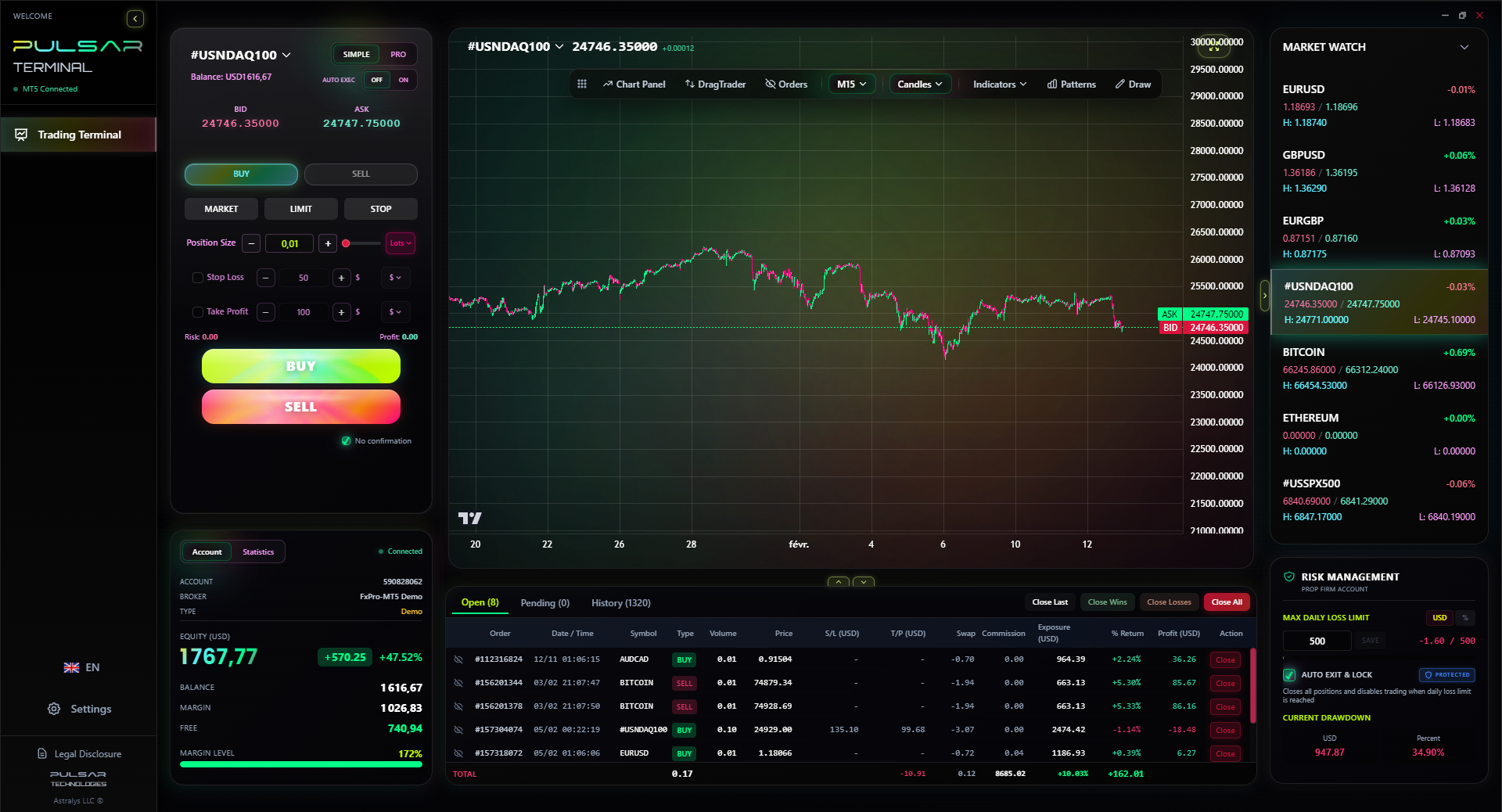
Accurate record-keeping starts with clean trade data, and tools like Pulsar Terminal can help organize and visualize your trading activity directly within MT5.
Pulsar Terminal
Alat MT5 all-in-one: order drag-and-drop, multi-TP/SL, trailing stop, grid trading, Volume Profile, dan perlindungan prop firm. Digunakan 1.000+ trader setiap hari.
“Always, always set aside a portion of every profitable withdrawal for tax. I treat it as my first and most important 'expense.'”
We're not talking about evasion here. We're talking about smart, legal structuring to keep more of your hard-earned profits.
1. Trade Through a Company This is a big one for serious traders. You register a private company (Pty Ltd) and trade through it. Profits are taxed at the corporate rate of 27%, not your personal rate which could be 45%. You can then pay yourself a salary or dividends. It adds admin and costs (audits, accounting), but for consistent profits over R500k a year, it's worth a chat with a tax professional.
2. Maximise Your Retirement Annuity (RA) You can deduct your RA contributions from your taxable income (up to 27.5% of your income or R350,000). If you have a big trading year, pumping money into your RA lowers your taxable income now. The growth inside the RA is also tax-free. It's a forced savings plan with a great tax break.
3. Tax-Free Savings Account (TFSA) You can't trade forex directly in a TFSA. But hear me out. Use your trading profits to max out your TFSA contribution (R36,000 per year). Invest that in ETFs or funds. All the growth, dividends, and interest in there are yours, tax-free, forever. It's a way to shield your trading profits from future tax once they're in your bank account.
A Personal Note: I used to pour every cent back into my trading account. My accountant sat me down and showed me how putting R30k of profits into my RA that year saved me R13,500 in tax immediately. That's a guaranteed 45% return before the RA even invested the money. It changed how I view profits.
“Always, always set aside a portion of every profitable withdrawal for tax. I treat it as my first and most important 'expense.'”
Pitfall 1: Ignoring Foreign Brokers
Thinking SARS won't know about your account with an offshore broker? That's a dangerous game. South Africa has Common Reporting Standard (CRS) agreements with over 100 countries. Your foreign broker is likely reporting your account details and balances to their tax authority, who shares it with SARS. The data is already there.
Pitfall 2: Mixing Personal and Trading Money
Using the same bank account for groceries, car payments, and trading deposits is a bookkeeping nightmare. Open a separate current account just for trading. All trading capital goes in, all withdrawals come out. It makes tracing everything for your tax return 100 times easier.
Pitfall 3: Not Understanding the 'Trading as a Business' Test
SARS uses factors like trade frequency, organization, and time spent. I had a client who traded only 15 times a year but used complex MACD and RSI divergence strategies, kept a detailed journal, and attended trading webinars nightly. SARS argued his sophisticated, organized approach indicated a business. He lost. It's not just about volume.
Pitfall 4: Withdrawing Profits to Cover a Tax Bill You Didn't Save For
This is a classic cycle of doom. You have a great year, spend the profits, then get a R80,000 tax assessment. You have to withdraw from your trading capital to pay it, crippling your ability to trade next year. Always, always set aside a portion of every profitable withdrawal for tax. I treat it as my first and most important 'expense.'
💡 Tips Winston
The single best tax deduction for a new trader? A consultation with a qualified tax practitioner who understands trading. The fee is deductible, and the advice is priceless.
“Forex tax in South Africa isn't a mystery, it's a process. It's boring, but it's the cost of doing business as a serious trader.”
Don't let this overwhelm you. Break it down into steps.
Throughout the Year:
- Keep that trade log and expense folder updated monthly.
- Use a separate bank account for all trading activity.
- Set aside at least 25-30% of your net profits in a separate savings account for tax.
- Review your provisional tax estimate after every quarter.
February (Second Provisional Tax):
- Finalize your profit/loss estimate for the tax year ending February.
- Make your second provisional tax payment (top-up).
July - October (Tax Season):
- Gather your final broker statements (Feb-Feb year).
- Reconcile your final P&L with your bank statements.
- Compile your expense file with all receipts.
- Send the complete package to your accountant (or do your return if you're brave).
- File your annual return and make any final payment (or get your refund) by the deadline.
The Bottom Line: Forex tax in South Africa isn't a mystery, it's a process. It's boring, it's administrative, but it's the cost of doing business as a serious trader. Getting it right from the start gives you peace of mind, keeps SARS off your back, and lets you focus on what you actually enjoy: finding the next good trade.
If you're just starting, pick one thing from this guide to implement now. Maybe it's opening that separate bank account. Or downloading your first month of trade history. Small steps prevent big headaches. Trust me, I've had the headaches.
FAQ
Q1Do I pay tax on forex trading if I use an international broker like Pepperstone or IC Markets?
Yes, absolutely. South Africa taxes you on your worldwide income as a resident. It doesn't matter where your broker is based. Through international data-sharing agreements (CRS), SARS is increasingly likely to receive information about your foreign trading accounts. You must declare all profits.
Q2How much tax will I pay on my forex profits?
It depends on your classification. If you're an active trader (likely), profits are added to your other income and taxed at your marginal rate (18%-45%). If classified as an investor for Capital Gains Tax, only 40% of the gain is taxed, with an annual exclusion of R50,000, leading to an effective max rate of 18%. Most active traders fall into the first, higher-tax category.
Q3What happens if I don't declare my forex trading income to SARS?
You risk severe penalties, interest on unpaid tax, and potential criminal prosecution for tax evasion. With automated data sharing, the risk of detection is higher than ever. It's far cheaper and safer to declare your income and pay what you owe.
Q4Can I deduct losses from my forex trading?
Yes, but with a caveat. If you're classified as a revenue trader, your trading losses can be deducted from your other income (like your salary), reducing your overall tax bill. If you're a capital investor, capital losses can only be offset against capital gains in the current or future years, not against your salary.
Q5Do I need to register a company to trade forex?
No, you can trade as an individual. However, registering a company (Pty Ltd) can be tax-efficient if you generate significant, consistent profits. The corporate tax rate is a flat 27%, which can be lower than a high personal marginal rate. The trade-off is added complexity and accounting costs.
Q6Is VAT payable on forex trading profits?
No, the buying and selling of foreign currency as a financial instrument is generally exempt from VAT. However, VAT may be charged on some of your business expenses, like trading software or educational courses, which you can often claim back if you're a registered VAT vendor (typically only for larger trading businesses).
Pelajaran Prof. Winston
Poin Penting:
- ✓Classify correctly: Active = Income Tax (up to 45%), Occasional = CGT (max 18%).
- ✓Keep every receipt. Deduct tech, data, software, and education expenses.
- ✓You are a provisional taxpayer. Pay SARS in August and February.
- ✓Use a separate bank account only for trading funds.
- ✓Foreign broker profits are fully taxable in South Africa.
Seberapa bermanfaat artikel ini?
Klik bintang untuk menilai
Wawasan Trading Mingguan
Analisis & strategi mingguan gratis. Tanpa spam.
Tentang Penulis
David van der Merwe
Trader Pasar Berkembang
Trader berbasis Johannesburg dengan 11 tahun di mata uang pasar berkembang. Spesialis pasangan ZAR, trading berregulasi FSCA, dan analisis pasar Afrika Selatan.
Komentar
Peringatan Risiko
Perdagangan instrumen keuangan mengandung risiko signifikan dan mungkin tidak cocok untuk semua investor. Kinerja masa lalu tidak menjamin hasil di masa depan. Konten ini hanya untuk tujuan edukasi dan tidak boleh dianggap sebagai nasihat investasi. Selalu lakukan riset Anda sendiri sebelum trading.
Anda mungkin juga suka

Cara Trading Forex Sukses: 7 Prinsip dari Trader Profesional
Cara trading forex sukses dengan 7 prinsip trader pro: manajemen modal, disiplin, journal trading, backtest. Data nyata, bukan janji profit palsu.
Jam Trading Forex Terbaik untuk Trader Indonesia: Panduan Lengkap dengan Tabel Waktu
Panduan jam trading forex untuk trader Indonesia. Tabel 4 sesi dunia, jam emas 20:00-00:00, sesi mana yang harus dihindari. Data akurat + tips dari trader berpengalaman.
Top 5 Sàn Forex Uy Tín Nhất 2026: Review Jujur dari Trader Indonesia
Top 5 sàn forex uy tín 2026 untuk trader Indonesia. Review jujur: spread, deposit, withdraw, dukungan lokal. Exness, XM, IC Markets & lebih.
Dapatkan Pulsar Terminal
Semua kalkulator ini terintegrasi dalam Pulsar Terminal dengan data real-time dari akun MT5 Anda.
Dapatkan Pulsar Terminal