


Staring at a chart covered in squiggly lines and wondering which forex technical indicators actually work? You're not alone.

David van der Merwe
Trader Pasar Berkembang ·  South Africa
☕ 10 mnt baca
Yang akan Anda pelajari:
- 1What Are Forex Technical Indicators, Really?
- 2The Must-Know Indicators for SA Traders
- 3Building a Simple, Profitable SA Trading Strategy
- 4Common Pitfalls (And How I Lost Money So You Don't Have To)
- 5Leveling Up: Indicator Confluence and Divergence
- 6The SA Trader's Toolkit: Broker, Platform, and Mindset
- 7Putting It All Together: Your Weekly Trading Routine
Staring at a chart covered in squiggly lines and wondering which forex technical indicators actually work? You're not alone. Most new traders in SA download every indicator under the sun, clutter their screen, and then lose money with perfect technical analysis. The truth is, less is more. This isn't about finding a magic button. It's about understanding a few core tools, how they interact with our unique market quirks - like ZAR volatility and FSCA's 30:1 use cap - and using them to stack probabilities in your favour. Let's cut through the noise.
At their core, forex technical indicators are just mathematical calculations plotted on a price chart. They don't predict the future. Anyone who tells you they do is selling something. What they do is quantify past price action and market conditions to give you a structured way to assess probability.
Think of them like the gauges on your car's dashboard. Your speedometer (an indicator) doesn't tell you when to brake, but it gives you critical information to make that decision. In the SA context, with the Rand's notorious swings, these gauges are essential for not blowing up your account.
There are two main families: Leading indicators and Lagging indicators. Leading ones, like the RSI indicator, try to signal potential turns before they happen. Lagging ones, like moving averages, confirm a trend that's already in place. Most beginners' mistake? Using five leading indicators at once and getting whipsawed to death. I've been there. In 2018, I had a chart with 14 indicators. I lost R8,000 in a week because every time one said 'buy,' another flashed 'sell.'

Warning: No indicator works 100% of the time. Their value comes from providing a consistent framework for your decisions, not from giving you sure-fire signals. Relying on a single indicator is a fast track to a margin call.
You only need a handful. Master these before you even look at anything else.
Moving Averages (The Trend Filter)
This is your foundation. A Moving Average (MA) smooths out price data to show the direction of the trend. The 50-period and 200-period Exponential Moving Averages (EMAs) are the classics. In a strong trend, price tends to respect these lines. For ZAR pairs like USD/ZAR, which can trend for long periods, the 200 EMA on the daily chart is sacred. I once rode a short on USD/ZAR from R18.50 to R16.80 in 2022, using the price's consistent rejection of the 50-day EMA as my 'stay in the trade' signal.
Relative Strength Index (RSI)
The RSI indicator measures the speed and change of price movements, oscillating between 0 and 100. It's famous for identifying overbought (above 70) and oversold (below 30) conditions. Here's the local tip: ZAR pairs are often more volatile. An RSI reading of 75 on EUR/ZAR doesn't necessarily mean an immediate reversal; it can stay overbought for ages in a strong trend. Use it to spot potential exhaustion, not as a standalone entry signal.
MACD
The MACD indicator is a powerhouse for spotting trend changes and momentum. It consists of two lines: the MACD line and the signal line. When the MACD crosses above the signal line, it suggests rising bullish momentum, and vice versa. I find it most useful on the 4-hour and daily charts for pairs like GBP/ZAR. A classic setup is waiting for price to pull back to a key moving average, then seeing the MACD histogram start to turn positive again. That's often a higher-probability entry than just the crossover alone.

Example: Let's say you're looking at USD/ZAR. Price is above the 200 EMA (uptrend). It pulls back to the 50 EMA. The RSI dips to 35 (oversold but not extreme), and the MACD histogram is flattening out, suggesting selling momentum is fading. That's a confluence of three indicators pointing to a potential continuation of the uptrend. That's how you use them.

💡 Tips Winston
An indicator giving a signal is an invitation to analyse, not an order to trade. Do your homework first.
“Most beginners' mistake? Using five leading indicators at once and getting whipsawed to death.”
Indicators are useless alone. You need a system. Here's a brutally simple trend-following strategy I've used successfully with ZAR pairs.
The Rules (Using 4-Hour Chart):
- Trend Identification: Price must be above the 50-period EMA for longs, below for shorts. This is your filter. No trading against this.
- Entry Trigger: Wait for a pullback to the 20-period EMA. Then, use the RSI indicator dipping below 40 (for a long) or above 60 (for a short) as your potential entry zone.
- Confirmation: The MACD indicator histogram should be above its zero line and starting to rise for a long entry (or below and falling for a short).
- Risk Management: Your stop-loss goes below the most recent swing low (for longs) or above the swing high (for shorts). Use a position size calculator to ensure you're never risking more than 1-2% of your account.
Why does this work for us? It respects the trend, waits for better prices (pullbacks), and uses momentum for confirmation. It keeps you out of choppy, sideways markets where most indicators fail. I used this exact setup on EUR/ZAR in late 2023. Price was above the 50 EMA, pulled back, RSI hit 38, MACD ticked up. Entered at R20.15, placed my stop at R19.95. Took profit at R20.65. Simple. Effective.
Remember, this is a framework for swing trading, not for scalping. For scalping, you'd need tighter timeframes and different indicators, but the principle of confluence remains the same.
We learn more from our losses. Here are the classic blunders.
Indicator Overload: This is the number one killer. Your chart looks like a rainbow threw up on it. You get conflicting signals, freeze, and then watch the perfect trade happen without you. Solution: Pick 2-3 complementary indicators. A trend one (MA), a momentum one (MACD/RSI), and maybe a volume one. That's it.
Ignoring the Timeframe: Using a daily chart trend with a 5-minute chart entry is a recipe for disaster. The 5-minute RSI indicator might be oversold, but if the daily trend is powerfully down, that 'oversold' condition can last for hours as price keeps falling. Always trade in the direction of the higher timeframe trend.
Chasing Overbought/Oversold: Seeing RSI at 85 on USD/ZAR and immediately shorting is a great way to get steamrolled. In a strong trend, markets can remain overbought or oversold for a very long time. Use these readings as a warning, not a command.
Forgetting About Spreads: This is crucial for SA traders. Exotic pairs like EUR/ZAR have wide spreads - sometimes 10-15 pips. If your strategy aims for 20-pip profits, the spread alone eats half your potential gain. Always factor in the cost of trading. A broker like Pepperstone or IC Markets might offer tighter spreads on majors, but ZAR pairs will always cost more. Check the spread definition to understand this fully.
My most expensive lesson? In 2019, I ignored a widening spread on GBP/ZAR during a news event. My calculated stop-loss was 25 pips away. The spread ballooned to 20 pips, and my market order stopped out instantly on the wrong side of it. I lost my planned risk plus the massive spread. The market then reversed and went my original way. A brutal, avoidable lesson.
💡 Tips Winston
If you can't explain what your indicator is calculating in one simple sentence, you shouldn't be trading with it.
“Indicators are useless alone. You need a system.”
Once you've got the basics down, these two concepts separate the amateurs from the professionals.
Confluence is when multiple, uncorrelated indicators or analysis methods point to the same trade idea. This is where the magic happens. Example: Price approaches a major support level on the daily chart (price action). The 4-hour chart shows a bullish MACD indicator crossover. The 1-hour RSI indicator is showing a bullish divergence (see below). All three are saying "buy." The probability of success is far higher than if just one indicator gave a signal.
Divergence is a powerful advanced signal. It occurs when the price makes a new high (or low), but the indicator fails to make a corresponding new high/low. There are two main types:
- Regular Bearish Divergence: Price makes a higher high, but the RSI makes a lower high. Suggests weakening bullish momentum.
- Regular Bullish Divergence: Price makes a lower low, but the RSI makes a higher low. Suggests weakening bearish momentum.
I caught a major turn in USD/ZAR using regular bearish divergence in early 2024. Price peaked at R19.05, pulled back, then rallied to a new high at R19.10. However, the RSI on the daily chart peaked at 72 on the first high and only reached 68 on the second, higher price high. That was a clear warning. I entered a short near R19.05, and the pair fell to R18.40 over the next few weeks.

Pro Tip: Divergence works best on higher timeframes (4-hour and above) and is most reliable when it occurs at key support/resistance levels or alongside a break of a major trendline. On its own on a 5-minute chart, it's mostly noise.
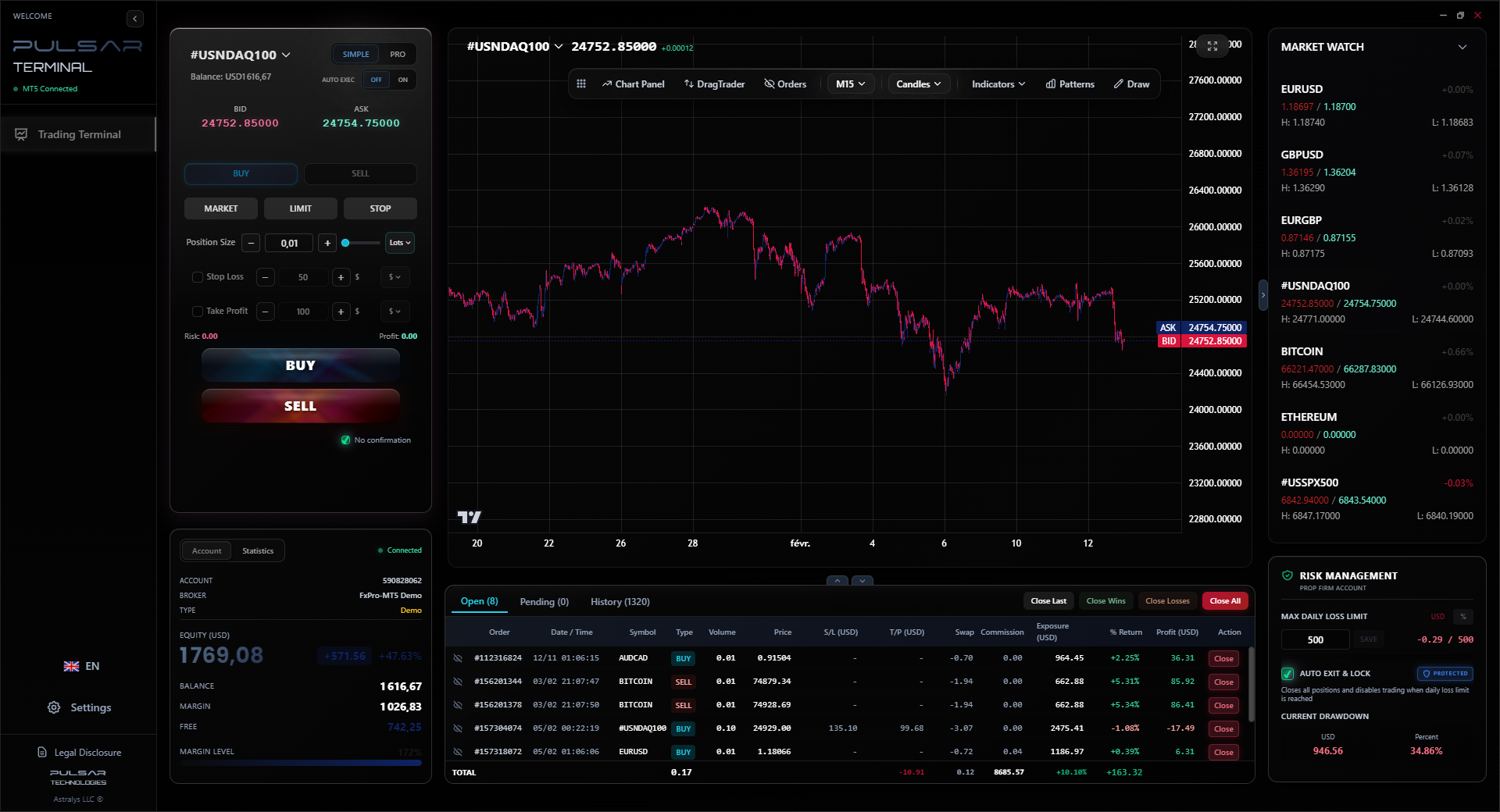
Spotting divergences and managing complex entries is easier with advanced charting and order tools that integrate directly with your MT5 platform.
Pulsar Terminal
Alat MT5 all-in-one: order drag-and-drop, multi-TP/SL, trailing stop, grid trading, Volume Profile, dan perlindungan prop firm. Digunakan 1.000+ trader setiap hari.
Your indicators are only as good as the platform they run on and the broker that provides the data.
Broker Choice is Critical: You need a broker that offers stable, fast execution, especially for ZAR pairs. Slippage during volatile SA market hours (like when SARB makes an announcement) can kill a good setup. Look for FSCA-regulated brokers for peace of mind regarding fund safety. Exness and XM are popular for their low minimum deposits, while IC Markets and Pepperstone are renowned for their raw spreads and ECN execution. Check their specific spreads on USD/ZAR and EUR/ZAR before you commit.
Platform: MetaTrader 4 or 5 is the standard for a reason. Almost every indicator you'll ever need is available. The key is learning to use the platform efficiently - setting templates, alerts, and custom indicators.
The Final Indicator: Your Psychology: This is the most important one, and it's not on your chart. Greed makes you ignore overbought signals. Fear makes you cut winners short. Impatience makes you trade without confluence. You must develop the discipline to follow your system, even when it's boring or you've had two losing trades in a row. Backtest your strategy. Know its win rate and average profit/loss. Then trust the math, not your gut.
💡 Tips Winston
The most reliable 'indicator' is price itself. All other tools are just derivatives trying to describe it.
“The hunt for the perfect indicator is a fool's errand. The goal is a perfect process.”
Here’s how a disciplined SA trader uses forex technical indicators.
Sunday Night/Monday Morning (Planning):
- Open your weekly and daily charts. No indicators yet. Just look at pure price. Where are the obvious support and resistance levels? What's the overall story?
- Now, add your 50 and 200 EMAs. What's the trend on the major pairs (EUR/USD, GBP/USD) and the ZAR crosses? Write this down.
- Scan for potential setups using your strategy's rules. Look for price near key levels with indicator confluence. Mark 2-3 potential trade zones for the week.
Daily (Execution & Management):
- Check your marked zones on the 4-hour chart. Have any of your conditions been met?
- If yes, drill down to your entry timeframe (e.g., 1-hour). Fine-tune your entry, stop-loss, and take-profit levels. Use your position size calculator.
- Place the trade and walk away. Set an alert for your stop or take-profit. Do not sit and watch it.
- Review closed trades. Did you follow your rules? Was the indicator reading correct? Log everything.
This routine removes emotion and turns trading into a process. The indicators serve the process; they don't drive it. After 12 years, this boring, systematic approach is the only thing that's consistently made money. The hunt for the perfect indicator is a fool's errand. The goal is a perfect process.
FAQ
Q1What is the single best forex technical indicator?
There isn't one. It's like asking for the single best tool in a toolbox. A hammer is useless for screwing. However, if I had to pick one for a beginner, it's the 200-period Exponential Moving Average (EMA). It's a superb trend filter. If price is above it, generally look for buys. Below it, look for sells. It won't give you precise entries, but it will keep you on the right side of the market more often than not.
Q2How many indicators should I use on one chart?
Rarely more than three. I run with two: a moving average (50 EMA) for trend and the MACD for momentum. Sometimes I'll have the RSI on a separate sub-chart. More than that and you're just creating confusion and lag. The signals will conflict, and you'll end up paralyzed. Start with one trend indicator and one momentum oscillator. Master their interaction.
Q3Why do my indicators work in backtesting but fail with real money?
Two main reasons. First, spreads, slippage, and commissions. Your backtest likely used ideal prices. In reality, you buy at the ask and sell at the bid. On a pair like EUR/ZAR with a 12-pip spread, that's a huge hurdle. Second, psychology. In backtesting, you calmly click 'next.' With real money on the line, fear and greed make you second-guess entries, move stops, and take early profits. You stop following the system.
Q4Are technical indicators enough for trading ZAR pairs?
Mostly, but you must respect fundamentals. The South African Rand is a commodity currency heavily influenced by local politics, SARB interest rate decisions, and global risk sentiment. A perfect bullish indicator setup on USD/ZAR can be obliterated by a surprise hawkish statement from the Fed or a major credit rating downgrade for SA. Use indicators for timing your entries, but always be aware of the economic calendar.
Q5What timeframe is best for using indicators in forex?
It depends on your strategy. For swing trading (holding trades days to weeks), the 4-hour and daily charts are king. Indicators on these timeframes generate fewer, higher-quality signals. For day trading, the 1-hour and 15-minute charts are common. Never use an indicator on a very low timeframe (like 1-minute) without confirming its signal with the trend on a higher timeframe. The higher timeframe always has more weight.
Q6Do professional traders in South Africa use indicators?
Yes, but not how you think. They use them as components of a larger system. A pro might use a volume profile tool to identify a key price level, wait for price to reach it, and then use an RSI divergence on the 1-hour chart for a precise entry. They use indicators for confirmation, not generation, of ideas. They also rely heavily on risk management tools, which are more important than any entry indicator.
Pelajaran Prof. Winston
Poin Penting:
- ✓Master 2-3 core indicators; more creates conflict, not clarity.
- ✓Always factor in ZAR pair spreads (10-15 pips) before taking a trade.
- ✓Use higher timeframe trends to filter all lower timeframe signals.
- ✓Indicator confluence at key support/resistance offers the highest probability setups.
Seberapa bermanfaat artikel ini?
Klik bintang untuk menilai
Wawasan Trading Mingguan
Analisis & strategi mingguan gratis. Tanpa spam.
Tentang Penulis
David van der Merwe
Trader Pasar Berkembang
Trader berbasis Johannesburg dengan 11 tahun di mata uang pasar berkembang. Spesialis pasangan ZAR, trading berregulasi FSCA, dan analisis pasar Afrika Selatan.
Komentar
Peringatan Risiko
Perdagangan instrumen keuangan mengandung risiko signifikan dan mungkin tidak cocok untuk semua investor. Kinerja masa lalu tidak menjamin hasil di masa depan. Konten ini hanya untuk tujuan edukasi dan tidak boleh dianggap sebagai nasihat investasi. Selalu lakukan riset Anda sendiri sebelum trading.
Anda mungkin juga suka

Cara Trading Forex Sukses: 7 Prinsip dari Trader Profesional
Cara trading forex sukses dengan 7 prinsip trader pro: manajemen modal, disiplin, journal trading, backtest. Data nyata, bukan janji profit palsu.
Jam Trading Forex Terbaik untuk Trader Indonesia: Panduan Lengkap dengan Tabel Waktu
Panduan jam trading forex untuk trader Indonesia. Tabel 4 sesi dunia, jam emas 20:00-00:00, sesi mana yang harus dihindari. Data akurat + tips dari trader berpengalaman.
Top 5 Sàn Forex Uy Tín Nhất 2026: Review Jujur dari Trader Indonesia
Top 5 sàn forex uy tín 2026 untuk trader Indonesia. Review jujur: spread, deposit, withdraw, dukungan lokal. Exness, XM, IC Markets & lebih.
Dapatkan Pulsar Terminal
Semua kalkulator ini terintegrasi dalam Pulsar Terminal dengan data real-time dari akun MT5 Anda.
Dapatkan Pulsar Terminal