


Here's a fact that might surprise you: as a South African trader, you have a better shot at trading with some of the world's most secure brokers than many Europeans or Americans do.

David van der Merwe
Trader Pasar Berkembang ·  South Africa
☕ 10 mnt baca
Yang akan Anda pelajari:
Here's a fact that might surprise you: as a South African trader, you have a better shot at trading with some of the world's most secure brokers than many Europeans or Americans do. Australian-regulated brokers, overseen by the formidable ASIC, are wide open to us. I learned this the hard way after blowing an account with an unregulated outfit back in 2015. This guide isn't just about the 'what' of forex trading Australia, it's about the 'why' – why an ASIC license matters to your capital, and how to strategically trade the AUD from Johannesburg or Cape Town.
Let's cut to the chase. You're in South Africa, regulated by the FSCA. Why look 10,000km away to Australia? It's about stacking the odds in your favour. The Australian Securities and Investments Commission (ASIC) is a Tier-1 regulator, the gold standard globally. They enforce client money segregation, meaning your funds are held in separate trust accounts. If the broker goes under, your money isn't part of their bankruptcy estate. I sleep better knowing that.
The FSCA is solid, don't get me wrong. But ASIC's long track record and its focus on strong financial requirements for brokers add an extra layer of security for your hard-earned Rands. It's like having a backup parachute. Also,, many top Australian brokers offer services to South African residents directly. You get their technology, their tight spreads, and their regulatory framework. It's a no-brainer for serious traders who view this as a business, not a gamble.

Warning: Not every broker with an '.au' website holds an ASIC license. Some operate under offshore licenses for certain jurisdictions. Always, and I mean always, verify the license number on ASIC's official professional registers. I got lazy once and nearly deposited with a clone firm. It was a close call.

💡 Tips Winston
The 'Aussie' (AUD/USD) often respects technical levels set during the Asian session. A break of the Sydney-session high or low can signal the day's direction.
“ASIC's reporting and capital requirements are brutal, which filters out the weaker players.”
Understanding the rulebook is half the battle. Here’s how the two regulatory landscapes shaping your choices stack up.
| Feature | ASIC (Australia) | FSCA (South Africa) |
|---|---|---|
| Primary Role | Corporate & financial services regulator. | Conduct regulator for financial institutions. |
| Client Money | Mandatory segregation in trust accounts. | Mandatory segregation for OTC derivative providers. |
| Retail use Limit | Maximum 30:1 for major forex pairs. | Maximum 30:1 for retail clients. (Aligned since 2021) |
| Compensation Scheme | No statutory compensation scheme for forex losses. | No statutory compensation scheme for forex losses. |
| Key Focus | Market integrity, consumer protection, financial resilience. | Financial sector stability, fair customer treatment. |
| Access for SA Traders | Yes, most major ASIC brokers accept SA clients. | Yes, for brokers holding an FSP license. |
The use alignment is crucial. A few years back, you could find brokers offering 500:1. Those days are largely gone for retail traders under both regimes, which is honestly a good thing. It forces better position size calculator discipline. The main difference you'll feel is in the broker's operational rigor. ASIC's reporting and capital requirements are brutal, which filters out the weaker players. When you're choosing a platform for scalping strategy where every pip definition counts, that stability matters.
“The 30:1 use limit is a protective cage, not a constraint.”
Based on my 12 years of trading and testing platforms with my own capital, these are the Australian-regulated brokers that consistently deliver for South African clients. I'm excluding those that don't accept us or have poor ZAR support.
IC Markets: My primary broker for raw spreads. Founded in Sydney, regulated by ASIC. Why I use them: true ECN pricing. I regularly see EUR/USD spreads at 0.0 pip definition on their Raw Spread account, with a commission of $7 round turn. Their execution is phenomenal for news trading. Minimum deposit is $200, which is reasonable. Their support handles ZAR funding queries well. Read my full, updated IC Markets review for the deep dive.
Pepperstone: Another Melbourne-based powerhouse. Also ASIC-regulated. Their Razor account is similar to IC's – tight spreads plus commission. Where Pepperstone shines for me is their platform suite: they offer MetaTrader, cTrader, and their own Capitalise.ai for automation. If you're into algorithmic trading, their API is strong. I once had a bot running on cTrader that exploited tiny arbitrage opportunities on AUD/JPY, and their infrastructure held up.
FP Markets: A strong contender, especially for MetaTrader purists. Also ASIC-regulated. They offer both standard and raw accounts. I find their research tools, particularly their trading ideas, to be above average. They cater well to swing trading strategies with their analysis.
AvaTrade: While they have a strong FSCA presence locally, they also hold an ASIC license. They are more suited to beginner or intermediate traders who prefer fixed spreads and no commissions. Their platform variety, including AvaTradeGO and MetaTrader, is excellent. Not my go-to for scalping, but perfect for set-and-forget swing trades.

Pro Tip: When funding an ASIC broker from SA, use a Wise (formerly TransferWise) borderless account if you can. It converts ZAR to AUD at the real mid-market rate, often saving you 2-3% compared to a broker's internal conversion or a bank wire. I saved over R1500 on a $10,000 deposit last quarter doing this.
“The 30:1 use limit is a protective cage, not a constraint.”
Trading Australian Dollar pairs is where the rubber meets the road. You're not just picking a broker, you're trading a economy tied to commodities China, and risk sentiment. Here’s what works from our timezone.
Key AUD Pairs to Watch
AUD/USD: The big one. Liquid, volatile, and a pure play on China growth (via iron ore) and global risk appetite. It's my most traded AUD pair. AUD/JPY: My favourite risk barometer. When global stocks rally (S&P 500, JSE Top 40), AUD/JPY usually goes up. When fear hits, it drops fast. It's excellent for momentum trades. AUD/NZD: The 'cross-Tasman' rivalry. Less about global themes, more about relative economic performance between Aus and NZ. Good for range trading. AUD/CAD: The 'commodity pair'. Both are resource-driven economies. I watch this for divergence plays between oil (CAD) and metals (AUD).
The Sydney-Tokyo Overlap Window
This is our secret weapon in South Africa. The Sydney session kicks off around 1:00 AM SAST (10:00 AM AEST). The Tokyo session joins at 3:00 AM SAST. This 2-3 hour overlap (3:00 AM - 6:00 AM SAST) is when liquidity in AUD and JPY pairs spikes. You don't need to be a night owl. I often place limit orders before bed to catch moves in this window. It's perfect for strategies based on the Asian session range.
Economic Catalysts
Chinese data (PMIs, GDP) at 11:00 SAST is huge for AUD. Australian employment data and CPI, released early morning SAST, cause immediate volatility. I got caught on the wrong side of an Aussie jobs report in 2022. The number beat expectations wildly, AUD/USD shot up 50 pips in seconds, and my stop-loss was hunted before the real move continued. Lesson? Either trade the news with ultra-wide stops, or wait 15 minutes for the initial chaos to settle.
💡 Tips Winston
When funding an offshore account, always check the USD/ZAR forward rate curve. If the Rand is expected to weaken (forward points are high), consider converting and sending more upfront.
“You are exposed to the ZAR exchange rate on your deposits and withdrawals. It's an extra currency trade you're making.”
This is the boring but vital stuff. Ignore it at your peril.
The Real Cost of Trading: With an ASIC broker like IC Markets or Pepperstone, you're typically looking at a commission-based model. Example: You trade 1 standard lot (100,000 units) of AUD/USD. The spread is 0.1 pips, and the commission is $7 AUD round turn. Your total cost is (0.1 pip * $10 per pip) + $7 = $8. That's cheap. Compare that to a 'commission-free' broker with a 1.5 pip spread: your cost is 1.5 pips * $10 = $15. The raw spread account wins every time for active traders. Always calculate the effective spread.
South African Tax (SARS): This is non-negotiable. Profits from forex trading, whether with an FSCA or ASIC broker, are considered income from a trade (if you're active) or capital gains (if it's more incidental). You must declare this in your annual tax return. Keep a pristine log: every trade confirmation, every monthly statement, every deposit and withdrawal. I use a simple spreadsheet and reconcile it monthly. SARS can and does ask for this. The tax rate depends on your total income bracket.
Funding & Withdrawals: Most ASIC brokers offer multiple methods: international bank wire, credit/debit card, and e-wallets like Neteller or Skrill. Bank wires from SA can take 2-5 business days and your bank will charge a forex fee (often 2-3%). E-wallets are faster (1 day) but have their own fees. Always withdraw to the same method you deposited with to avoid anti-money laundering headaches. I stick to bank wires for large amounts for the audit trail.

Example: You deposit R20,000. Your bank converts it to ~$1,650 AUD at a poor rate with a R350 fee. You trade, make a 10% profit ($165), and withdraw $1,815. The broker sends it back, it's converted to Rands, and you net R21,800 after more fees. Your real profit wasn't R1,800, it was closer to R1,100 after all the hidden forex costs. Plan for this.
“You are exposed to the ZAR exchange rate on your deposits and withdrawals. It's an extra currency trade you're making.”
Let's get vulnerable. I've lost money so you might learn.
Pitfall 1: Chasing High use Offshore. Before the FSCA capped use, I was lured to an unregulated 'offshore' broker offering 1:1000. The dream of turning R5000 into R50,000. The reality? I did turn R5000 into R12,000 on a wild XAU/USD guide trade. Then, on the next trade, a flash spike triggered a margin call and wiped the account to zero. The broker's 'liquidity' vanished when I needed it. The 30:1 limit is a protective cage, not a constraint.
Pitfall 2: Ignoring Timezone Drift. I once held a long EUR/USD guide swing trade into the Asian session. The pair was drifting down slowly, eating my profit. I was asleep in SA. By the time I woke, my 60-pip profit was a 10-pip loss. I didn't use a trailing stop. Now, if I have a profitable trade running into a dead session, I either move my stop to breakeven or use an automated trailing stop. A tool that can manage this for you on MT4/5 is a lifesaver.
Pitfall 3: Underestimating ZAR Volatility on Funding. I deposited $1000 when USD/ZAR was at 14.50. A few months later, when I withdrew, the rate was 18.00. Even though my trading was break-even in USD, I took a 20% loss in ZAR terms. Now, I factor in my view on the Rand when making large deposits or withdrawals. It's an extra currency trade you're making, whether you like it or not.
💡 Tips Winston
A quiet AUD/JPY during the Asian session that suddenly starts moving with volume is a strong signal that institutional flow is entering. Pay attention.
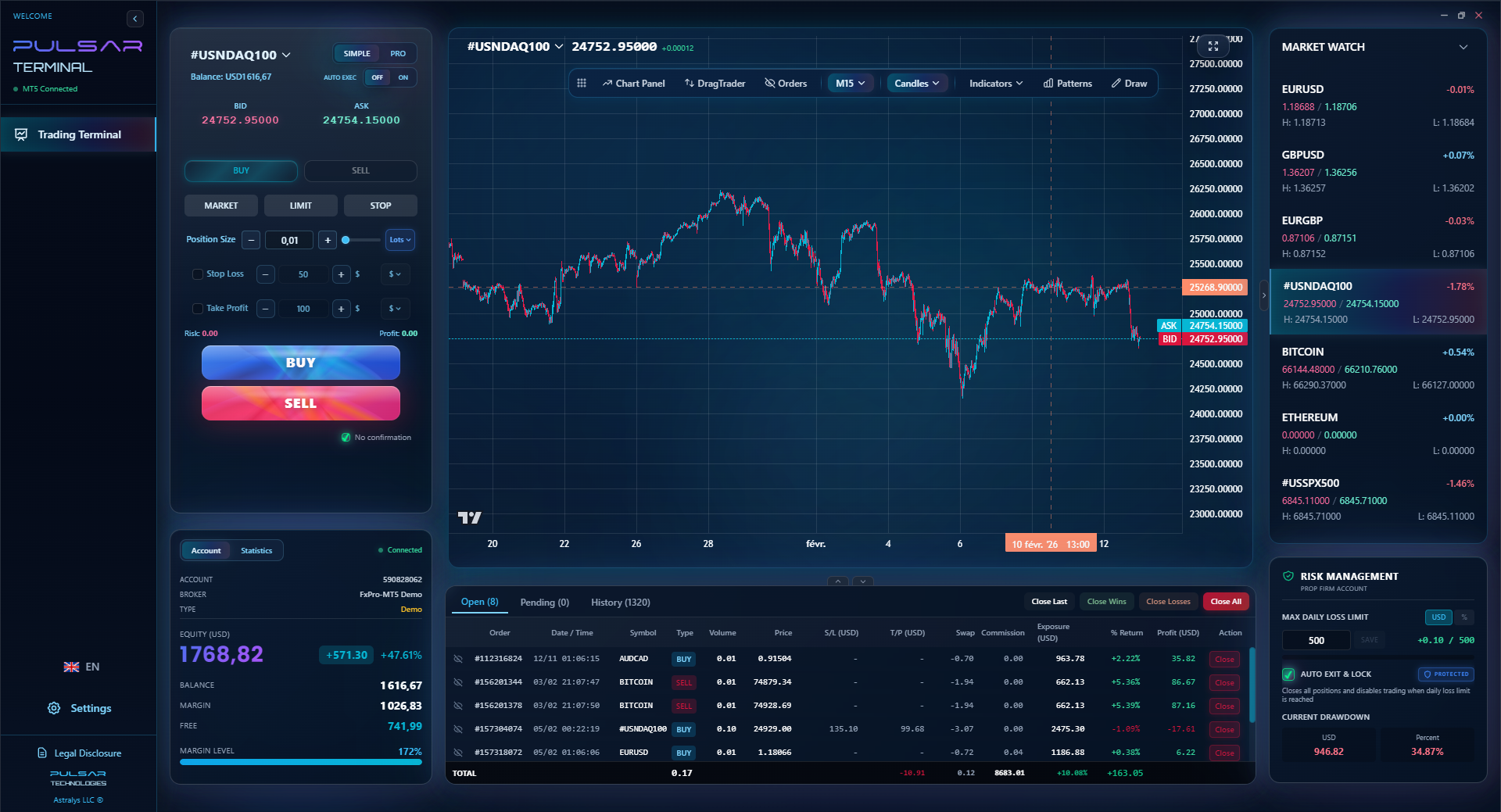
Managing trades across timezones is a major challenge for South Africans trading AUD pairs, but tools like Pulsar Terminal can automate trailing stops and breakeven orders directly on your MT5 platform while you sleep.
Pulsar Terminal
Alat MT5 all-in-one: order drag-and-drop, multi-TP/SL, trailing stop, grid trading, Volume Profile, dan perlindungan prop firm. Digunakan 1.000+ trader setiap hari.
“Risk management is non-transferable. The ASIC won't save you from bad risk management.”
How do you actually make money from this? It starts with a plan tailored to the Aussie market's rhythm.
Step 1: Define Your Session. Are you a Sydney-session trader (early morning SAST) catching the initial volatility? Or a London-session trader (afternoon SAST) trading the AUD as a 'risk asset' alongside European stocks? I'm the latter. My strategy revolves around the MACD indicator and price action on the 4-hour chart, looking for alignments with the S&P 500 futures. I rarely trade the Asian session actively anymore.
Step 2: Choose Your Weapon (Pair). Don't trade all AUD pairs. Master one. For me, it's AUD/JPY for its clean risk-on/risk-off signals. For you, it might be AUD/USD. Learn its average daily range (about 70-90 pips), its common support/resistance levels, and how it reacts to specific news.
Step 3: Risk Management is Non-Transferable. The ASIC won't save you from bad risk management. My rule: never risk more than 1% of my account on a single trade. On a AUD/JPY trade, that means if my stop-loss is 30 pips away, my position size is calculated to lose exactly 1% if that stop is hit. I use a position size calculator for every single trade. No exceptions. This discipline alone turned me from a consistent loser to a consistent survivor.
Step 4: Review and Adapt. The AUD's drivers change. In 2010, it was all about mining investment. Now, it's about Chinese stimulus and central bank policy divergence. Every quarter, I review my trade journal. Are my setups still working? Has the market's volatility changed, requiring wider stops? This isn't a set-and-forget game.
FAQ
Q1Is it legal for South Africans to trade with Australian brokers?
Yes, it is completely legal. There are no South African exchange controls that prevent you from opening an account with a foreign-regulated broker like those in Australia. The responsibility is on you to declare any profits to SARS for tax purposes.
Q2Do Australian brokers offer ZAR accounts?
Typically, no. Most ASIC-regulated brokers will denominate your trading account in a major currency like USD, AUD, EUR, or GBP. You deposit ZAR from your South African bank account, the broker (or your payment provider) converts it at the prevailing rate, and your trading capital is in the account currency. This means you are exposed to the ZAR/USD or ZAR/AUD exchange rate on your deposits and withdrawals.
Q3Can I get higher use than 30:1 with an ASIC broker?
For retail clients, no. ASIC's product intervention order caps use at 30:1 for major forex pairs for all retail traders globally under their license. Some brokers may offer 'professional' accounts with higher use, but qualifying as a professional requires meeting strict criteria (like significant trading experience and portfolio size) that most traders won't meet.
Q4How do I pay tax in South Africa on profits from an Australian broker?
You must self-declare your net trading profit (profits minus losses, minus allowable expenses) on your annual SARS income tax return (ITR12). It should be declared as 'Other Income' or under the relevant business income section if you trade professionally. Keep all your trading statements and records for at least five years. It's highly advisable to consult with a South African tax professional who understands trading income.
Q5Which is better for a beginner: an FSCA or ASIC broker?
For a complete beginner in South Africa, starting with a well-established FSCA-licensed broker like one from our XM review or Exness review can be simpler. They often have local support, easier ZAR deposits, and educational materials tailored to the region. As you gain experience and your account size grows, the superior technology and raw pricing of top ASIC brokers like Pepperstone review become more attractive.
Q6What is the best time of day to trade AUD/USD from South Africa?
The most volatile and liquid times are during the Sydney-Tokyo session overlap (3:00 AM - 6:00 AM SAST) and when the London session opens (11:00 AM SAST). The London-US overlap (4:00 PM - 6:00 PM SAST) can also be active. For most South Africans with day jobs, the London session (afternoon) is the most practical and active window to trade AUD pairs.
Pelajaran Prof. Winston
Poin Penting:
- ✓Verify ASIC license numbers directly on the regulator's website.
- ✓Calculate the 'effective spread' (spread + commission) to compare real costs.
- ✓Sydney-Tokyo overlap (3-6 AM SAST) is prime time for AUD volatility.
- ✓Always declare forex profits to SARS; keep records for 5 years.
- ✓Use a position size calculator. Never risk more than 1% per trade.
Seberapa bermanfaat artikel ini?
Klik bintang untuk menilai
Wawasan Trading Mingguan
Analisis & strategi mingguan gratis. Tanpa spam.
Tentang Penulis
David van der Merwe
Trader Pasar Berkembang
Trader berbasis Johannesburg dengan 11 tahun di mata uang pasar berkembang. Spesialis pasangan ZAR, trading berregulasi FSCA, dan analisis pasar Afrika Selatan.
Komentar
Peringatan Risiko
Perdagangan instrumen keuangan mengandung risiko signifikan dan mungkin tidak cocok untuk semua investor. Kinerja masa lalu tidak menjamin hasil di masa depan. Konten ini hanya untuk tujuan edukasi dan tidak boleh dianggap sebagai nasihat investasi. Selalu lakukan riset Anda sendiri sebelum trading.
Anda mungkin juga suka

Cara Trading Forex Sukses: 7 Prinsip dari Trader Profesional
Cara trading forex sukses dengan 7 prinsip trader pro: manajemen modal, disiplin, journal trading, backtest. Data nyata, bukan janji profit palsu.
Jam Trading Forex Terbaik untuk Trader Indonesia: Panduan Lengkap dengan Tabel Waktu
Panduan jam trading forex untuk trader Indonesia. Tabel 4 sesi dunia, jam emas 20:00-00:00, sesi mana yang harus dihindari. Data akurat + tips dari trader berpengalaman.
Top 5 Sàn Forex Uy Tín Nhất 2026: Review Jujur dari Trader Indonesia
Top 5 sàn forex uy tín 2026 untuk trader Indonesia. Review jujur: spread, deposit, withdraw, dukungan lokal. Exness, XM, IC Markets & lebih.
Dapatkan Pulsar Terminal
Semua kalkulator ini terintegrasi dalam Pulsar Terminal dengan data real-time dari akun MT5 Anda.
Dapatkan Pulsar Terminal