


I lost LKR 250,000 in my first six months trading.

Daniel Harrington
Kepala Konten
☕ 10 mnt baca
Yang akan Anda pelajari:
- 1Why You Actually Need Proper Education (And What That Means)
- 2What a Worthwhile Course Should Actually Teach You
- 3The Sri Lankan Reality: Regulations, Taxes, and Funding
- 4What Should a Course Cost? (LKR vs. Value)
- 5Choosing Your Tools: Brokers and Platforms for LKR Traders
- 6What I Did Wrong (And What Finally Worked)
- 7You Finished a Course. Now What?
I lost LKR 250,000 in my first six months trading. Not on bad trades, but on a 'course' that promised secret signals and instant wealth. The guy teaching it drove a fancy car, had slick Instagram ads, and spoke perfect English. He took my money, gave me a pirated PDF of basic concepts, and vanished when I started asking real questions. That experience taught me more about trading in Sri Lanka than any indicator ever could. Here's what I wish someone had told me before I spent a single rupee on education.
Let's be brutally honest: most 'forex gurus' in Sri Lanka are selling dreams, not education. They target your desperation - the desire to escape a 9-to-5, to earn in dollars while the LKR fluctuates. A real forex trading course in Sri Lanka shouldn't make you feel excited; it should make you feel prepared. It should bore you with risk management before it dazzles you with charts.
The core of trading isn't predicting the market. It's managing your money so you survive long enough to be right. I learned this the hard way. After my initial loss, I found a mentor who focused 80% of our time on position sizing and psychology. We used a simple position size calculator for every single trade. It was tedious, but it saved my account.
A proper education covers three pillars: the technical (charts, indicators), the fundamental (economic news, central bank policy - especially the CBSL), and the psychological (your own brain trying to sabotage you). If a course skips any one of these, it's incomplete. For chart analysis, understanding tools like the RSI indicator and MACD indicator is a solid start, but they're just pieces of the puzzle.

Warning: Be wary of any course that guarantees profits, shows off luxury items as 'proof' of success, or pressures you to sign up for 'mastermind' groups with recurring fees. If they're such great traders, why are they spending all day recruiting students?

💡 Tips Winston
The first rule of trading with LKR is to preserve your capital. A 2% gain you keep is infinitely better than a 20% gain you give back next week.
“A real forex trading course in Sri Lanka shouldn't make you feel excited; it should make you feel prepared.”
Here’s a breakdown of what your money should buy. Think of this as a syllabus checklist.
The Non-Negotiable Basics
This is where you learn the language. What is a pip definition? What's the difference between a stop-loss and a take-profit? How does use work, and why is it a double-edged sword? You need to understand the spread definition and how it eats into your profits. This section should be crystal clear, with local examples using LKR.
Market Analysis That Works Here
You need strategies that account for Sri Lanka's unique time zone (GMT+5:30) and liquidity patterns. Trading the London open might mean being active at 1:30 PM our time. A good course will teach you how to adapt global strategies, like scalping strategy or swing trading, to our schedule. It should also cover how major events from the CBSL or local political news can cause volatility in pairs you might not expect.
Risk Management: Your Survival Kit
This is the most important module. It must include:
- How to calculate your risk per trade (never more than 1-2% of your capital).
- How to set stop-losses based on market structure, not wishful thinking.
- Understanding correlation (so you're not taking three trades that all fail for the same reason).
- The emotional discipline to stick to your plan when a trade goes against you.

Example: If you have a LKR 100,000 account, risking 1% means you can lose LKR 1,000 on a trade. If your stop-loss is 50 pips away on EUR/USD, your position size must be small enough that a 50-pip loss equals LKR 1,000. A position size calculator does this math instantly.
The Boring (But Critical) Stuff
A legitimate course will spend time on the operational side: how to choose a broker, the pros and cons of platforms like MT5, record-keeping for tax purposes (remember, profits are taxable by the IRD), and - critically for us - legal funding methods. Ignoring this is like learning to drive without knowing the traffic laws.
“Funding an international broker directly from your Sri Lankan bank account is the single biggest practical hurdle you'll face.”
This is the part most international courses completely ignore. Trading from Sri Lanka comes with extra homework.
First, the legal stuff. Forex trading itself is legal, regulated loosely by the CBSL's Department of Foreign Exchange. But here's the catch: funding an international broker directly from your Sri Lankan bank account for margin trading is restricted. This isn't about trading being illegal; it's about capital controls. So, you're using brokers regulated abroad, like Exness review, IC Markets review, or XM review, which accept Sri Lankans. You have no local regulatory protection, so the broker's international license (ASIC, FCA, CySEC) becomes your safety net. Choose wisely.
Then there's tax. Your trading profits are income. Full stop. The Inland Revenue Department (IRD) will want their share. The progressive rates start at 6% for the first LKR 500,000 of annual profit and go up to 36%. You need to keep careful records of all trades, deposits, and withdrawals. A good local course should at least point you to a reliable accountant who understands trading income.
Finally, funding. How do you get money in and out? Direct bank transfers are a headache. Most seasoned traders I know use e-wallets like Skrill or Neteller as a bridge. Some use crypto, though that landscape keeps changing. Your course should discuss these practical payment hurdles openly, not pretend they don't exist.

Pro Tip: Before depositing large amounts, do a small test withdrawal. Make sure you can actually get your profits back into your Sri Lankan bank account without issues. This is your most important test of a broker's reliability for you.
“Funding an international broker directly from your Sri Lankan bank account is the single biggest practical hurdle you'll face.”
Let's talk numbers. According to market data, you'll see courses ranging from LKR 4,000 for a short webinar to LKR 13,000 for a 'diploma.' I've seen 'elite' programs for over LKR 100,000. Price doesn't equal quality.
My rule? You shouldn't be paying for promises, you should be paying for structure and access. A LKR 10,000 course that gives you a clear, sequential curriculum, access to a knowledgeable instructor for Q&A, and a community of serious traders is a better investment than a LKR 50,000 'signal service' that makes you dependent.
Consider free resources first. There's immense value in YouTube tutorials, broker education centers, and books. But they're scattered. A good course's value is in curating and structuring that information for you, saving you hundreds of hours.
Here’s a personal benchmark: The education that finally worked for me cost about LKR 8,000. It wasn't flashy. It was a series of weekly Zoom sessions with a trader who focused on one concept at a time, followed by homework - actual trading journal entries we had to submit. The value was in the accountability and the feedback, not the PowerPoint slides.
Remember, the real cost of a course isn't just the fee. It's the time you invest and the capital you might lose while applying untested knowledge. A cheap, bad course is the most expensive thing you can buy.
💡 Tips Winston
Your trading platform is your cockpit. If you don't know how to set a stop-loss with one click, you're not ready to fly. Master the basics of MT5 before you risk real money.
“The education that finally worked for me bored me with risk management before it dazzled me with charts.”
Your broker is your gateway to the market. For Sri Lankans, key factors are: acceptance of clients from Sri Lanka, reliable deposit/withdrawal methods we can use, and strong international regulation.
Based on my experience and community consensus, brokers like Pepperstone review, IC Markets, and Exness are consistently mentioned. They offer tight spreads (crucial for your profitability), support MT4/MT5, and have established procedures for clients in regions like ours.
| Broker Feature | Why It Matters in Sri Lanka |
|---|---|
| Minimum Deposit | Start small. $50-$100 is plenty to learn with real money. Brokers with $0 or $5 minimums let you test their platform. |
| Spread on EUR/USD | This is your main trading cost. Look for averages below 1.0 pip in a standard account. ECN accounts offer raw spreads but charge a commission. |
| Deposit Methods | Must support Skrill, Neteller, or other e-wallets accessible to you. Bank transfer support is a plus but expect delays. |
| Platform | MT4/MT5 is the standard. Ensure it runs smoothly on your internet connection. |
The platform is your workspace. MT5 is more powerful than MT4, but both work. You'll spend 90% of your time here, so get comfortable. Learn how to place orders, set stops, and read the market depth. Many advanced concepts, like using a proper trailing stop or managing a grid of orders, are where a powerful platform combined with the right tools makes all the difference. Manual trailing stops are emotional nightmares; automated ones let you think clearly.
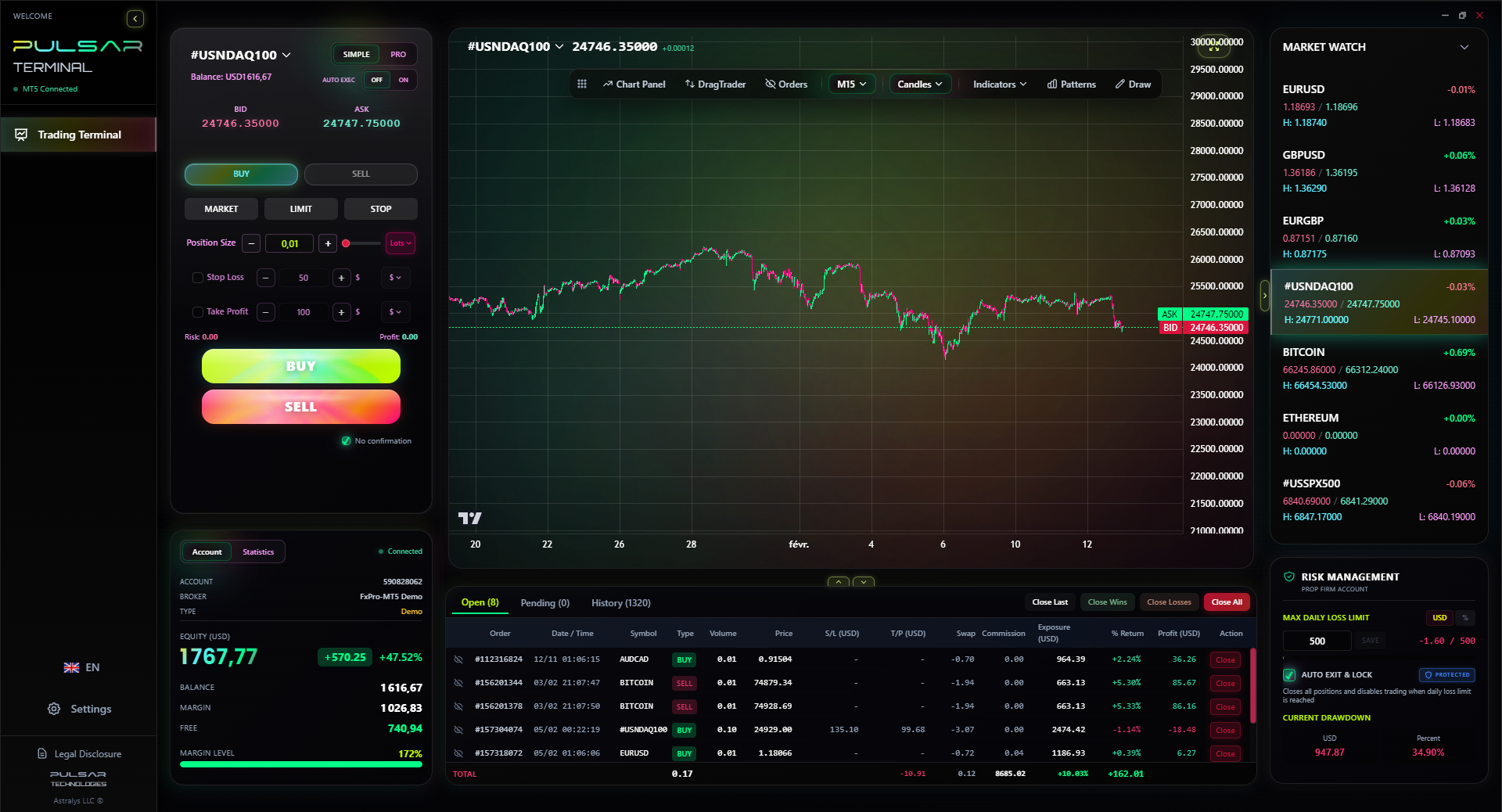
Managing multiple trades and advanced orders manually on MT5 is stressful; a tool like Pulsar Terminal lets you drag-and-drop take-profit levels and set automated trailing stops directly on your chart, so your execution matches your plan.
Pulsar Terminal
Alat MT5 all-in-one: order drag-and-drop, multi-TP/SL, trailing stop, grid trading, Volume Profile, dan perlindungan prop firm. Digunakan 1.000+ trader setiap hari.
“The education that finally worked for me bored me with risk management before it dazzled me with charts.”
Let me be specific about my failures so you can avoid them.
Phase 1: The Get-Rich-Quick Disaster (Cost: LKR 250,000) I bought a 'course' from a local 'mentor' for LKR 75,000. He taught a complicated system of 15 indicators. The signal service he sold (another LKR 15,000/month) had me in 10 trades a day. I blew up my first LKR 100,000 account in 3 months. I deposited another LKR 150,000, convinced I just needed to 'follow the signals better.' Lost that too. The system was designed for activity, not profitability. The margin call emails became a regular horror.
Phase 2: The Free-For-All Confusion (Cost: LKR 50,000 & 1 year) I swore off paid courses. I watched every free video, read every forum. I tried day trading, then swing trading, then fundamentals. I was knowledgeable but had no cohesive strategy. I'd have a winning week, then give it all back in one emotional trade. I slowly bled another LKR 50,000 over a year.
Phase 3: The Structured Learning That Stuck (Cost: LKR 8,000 & My Ego) I joined a small group run by a trader who focused on one market (I chose EUR/USD guide for its liquidity). The curriculum was simple: price action, support/resistance, and risk management. For 3 months, we were only allowed to paper trade. Then, we had to trade a $100 account for 3 months and show a consistent journal. The first real trade I placed with this method: BUY EUR/USD at 1.0725, Stop Loss at 1.0690 (35 pips), Take Profit at 1.0780 (55 pips). I risked 0.5% of my capital. It hit my take-profit. It wasn't exciting. It was just a plan, executed. That's when it clicked.
💡 Tips Winston
The market doesn't care about your tuition fees, your rent, or the LKR/USD rate. Trade the chart in front of you, not the financial pressure behind you.
“Your goal for the first six months with real money is not profit. It's to not lose more than 10% of your account.”
Completing a course is the beginning, not the end. Here's your roadmap.
- Paper Trade for a Minimum of 3 Months. No exceptions. Your goal isn't to make fake money; it's to execute your plan 100 times without emotion. Test your understanding of the EUR/USD guide or the XAU/USD guide in real-time market conditions.
- Fund a Micro Account. Start with the smallest amount your broker allows - $50, $100. Your goal for the next 6 months is not profit. Your goal is to not lose more than 10% of this account. If you can preserve capital, you're learning.
- Keep a Detailed Journal. For every trade, note: entry reason, entry price, stop-loss, take-profit, exit price, and - most importantly - your emotional state. Review this weekly. You'll see your mistakes repeating.
- Find a Community. Not a signal group. A community of peers who are also learning. Share your journal entries, discuss market ideas, and hold each other accountable. This is useful.
- Continuously Learn. The market changes. Once you have a base, explore advanced topics like order flow or market profile. But master your core strategy first.
The journey from student to consistent trader takes years, not months. The right forex trading course in Sri Lanka is the one that gives you a solid foundation and the discipline to walk this long path yourself, without promising shortcuts that don't exist.
FAQ
Q1Is forex trading legal in Sri Lanka?
Yes, the act of trading forex is legal. However, it's regulated by the Central Bank's Department of Foreign Exchange, and there are strict controls on sending money abroad to fund trading accounts. You'll typically use internationally regulated brokers, not ones locally licensed by the CBSL.
Q2How do I pay for an international broker from Sri Lanka?
Direct bank transfers for margin trading are problematic due to forex controls. Most traders use intermediary e-wallet services like Skrill, Neteller, or Perfect Money. Some brokers also accept cryptocurrency deposits. Always test a small withdrawal first to ensure the process works smoothly.
Q3Do I have to pay tax on my forex trading profits?
Yes. The Inland Revenue Department (IRD) treats trading profits as taxable income. You're subject to progressive tax rates, starting at 6% for the first LKR 500,000 of annual profit. Keep detailed records of all your trades for tax filing.
Q4What's a reasonable amount to pay for a forex trading course?
Anywhere from LKR 5,000 to LKR 15,000 for a complete, structured course is reasonable. Be very skeptical of courses costing LKR 50,000+ that promise extraordinary results. The price should be for education and mentorship, not for 'secret signals' or guaranteed profits.
Q5Which trading platform is best for beginners in Sri Lanka?
MetaTrader 4 (MT4) or MetaTrader 5 (MT5) are the industry standards and are perfectly suitable for beginners. They are stable, widely supported by brokers, and have a vast library of free educational resources and indicators online.
Q6How much money do I need to start trading forex?
You can open an account with as little as $10-$50 with some brokers. However, I strongly recommend you start with a demo (paper trading) account for at least 3 months. When you go live, consider your first $100 as tuition fee you expect to lose. Focus on learning, not earning.
Q7What percentage of traders actually make money?
Globally, the statistics are grim. Studies by regulators often show that between 70% and 95% of retail traders lose money. This is why a course focusing on risk management and psychology is more valuable than one focusing only on entry signals.
Pelajaran Prof. Winston
Poin Penting:
- ✓Risk a maximum of 1-2% of capital per trade.
- ✓Paper trade for 3 months minimum before using real money.
- ✓Verify profit withdrawal before making large deposits.
- ✓Taxes on profits start at 6% for the first LKR 500k.
Seberapa bermanfaat artikel ini?
Klik bintang untuk menilai
Wawasan Trading Mingguan
Analisis & strategi mingguan gratis. Tanpa spam.
Tentang Penulis
Daniel Harrington
Kepala Konten
Kepala konten di The Trading Mentor. Trader berpengalaman yang bersemangat membuat konsep trading kompleks mudah dipahami. Mencakup topik global, strategi, dan panduan platform.
Komentar
Peringatan Risiko
Perdagangan instrumen keuangan mengandung risiko signifikan dan mungkin tidak cocok untuk semua investor. Kinerja masa lalu tidak menjamin hasil di masa depan. Konten ini hanya untuk tujuan edukasi dan tidak boleh dianggap sebagai nasihat investasi. Selalu lakukan riset Anda sendiri sebelum trading.
Anda mungkin juga suka

Cara Trading Forex Sukses: 7 Prinsip dari Trader Profesional
Cara trading forex sukses dengan 7 prinsip trader pro: manajemen modal, disiplin, journal trading, backtest. Data nyata, bukan janji profit palsu.
Jam Trading Forex Terbaik untuk Trader Indonesia: Panduan Lengkap dengan Tabel Waktu
Panduan jam trading forex untuk trader Indonesia. Tabel 4 sesi dunia, jam emas 20:00-00:00, sesi mana yang harus dihindari. Data akurat + tips dari trader berpengalaman.
Top 5 Sàn Forex Uy Tín Nhất 2026: Review Jujur dari Trader Indonesia
Top 5 sàn forex uy tín 2026 untuk trader Indonesia. Review jujur: spread, deposit, withdraw, dukungan lokal. Exness, XM, IC Markets & lebih.
Dapatkan Pulsar Terminal
Semua kalkulator ini terintegrasi dalam Pulsar Terminal dengan data real-time dari akun MT5 Anda.
Dapatkan Pulsar Terminal