


I lost ₹87,000 in a single week back in 2018.

Rajesh Sharma
Analis Forex Senior ·  India
India
☕ 11 mnt baca
Yang akan Anda pelajari:
- 1The Legal Landscape: FEMA and the RBI's Iron Grip
- 2What You Can Actually Trade (The Legal List)
- 3The Big Prohibitions: What Will Get You in Trouble
- 4The Real Costs: Fees, Spreads, and the Tax Hit
- 5Choosing a Legal Broker: SEBI is Your Friend
- 6A Practical Trading Strategy Within the Rules
- 7Common Pitfalls and Final Advice
I lost ₹87,000 in a single week back in 2018. Not from a bad trade, but from a frozen account. I'd been trading EUR/USD through an offshore broker I found online, thinking I was being clever by 'accessing global markets.' A few months in, the RBI issued one of its periodic warnings, my broker got spooked, and they locked my funds during a volatile period. By the time I got my money back (minus hefty 'administrative fees'), the lesson was burned in: in India, you don't just trade the charts, you trade within a very specific rulebook. Understanding the RBI guidelines isn't optional, it's the foundation of your entire operation.
Let's get one thing straight upfront: forex trading in India isn't a free-for-all. The entire game is governed by the Foreign Exchange Management Act (FEMA) of 1999. Think of FEMA as the rulebook, and the Reserve Bank of India (RBI) as the head referee with a very loud whistle.
The core principle is about managing India's foreign exchange reserves and preventing capital flight. The RBI's primary job is to stop rupees from flooding out of the country for speculative purposes. This is why their rules feel so restrictive compared to what you hear about traders in the US or UK.
Everything hinges on what's termed a 'permitted' activity. If it's not explicitly permitted, it's prohibited. There's no grey area when the RBI decides to look at your transactions. I learned this the hard way when my bank temporarily flagged a series of small international transfers meant for a 'software subscription' that looked a bit too much like funding a trading account.

Warning: Using the Liberalised Remittance Scheme (LRS) – that $250,000 annual limit – for speculative forex trading is a direct violation. Banks are required to report these transactions, and misdeclaring the purpose can lead to penalties and your LRS limit being suspended.
“In India, you don't just trade the charts, you trade within a very specific rulebook.”
This is where most new Indian traders get confused. You cannot just open an account with any international broker and start trading spot forex. That's illegal. Full stop. What you can do is trade currency derivatives on Indian exchanges.
The Approved Venues
All legal forex action happens on recognized stock exchanges: the National Stock Exchange (NSE), the Bombay Stock Exchange (BSE), and the Metropolitan Stock Exchange (MSEI). You need an account with a SEBI-registered broker who is a member of these exchanges. Think Zerodha, Angel One, Upstox, ICICI Direct, or HDFC Securities.
The Approved Instruments
You're trading futures and options contracts, not the spot market. These are standardized contracts traded on the exchange. For example, you might trade a USDINR futures contract that expires next month.
The Approved Currency Pairs
Your trading must involve the Indian Rupee. The main pairs are:
| Pair | Typical Contract Size (on NSE) | What It Is |
|---|---|---|
| USD/INR | $1000 | US Dollar vs. Indian Rupee |
| EUR/INR | €1000 | Euro vs. Indian Rupee |
| GBP/INR | £1000 | British Pound vs. Indian Rupee |
| JPY/INR | ¥100,000 | Japanese Yen vs. Indian Rupee |
You can also trade cross-currency futures (like EUR/USD, GBP/USD, USD/JPY) on these exchanges, but they are settled in INR. This is a key legal loophole that allows you exposure to major global pairs without breaking RBI rules.

Pro Tip: Liquidity is king. The USD/INR futures market is by far the most liquid, with tight spreads. Be cautious with the other INR pairs (EUR/INR, etc.) as spreads can widen significantly, especially around local market close, turning a good idea into a losing scalping strategy quickly.

💡 Tips Winston
The RBI isn't trying to stop you from trading. They're trying to stop the rupee from leaving. Your job is to find the opportunity within those guardrails. The USD/INR future is that opportunity.
“If it's not explicitly permitted by the RBI, it's prohibited. There's no grey area.”
If the permitted list seems short, the prohibited list is what you really need to memorize. I see ads every day for 'global forex brokers' accepting Indian clients. Here's the reality.
Trading spot forex through offshore platforms is illegal. This means if you're signing up with an international brand (even big names you've heard of) to trade live EUR/USD prices, you're operating outside RBI guidelines. The broker might accept you, but you have zero legal recourse if something goes wrong.
CFDs and Binary Options are completely banned. Don't even think about it. SEBI has a clear stance against these products for Indian residents.
Funding overseas trading accounts for forex speculation is a major red flag. Using your credit card, PayPal, or international wire transfers (beyond your LRS for permitted purposes) to send money to an offshore broker for trading non-INR pairs will eventually be noticed. Banks have automated systems that flag patterns of such transactions.
I have a friend who tried the 'small amounts' approach, funding an account with a broker like Exness or XM with $100 here and $200 there via multiple payment channels. He made a decent profit of about $1500 over six months. When he tried to withdraw it, the broker asked for source of funds documentation he couldn't provide (as it was from his Indian salary account for a prohibited activity), and the withdrawal was stuck for months. The profit wasn't worth the headache.
Using the LRS to remit margin money to an international exchange or broker for online forex trading is specifically prohibited. That $250,000 limit is for things like education, travel, gifts, or investing in overseas stocks - not for funding your forex margin account.
“If it's not explicitly permitted by the RBI, it's prohibited. There's no grey area.”
Trading legally on Indian exchanges isn't necessarily cheaper. You need to factor in all the costs, which are structured differently than international spot forex.
Brokerage: This is usually a flat fee per lot or a percentage of turnover. It's transparent but adds up, especially for high-frequency trading. Compare brokers carefully.
Exchange & Regulatory Charges: Small fixed fees levied by the exchange and SEBI on every transaction.
STT (Securities Transaction Tax): This is the big one. It's a tax applied on the sale side of futures contracts. For currency derivatives, it's currently ₹1,000 on every ₹1 crore of turnover (0.001%). While it sounds small, for active traders, this significantly impacts net profitability. You need to factor this into your position size calculator.
Spreads: On the USD/INR future, the spread is usually very tight, often just 0.0025 INR (a quarter of a pip). However, on less liquid pairs like EUR/INR, I've seen the spread jump to 0.05 INR or more during off-peak hours. That's a huge cost to overcome.
Taxation: Your profits from trading currency derivatives on Indian exchanges are treated as business income or speculative business income. You need to file your returns accordingly, and you can offset losses against this income. This is different from the 20% with indexation benefits you might get from equity investments. Keep careful records of every trade. I once spent three days reconciling a year's worth of trades for my CA. Now I use a dedicated spreadsheet from day one.

Example: Let's say you buy 10 lots of USD/INR futures (1 lot = $1000). Your total turnover on the buy side is 10 * $1000 * say, ₹83 = ₹8,30,000. When you sell, another ₹8,30,000 of turnover. Total turnover = ₹16,60,000. STT on the sale = ₹16.6. Plus brokerage of, say, ₹20 per lot = ₹200. Plus exchange charges of maybe ₹5 per lot = ₹50. Your direct costs for the round turn are nearly ₹270 before you've even made a profit.
💡 Tips Winston
If a broker's offer seems too good to be true for an Indian resident (high use, easy sign-up, non-INR pairs), it is. You're not getting a special deal, you're taking a regulatory risk.
“View the RBI guidelines not as a cage, but as the playing field.”
Your broker must be a SEBI-registered stockbroker and a member of the NSE, BSE, or MSEI's currency derivative segment. This is non-negotiable.
Popular and reputable choices include: Zerodha, Angel One, Upstox, ICICI Direct, HDFC Securities, Sharekhan, Motilal Oswal, and 5paisa. These platforms are built for the Indian market. Their charts, tools, and order types are designed for trading futures and options on Indian exchanges.
What about international brokers like Interactive Brokers? Interactive Brokers (IBKR) is a special case. They are legally accessible to Indians because they provide access to global stock exchanges, not spot forex. You cannot trade forex CFDs or spot on IBKR as an Indian resident. You could use them to trade USD/INR futures on the NSE (which they offer), but it's simpler to use a domestic broker for that. Their real value for Indians is access to US stocks, not forex.
The platform matters. The trading platforms (like Zerodha's Kite or Angel One's platform) are good, but they are not MetaTrader 4 or 5. The charting and analysis tools can feel limited if you're used to advanced international platforms. This is where having a solid, rule-based strategy becomes critical, as you can't rely on 50 complex indicators. I mostly use price action and a couple of key tools like the RSI indicator and MACD indicator in confluence.
Account funding is seamless and legal. You fund your trading account via standard Indian bank transfer (NEFT/RTGS/UPI) directly from your bank account to your broker's designated account. Withdrawal is the reverse. No international wire drama, no currency conversion fees beyond the bank's spread.
“View the RBI guidelines not as a cage, but as the playing field.”
So how do you actually make this work? You adapt. The USD/INR future is your main playground. It's liquid from 9 AM to 5 PM IST, with the most action around 9:15-9:45 AM (when banks are active) and 3:30-5:00 PM (London open overlap).
I run a modified swing trading approach on the weekly and daily charts of USD/INR. Because of the STT and brokerage, scalping tiny moves is a tough game. I look for 50-100 pip moves (where a pip is 0.0025 INR) over a few days.
Here's a real trade from last month:
- I identified a key support zone around ₹82.80 on the daily chart for USD/INR April future.
- Price tapped it twice and showed a bullish rejection candle on March 15th.
- I went long at ₹82.85 on March 16th. My stop loss was at ₹82.65, risking 20 pips (₹500 per lot, since 1 pip = ₹25 per lot).
- I scaled out half my position at ₹83.15 (30 pips profit) and trailed the rest.
- I closed the final position at ₹83.40 on March 22nd for a 55 pip profit on the remainder.
- Net result: Average gain of about 42.5 pips across the position. After costs (STT, brokerage), my net was roughly ₹950 per lot. Not a home run, but consistent, low-stress, and most importantly, completely legal.
The key is patience and position sizing. You can't revenge trade or over-use easily because the market hours are limited and the product is less volatile than spot EUR/USD. This forced discipline actually improved my overall trading psychology.
Pro Tip: News is everything. RBI monetary policy announcements, US Non-Farm Payrolls, and major Fed statements cause huge volatility in USD/INR. Either trade the volatility with a very clear plan, or stay out. I've been whipped out of good positions by holding through an RBI announcement without a wide enough stop.
💡 Tips Winston
Treat the STT and brokerage as part of your spread. If your strategy needs a 5-pip stop loss, but costs eat 2 pips, you really need a 3-pip edge. Most strategies don't have that. Adjust your timeframe.
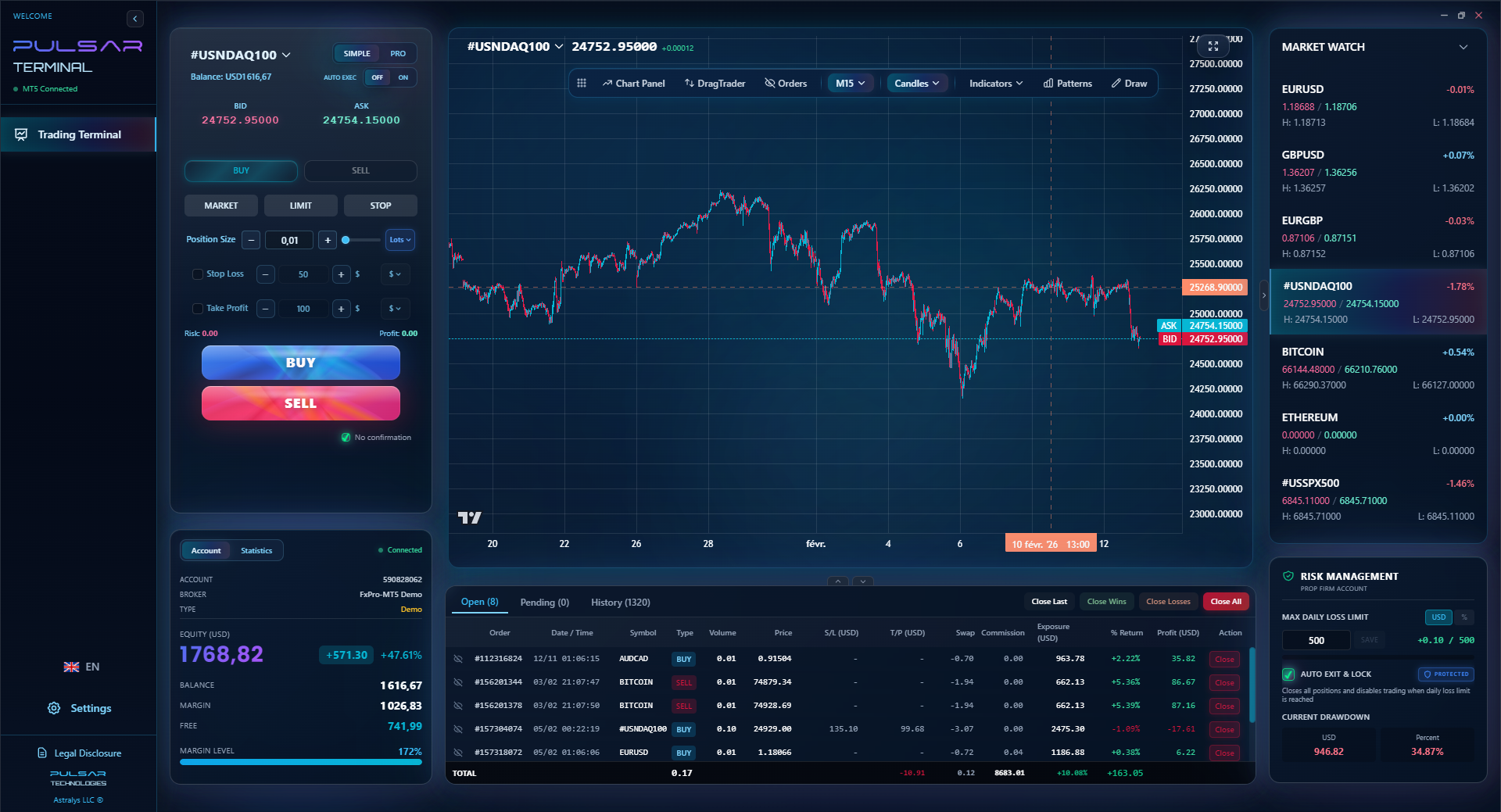
Managing multiple lots and partial profit targets on Indian trading platforms can be clunky, but tools like Pulsar Terminal streamline this with drag-and-drop order management directly on your chart.
Pulsar Terminal
Alat MT5 all-in-one: order drag-and-drop, multi-TP/SL, trailing stop, grid trading, Volume Profile, dan perlindungan prop firm. Digunakan 1.000+ trader setiap hari.
“The peace of mind from legal trading is worth more than any forbidden use.”
Let's wrap up with the mistakes I see all the time, so you can avoid them.
Pitfall 1: Chasing 'Offshore' use. You'll see ads offering 1:500 use. On Indian exchanges, use for currency futures is effectively set by the exchange-mandated margin, which is usually around 2-5% of contract value (1:20 to 1:50 use). It feels low, but it protects you from a quick margin call. Accept it.
Pitfall 2: Ignoring Time Decay in Options. If you trade currency options, remember they are wasting assets. Buying far-out-of-the-money options hoping for a big swing is a sure way to lose premium. I've burned money here thinking I was 'smart' using options.
Pitfall 3: Not Accounting for All Costs. That STT and brokerage turns breakeven trades into losers. Your strategy's win rate and risk-reward ratio must be strong enough to absorb these friction costs.
My final advice is this: View the RBI guidelines not as a cage, but as the playing field. Once you know exactly where the boundaries are, you can focus on getting better at the game within them. The peace of mind that comes from knowing your profits are legitimate, taxable, and withdrawable without fear is worth more than any forbidden use an offshore broker can offer. Build your skills on the USD/INR future. It's a deep, tradable market that teaches real discipline. Once you can consistently make money there, you're a trader, no matter what the rulebook says.
FAQ
Q1Is forex trading legal in India?
Yes, but only in a specific form. Trading currency derivatives (futures and options) on Indian stock exchanges like the NSE and BSE through a SEBI-registered broker is legal. Trading spot forex or CFDs through international brokers is prohibited by RBI guidelines.
Q2Can I use international brokers like Exness or XM in India?
You can open an account, but it is illegal to use them for forex trading as an Indian resident. The RBI has repeatedly warned against this. These brokers are not authorized to offer forex trading services to Indians. Any trading you do with them is at your own risk, with no legal protection for your funds. For a legal alternative, see our reviews of platforms that help exchange-traded products, like IC Markets for global markets (not spot forex) or stick to domestic brokers.
Q3What is the maximum use allowed for forex trading in India?
For legal currency derivative trading on Indian exchanges, use is determined by the exchange-mandated margin. It typically ranges from 2% to 5% of the contract value, which translates to roughly 1:20 to 1:50 use. The 1:500 use advertised by offshore brokers is not available for legal trading in India.
Q4How are forex trading profits taxed in India?
Profits from trading currency derivatives on Indian exchanges are treated as 'Business Income' or 'Speculative Business Income' for tax purposes. You must file ITR-3 and can carry forward losses to set off against future speculative income. It is not taxed under capital gains.
Q5Can I trade EUR/USD legally from India?
Yes, but only as a cross-currency futures contract (EUR/USD futures) traded on Indian exchanges like the NSE. These contracts are settled in Indian Rupees. You cannot trade the spot EUR/USD pair through an international broker.
Q6What is the minimum amount needed to start forex trading in India?
It depends on the broker and the contract. For example, one lot of USD/INR futures represents $1000. With a typical margin requirement of around 3-4%, you'd need roughly ₹2,500 - ₹3,500 in margin per lot, plus extra capital for the stop loss. Most domestic brokers have no minimum account balance, but you need enough to cover one contract and risk.
Q7Does the RBI allow trading in gold (XAU/USD)?
Similar rules apply. You cannot trade spot XAU/USD through an offshore broker. However, you can legally trade gold futures and options contracts on Indian commodity exchanges (MCX) which are priced in INR per 10 grams. For more on gold trading mechanics, check our XAU/USD guide for conceptual understanding, but remember the execution must be on a domestic exchange.
Pelajaran Prof. Winston
Poin Penting:
- ✓Only trade INR-based derivatives on NSE/BSE.
- ✓Spot forex & CFDs with offshore brokers are illegal.
- ✓Factor in STT tax (0.001%) on every sale.
- ✓Profits are taxed as business income.
- ✓Maximum legal use is ~1:50, not 1:500.
Seberapa bermanfaat artikel ini?
Klik bintang untuk menilai
Wawasan Trading Mingguan
Analisis & strategi mingguan gratis. Tanpa spam.
Tentang Penulis
Rajesh Sharma
Analis Forex Senior
Berpengalaman lebih dari 10 tahun di pasar India dan Asia Selatan. Memulai dari derivatif mata uang NSE sebelum beralih ke forex internasional. Spesialis pasangan USD/INR dan pasar negara berkembang.
Komentar
Peringatan Risiko
Perdagangan instrumen keuangan mengandung risiko signifikan dan mungkin tidak cocok untuk semua investor. Kinerja masa lalu tidak menjamin hasil di masa depan. Konten ini hanya untuk tujuan edukasi dan tidak boleh dianggap sebagai nasihat investasi. Selalu lakukan riset Anda sendiri sebelum trading.
Anda mungkin juga suka

Cara Trading Forex Sukses: 7 Prinsip dari Trader Profesional
Cara trading forex sukses dengan 7 prinsip trader pro: manajemen modal, disiplin, journal trading, backtest. Data nyata, bukan janji profit palsu.
Jam Trading Forex Terbaik untuk Trader Indonesia: Panduan Lengkap dengan Tabel Waktu
Panduan jam trading forex untuk trader Indonesia. Tabel 4 sesi dunia, jam emas 20:00-00:00, sesi mana yang harus dihindari. Data akurat + tips dari trader berpengalaman.
Top 5 Sàn Forex Uy Tín Nhất 2026: Review Jujur dari Trader Indonesia
Top 5 sàn forex uy tín 2026 untuk trader Indonesia. Review jujur: spread, deposit, withdraw, dukungan lokal. Exness, XM, IC Markets & lebih.
Dapatkan Pulsar Terminal
Semua kalkulator ini terintegrasi dalam Pulsar Terminal dengan data real-time dari akun MT5 Anda.
Dapatkan Pulsar Terminal