


Here's a statistic that should make you pause: over 90% of Indian retail traders who attempt to trade major forex pairs like EUR/USD are breaking the law.

Rajesh Sharma
Analis Forex Senior ·  India
India
☕ 12 mnt baca
Yang akan Anda pelajari:
- 1The Legal Framework: FEMA, SEBI, and the RBI's Iron Grip
- 2What You Can Actually Trade (Legally)
- 3The Offshore Broker Grey Area (Where Most Get Burnt)
- 4Costs, Fees, and The Real Price of Trading
- 5A Practical Guide to Getting Started (The Right Way)
- 6Tax Implications: Don't Get a Surprise Notice
- 7Common Pitfalls and How to Avoid Them
Here's a statistic that should make you pause: over 90% of Indian retail traders who attempt to trade major forex pairs like EUR/USD are breaking the law. They just don't know it yet. The landscape here isn't just regulated, it's deliberately restrictive. I've seen too many traders get excited about charts and strategies, only to completely ignore the legal minefield they're stepping into. Trading in India isn't about finding the best setup, it's first about understanding the narrow corridor you're allowed to walk in. Let's clear up the confusion, separate fact from dangerous fiction, and look at what you can actually do.
Forget everything you've heard from YouTube gurus selling forex dreams. In India, the rulebook is written by the Reserve Bank of India (RBI) under the Foreign Exchange Management Act (FEMA) of 1999. This isn't a suggestion, it's the law. The core principle is simple: the Indian Rupee (INR) is a controlled currency. Its value against other currencies is managed, and speculative trading that could impact this is heavily restricted.
The Securities and Exchange Board of India (SEBI) regulates the exchanges where some legal trading happens. Think of it this way: the RBI says what you can trade, and SEBI oversees how you trade it on approved platforms. The most critical rule, and the one most people ignore, is this: you are only permitted to trade currency pairs that include the Indian Rupee.
That means USD/INR, EUR/INR, GBP/INR, JPY/INR. That's your universe. Want to trade EUR/USD, GBP/JPY, or even AUD/CAD? According to FEMA, you cannot. Not legally. The RBI has been crystal clear: resident individuals are not permitted to undertake forex transactions for speculative purposes on unauthorized Electronic Trading Platforms (ETPs).

Warning: The RBI publishes an 'Alert List' of unauthorized forex trading platforms. Using them is illegal. Funds sent there have no legal protection. I've spoken to traders who lost five-figure sums when an offshore broker simply stopped responding, and they had zero recourse.
A 2024 RBI circular further tightened the screws, stating that on-exchange rupee derivatives should be used for hedging 'contracted exposure,' not pure speculation. While enforcement on this specific point for retail traders is debated, the intent is clear: the authorities view currency speculation with deep suspicion.
“Over 90% of Indian retail traders who attempt to trade major forex pairs like EUR/USD are breaking the law.”
So, if the rules are so tight, what's left? Your legal playground is on Indian exchanges like the National Stock Exchange (NSE) and the Bombay Stock Exchange (BSE). Here, you trade currency futures and options.
Currency Futures
These are standardized contracts to buy or sell a currency pair at a future date. The most liquid is the USD/INR future. You're not trading a spot price from an international broker; you're trading a contract on an Indian exchange. The contract sizes are fixed (e.g., $1000 for USD/INR), and they have expiry dates, typically monthly.
Currency Options
These give you the right, but not the obligation, to buy or sell a currency pair at a set price before expiry. They're more complex and less liquid than futures for retail traders.
The experience is fundamentally different from trading on MetaTrader with an offshore broker. The spreads are wider, the use is lower (SEBI mandates strict limits), and the price action can feel disconnected from the global spot market you see on TV. It's a different game.

Example: Let's say you buy one lot of USD/INR futures at 83.5000. Each pip move in USD/INR is worth ₹100 (for the standard $1000 contract). If it moves to 83.5100, that's a 10-pip move, or a ₹1000 profit before brokerage. Compare that to a standard forex lot where a 10-pip move on EUR/USD is $100. The psychology and position size calculator you'd use are different.
Your brokers for this legal route are SEBI-registered Indian firms: Zerodha, Upstox, Angel One, ICICI Direct, and others. They charge brokerage fees, not spreads in the traditional forex sense. For example, Zerodha might charge a flat ₹20 per order for currency options. It's a cost structure built for equities, adapted for currencies.

💡 Tips Winston
The most expensive tool in trading is hope. Hoping the RBI won't notice, hoping the broker will pay, hoping the taxman won't ask. Build your plan on certainty, not hope. Trade what's explicitly permitted.
“You're paying for the convenience of offshore trading with risk, not just money.”
This is the elephant in the room. Visit any trading forum, and you'll see Indians actively discussing brokers like IC Markets, Pepperstone, and XM. They're depositing money, trading EUR/USD, and making withdrawals. How is this possible if it's illegal?
It operates in a massive grey area. These international brokers are not regulated by SEBI or authorized by the RBI. They accept Indian clients through their offshore entities (often in Cyprus, the Seychelles, or Australia). You send money via international bank transfer or credit card, which technically falls under the Liberalised Remittance Scheme (LRS).
The RBI's LRS allows you to send up to $250,000 per financial year abroad for approved purposes like education, travel, or investing in overseas stocks. It explicitly states this cannot be used for margin trading on forex platforms. When you fund an offshore broker, you're likely mis-declaring the purpose of the remittance. Your bank might ask questions for larger amounts.
I tried this early in my career. In 2015, I deposited $500 with an offshore broker, declaring it as 'online services.' It worked. I turned that $500 into $3200 in three months trading gold (XAU/USD guide). I felt like a genius. Then I tried to withdraw $2000. The broker asked for endless documentation, my bank froze the incoming transfer for two weeks for investigation, and I was grilled on the source of these 'foreign earnings.' I got my money, but the stress wasn't worth the profit. I never did it again.
The risks are layered:
- Legal Risk: You're violating FEMA. While prosecution of small retail traders is rare, the RBI can and does block payments to known broker entities.
- Broker Risk: You have no SEBI protection. If the broker goes under or refuses your withdrawal, you're filing a complaint with a financial regulator in another country. Good luck.
- Banking Risk: Your bank can flag your account for suspicious cross-border activity. Repeated transactions can lead to account closure.
- Taxation Nightmare: How do you declare these profits? As 'foreign income'? It creates a messy tax situation most CAs aren't equipped to handle.

Pro Tip: If you still go this route despite the warnings, use a broker with a long, solid reputation and clear withdrawal policies. Check our deep dives on IC Markets review and Pepperstone review for specifics. But understand, you're on your own.
“You're paying for the convenience of offshore trading with risk, not just money.”
Whether you trade legally on NSE or go offshore, the costs eat into your profits. They're just structured differently.
On Indian Exchanges (USD/INR Futures):
- Brokerage: A fixed fee per order (e.g., ₹20) or a percentage of turnover. Zerodha charges ₹0.05 per lakh + GST for futures.
- Exchange & Regulatory Charges: Small fees levied by the exchange and SEBI.
- STT (Securities Transaction Tax): Applicable on options, not futures.
- GST: 18% on the brokerage fee.
- Spreads: The bid-ask spread exists but isn't the primary cost. It's usually a few paisa (0.01-0.05).
With Offshore Brokers (EUR/USD):
- Spreads: This is your main cost. They vary wildly.
| Broker | Account Type | Avg. EUR/USD Spread | Commission |
|---|---|---|---|
| IC Markets | Raw Spread | 0.1 pips | $3.50 per lot |
| Pepperstone | Razor | 0.0 pips | $3.50 per lot |
| XM | Standard | 1.7 pips | None |
| AvaTrade | Standard | 0.9 pips | None |
- Payment Fees: Your bank will charge 3-5% for international card payments plus GST. Bank transfers have flat fees and poor exchange rates.
- Inactivity Fees: Many offshore brokers charge if you don't trade for 3-6 months.
Let's do a quick comparison. Say you trade 10 mini lots (0.1 standard lots each) of EUR/USD in a month with an offshore broker at 0.5 pip average spread. Your spread cost is 10 lots * $1 per pip * 0.5 pips = $5. Add commissions if applicable. On NSE, 10 trades of USD/INR might cost you 10 * ₹20 = ₹200 (~$2.40) in brokerage, plus other tiny fees. The offshore route can be cheaper on pure execution, but that ignores the massive legal and security risks you're absorbing. You're paying for convenience with risk.
💡 Tips Winston
Your first job as an Indian trader isn't to analyze the MACD or RSI. It's to read the FEMA Act and the latest RBI circular on derivatives. Your edge comes from knowing the rules better than the person on the other side of the trade.
“Acceptance is key. The Indian market is your reality. Learn its rhythms.”
If you want to trade forex legally in India, here's your step-by-step playbook. This is the boring, compliant, and sustainable path.
- Open a Demat & Trading Account: Choose a SEBI-registered broker like Zerodha, Angel One, or Upstox. The account opening is fully online and free.
- Learn the Product: Don't assume you know futures because you've watched forex videos. Understand contract specifications, expiry cycles, settlement (cash-settled in INR), and margin requirements. Use the broker's knowledge base.
- Start with Paper Trading: Every major Indian broker offers a virtual trading platform. Trade USD/INR futures there for at least two months. Get a feel for the liquidity (it's great during market hours, dead after), and how news events like RBI announcements cause gaps.
- Fund Your Account: Transfer money from your bank via UPI or Net Banking. It's instant and safe.
- Trade Small: Your first live trade should be for just 1 contract. The margin might be ₹15,000-₹20,000. Your goal isn't profit, it's to experience the emotional cycle of a real, legal trade from entry to exit.
- Focus on USD/INR: It has the deepest liquidity and tightest spreads. EUR/INR and others are far less traded. I made the mistake of trying to swing trade GBP/INR early on. A small news event caused a huge slippage because there were no buyers, turning a small winning idea into a loss. Stick to the main pair.
- Keep a Log: Document every trade, including the rationale. Since you're likely hedging (or stating you are), note what underlying exposure you're theoretically hedging. It's good practice.
This path won't give you the 500:1 use or 100+ pairs of offshore brokers. It will, however, let you sleep at night without worrying about a regulatory hammer or a broker vanishing with your capital.
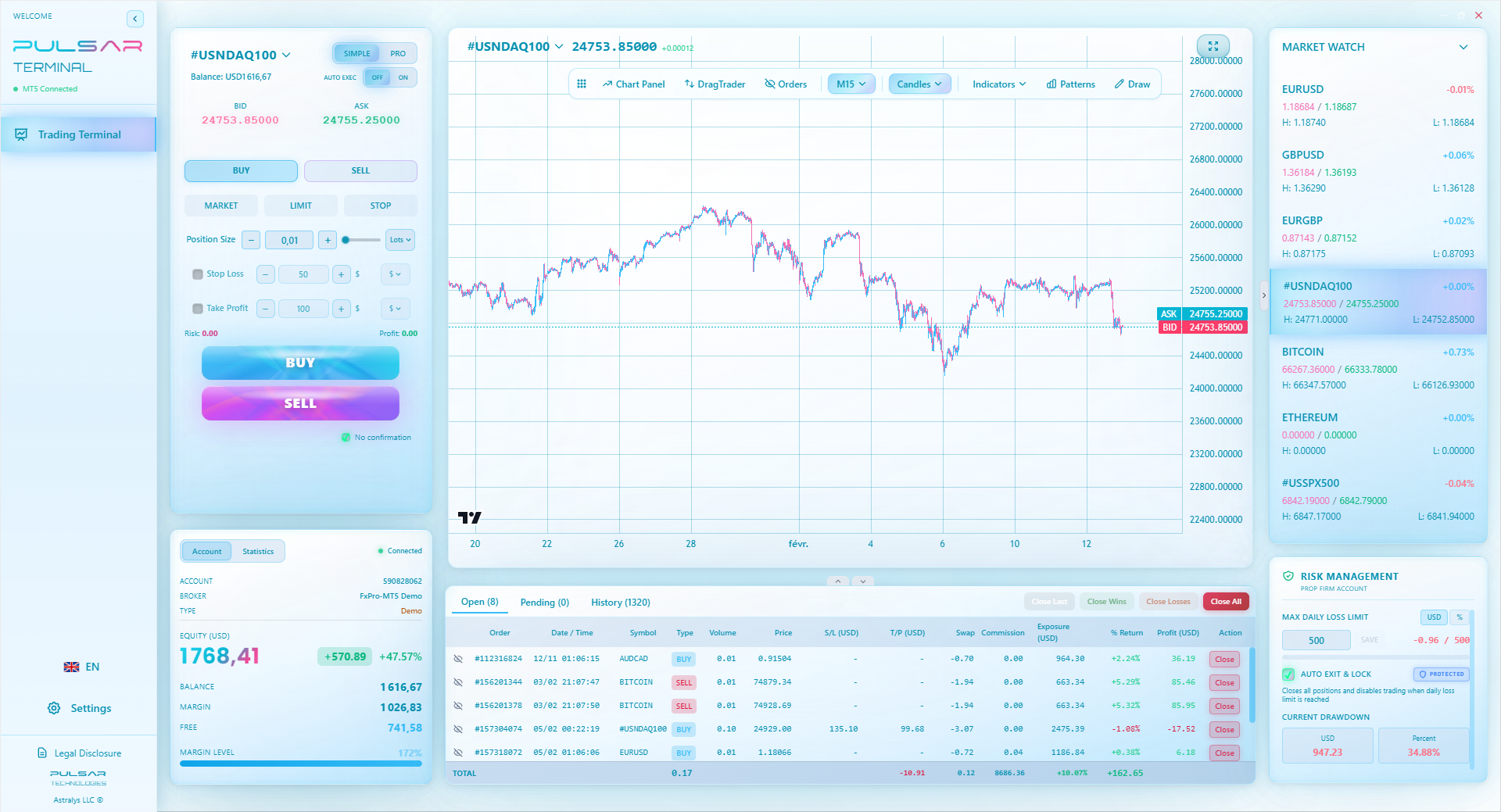
Managing multiple targets and stops on exchange platforms can be clunky, but tools like Pulsar Terminal bring advanced order management directly to your MT5, helping you execute complex strategies with precision, even when adapting methods to the USD/INR market.
Pulsar Terminal
Alat MT5 all-in-one: order drag-and-drop, multi-TP/SL, trailing stop, grid trading, Volume Profile, dan perlindungan prop firm. Digunakan 1.000+ trader setiap hari.
“Acceptance is key. The Indian market is your reality. Learn its rhythms.”
The taxman always gets his share. How your forex trading income is taxed depends entirely on how you trade.
For Legal Exchange Trading (Futures & Options): These are considered 'non-speculative business income' if you're a frequent trader. You can choose to file under:
- Presumptive Taxation (Section 44AD): If your total turnover is under ₹2 crore, you can declare 6% of the turnover as profit (8% if not digital). This is simple but may not be optimal if you have significant losses or expenses.
- Regular Business Income: You file your P&L with all details. You can deduct expenses like internet, broker fees, and home office costs. This is more work but can be better if your net profit margin is low.
For Illegal Offshore Trading: You're in a mess. You can't officially declare this as business income without admitting to breaking FEMA. Some traders try to lump it under 'Income from Other Sources,' but that invites scrutiny on the source. If you generate consistent profits and withdraw them to your Indian bank account, the bank's systems will flag it. I know a trader who made ₹25 lakhs over two years trading CFDs. His bank asked for a source, he had no convincing answer, and the entire amount was frozen pending an audit. He ended up paying a hefty tax and a penalty. The profit was wiped out.
The cleanest approach is to trade legally, keep clear records of your exchange contract notes (provided by your broker), and consult a CA who understands trading. It's boring, but it's bulletproof.
💡 Tips Winston
If you wouldn't explain your trading setup to a bank manager during a withdrawal query, you shouldn't be in that trade. Complexity is the enemy of compliance.
“High use is a debt trap, not a tool. It makes you poor, fast.”
After 12 years, I've seen the same mistakes crash Indian traders again and again. Here’s the hall of shame.
Pitfall 1: Chasing the 'Real' Forex Market. You see the smooth trends on EUR/USD charts and find USD/INR choppy and frustrating. So you jump to an offshore broker, lured by the idea of 'real' trading. This is how the cycle of loss and legal risk begins. Acceptance is key. The Indian market is your reality. Learn its rhythms.
Pitfall 2: Misunderstanding use. On exchanges, use is limited by SEBI-mandated margins. It might feel low (10:1 or so). Offshore brokers offer 100:1, 200:1, even 500:1. This is a debt trap, not a tool. I used 100:1 early on. A 100-pip move against me on a standard lot was a 100% loss. High use accelerates the margin call. It makes you poor, fast.
Pitfall 3: Ignoring the RBI Alert List. You see a slick ad for a broker offering bonuses. You check, and they're not on the RBI's Alert List yet. You deposit. Six months later, they appear on the list, and your withdrawal is stuck. Always check the RBI website. If a broker is there, run.
Pitfall 4: Using Unstable Strategies. Many popular forex scalping strategies rely on ultra-low spreads and instant execution. The latency and wider spreads on Indian exchanges can destroy these strategies. A strategy that backtests well on EUR/USD data will fail on USD/INR futures data. Test your method on the actual market you'll trade.
Pitfall 5: No Risk Management. This is universal, but in India's restricted environment, it's even more critical. Your capital is harder to replace if you blow up a legal account. If you blow up an illegal offshore account, you might not be able to open another one easily. Use a hard stop-loss on every single trade. No exceptions.
FAQ
Q1Is forex trading legal in India?
Yes, but only in a very specific way. Trading currency futures and options involving the Indian Rupee (like USD/INR) on SEBI-regulated exchanges like NSE is legal. Trading international pairs like EUR/USD or using offshore forex brokers for spot trading is not permitted under RBI's FEMA regulations.
Q2Can I use the $250,000 LRS limit for forex trading?
No. The Reserve Bank of India has explicitly stated that the Liberalised Remittance Scheme (LRS) cannot be used for margin trading on foreign exchange platforms. Using it to fund an offshore forex broker account is a violation of the scheme's rules.
Q3What is the best legal broker for forex trading in India?
For legal trading of USD/INR futures and options, SEBI-registered discount brokers like Zerodha, Upstox, and Angel One are excellent choices due to their low brokerage fees and strong platforms. There is no 'best' legal broker for international forex, as that activity itself is not permitted.
Q4What is the punishment for illegal forex trading in India?
Violations of FEMA are civil offenses, not criminal. The RBI can impose hefty monetary penalties, often a multiple of the amount involved in the unauthorized transaction. In severe cases, assets can be seized. While small retail traders are rarely pursued aggressively, the risk and lack of legal protection for your funds are severe punishments in themselves.
Q5How are profits from USD/INR futures taxed?
Profits from exchange-traded currency derivatives are typically treated as non-speculative business income. You can opt for presumptive taxation (declaring 6% of turnover as profit) under Section 44AD if your turnover is below ₹2 crore, or file a detailed profit & loss statement. Consult a chartered accountant for your specific situation.
Q6Why are spreads so high on Indian currency futures compared to EUR/USD?
Liquidity. The global EUR/USD market trades trillions daily. The USD/INR futures market on NSE, while liquid by Indian standards, is orders of magnitude smaller. Fewer participants mean a wider gap between the best buy and sell prices (the spread definition). It's the cost of trading in a regulated, onshore market.
Q7Can I use MetaTrader 5 in India?
For legal exchange trading, no. Indian brokers use their own proprietary platforms or platforms like NOW or Kite. You can only use MetaTrader 5 if you open an account with an offshore broker, which, as discussed, carries significant legal and financial risks.
Pelajaran Prof. Winston
Poin Penting:
- ✓Only trade INR pairs (USD/INR) on NSE/BSE.
- ✓Offshore brokers mean legal risk & zero protection.
- ✓LRS $250k limit cannot fund forex trading.
- ✓Tax legally: declare exchange profits as business income.
Seberapa bermanfaat artikel ini?
Klik bintang untuk menilai
Wawasan Trading Mingguan
Analisis & strategi mingguan gratis. Tanpa spam.
Tentang Penulis
Rajesh Sharma
Analis Forex Senior
Berpengalaman lebih dari 10 tahun di pasar India dan Asia Selatan. Memulai dari derivatif mata uang NSE sebelum beralih ke forex internasional. Spesialis pasangan USD/INR dan pasar negara berkembang.
Komentar
Peringatan Risiko
Perdagangan instrumen keuangan mengandung risiko signifikan dan mungkin tidak cocok untuk semua investor. Kinerja masa lalu tidak menjamin hasil di masa depan. Konten ini hanya untuk tujuan edukasi dan tidak boleh dianggap sebagai nasihat investasi. Selalu lakukan riset Anda sendiri sebelum trading.
Anda mungkin juga suka

Cara Trading Forex Sukses: 7 Prinsip dari Trader Profesional
Cara trading forex sukses dengan 7 prinsip trader pro: manajemen modal, disiplin, journal trading, backtest. Data nyata, bukan janji profit palsu.
Jam Trading Forex Terbaik untuk Trader Indonesia: Panduan Lengkap dengan Tabel Waktu
Panduan jam trading forex untuk trader Indonesia. Tabel 4 sesi dunia, jam emas 20:00-00:00, sesi mana yang harus dihindari. Data akurat + tips dari trader berpengalaman.
Top 5 Sàn Forex Uy Tín Nhất 2026: Review Jujur dari Trader Indonesia
Top 5 sàn forex uy tín 2026 untuk trader Indonesia. Review jujur: spread, deposit, withdraw, dukungan lokal. Exness, XM, IC Markets & lebih.
Dapatkan Pulsar Terminal
Semua kalkulator ini terintegrasi dalam Pulsar Terminal dengan data real-time dari akun MT5 Anda.
Dapatkan Pulsar Terminal