


Most guides on forex trading terminology are useless.

Olumide Adeyemi
Pelopor Trading Afrika Barat ·  Nigeria
☕ 9 mnt baca
Yang akan Anda pelajari:
Most guides on forex trading terminology are useless. They give you a dictionary of words without telling you which ones will actually save your account or get you laughed out of a trading room. If you don't know the difference between a 'pip' and a 'lot', or why 'margin call' is the two words you should fear most, you're just gambling with fancy words. I'm going to cut through the noise and explain the terms you need to survive, specifically for the Nigerian context where your internet might go off mid-trade and you're dealing with Naira conversions.
Let's start with what's staring you in the face on the chart. If you don't get this, close this tab and go back to watching football.
Currency Pair: This is what you're trading. It's always quoted as one currency against another, like EUR/USD (Euro vs US Dollar). The first currency is the 'base', the second is the 'quote'. In Nigeria, you'll mostly trade 'major pairs' that involve the USD, like GBP/USD or USD/JPY. Forget exotic pairs for now; the spreads will eat your money faster than Lagos traffic.
Bid/Ask Price: This is the market's two-handed slap. The Bid is the price the market will buy from you. The Ask is the price the market will sell to you. The difference between them is the spread, which is your immediate cost of entering a trade. If you see EUR/USD quoted as 1.0850 / 1.0852, the spread is 2 pips. You buy at 1.0852 (ask) and sell at 1.0850 (bid). You're already in the hole.
Pip: Stands for 'Percentage in Point'. It's the smallest price move a pair can make, usually the 4th decimal place (0.0001). For JPY pairs, it's the 2nd decimal (0.01). This is how you measure profit and loss. If you buy EUR/USD at 1.0850 and it goes to 1.0860, you've made 10 pips.

Example: A 10-pip move on a standard lot (100,000 units) of EUR/USD is roughly $100. On a mini lot (10,000 units), it's $10. This is why your position size calculator is your best friend.
Lot Size: This is your trade volume. Trading 1.00 lot means you're controlling 100,000 units of the base currency. That's massive for a beginner. Most Nigerian traders start with micro lots (0.01) or mini lots (0.10). Don't let anyone online shame you for trading small. A live small account is better than a blown-up big one.

💡 Tips Winston
If you can't explain what a 'pip' is and calculate its value for your trade size in under 30 seconds, you have no business placing a live trade. Go back to the demo.
Placing a market order is like hailing a danfo - you get on at the current price, no questions asked. But pros use other orders to be strategic.
Market Order: An order to buy or sell immediately at the current market price. Fast, but you get whatever price is available, which can be terrible during high volatility (like when US news drops and your VPN is struggling).
Pending Orders: These are instructions you leave with your broker to execute a trade if the price reaches a certain level.
- Buy Limit: Order to buy at or below a specified price. You think price will dip then rally.
- Sell Limit: Order to sell at or above a specified price. You think price will rally then drop.
- Buy Stop: Order to buy at or above a specified price. Used to enter a breakout if price moves up.
- Sell Stop: Order to sell at or below a specified price. Used to enter a breakdown.
Stop-Loss (SL): This is your lifeline. An order that automatically closes your trade at a predetermined price to limit your loss. If you don't use one, you're not a trader; you're a philanthropist donating to the market. Setting it is an art - too tight, and you get stopped out by noise; too wide, and your risk is insane.
Take-Profit (TP): The opposite. An order to close your trade at a predetermined profit level. Greed makes people skip this, hoping for more. I've watched a 50-pip profit turn into a 30-pip loss more times than I care to admit. Always have a TP.
Slippage & Requotes
These are execution realities, especially with Nigerian brokers. Slippage is when your order fills at a worse price than you requested, common during fast markets. A requote is when your broker rejects your requested price and offers you a new one (always worse). It's frustrating. Choosing a broker with solid execution, like IC Markets or Pepperstone, minimizes this pain.
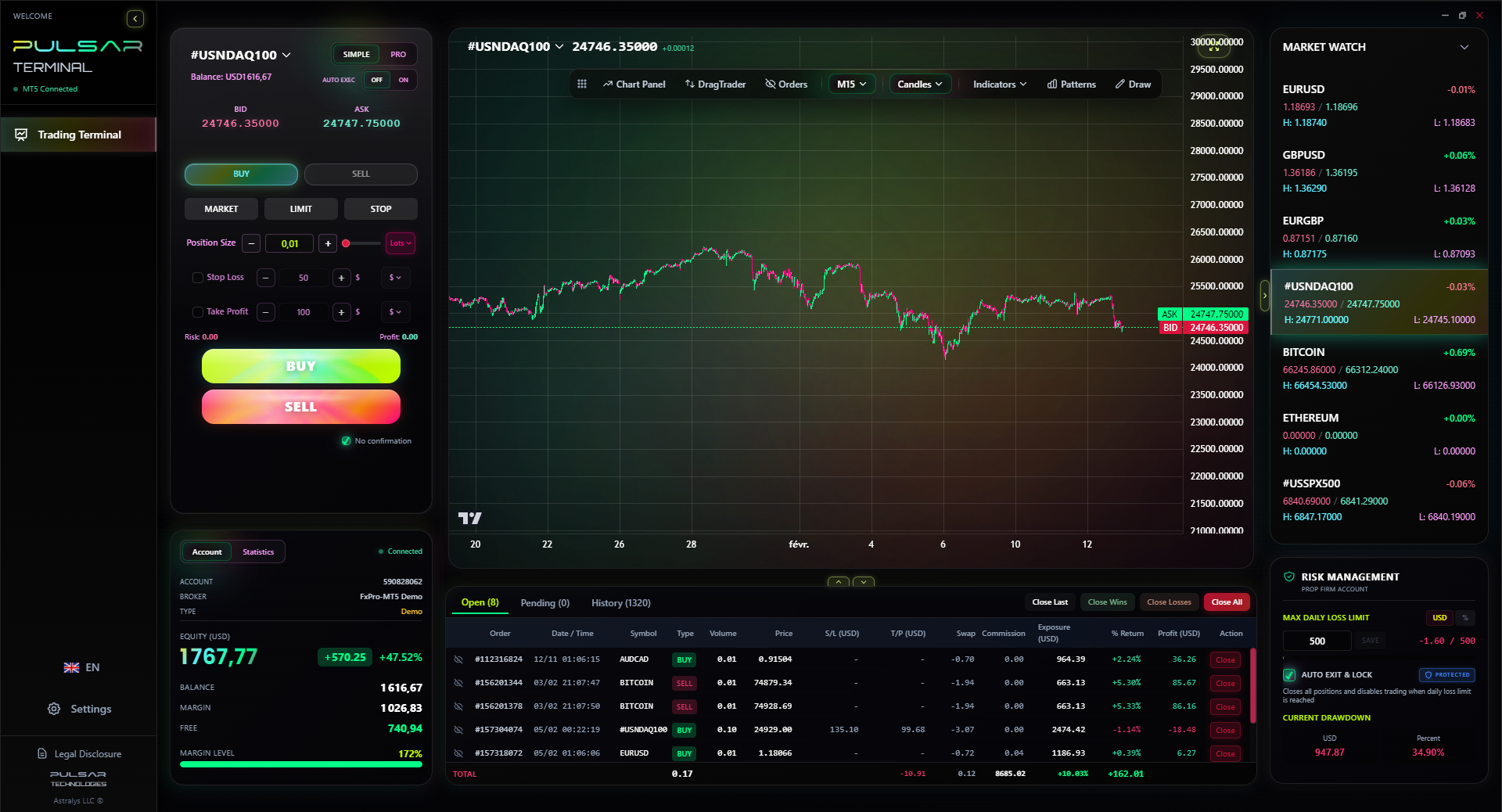
Managing multiple pending orders, stop-losses, and take-profits manually on MT5 is a headache; Pulsar Terminal lets you drag-and-drop them all visually and set partial closures with a single click.
Pulsar Terminal
Alat MT5 all-in-one: order drag-and-drop, multi-TP/SL, trailing stop, grid trading, Volume Profile, dan perlindungan prop firm. Digunakan 1.000+ trader setiap hari.
“Using more than 1:30 use for a beginner is asking for trouble. Your goal is survival, not a Lamborghini in week one.”
This is the most dangerous part of forex trading terminology. Nigerians love high use because it makes small capital seem powerful. It is. Like a powerful curse.
Margin: This is not your profit. It's a good-faith deposit you put up with your broker to open and hold a position. Think of it as collateral.
use: Expressed as a ratio (like 1:100, 1:500). It's the broker lending you money to control a larger position. With 1:100 use, you can control $10,000 with just $100 of your own money (your margin).
Here’s the trap: use amplifies everything.
| Your Capital | use | Position You Control | 10 Pip Loss |
|---|---|---|---|
| ₦50,000 | 1:10 | ₦500,000 | ₦5,000 |
| ₦50,000 | 1:100 | ₦5,000,000 | ₦50,000 |
See that? At 1:100, a small 10-pip move against you wipes your entire capital. That 10-pip move happens in seconds.
Margin Call: This is the phone call you never want to get. It happens when your losses eat up most of your margin, and your broker warns you to add more funds or they'll start closing your positions.
Stop Out Level: This is the sequel. If you ignore the margin call and losses continue, your broker will automatically close your positions (starting with the biggest loser) to prevent your account balance from going negative. It's the sound of your trading dream hitting the floor. I learned about margin calls the hard way in 2015, turning $2,000 into $300 in one afternoon on a overly-leveraged gold trade. The market doesn't care about your plans.

Warning: Nigerian brokers often offer insane use like 1:1000. It's a marketing trick. Using more than 1:30 for a beginner is asking for trouble. Your goal is survival, not a Lamborghini in week one.
💡 Tips Winston
The market doesn't know your margin level. It will take every penny you've made available to it. Your use is your choice of weapon; choose one you can control when things get chaotic.
These are the languages of your trading strategy. You need to pick one and learn its grammar.
Technical Analysis: Studying price charts and patterns to predict future moves. Key terms here:
- Support & Resistance: Price levels where the market repeatedly pauses or reverses. Support is a 'floor', Resistance is a 'ceiling'.
- Trend: The general direction. Uptrend (higher highs, higher lows), Downtrend (lower highs, lower lows), Range (bouncing between support and resistance).
- Indicators: Math formulas applied to price. The RSI indicator measures overbought/oversold. The MACD indicator shows trend momentum. They are lagging - they tell you what has happened, not what will.
Fundamental Analysis: Looking at economic factors - interest rates, inflation (huge in Nigeria!), GDP, employment data. When the US Federal Reserve hikes rates, the USD usually strengthens. When CBN makes a policy announcement, it can shake the Naira pairs.
Market Sentiment: The overall 'mood' of traders. Are most people bullish or bearish on the Pound? You can see this in Commitment of Traders (COT) reports or just by feeling the chatter in trading groups. Sometimes, the market is irrational longer than you can stay solvent.
Most Nigerian retail traders start with technical analysis because the charts are the same for everyone, everywhere. But ignoring fundamentals is like driving with your eyes closed. A major news event will smash through your pretty chart patterns.
“All the terminology in the world is useless without discipline. A plan is just a piece of paper unless you have the guts to execute it when you're scared.”
This is where they get you. The hidden costs. You think you're just trading the market, but you're also paying your broker.
Spread: We mentioned it. The difference between bid and ask. It's how many brokers make money. A 'tight' spread (like 0.8 pips on EUR/USD) is good. A 'wide' spread (3+ pips) is a rip-off, especially for a scalping strategy. Always check average spreads before funding an account.
Commission: Some brokers charge a direct fee per lot traded, on top of a tiny spread. This can actually be cheaper for high-volume traders.
Swap Rate (Overnight Financing): The cost of holding a position past the daily rollover time (usually 10 PM GMT). You either pay or earn a small interest amount based on the interest rate differential between the two currencies. If you're swing trading and holding for days, this adds up. A negative swap on a long-term trade can slowly bleed your account.
CFD: 'Contract for Difference'. This is what you're actually trading with most brokers. You don't own the currency; you have a contract to exchange the difference in price from when you opened to when you close. This is why use is possible.
When reviewing brokers like Exness or XM for Nigeria, don't just look at the welcome bonus. Dig into their typical spreads on the pairs you'll trade, their swap rates, and their deposit/withdrawal policies for Naira. A cheap deposit that takes 5 days to process isn't cheap.
💡 Tips Winston
All the technical terms for patterns and indicators are just descriptions of past behavior. Your job is to gauge the probability they'll repeat. Never confuse a named pattern with a guaranteed outcome.
Finally, the informal lingo. This is how traders really talk.
Long/Short: 'Going long' means buying (expecting price to rise). 'Going short' means selling (expecting price to fall). In forex, you can short as easily as you can long.
Bull/Bear: A 'bull' is optimistic (prices rising). A 'bear' is pessimistic (prices falling). A 'bull market' is a sustained uptrend.
Stop Hunting: The belief that big players (banks) push price to trigger clusters of retail stop-loss orders before moving in the intended direction. It feels personal, but it's just liquidity.
Bag Holder: Someone holding onto a losing trade for too long, hoping it will come back. Don't be one.
FOMO: Fear Of Missing Out. Jumping into a trade that's already run far because you're scared of not making money. This is a guaranteed way to buy the top.
Risk-On/Risk-Off: Overall market moods. 'Risk-on' means traders are confident, buying stocks, commodities, and riskier currencies. 'Risk-off' means they're scared, fleeing to safe havens like the US Dollar and Gold (XAU/USD).
The most important term isn't on any list: Discipline. It means following your plan, using your stop-loss, and not letting a winning trade turn into a loser. All the terminology in the world is useless without it. I had to blow up half an account years ago to truly learn that a plan is just a piece of paper unless you have the discipline to execute it, especially when you're scared.
FAQ
Q1What is the most important forex term for a beginner in Nigeria to understand?
Stop-Loss (SL). Full stop. Before you even think about profit, you must know how to define and accept your loss. The Nigerian market can be volatile, and without an SL, a single bad trade with high use can wipe you out. It's not a suggestion; it's a survival tool.
Q2Is high use (like 1:500) good for a Nigerian trader with small capital?
It's a trap. It looks good because you can open bigger positions, but it massively increases your risk. A 10-pip move against you with 1:500 use can take out a huge chunk of your account. Start with low use (1:10 or 1:20) to learn how to manage trades and risk properly. Preserve your capital first.
Q3What does 'spread' mean and why does it matter to my profit?
The spread is the difference between the buy (ask) and sell (bid) price. It's your immediate transaction cost. If the EUR/USD spread is 2 pips, the pair needs to move 2 pips in your favor just for you to break even. For strategies like scalping that target small gains, a wide spread can make you unprofitable. Always check a broker's average spreads.
Q4What is a 'pip' and how much is it worth in Naira?
A pip is the smallest standard price move, usually 0.0001 for pairs like EUR/USD. Its value in Naira depends on your trade size and the current USD/NGN rate. For a standard lot (100,000 units), 1 pip is roughly $10. If $1 is ₦1,500, then 1 pip is about ₦15,000. This is why using a position size calculator is non-negotiable to understand your risk in your local currency.
Q5What's the difference between a market order and a pending order?
A market order executes immediately at the current price. A pending order (like a Limit or Stop order) is set at a future price and only triggers if the market reaches that price. Use market orders for immediate entry. Use pending orders to plan your trades in advance, like entering on a pullback or a breakout, without staring at the screen all day.
Q6What is a 'swap rate' and should I worry about it?
A swap rate is the interest paid or earned for holding a position overnight. If you're a day trader and close all positions before 10 PM GMT, you can ignore it. If you're a swing trader holding trades for days or weeks, you need to check it. A consistently negative swap can significantly eat into your profits over time. Your broker's platform will show the swap rate for each pair.
Pelajaran Prof. Winston
Poin Penting:
- ✓A Stop-Loss is non-negotiable. It's not a suggestion.
- ✓use above 1:30 is a risk accelerator, not a profit tool.
- ✓The spread is your first cost. Know it before you trade.
- ✓Pip value changes with lot size. Always calculate it.
Seberapa bermanfaat artikel ini?
Klik bintang untuk menilai
Wawasan Trading Mingguan
Analisis & strategi mingguan gratis. Tanpa spam.
Tentang Penulis
Olumide Adeyemi
Pelopor Trading Afrika Barat
Salah satu edukator trading forex paling aktif di Nigeria. 8 tahun pengalaman trading dari Lagos. Spesialis strategi modal rendah dan tantangan prop firm untuk trader Afrika.
Komentar
Peringatan Risiko
Perdagangan instrumen keuangan mengandung risiko signifikan dan mungkin tidak cocok untuk semua investor. Kinerja masa lalu tidak menjamin hasil di masa depan. Konten ini hanya untuk tujuan edukasi dan tidak boleh dianggap sebagai nasihat investasi. Selalu lakukan riset Anda sendiri sebelum trading.
Anda mungkin juga suka

Cara Trading Forex Sukses: 7 Prinsip dari Trader Profesional
Cara trading forex sukses dengan 7 prinsip trader pro: manajemen modal, disiplin, journal trading, backtest. Data nyata, bukan janji profit palsu.
Jam Trading Forex Terbaik untuk Trader Indonesia: Panduan Lengkap dengan Tabel Waktu
Panduan jam trading forex untuk trader Indonesia. Tabel 4 sesi dunia, jam emas 20:00-00:00, sesi mana yang harus dihindari. Data akurat + tips dari trader berpengalaman.
Top 5 Sàn Forex Uy Tín Nhất 2026: Review Jujur dari Trader Indonesia
Top 5 sàn forex uy tín 2026 untuk trader Indonesia. Review jujur: spread, deposit, withdraw, dukungan lokal. Exness, XM, IC Markets & lebih.
Dapatkan Pulsar Terminal
Semua kalkulator ini terintegrasi dalam Pulsar Terminal dengan data real-time dari akun MT5 Anda.
Dapatkan Pulsar Terminal