


I remember staring at my screen in my Lagos apartment in late 2022, watching the GBP/USD chart.

Olumide Adeyemi
Pelopor Trading Afrika Barat ·  Nigeria
☕ 8 mnt baca
Yang akan Anda pelajari:
I remember staring at my screen in my Lagos apartment in late 2022, watching the GBP/USD chart. The UK's mini-budget had just been announced, and the pound was in freefall. I was up nearly 300 pips on a short position. The excitement was real, but so was the nagging thought: 'Am I even allowed to be doing this with a broker that says it's regulated in Cyprus?' That moment crystallized the whole 'forex trading USA' confusion for me. We see the term everywhere, but for us in Nigeria, it rarely means trading with an actual American broker. It's a mindset, a standard, and a set of practices we need to understand.
Let's clear this up right away. When you see ads screaming 'forex trading USA,' they're usually not talking about opening an account with a broker like Charles Schwab. US regulators (the CFTC and NFA) have rules that make it incredibly difficult, if not impossible, for brokers to accept clients from Nigeria directly. Their use caps are super low (like 50:1 for majors), and the paperwork is a mountain.
So, what are they selling? They're selling an idea. The idea of the tight regulation, transparency, and market access that the US financial system represents. For us, 'forex trading USA' becomes a benchmark. We should be looking for brokers that, while not US-based, emulate those high standards of safety. We're talking about firms regulated by top-tier authorities like the UK's FCA, Australia's ASIC, or Cyprus's CySEC (though CySEC is a notch below, honestly).
I learned this the hard way early on. I funded an account with a flashy 'offshore' broker promising 1000:1 use. The spreads were great until news hit, then they widened to 15 pips on EUR/USD. My stop loss got slipped, and I lost more than I planned. That's when I started paying real attention to who was behind the brand. Now, I'd rather take a slightly higher spread with a broker from our IC Markets review that's properly regulated than get a 'too-good-to-be-true' deal from a no-name island.

Warning: If a broker actively markets 'USA trading accounts' to Nigerian residents, be very skeptical. They are likely misrepresenting their services or operating a questionable setup.
The goal isn't to find a US broker. It's to find a broker that makes you feel as secure as if you were trading with one.

💡 Tips Winston
The 'USA' in forex marketing is often a glittering lure. Your real safety net is the regulator's name on your broker's website, not the flag in their ad.
Back home, the scene is governed by the Securities and Exchange Commission (SEC) of Nigeria and the Central Bank of Nigeria (CBN). The SEC is the main watchdog for capital market activities, including forex trading by individuals through brokers.
The Legal Bottom Line
Forex trading is legal for individuals in Nigeria. Full stop. You won't get into trouble for buying EUR/USD. However, the CBN strictly controls the flow of Naira for forex transactions to protect the currency's value. This is why you can't just wire Naira from your Nigerian bank account to an international broker. You'll hit a wall.
This leads to the biggest practical hurdle: funding. Most of us rely on international debit/credit cards (like Visa/Mastercard) or cryptocurrencies to deposit. Cards often have limits and can be declined. Crypto has become a popular workaround, but you've got to factor in transfer fees and volatility on the crypto itself before it even hits your trading account.

Pro Tip: Always check your broker's specific deposit methods for Nigeria. Some, like Exness, have localized payment options that can be smoother. Our Exness review details their deposit process for Nigerian clients.
Another reality is the Naira pairs. Trading USD/NGN on the international market is different from the official CBN rate. The price reflects offshore demand and can be volatile. I once tried scalping USD/NGN during a period of political uncertainty. The spreads were massive, and liquidity was thin. I made a few small wins but got stopped out on a wild 50-pip spike in seconds. It's a different beast compared to EUR/USD.
“Your worth as a trader isn't your daily profit; it's the consistency of your process.”
Your broker is your gateway. Picking the wrong one is like trying to drive from Lagos to Abuja with a faulty engine. Here’s what matters most for us:
| Priority | Why It Matters for Nigerian Traders | What to Look For |
|---|---|---|
| Regulation | Safety of your funds. Your main protection against fraud. | FCA, ASIC, CySEC, FSCA. Avoid unregulated 'offshore' entities. |
| Deposit/Withdrawal | The make-or-break practical issue. | Multiple options: Crypto, card, local bank transfers (if offered). Fast, reliable withdrawal process. |
| use | Capital efficiency. We often start with smaller accounts. | Flexible options. 500:1 is common, but manage it wisely. Don't max it out! |
| Spreads & Commissions | Directly impacts profitability, especially for frequent trading. | Low, stable spreads on majors. Check for hidden fees. |
| Customer Support | When you have a funding issue at 10 PM, you need help. | 24/7 support, live chat, local phone number or responsive email. |
I split my capital between two brokers for diversification. One is a well-known ASIC-regulated broker I use for my main swing trading ideas. The other, like XM, often has promotions and better support for local payment quirks. You can see how they stack up in our XM review.
Never, ever skip the demo account. Test their platform execution speed, see how their spreads behave during London open, and try a dummy withdrawal. It's the best free research you can do.
💡 Tips Winston
In Nigeria, your first trade isn't on EUR/USD. It's successfully depositing and withdrawing from your broker. Test that cycle with a small amount before any real trading.
The market doesn't care if you're in Ikoyi or Indiana. Price action is universal. But our context - like internet reliability and available time - shapes how we apply strategies.
Focus on the Major Sessions: Align your trading with the London and New York overlaps (2 PM - 5 PM Nigerian time). That's when liquidity is highest and spreads are tightest. Trying to trade the Tokyo session from Nigeria at 4 AM? Unless you're a night owl, it's not sustainable.
Keep It Simple: I wasted months overcomplicating charts with 15 indicators. Now, my core setup is price action, a moving average for trend, and the RSI indicator for momentum extremes. For example, on a strong uptrend in Gold (XAU/USD), I'll wait for a pullback to a key level and look for RSI to dip near 40 before considering a long. You can get deeper into gold specifics in our XAU/USD guide.
Risk Management is Non-Negotiable: This is the 'USA standard' we must adopt. Use a position size calculator for every single trade. My rule: never risk more than 1% of my account on a trade. In 2021, I broke this rule. I was confident on a EUR/USD breakout and risked 5%. A false breakout happened, and I lost a chunk of my monthly target in one go. It took two weeks of disciplined 1% trades to dig out of that hole. A margin call is a phone call you never want to get.

Example: You have a $1,000 account. 1% risk = $10. You're buying EUR/USD at 1.0850 with a stop loss at 1.0820 (30 pips risk). How much can you buy? $10 / (30 pips * $1 per pip on a micro lot) = 0.33 lots. So, you'd buy 3 micro lots (0.03 standard lots).
“The market doesn't care if you're in Ikoyi or Indiana. Price action is universal, but your context shapes your strategy.”
Trading can be lonely. You're in your room, facing the charts. The psychological pressure is immense, and in Nigeria, you might face extra noise from family who see trading as 'gambling.'
Journal Everything: Not just 'bought EUR/USD.' Write down your reasoning, your emotional state ('felt FOMO after missing the first move'), and the outcome. Review it weekly. I found I lost most on Monday mornings trying to force a trade after a quiet weekend.
Find a Real Community: Avoid Telegram groups promising '100% signals.' Look for communities focused on education and review. Discussing a MACD indicator divergence with another trader is useful; blindly copying a signal is not.
Separate Ego from P&L: Your worth isn't your daily profit. I used to hide losing trades from my own journal. Once I started owning them publicly in my trader's circle, I started learning from them. A losing trade with a good plan is better than a winning trade with no plan.
💡 Tips Winston
Your most powerful indicator isn't on the chart. It's your trading journal. A pattern of losses before lunch tells you more than any RSI reading ever could.
We all make mistakes. Here are the big ones I see (and have made):
- Chasing 'USA' Brokers That Don't Want You: Spending hours trying to open an account with a US-regulated firm is a dead end. Focus your energy on vetting the international brokers that welcome Nigerian clients.
- Ignoring the True Cost of a Pip: Understand how your broker calculates profit and loss. A pip definition is basic, but know the dollar value for your lot size. It focuses the mind.
- Underestimating the Spread: That's your immediate cost. A 3-pip spread vs. a 0.8-pip spread makes a huge difference in scalping. Always check the live spread before clicking buy.
- Trading Without a Stop Loss: This is suicide. The market can gap against you overnight. Always have a stop. No debate.
- Confusing a Prop Firm's Rules with a Real Broker: Many prop firms have 'USA' in their name but are not brokers. They have specific challenge rules (like max daily loss). Using a standard broker platform like MT5 with a prop firm account requires extra discipline, which tools can help automate.
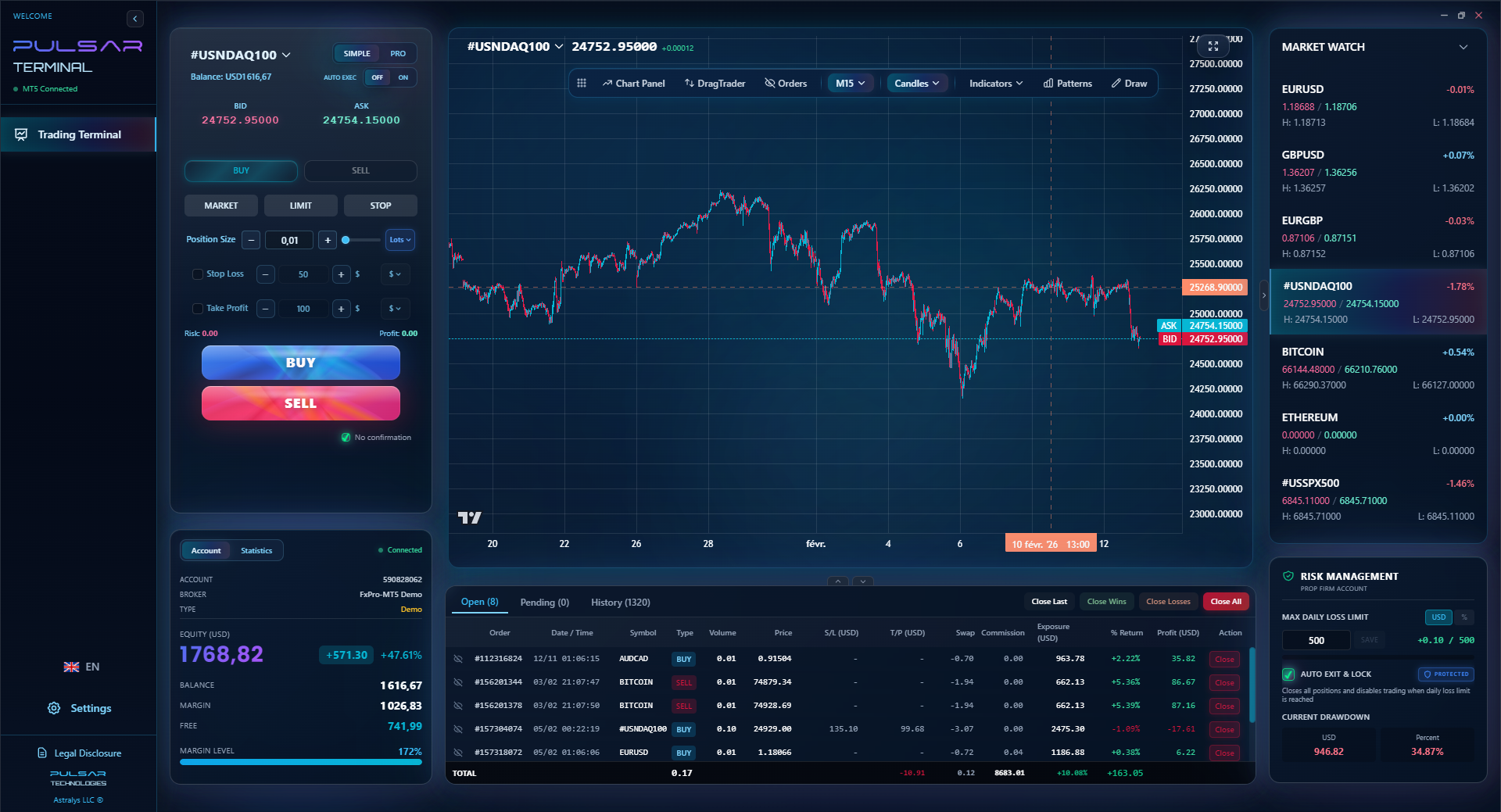
Managing prop firm challenge rules and complex order types manually is stressful; Pulsar Terminal automates daily loss limits, trailing stops, and multi-TP orders directly on your MT5.
Pulsar Terminal
Alat MT5 all-in-one: order drag-and-drop, multi-TP/SL, trailing stop, grid trading, Volume Profile, dan perlindungan prop firm. Digunakan 1.000+ trader setiap hari.
FAQ
Q1Can I legally trade forex in Nigeria?
Yes, absolutely. Forex trading by individuals is legal and regulated by the Securities and Exchange Commission (SEC) of Nigeria. The challenge isn't legality; it's finding practical ways to fund your international trading account due to Central Bank of Nigeria (CBN) restrictions on forex outflow.
Q2Why can't I use a US-regulated broker like a US citizen can?
US regulators (CFTC/NFA) impose strict rules to protect US consumers, including limits on use and stringent client onboarding. These rules make it commercially unviable for those brokers to service clients from countries like Nigeria. They typically restrict their services to US residents only.
Q3What is the best way to fund my forex account from Nigeria?
The most common methods are international debit/credit cards (Visa/Mastercard) and cryptocurrency transfers (like USDT). Cards can be unreliable. Crypto has become the go-to for many due to its speed, though you must account for network fees. Some brokers offer localized bank transfer options.
Q4Is trading USD/NGN the same as trading other pairs?
Not really. The USD/NGN you can trade with an international broker reflects an offshore 'black market' rate, not the official CBN rate. It can be highly volatile with wide spreads, especially during local economic news or political events. It requires specific knowledge.
Q5How much money do I need to start forex trading?
You can start with a very small amount, even $50 or less, thanks to micro and cent accounts. However, to trade comfortably and apply proper risk management (e.g., not being forced to use extreme use), a starting capital of $200-$500 is more realistic for a beginner.
Q6What's the most important thing for a Nigerian beginner to learn first?
Risk management. Before you learn how to make money, learn how not to lose it all. This means understanding position sizing, always using a stop loss, and never risking more than 1-2% of your account on a single trade. It's boring but it's what keeps you in the game.
Pelajaran Prof. Winston
Poin Penting:
- ✓US brokers are off-limits; seek FCA/ASIC regulation instead.
- ✓Test deposit/withdrawal cycles before trading with real money.
- ✓Never risk more than 1% of your capital per trade.
- ✓Trade the London/New York overlap for best liquidity.
- ✓A losing trade with a plan beats a winning trade with none.
Seberapa bermanfaat artikel ini?
Klik bintang untuk menilai
Wawasan Trading Mingguan
Analisis & strategi mingguan gratis. Tanpa spam.
Tentang Penulis
Olumide Adeyemi
Pelopor Trading Afrika Barat
Salah satu edukator trading forex paling aktif di Nigeria. 8 tahun pengalaman trading dari Lagos. Spesialis strategi modal rendah dan tantangan prop firm untuk trader Afrika.
Komentar
Peringatan Risiko
Perdagangan instrumen keuangan mengandung risiko signifikan dan mungkin tidak cocok untuk semua investor. Kinerja masa lalu tidak menjamin hasil di masa depan. Konten ini hanya untuk tujuan edukasi dan tidak boleh dianggap sebagai nasihat investasi. Selalu lakukan riset Anda sendiri sebelum trading.
Anda mungkin juga suka

Cara Trading Forex Sukses: 7 Prinsip dari Trader Profesional
Cara trading forex sukses dengan 7 prinsip trader pro: manajemen modal, disiplin, journal trading, backtest. Data nyata, bukan janji profit palsu.
Jam Trading Forex Terbaik untuk Trader Indonesia: Panduan Lengkap dengan Tabel Waktu
Panduan jam trading forex untuk trader Indonesia. Tabel 4 sesi dunia, jam emas 20:00-00:00, sesi mana yang harus dihindari. Data akurat + tips dari trader berpengalaman.
Top 5 Sàn Forex Uy Tín Nhất 2026: Review Jujur dari Trader Indonesia
Top 5 sàn forex uy tín 2026 untuk trader Indonesia. Review jujur: spread, deposit, withdraw, dukungan lokal. Exness, XM, IC Markets & lebih.
Dapatkan Pulsar Terminal
Semua kalkulator ini terintegrasi dalam Pulsar Terminal dengan data real-time dari akun MT5 Anda.
Dapatkan Pulsar Terminal