


Let's cut the rubbish.

David van der Merwe
Trader Pasar Berkembang ·  South Africa
☕ 11 mnt baca
Yang akan Anda pelajari:
Let's cut the rubbish. Most South Africans trading the USD are just funding their broker's next yacht party. They chase 500:1 use from dodgy offshore bucketshops, ignore SARS until it's too late, and treat USD/ZAR like a slot machine. I've seen it for over a decade. But here's the controversial bit: trading the USD from South Africa is one of the best opportunities you have, precisely because the local market is so messed up. If you can navigate the FSCA's 30:1 leash, handle the Rand's volatility, and keep SARS happy, you're playing a game most locals have already lost. I'll prove it by showing you the exact numbers, the real brokers, and the painful mistakes I made so you don't have to.
Trading forex is legal here, but the regulatory framework is a double-edged sword. It protects you from outright fraud while also limiting your potential gains. You need to understand both sides.
The FSCA's 30:1 Reality Check
Since 2021, the FSCA has capped use at 30:1 for retail traders. This isn't a suggestion; it's the law for any broker operating under their license. That means for every R1,000 in your account, you can control a position worth R30,000. Compare that to the "unlimited" use some offshore brokers advertise, and it feels restrictive. It is. But after blowing up an account using 1:500 use on EUR/JPY back in 2015 (a R25,000 lesson in humility), I can tell you this cap is probably saving more accounts than it's hindering. It forces proper position size calculator use. The brokers offering higher use? They're usually operating under a different jurisdiction's license. Your money might be safe, but your recourse if something goes wrong is a legal headache overseas.
SARS Wants Its Share
This is where I see most traders get blindsided. Profits from forex trading are taxable income. Full stop. It's not a hobby if you're doing it regularly. SARS considers it speculative income, taxed at your marginal income tax rate. The kicker? They tax you on your worldwide income. So even if you're trading with an international broker like IC Markets or Exness, those profits need to be declared. I keep a simple spreadsheet: date, pair, profit/loss in USD, and the ZAR conversion rate on the day I closed the trade. My accountant loves me for it. Come tax season, you need a clear P&L statement. If you can't produce one, you're not a trader; you're a gambler waiting for an audit.

Warning: The SARB's exchange control rules mean you can't legally speculate directly against the Rand with a South African broker. You trade USD pairs, not ZAR pairs, for speculation. Large withdrawals back to SA (over R1 million) also need paperwork. Get your TCS PIN from SARS sorted early.

💡 Tips Winston
Your first R10,000 in profits isn't yours. It's SARS's. Set it aside immediately in a separate account and forget about it.
Forget the "from 0.0 pips" ads. Let's talk about what you'll actually pay. The all-in cost is what murders your profits.
Spreads & Commissions: Yes, some brokers like IC Markets offer raw spreads from 0.0 pips on EUR/USD. But that's on a Raw or Pro account that charges a commission. A typical structure is $3.50 per lot, per side. So a round turn (open and close) costs you $7. On a 1-lot trade, that's 0.7 pips gone before you even start. A "spread-only" account might show 0.8 pips, with no commission. Which is cheaper? It depends on your trade size. You have to do the math.
The ZAR Conversion Trap: If you fund a USD account with Rands, your bank will nail you on the forex conversion spread, often 1-2%. That's an instant loss. Some local brokers like Khwezi Trade offer ZAR-denominated accounts, which solves this. With international brokers, consider using a digital wallet if possible, but always check the final landing amount in your trading account.
Overnight Financing (Swap): Holding a position past 10 PM GMT? You pay or receive swap. This is based on the interest rate differential between the two currencies. Right now, with high US rates, if you're long USD against a low-yielding currency, you might earn a tiny bit. If you're short USD, you pay. It adds up fast for swing trading positions. I once held a GBP/USD short for three weeks and paid over $120 in swap on a 2-lot position. It turned a winning trade into a breakeven mess.

Example: Trading 1 standard lot EUR/USD.
- Raw Account: Spread = 0.1 pips, Commission = $7. Total cost = $7 + (0.1 pip * $10) = $8.
- Standard Account: Spread = 0.8 pips, Commission = $0. Total cost = 0.8 pips * $10 = $8. Same cost, different structure. The difference comes in slippage during news events, which is often worse on commission-free accounts.
“Your edge as a South African isn't trading the Rand. It's using your time zone.”
The choice isn't just about tight spreads. It's about survival.
FSCA-Regulated (The Safe Play): Your money is segregated, you have local recourse, and use is capped at 30:1. Brokers like Tickmill (FSCA licensed), AvaTrade, and FP Markets fall here. Khwezi Trade is a solid local option if you want everything in Rands. The peace of mind is worth the lower use. For most new traders, this is the only category they should consider.
International with Local Presence (The Middle Ground): Brokers like IC Markets, XM, and Pepperstone have global reputations and often offer South African traders accounts under their international entities (e.g., in Seychelles or Cyprus). This is where you might find use up to 500:1. The execution and pricing are often top-tier. But understand: you're not protected by FSCA rules if your account is with their offshore entity. You're relying on that foreign regulator. Do your homework.
The Bucketshop (The Path to Ruin): Any outfit offering "guaranteed profits," bonuses that are too good to be true, or pressure to deposit more. They're often unregulated. Your deposit is their profit. Avoid.
My personal setup? I use an FSCA-regulated broker for my core, long-term capital (where 30:1 is fine), and a single, well-respected international broker for specific scalping strategy where I want the absolute lowest latency and will use slightly higher use (never more than 100:1). I keep detailed records for both for SARS.
💡 Tips Winston
If you can't explain your trade setup in one sentence before you enter, you don't have a strategy. You have a hope.
Your instinct is to trade USD/ZAR. It's familiar. Resist it. As a South African, it's one of the most dangerous pairs you can trade.
Why USD/ZAR is a Trap: You have a natural bias. You hear the news about load-shedding, politics, and the Rand weakening. That emotional connection clouds your judgment. The pair is also notoriously volatile and prone to gaps. The spread is usually much wider (think 50-100 pips vs. 0.8 on EUR/USD). That's a huge hurdle. I lost R8,000 in 30 seconds on a USD/ZAR trade when a SARB announcement caused a 400-pip gap against me. Never again.
The Real Opportunity: Majors & Crosses: Focus on the liquid majors where the USD is one half: EUR/USD, GBP/USD, USD/JPY, USD/CHF. The spreads are tight, liquidity is massive, and your emotional attachment is zero. You can apply pure technical or fundamental analysis. For example, trading a EUR/USD guide breakout during the London session is a cleaner, more predictable setup than guessing what a politician will say about the Rand.
Using Gold as a USD Proxy: XAU/USD (Gold vs. USD) is a fantastic market for South Africans. It often moves inversely to the USD's strength and provides excellent trends. The volatility is high but more structured than exotic currency pairs. It's become a staple in my portfolio.
Your edge as a South African isn't trading the Rand. It's using your time zone. You're awake for the tail end of Asia, all of London, and the open of New York. That's the most active period of the day. Use it to trade the world's most liquid pairs, not the most emotionally charged one.
“With 30:1 use, a 3% move against you is a 90% loss. You cannot wing this.”
Forget complex indicators. Here’s a simple, time-zone-aware framework I've used successfully.
The London Breakout Fade
This works because of our location. The London session (10 AM - 7 PM SAST) is the most liquid. Often, a big move happens in the first few hours.
- Identify the Range: From 7 AM to 10 AM SAST (Asian session), note the high and low on the 1-hour chart for EUR/USD or GBP/USD.
- Wait for the Break: As London momentum picks up, price will often sharply break above or below this Asian range.
- Fade the Break: If the break lacks follow-through (you see a 15-minute candle close back inside the range), enter a trade in the opposite direction of the break. Your stop loss goes just beyond the extreme of the false breakout.
- Target: Aim for a move back to the midpoint or opposite edge of the Asian range.
Why it works: The initial burst is often stop-hunting or over-eager momentum. The real institutional flow might be waiting for a better price. I use the RSI indicator on the 15-minute chart to check for divergence at the breakout point for extra confirmation.
Risk Management is Non-Negotiable
With 30:1 use, a 3% move against you is a 90% loss. You cannot wing this.
- Never risk more than 1% of your account on a single trade. Use a position size calculator every time.
- Your stop loss is sacred. Placing it and forgetting it isn't enough. A tool that can automate a trailing stop or move to breakeven is a lifesaver. It removes emotion.
- Know your margin call level. If you're using 30:1, you have almost no room for error. Keep your margin usage below 15-20%.

Pro Tip: Our evenings (7 PM onwards SAST) overlap with the US afternoon. Liquidity dies. Avoid entering new trades after 7 PM. The spreads widen, and the moves get choppy. It's a great time to review your journal, not to trade.
💡 Tips Winston
The most important candle on your chart is the one that hits your stop loss. Study it more than your winners.
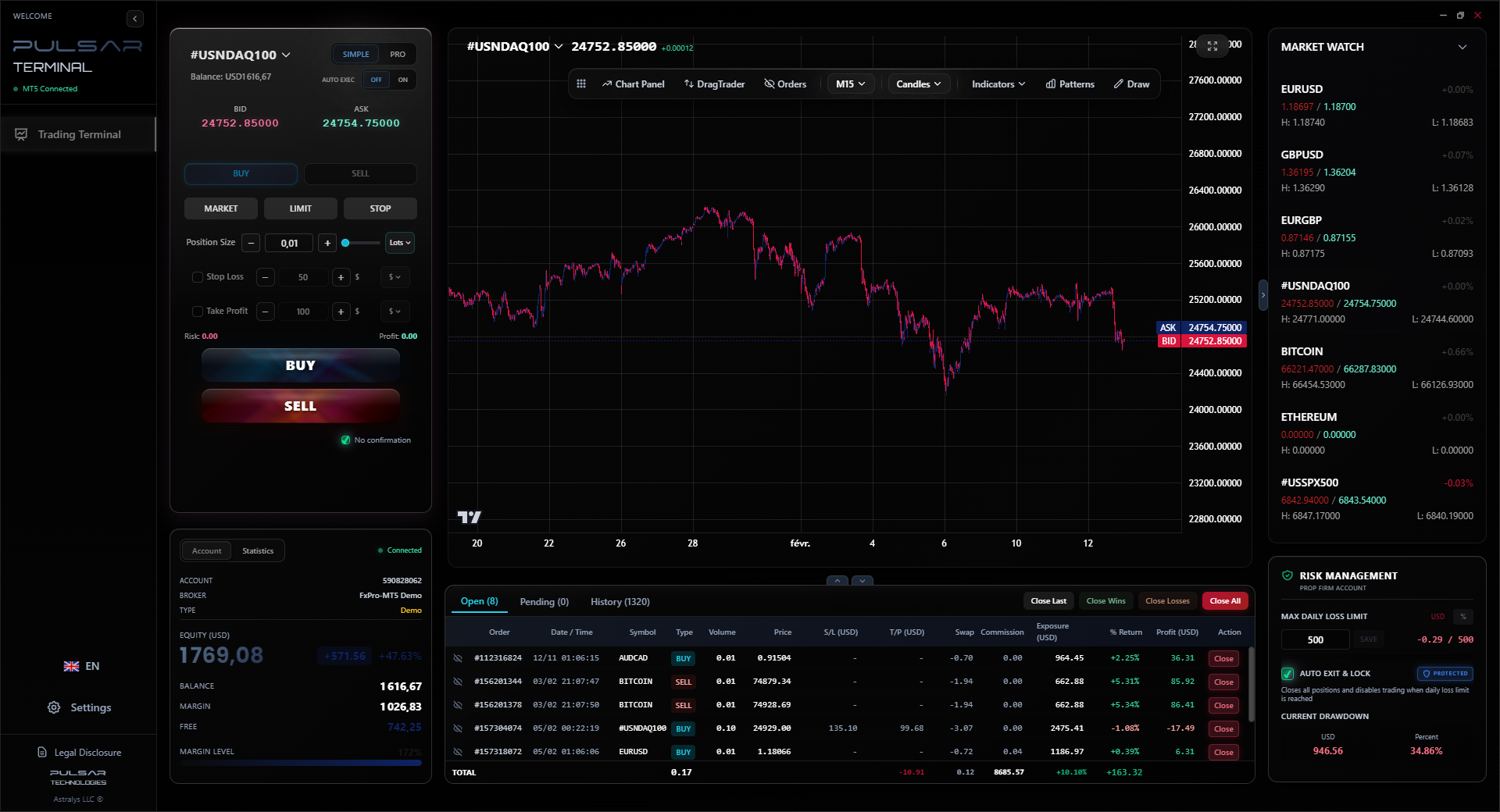
Managing multiple trades and moving stops to breakeven manually is a hassle; Pulsar Terminal automates trailing stops and partial closures directly on your MT5 charts.
Pulsar Terminal
Alat MT5 all-in-one: order drag-and-drop, multi-TP/SL, trailing stop, grid trading, Volume Profile, dan perlindungan prop firm. Digunakan 1.000+ trader setiap hari.
This is boring. It's also the difference between keeping your profits and giving them all back.
Record Everything: You need a log for every trade: Entry price, exit price, date/time, profit/loss in the trade's currency, and the ZAR/USD exchange rate on the day you closed. Your broker's statement is not enough for SARS. They want to see your calculation of ZAR profits.
Expenses are Deductible: Your data costs, trading platform fees, educational courses (if relevant), and even a portion of your home office can be deductible. Keep those receipts. My first year trading, I didn't claim a cent in expenses. My accountant nearly cried.
Provisional Tax: If you're making consistent profits, you'll likely need to pay provisional tax twice a year. Don't get hit with penalties. Set aside at least 30% of your net profits in a separate savings account immediately. Treat it as money that's already gone to SARS.
The recent SARB tightening (late 2025) means getting money back into SA from international brokers requires proof of tax compliance. Have your SARS TCS-AIT PIN ready before you even think about a large withdrawal. The bureaucracy is real, but it's manageable if you're organized from day one.
“The goal isn't to avoid mistakes; it's to make cheaper ones.”
Forex trading USD from South Africa isn't easy. You're competing with global banks, armed with 30:1 use and a volatile local currency. But you have an edge if you choose to use it.
Your edge is discipline. The FSCA's use cap forces it. Your edge is timezone. You're perfectly placed for the London/New York overlap. Your edge is clarity. By avoiding the emotional USD/ZAR trap and focusing on clean majors like EUR/USD, you see the market more clearly.
Start small. Use an FSCA-regulated broker. Master a single strategy on a demo account, then a live account with R5,000. Journal every trade, win or lose. Get your tax spreadsheet set up before your first profitable month.
I've made every mistake in the book - overtrading, revenge trading, ignoring swaps, forgetting about tax. The goal isn't to avoid mistakes; it's to make cheaper ones. Learn from mine. Trade the USD, but trade it like a professional, not like another hopeful punter from Pretoria. The market doesn't care where you're from. It only cares if you're right, and if you've managed your risk well enough to survive when you're wrong.
FAQ
Q1Is forex trading legal in South Africa?
Yes, it's completely legal, but it must be done through a broker regulated by the Financial Sector Conduct Authority (FSCA). Trading with unregulated offshore brokers is legal from a user perspective but offers you no local protection if things go wrong.
Q2What is the maximum use I can get in South Africa?
For retail traders, the FSCA mandates a maximum use of 30:1. Some international brokers may offer higher use (like 100:1 or 500:1) if you open an account under their offshore entity, but you then forfeit FSCA protection. Higher use significantly increases your risk of a margin call.
Q3How are my forex trading profits taxed by SARS?
Profits are considered taxable income and are added to your other income, taxed at your marginal tax rate. You must declare worldwide profits. You can deduct certain trading-related expenses. careful record-keeping of every trade's profit/loss in ZAR is non-negotiable.
Q4Should I trade USD/ZAR as a South African?
Generally, no. It's emotionally charged, has wide spreads, and is prone to sharp gaps due to local news. Your emotional bias will hurt you. You'll find cleaner, cheaper opportunities in major pairs like EUR/USD or GBP/USD.
Q5What's the best trading platform for South Africans?
Q6Can I open a trading account in South African Rands (ZAR)?
Yes, some local FSCA-regulated brokers like Khwezi Trade offer ZAR-denominated accounts. This avoids costly currency conversion fees when you deposit and withdraw. Most international brokers require accounts in USD, EUR, or GBP.
Q7What is a realistic daily profit target?
Anyone promising a fixed daily percentage is lying. A realistic, professional target is to aim for a 1-2% return on your risk capital per month, not per day. Focus on consistent risk management over chasing profits. A good day is one where you followed your plan, even if you lost 0.5%.
Pelajaran Prof. Winston
Poin Penting:
- ✓FSCA use is 30:1 max for retail. Use it wisely.
- ✓Trade USD majors, not USD/ZAR. Remove emotion.
- ✓Set aside 30% of profits for SARS immediately.
- ✓Never risk more than 1% of your account per trade.
Seberapa bermanfaat artikel ini?
Klik bintang untuk menilai
Wawasan Trading Mingguan
Analisis & strategi mingguan gratis. Tanpa spam.
Tentang Penulis
David van der Merwe
Trader Pasar Berkembang
Trader berbasis Johannesburg dengan 11 tahun di mata uang pasar berkembang. Spesialis pasangan ZAR, trading berregulasi FSCA, dan analisis pasar Afrika Selatan.
Komentar
Peringatan Risiko
Perdagangan instrumen keuangan mengandung risiko signifikan dan mungkin tidak cocok untuk semua investor. Kinerja masa lalu tidak menjamin hasil di masa depan. Konten ini hanya untuk tujuan edukasi dan tidak boleh dianggap sebagai nasihat investasi. Selalu lakukan riset Anda sendiri sebelum trading.
Anda mungkin juga suka

Cara Trading Forex Sukses: 7 Prinsip dari Trader Profesional
Cara trading forex sukses dengan 7 prinsip trader pro: manajemen modal, disiplin, journal trading, backtest. Data nyata, bukan janji profit palsu.
Jam Trading Forex Terbaik untuk Trader Indonesia: Panduan Lengkap dengan Tabel Waktu
Panduan jam trading forex untuk trader Indonesia. Tabel 4 sesi dunia, jam emas 20:00-00:00, sesi mana yang harus dihindari. Data akurat + tips dari trader berpengalaman.
Top 5 Sàn Forex Uy Tín Nhất 2026: Review Jujur dari Trader Indonesia
Top 5 sàn forex uy tín 2026 untuk trader Indonesia. Review jujur: spread, deposit, withdraw, dukungan lokal. Exness, XM, IC Markets & lebih.
Dapatkan Pulsar Terminal
Semua kalkulator ini terintegrasi dalam Pulsar Terminal dengan data real-time dari akun MT5 Anda.
Dapatkan Pulsar Terminal