


The chart was frozen.

David van der Merwe
Trader Pasar Berkembang ·  South Africa
☕ 12 mnt baca
Yang akan Anda pelajari:
- 1The Rulebook: FSCA, SARB, and What's Actually Allowed
- 2The Real Cost of Doing Business: Spreads, Commissions, and Hidden Fees
- 3Picking Your Corner: Brokers, Minimum Deposits, and use
- 4Trading the Rand: USD/ZAR and Local Market Psychology
- 5How to Make Forex Work as a Real Side Hustle
- 6The Admin: SARS, Banking, and Getting Your Money Out
- 7Mistakes I Made (So You Don't Have To)
The chart was frozen. USD/ZAR at 18.75, my sell order filled, and the platform just… stopped. No ticks, no updates. This was 2021, trading with a dodgy ‘international’ broker from my flat in Sandton. The ZAR kept weakening, my profit was ballooning, but I couldn’t close. The ‘support’ line rang out. By the time it came back, the price had reversed and taken out my stop loss. I learned the hard way that for forex work to be real work in South Africa, you need more than a strategy. You need to understand the local landscape, the regulators, and the very real cost of getting it wrong.
Let's get the boring but critical stuff out the way first. Forex trading is legal here, but it's not the wild west. There are cops on the beat, and they will fine you or your broker into oblivion if you break the rules.
The main regulator is the Financial Sector Conduct Authority (FSCA). Think of them as the financial traffic department. Any broker offering services to South Africans should have an FSP license from them. This isn't just a sticker on a website. It means they have to keep your money in a separate bank account (so they can't run off with it), they have to be financially sound, and they have to execute your trades fairly. If they don't, you have somewhere to complain. Trading with an unregulated offshore broker? You're on your own, mate. The FSCA can't help you when things go tits up.
Then there's the South African Reserve Bank (SARB). Their Financial Surveillance Department controls the flow of money in and out of the country. Here's the big one most new traders miss: You cannot legally speculate directly against the Rand with an offshore broker. That means no buying or selling USD/ZAR on some fancy platform based in Cyprus. Why? SARB wants to manage Rand volatility. You can use your foreign investment allowance (R10 million per year) to send money abroad to a properly licensed broker and trade other pairs like EUR/USD or Gold. But trying to punt the Rand from offshore is a quick way to get your account flagged.
The use Cap
Since 2021, the FSCA capped use for retail traders at 30:1. This matches Europe and is meant to stop you from blowing up your account in 5 minutes. Sure, you'll see ads for brokers offering 500:1 or even 1000:1. Those are almost certainly not FSCA-regulated. Higher use isn't a reward; it's a risk multiplier. I've seen more traders destroyed by misused use than by any bad trade idea. Start with the 30:1 limit. It's enough.

Warning: If a 'broker' is promising guaranteed returns, WhatsApp signal groups, or pressure-selling you an 'investment plan', run. The FSCA publishes a huge list of these scammers. In late 2025, they fined operators R2.1 million and banned individuals for 20 years. This is not a game.

💡 Tips Winston
The FSCA's 30:1 use limit isn't a cage, it's training wheels. Master trading with it before you even think about looking for more elsewhere.
“Trading with an unregulated offshore broker? You're on your own when things go tits up.”
Your profit starts here, by not giving it all away in costs. Most beginners look at the ticket price (the spread) and ignore the rest. Big mistake.
Spreads are the difference between the buy and sell price. It's the broker's cut for making the market. For major pairs like EUR/USD, a good raw spread account might show 0.0 to 0.3 pips. But that's usually with a commission on top. A standard commission-free account might have spreads from 0.8 pips.
Here’s a reality check from my own trading journal last month:
| Pair | Broker A (Raw + Commission) | Broker B (Commission-Free) |
|---|---|---|
| EUR/USD | 0.1 pip + $7 per lot | 0.9 pips |
| GBP/USD | 0.2 pips + $7 per lot | 1.2 pips |
| USD/ZAR | 45 pips (no commission) | 100 pips |
Notice USD/ZAR? That's the local exotic. Spreads are naturally wider because it's less liquid. On a standard account, you could be down 100 pips before you even start. That's R1000 on a standard lot! You need a much bigger move just to break even. This is why understanding the spread definition is non-negotiable.
Commissions are straightforward: you pay per trade. On a raw account, it's typically $3.50 to $7 per lot (100,000 units). Do the math. If you're a scalper making 10 trades a day for a 5-pip profit each, those commissions will eat you alive.
The Silent Killers:
- Swap Fees: Holding a position overnight? You'll pay or receive interest. For a long-term swing trading position on AUD/JPY, I once had a swap cost of -$12 per lot, per night. Over a week, that's a whole trade's potential profit gone.
- Currency Conversion: Your account is in ZAR, but you're trading EUR/USD. The broker converts your margin and P&L. Some charge a fixed markup, like 1.2% on the rate. On a R10,000 deposit, that's R120 gone immediately.
- Bank Fees: Funding via Nedbank? They'll charge a commission (around 1% with a R200 minimum) for the international transfer. Use a broker with a local ZAR account to avoid this.

Example: You deposit R15,000. Bank fee: ~R150. Currency conversion to USD at 1.2%: ~$3.50. You open a 0.3-lot trade on EUR/USD on a 'commission-free' account with a 1-pip spread. Your immediate cost is about R150 + R60 + the spread cost of $3. You're R200+ in the hole before the market moves a tick in your favor.
“Higher use isn't a reward; it's a risk multiplier. I've seen more traders destroyed by misused use than by any bad trade idea.”
The broker is your gateway. Choose wrong, and the gateway slams shut on your fingers. I've traded with most of the big names here.
FSCA-regulated brokers are your safest bet. Think Pepperstone, IG, Exness (via their local entity), and XM. They play by our rules. But 'regulated' doesn't mean 'identical'.
Minimum deposits are all over the show. You can start with $0 at Fusion Markets or $10 with some. Others want $100 or even R1,500. My advice? Don't start with the minimum. If you can only afford the R500 minimum, you can't afford the risk of trading yet. Save up. You need enough capital to survive more than two losing trades. Our position size calculator will show you why.
Let's talk about two I've used extensively.
IC Markets: I ran a scalping account with them for a year. Their raw spreads are legit - often 0.0 on EUR/USD. But it's an ECN model; you pay commission. Execution was lightning-fast, which is critical for a scalping strategy. The downside? Their customer service for South Africans was slow during our time zone. If you're a technical trader who needs tight spreads, they're solid. (Read our full IC Markets review).
Exness: I used them for testing strategies on USD/ZAR. They're one of the few major regulated brokers that openly offer this pair to South Africans (on their FSCA-licensed platform). Spreads were competitive for the exotic, around 50-60 pips. Their platform is simple, maybe too simple for advanced charting. But for accessing the Rand pair legally, they're a key option. (See our Exness review for more).
The use trap is real. An offshore broker might offer you 500:1. On a R10,000 account, that's R5 million in buying power. One bad 20-pip move could wipe you out. The FSCA's 30:1 limit feels restrictive, but it's a seatbelt. Use it.
“Higher use isn't a reward; it's a risk multiplier. I've seen more traders destroyed by misused use than by any bad trade idea.”
The Rand is our home team, and it's a volatile, emotional player. Trading USD/ZAR isn't like trading EUR/USD. It's thinner, jumpier, and reacts violently to local news.
What moves the ZAR?
- Commodity Prices: We're a mining country. Strong gold and platinum prices often strengthen the Rand. I've taken trades based on XAU/USD (gold) breaking key levels, knowing the ZAR would follow.
- US Dollar Strength: This is the big one. When the dollar flexes, emerging market currencies like ours often wilt.
- Local Politics and Eskom: A cabinet reshuffle, a rating agency warning, or yet another stage of load-shedding. These cause instant knee-jerk sells.
- Global Risk Appetite: When the world is scared, money flows out of markets like South Africa. When they're greedy, it flows back in.
In April 2026, USD/ZAR dropped to 16.33 after a US-Iran ceasefire boosted emerging markets. That was a 2.7% move in a day. On a standard lot, that's a R27,000 move. This is the opportunity and the danger.
A Personal Trade: In late 2025, I went long USD/ZAR at 18.40. My thesis was simple: global inflation fears were rising, the dollar was strong, and local political noise was escalating. I used a wide stop (18.00) because this pair whipsaws. It ran up to 19.90 - an 80,000 pip move. I took partial profits at 19.00 and 19.50. The final leg was pure greed, and I gave back 20% of the profit before I closed. The lesson? Have a plan for taking profits. The Rand doesn't give gifts for long.
You can't just look at a chart pattern here. You need to watch the news, understand the macro. It's a fundamental trader's playground, but you need the stomach for the swings.
💡 Tips Winston
Your first R10,000 in the market is tuition, not capital. Expect to pay for your education. The goal is to keep the tuition fees as low as possible.
“The best trade is often no trade. If the market is choppy, or you're emotional - just walk away.”
This is the part you're here for. Can you actually make money? Yes. Is it easy? Absolutely not. It's a skill, like welding or coding. It takes practice, and you will burn yourself a few times learning.
First, drop the 'get rich quick' fantasy. Aim for consistent, small gains. A 3-5% return per month is phenomenal. Compound that over a year. Trying for 50% a month is a surefire path to a margin call.
Step 1: Treat it like a business. Open a separate bank account for trading capital. Get a proper accounting spreadsheet (or software). Track every trade, including costs. You need to know your profit factor (gross profit / gross loss). If it's not above 1.2, you're not profitable yet.
Step 2: Specialize. Don't trade 28 pairs. Pick two or three. I focus on EUR/USD for its liquidity and clean technicals, and XAU/USD (gold) because it often leads ZAR moves. Learn everything about them. What time do they move? What economic news matters? Our EUR/USD guide and XAU/USD guide are good starting points.
Step 3: Develop a mechanical edge. This is your rule-based system. It could be: "Buy when price pulls back to the 50-day EMA and the RSI indicator is above 30 on the 4-hour chart." Backtest it. Then forward-test it on a demo account for at least 3 months. My first 'great' strategy made 12% in backtesting. In live markets, it lost 5% in two weeks. The market had changed. I had to adapt.
Step 4: Manage your risk like a hawk. Never risk more than 1-2% of your account on a single trade. Use stop losses. Always. I set my stop before I enter the trade. This isn't a suggestion; it's the law if you want to survive.
Step 5: Handle the psychology. The market will test you. You'll have a losing streak. You'll watch a trade turn profitable and then reverse to a loss. This is where most quit. You need a routine. Exercise, meditate, walk away from the screens. Your mental state is your biggest asset.

Pro Tip: The best trade is often no trade. If the market is choppy, if you're tired, if you're emotional after a win or a loss - just walk away. The market will be there tomorrow. Preserving capital is job number one.
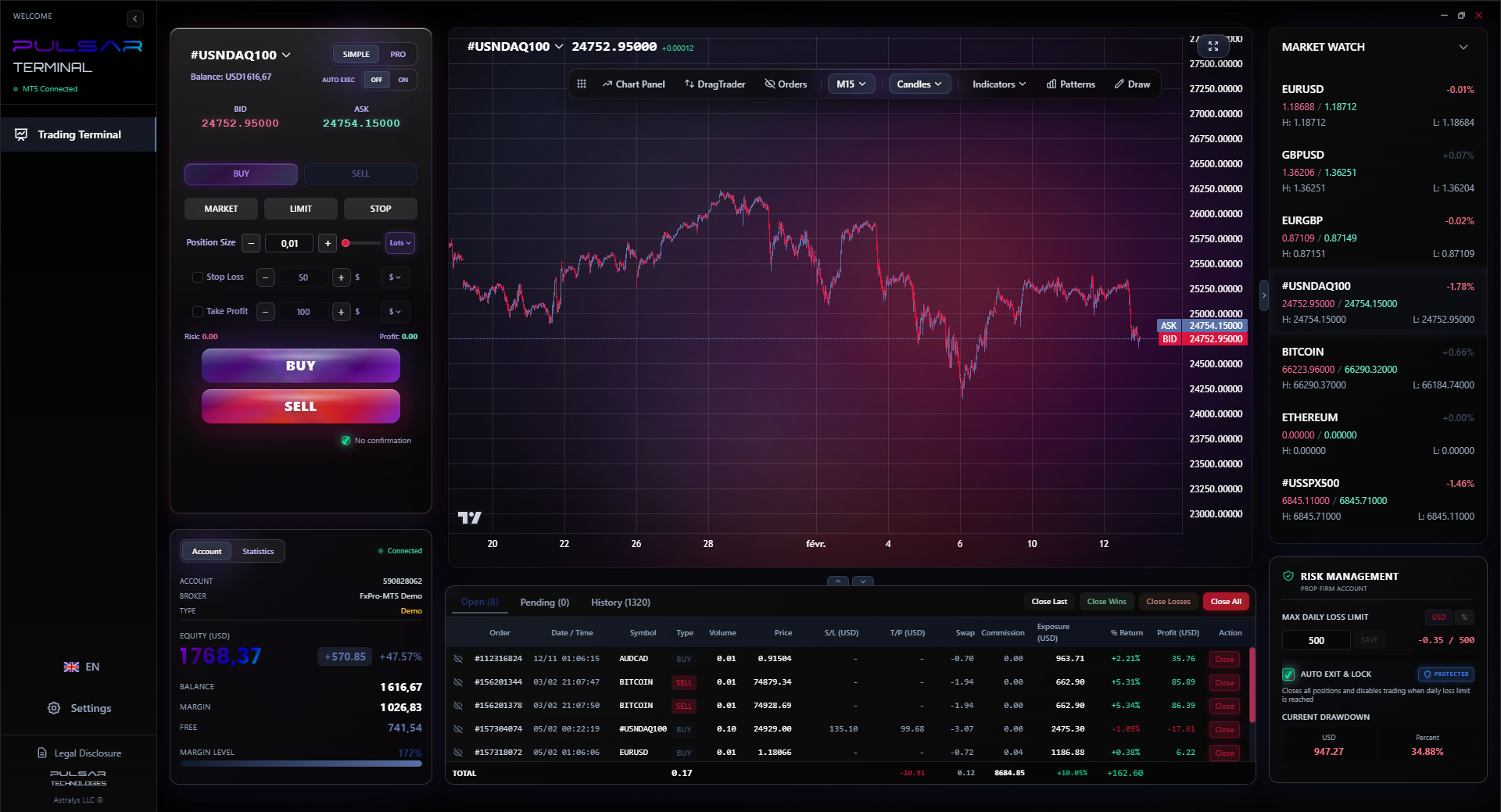
Managing a multi-take-profit strategy and strict daily loss limits manually is chaotic, which is why tools like Pulsar Terminal automate it directly on your MT5 platform.
Pulsar Terminal
Alat MT5 all-in-one: order drag-and-drop, multi-TP/SL, trailing stop, grid trading, Volume Profile, dan perlindungan prop firm. Digunakan 1.000+ trader setiap hari.
“The best trade is often no trade. If the market is choppy, or you're emotional - just walk away.”
The fun part is making money. The boring, essential part is keeping it legal and getting it into your FNB account.
Tax (SARS): Listen carefully. Your net trading profits are taxable income. It doesn't matter if your broker is in Mauritius or Mars. If you make money, you declare it. You can deduct your trading expenses (data subscriptions, platform fees, a portion of internet costs). Keep careful records. I know traders who've been audited. SARS isn't playing. Factor tax into your profit targets.
Banking and Payments:
- Funding: The easiest way is often a credit/debit card or an e-wallet like PayPal (if your broker supports it). Instant, but check for fees.
- Withdrawals: This is where some brokers get sticky. A good broker processes withdrawals in 24 hours. A bad one takes weeks. Always do a small test withdrawal first.
- Use a ZAR Account: If your broker offers a Rand-denominated account, use it. It eliminates the conversion fee headache on every trade and withdrawal.
Platforms: MT4 and MT5 are the standards here. They're strong, have thousands of indicators, and are supported by every broker. cTrader is gaining ground for its cleaner ECN execution. Don't get sucked into a broker's 'proprietary' platform unless it's truly exceptional. You want to be able to take your skills and scripts with you if you switch brokers.
“Your net trading profits are taxable income. It doesn't matter if your broker is in Mauritius or Mars.”
Let me be the cautionary tale. I've paid for these lessons so you can get them for free.
1. Chasing Losses: My worst day. I lost R2000 on a bad EUR/USD trade. I was angry, not thinking. I jumped right back in with double the size to 'make it back fast.' I lost another R4000 in 10 minutes. I broke every rule. The solution? After a loss, shut down. Go for a walk. The market isn't going anywhere.
2. Ignoring Total Cost: I was ecstatic about a 15-pip win on GBP/USD. Then I looked: spread was 1.8 pips, commission was $10. My net profit was about 3 pips. I was basically working for the broker. Know your all-in cost per trade.
3. Overcomplicating the Charts: I had a phase with 15 indicators on screen. MACD, Bollinger Bands, Stochastics, you name it. It was a rainbow of confusion. Price action was screaming one thing, my indicators were conflicting. I now use maybe two indicators at most. Clean charts lead to clear decisions.
4. Not Having a Daily Loss Limit: I didn't have one. On that bad day, I lost 6% of my account. Now, my rule is ironclad: if I lose 2% of my account in a day, I'm done. No arguments, no 'one more trade.' This single rule has saved my account multiple times.
Forex work is possible. But it's work. It's analysis, discipline, and brutal honesty with yourself. Start slow, learn the rules, manage your risk, and focus on the process, not the payout. The money follows the skill, not the other way around.
💡 Tips Winston
If you can't explain your trade setup in one simple sentence ('Price at weekly support, RSI oversold'), you don't understand it well enough to risk money on it.
FAQ
Q1Is forex trading legal in South Africa?
Yes, it's completely legal. It's regulated by the Financial Sector Conduct Authority (FSCA). However, you must trade with an FSCA-licensed broker or a reputable international broker that complies with local exchange control rules. Speculating directly against the Rand (ZAR) with an offshore broker is not allowed by the South African Reserve Bank (SARB).
Q2What is the best broker for South African traders?
There's no single 'best' broker - it depends on your style. For tight spreads and active trading, consider FSCA-regulated brokers like Pepperstone or IC Markets. If you want to trade USD/ZAR specifically, you need a broker like Exness that offers it legally to SA clients. Always prioritize FSCA regulation for safety. Check our detailed XM review and Pepperstone review for comparisons.
Q3How much money do I need to start forex trading in South Africa?
You can technically start with $10 or even $0 at some brokers. But realistically, you need enough to properly manage risk. If your account is too small, you'll be forced to use excessive use or risk too high a percentage per trade. A more sensible starting point is R10,000 - R20,000, allowing you to risk 1-2% per trade without being stopped out by normal market noise.
Q4How are forex profits taxed by SARS?
Net profits from forex trading are considered ordinary income by the South African Revenue Service (SARS). You must declare them on your annual tax return (ITR12). You can deduct legitimate trading expenses (platform fees, data, internet costs). Keep detailed records of all trades, deposits, and withdrawals.
Q5Why is the spread on USD/ZAR so wide?
USD/ZAR is an exotic currency pair with lower liquidity compared to majors like EUR/USD. There are fewer buyers and sellers at any given moment, so brokers widen the spread to cover their risk. Spreads of 50-100 pips are common. This means the price needs to move significantly in your favor just to break even, which affects your strategy and position sizing.
Q6Can I use a prop firm as a South African trader?
Yes, many international prop firms accept South African traders. However, you must still adhere to SARB's exchange control rules when sending the registration fee (often a few hundred dollars) abroad using your discretionary allowance. Be aware that prop firm challenges have strict daily and overall loss limits, requiring impeccable risk management.
Q7What's the most important skill for a new forex trader?
Risk management. Full stop. It's not analysis or finding the perfect entry. It's knowing exactly how much you can afford to lose on a trade (your position size) and having the discipline to stick to your stop loss. Without this, you will not survive long enough to learn any other skill.
Pelajaran Prof. Winston
Poin Penting:
- ✓FSCA regulation is non-negotiable for safety.
- ✓Your all-in trading cost must be under 30% of your target profit.
- ✓Never risk more than 2% of your capital on a single trade.
- ✓USD/ZAR spreads of 50-100 pips require adjusted position sizing.
Seberapa bermanfaat artikel ini?
Klik bintang untuk menilai
Wawasan Trading Mingguan
Analisis & strategi mingguan gratis. Tanpa spam.
Tentang Penulis
David van der Merwe
Trader Pasar Berkembang
Trader berbasis Johannesburg dengan 11 tahun di mata uang pasar berkembang. Spesialis pasangan ZAR, trading berregulasi FSCA, dan analisis pasar Afrika Selatan.
Komentar
Peringatan Risiko
Perdagangan instrumen keuangan mengandung risiko signifikan dan mungkin tidak cocok untuk semua investor. Kinerja masa lalu tidak menjamin hasil di masa depan. Konten ini hanya untuk tujuan edukasi dan tidak boleh dianggap sebagai nasihat investasi. Selalu lakukan riset Anda sendiri sebelum trading.
Anda mungkin juga suka

Cara Trading Forex Sukses: 7 Prinsip dari Trader Profesional
Cara trading forex sukses dengan 7 prinsip trader pro: manajemen modal, disiplin, journal trading, backtest. Data nyata, bukan janji profit palsu.
Jam Trading Forex Terbaik untuk Trader Indonesia: Panduan Lengkap dengan Tabel Waktu
Panduan jam trading forex untuk trader Indonesia. Tabel 4 sesi dunia, jam emas 20:00-00:00, sesi mana yang harus dihindari. Data akurat + tips dari trader berpengalaman.
Top 5 Sàn Forex Uy Tín Nhất 2026: Review Jujur dari Trader Indonesia
Top 5 sàn forex uy tín 2026 untuk trader Indonesia. Review jujur: spread, deposit, withdraw, dukungan lokal. Exness, XM, IC Markets & lebih.
Dapatkan Pulsar Terminal
Semua kalkulator ini terintegrasi dalam Pulsar Terminal dengan data real-time dari akun MT5 Anda.
Dapatkan Pulsar Terminal