


You hear about 'forex world changers' all the time - some new indicator, a guru's secret strategy, the next big thing.

David van der Merwe
Trader Pasar Berkembang ·  South Africa
☕ 11 mnt baca
Yang akan Anda pelajari:
- 1The Real World-Changers (They're Boring)
- 2ZAR Pairs: The Volatile Heart of Local Trading
- 3Navigating the Broker Landscape: Who Actually Serves You?
- 4The Silent Account Killers: Spreads, Swaps, and Slippage
- 5The Psychology of Surviving a Volatile Market
- 6Building a System That Works Here
- 7What's Next for SA Traders?
You hear about 'forex world changers' all the time - some new indicator, a guru's secret strategy, the next big thing. But what actually changes your trading world here in South Africa? It's not flashy gimmicks. It's the hard rules from the FSCA, the wild swings in USD/ZAR, and understanding that 80% of Rand trading happens offshore. I've watched traders blow R50,000 accounts chasing 'revolutionary' systems while ignoring the real game-changers: regulation, cost, and psychology. Let's talk about what actually matters.
Forget the YouTube ads. The true forex world changers in South Africa are structural, often dull, and massively impactful. They dictate whether you keep your profits and how much you actually get to trade with.
The first is FSCA regulation. Since 2021, use for retail clients is capped at 30:1. I know, international brokers whisper about 500:1. I tried that early on. Funded an offshore account, got the crazy use, and wiped a $2,000 deposit in three trades during a volatile GBP/USD session. The 'world-changing' use just accelerated my failure. The FSCA cap forces discipline. It's a pain, but it's a lifesaver.
The second is SARB exchange controls. You can't just move millions offshore. Need to move over R1 million? You're getting an AIT from SARS. This isn't a minor detail; it shapes your entire capital management strategy. Your trading capital is effectively 'trapped' in the ZAR system unless you navigate these rules. It makes choosing a broker with a solid ZAR account critical to avoid conversion fees eating your edge.

Warning: Trading with an unregulated international broker for higher use means you have zero FSCA protection. If they vanish with your deposit, you're on your own. I've had to help two clients through this nightmare; it's not worth it.
The third changer is cost. The average spread on EUR/USD here is about 0.6 pips. But you can get it down to 0.1 pips or even 0.0 with a commission. That difference is a world changer. On a standard lot, 0.6 pips is $6. 0.1 pips is $1. Do 100 trades a month, and you've just saved R9,000 in slippage. That's real money. Brokers like Tickmill and IC Markets compete fiercely on these raw costs for a reason.

💡 Tips Winston
The market doesn't care about your opinion on the government or Eskom. Trade the price on the screen, not the frustration in your heart.
This is our home turf. If you're not watching USD/ZAR, you're missing the pulse. It's an exotic pair, which means wider spreads but moves that can make your month in a single session.
Why USD/ZAR is a Different Beast
Globally, 80% of Rand trading happens offshore. Think about that. The price you see is largely set by big institutions in London and New York reacting to global risk sentiment and commodity prices. When gold or platinum tanks, the ZAR often follows. I learned this the hard way in 2020. I was long USD/ZAR at 14.50, thinking SA fundamentals were the only driver. Then a global risk-off wave hit, and the pair spiked to 19.00. My stop-loss was obliterated in the gap. I lost R15,000. The lesson? Your chart is local, but the drivers are global.
Trading ZAR Pairs Realistically
You need a wider stop. A 50-pip stop on EUR/USD might be fine. On USD/ZAR, that can get taken out by normal lunchtime volatility. I now use a minimum of 150-200 pips for any swing trading setup on this pair. Your position size must account for this. Use a position size calculator religiously. If you'd normally risk 1% on a major pair, consider risking 0.5% on USD/ZAR because the volatility is double or triple.
Popular ZAR pairs and what moves them:
| Pair | Key Driver | Typical Daily Range (Pips) |
|---|---|---|
| USD/ZAR | Global risk, US rates, SA commodity exports | 300 - 800 |
| EUR/ZAR | EU economic data, SA trade ties | 250 - 600 |
| GBP/ZAR | UK politics, BoE policy, SA risk sentiment | 300 - 700 |

Pro Tip: Don't trade ZAR pairs around major SA budget speeches or SARB rate announcements unless you're specifically scalping the event. The spreads widen to insane levels, and slippage will kill you. I once watched the spread on USD/ZAR blow out to 50 pips during a chaotic MPC announcement.
“The real forex world changers are often the hidden friction costs: the spread that widens at 5 PM, the slippage on a news spike, the swap that turns against you.”
Choosing a broker isn't about who has the flashiest ads. It's about who can reliably execute your trades, hold your ZAR, and not collapse. Here’s the breakdown from the trenches.
FSCA-Regulated Safety: Brokers like IG, AvaTrade, and Khwezi Trade operate under the FSCA's watch. Your funds are segregated. There's a complaint process. This is the safe, slow road. Khwezi is a local favourite for a reason - they get our market. Minimum deposits are low (R500 at Khwezi), which is great for starting.
The 'International' Low-Cost Crew: Then you have brokers like IC Markets, Tickmill, and Exness. They're regulated elsewhere (CySEC, ASIC) but serve SA clients brilliantly. They offer the razor-thin spreads (0.0 pips on majors) and the MT5 platforms we love. Their ZAR accounts are seamless. I've run my main account with one of these for years. The execution speed on news events is consistently under 40ms, which matters when you're scalping.
The Reality Check: The 'best' broker depends on your style. Are you a high-volume scalper chasing the lowest all-in cost? The international ECN brokers win. Are you a beginner who values hand-holding and fears regulatory grey areas? Stick with a major FSCA name like IG. I started with XM because of their $5 minimum deposit. It let me practice with real money without sweating. There's no shame in that.

Example: Let's compare real cost on a 1-lot EUR/USD trade.
- Broker A (Standard): 1.2 pip spread = $12 cost.
- Broker B (Raw ECN): 0.1 pip spread + $7 commission = $8 total cost. That's a R75 saving on one trade. Over a year, it pays for a new trading PC.
You might focus on your winning trades, but I look at my monthly statement's 'Other Charges' column. That's where dreams go to die. The real forex world changers are often these hidden friction costs.
Spreads are the most obvious. But did you know they widen dramatically at 5 PM SA time? That's the New York close. Liquidity dries up for 20 minutes. If you're trading EUR/ZAR then, you could pay 5x the normal spread. I schedule my trading to avoid this window entirely.
Swap Rates (overnight financing) are a complex beast. Holding a USD/ZAR long position (buying USD, selling ZAR) often pays a positive swap because of the interest rate differential. But it can flip negative quickly if SARB cuts rates. I once held a long GBP/ZAR trade for a week for a +R1200 swap credit. The trade itself was a loser, but the swap saved my bacon. Don't trade just for swap, but know it's a factor.
Slippage is the assassin. You click at 18.5250, but your order fills at 18.5280. That's 3 pips gone. On a 2-lot USD/ZAR trade, that's R120 vanished. It happens most during news (like US Non-Farm Payrolls) and on low-liquidity exotics. The fix? Use limit orders, not market orders, for entry whenever possible. And if you must trade news, accept that slippage is part of the fee.
Your broker's execution model matters here. An ECN broker passing orders to a liquidity pool usually gives better slippage than a market maker broker internalising your trade. It's why I switched to an ECN model after seeing consistently worse fills on my old platform.
💡 Tips Winston
Your first profitable system will be boring. It will feel like work. The exciting, 'world-changing' strategies are usually just expensive stories.
“80% of Rand trading happens offshore. The price on your screen is set in London and New York, not Sandton.”
All the strategy in the world means nothing if your mind can't handle the ZAR's mood swings. The biggest world changer is between your ears.
South African traders face a unique psychological trap: the volatility normalisation bias. We get used to USD/ZAR moving 500 pips a week. Then, when we trade a major pair like EUR/USD that might move 100 pips, we get impatient. We overtrade, we chase, we use excessive size because it 'feels' slow. I've done this. Blown a perfectly good EUR/USD strategy by applying my ZAR-influenced brain to it.
Another killer is political fatigue. Loadshedding, corruption headlines, rand crashes - it wears you down. You start taking trades out of frustration with the country's direction, not based on the chart. That's a sure path to a margin call. I had to institute a rule: no trading within two hours of reading a particularly infuriating political news headline. My equity curve thanked me.
The fix is systematic de-escalation.
- Separate environments: Use one set of rules and position sizing for volatile ZAR pairs, and a calmer, tighter set for major forex pairs.
- Track your emotional triggers: Keep a simple journal. Note your mental state before each trade. After 50 trades, you'll see patterns (e.g., 'losses cluster on Monday mornings when I'm anxious about the week').
- Define your stop-loss BEFORE your profit target. This inverts the natural greed instinct. Your first job is to define what you're willing to lose. The potential profit is secondary. This one mental shift saved my career after a brutal drawdown.
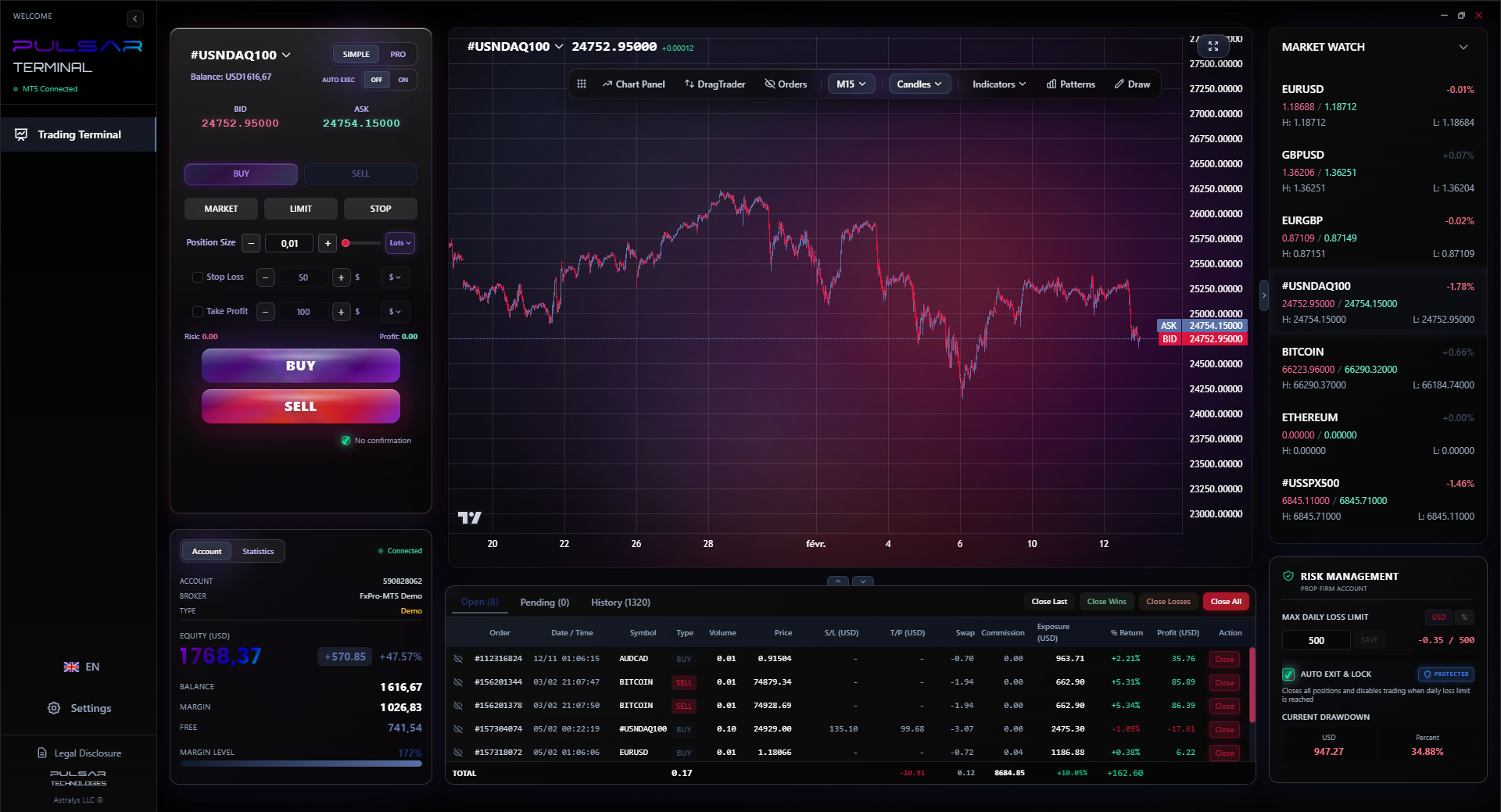
Managing the psychology of volatile ZAR pairs requires iron-clad rules, which is where automating your stop-losses, take-profits, and breakeven moves with Pulsar Terminal removes the emotion from the equation.
Pulsar Terminal
Alat MT5 all-in-one: order drag-and-drop, multi-TP/SL, trailing stop, grid trading, Volume Profile, dan perlindungan prop firm. Digunakan 1.000+ trader setiap hari.
So how do you stitch this together? You build a system that respects the local realities, not a copy-paste from a US trader.
Step 1: Accept the Constraints. Your max use is 30:1. Your capital is in ZAR. Your most volatile opportunity is USD/ZAR. Start there. Design a position sizing model that uses 30:1 as the absolute ceiling, but ideally operates at 10:1 or less. This isn't limiting; it's forcing quality over gambling.
Step 2: Choose Your Battleground. Are you a scalping wizard? Then major pairs with tight spreads (EUR/USD, USD/JPY) on an ECN account are your world. Use tools like the RSI indicator for overbought/oversold levels on lower timeframes. Are you a patient swing trader? Then USD/ZAR on the 4H or Daily chart is your arena. Here, tools like the MACD indicator for trend momentum work better. Don't try to be both.
Step 3: Integrate Cost into Your Edge. Your strategy must have a proven edge after costs. If your average winning trade is 8 pips and the average spread+slippage is 3 pips, your real win is 5 pips. Is that enough? Backtest with realistic spread data from your broker, not the ideal 'zero spread' fantasy.
Step 4: Automate Your Discipline. This is where modern tools become world changers. Use platform features to set trailing stops, take partial profits, and move to breakeven. These rules, when executed automatically, remove emotion. They lock in profits and cap losses in a way your panicking brain never will.
Pro Tip: Your first R20,000 should be viewed as tuition, not capital. Your goal with that money isn't to get rich. It's to learn, make mistakes, and find your style without destroying your life savings. I turned my first R5,000 into R0 three times before something finally clicked.
“Your first R20,000 is tuition, not capital. Its purpose is to be lost while you learn what not to do.”
The landscape is shifting. The real forex world changers on the horizon are about access and sophistication.
Fintech integration is smoothing deposits and withdrawals. EFTs are still king, but digital wallets are growing. This will make funding faster, lowering the barrier to entry even more.
Prop Firm Challenges are exploding in popularity. They offer a path to trade larger capital without risking your own savings. But they come with strict daily loss limits and drawdown rules. Passing these requires iron-clad discipline - the kind of automated risk management that tools are built for. It's a structured way to prove you're not just a gambler.
Algorithmic Trading is no longer just for institutions. Retail traders can code or rent EAs (Expert Advisors). The danger is buying a 'magic bullet' EA that doesn't understand ZAR volatility. The opportunity is automating your own proven, boring strategy to run 24/5, catching moves while you sleep.
The core won't change. The Rand will remain volatile. The FSCA will keep things tight. Your psychology will be your biggest enemy. The traders who succeed will be the ones who see these not as obstacles, but as the very framework within which a durable, professional career is built. They stop looking for world changers and start mastering the world they're actually in.
FAQ
Q1Is forex trading legal in South Africa?
Yes, completely legal. It's regulated by the Financial Sector Conduct Authority (FSCA). The key is to use an FSCA-licensed broker or a reputable international broker that serves SA clients. This ensures your funds are segregated and you have some recourse if things go wrong.
Q2What's a realistic monthly income for a beginner forex trader in SA?
Realistic is the key word. Most beginners should aim for consistency, not income. But based on common account sizes, a beginner with R10,000 capital aiming for a 5% monthly return is targeting R500. Many lose money initially. An intermediate trader with a proven system might aim for 5-10% monthly (R5,000-R20,000 on a R200k account). Anyone promising you guaranteed monthly thousands from a small account is lying.
Q3Why is USD/ZAR so volatile?
Two main reasons. First, the ZAR is an emerging market currency, heavily influenced by global risk sentiment and commodity prices (gold, platinum). When global investors get nervous, they pull money out of markets like SA. Second, about 80% of all Rand trading happens offshore, so its price is set by large international flows that can be sudden and massive.
Q4What's the minimum amount I need to start trading forex in South Africa?
You can technically start with $1 or $5 at some brokers like XM. But for meaningful trading that allows for proper risk management, I recommend at least R1,500 to R5,000. This lets you trade micro lots (1,000 units) and survive the inevitable learning-curve losses without blowing up in a week.
Q5How are my forex profits taxed in South Africa?
SARS views forex trading profits as income if you're trading frequently (seen as a business), or as capital gains if it's more incidental. You are responsible for declaring this income. Keep detailed records of all trades, deposits, and withdrawals. It's wise to consult a tax professional who understands trading. Don't ignore this; it's a sure way to turn profits into a nightmare.
Q6Should I use an international broker or a local South African one?
It depends on your priorities. Local FSCA brokers (like Khwezi, IG SA) offer direct regulation and often better local support. International brokers (like IC Markets, Pepperstone) often offer lower spreads, higher use options (though you shouldn't use the max), and advanced platforms like MT5. Many international brokers offer ZAR accounts. I use an international broker for costs and execution, but I only recommend ones with a long, solid reputation.
Q7What's the single biggest mistake new SA traders make?
Using excessive use, especially on volatile ZAR pairs. They see the 500:1 offer from an offshore broker, trade too large, and a normal 200-pip move in USD/ZAR wipes them out. The FSCA's 30:1 limit is frustrating for some, but it's designed to prevent this exact self-destruction. Start with 10:1 or less.
Pelajaran Prof. Winston
Poin Penting:
- ✓Max 30:1 use is a protective cage, not a limit.
- ✓Price a 200-pip stop for USD/ZAR, not 50.
- ✓Your strategy must win after 3 pips of slippage.
- ✓Trade the chart, not the political headline.
Seberapa bermanfaat artikel ini?
Klik bintang untuk menilai
Wawasan Trading Mingguan
Analisis & strategi mingguan gratis. Tanpa spam.
Tentang Penulis
David van der Merwe
Trader Pasar Berkembang
Trader berbasis Johannesburg dengan 11 tahun di mata uang pasar berkembang. Spesialis pasangan ZAR, trading berregulasi FSCA, dan analisis pasar Afrika Selatan.
Komentar
Peringatan Risiko
Perdagangan instrumen keuangan mengandung risiko signifikan dan mungkin tidak cocok untuk semua investor. Kinerja masa lalu tidak menjamin hasil di masa depan. Konten ini hanya untuk tujuan edukasi dan tidak boleh dianggap sebagai nasihat investasi. Selalu lakukan riset Anda sendiri sebelum trading.
Anda mungkin juga suka

Cara Trading Forex Sukses: 7 Prinsip dari Trader Profesional
Cara trading forex sukses dengan 7 prinsip trader pro: manajemen modal, disiplin, journal trading, backtest. Data nyata, bukan janji profit palsu.
Jam Trading Forex Terbaik untuk Trader Indonesia: Panduan Lengkap dengan Tabel Waktu
Panduan jam trading forex untuk trader Indonesia. Tabel 4 sesi dunia, jam emas 20:00-00:00, sesi mana yang harus dihindari. Data akurat + tips dari trader berpengalaman.
Top 5 Sàn Forex Uy Tín Nhất 2026: Review Jujur dari Trader Indonesia
Top 5 sàn forex uy tín 2026 untuk trader Indonesia. Review jujur: spread, deposit, withdraw, dukungan lokal. Exness, XM, IC Markets & lebih.
Dapatkan Pulsar Terminal
Semua kalkulator ini terintegrasi dalam Pulsar Terminal dengan data real-time dari akun MT5 Anda.
Dapatkan Pulsar Terminal