


I remember staring at my screen in 2018, watching a $30 no-deposit bonus from XM turn into R1,200 in profit.

David van der Merwe
Trader Pasar Berkembang ·  South Africa
☕ 12 mnt baca
Yang akan Anda pelajari:
- 1What Exactly Is a Free Start Up Bonus?
- 2The South African Regulatory Landscape: Your Safety Net
- 3Decoding the Fine Print: The Real Cost of 'Free'
- 4Top FSCA Brokers and Their Real Offers
- 5A Realistic Strategy for Using Bonuses
- 6Common Pitfalls and How to Avoid Them
- 7Better Alternatives to Chasing Bonuses
- 8The Final Verdict for South African Traders
I remember staring at my screen in 2018, watching a $30 no-deposit bonus from XM turn into R1,200 in profit. The EUR/USD was at 1.1650, and I felt like a genius. Then I tried to withdraw it. That's when I learned the first hard lesson about free start up bonus forex offers: the money isn't really yours until you've jumped through every hoop. In South Africa, with over 500,000 traders now in the game, these bonuses are everywhere. They're tempting, but they come with strings attached that can trip you up if you're not careful.
Let's cut through the marketing. A free start up bonus is risk-free trading capital given to you by a broker to try their platform. The key word there is risk-free for you, not for them. You can't withdraw the bonus cash itself. What you can potentially withdraw are the profits you make from trading with it, but only after meeting specific conditions, usually a trading volume target.
There are two main types you'll see advertised to South African traders:
No-Deposit Bonus: This is the classic 'free money' offer. You sign up, verify your account, and they credit you a small amount, typically $30 to $100. No deposit from you is required. XM's $30 offer is the most famous example.
Deposit Match Bonus: Here, you put in your own money, and the broker matches a percentage of it. A 100% bonus on a R1,000 deposit would give you R2,000 total to trade with. Brokers like IFX Brokers offer these.

Warning: That 'free' bonus is a marketing cost for the broker. Their business model counts on most traders either blowing the account quickly or failing to meet the withdrawal conditions. It's a sample, not a gift.
This is the most important section. Trading with an unregulated broker is like playing soccer on a highway. The Financial Sector Conduct Authority (FSCA) is our referee. Any broker seriously offering services here needs their license.
Why the FSCA Matters for Bonuses
The FSCA keeps an eye on bonus promotions. They've stopped brokers from making outrageous promises like 'guaranteed profits.' This means the terms you see on an FSCA-regulated broker's site are more likely to be clear and enforceable. They also mandate client fund segregation. This means your deposit (and any profits) should be held in a separate bank account from the broker's company funds. If the broker goes under, your money isn't used to pay their bills.
I learned this the hard way early on. I deposited with an offshore broker offering a 200% bonus. The spreads were terrible, the platform froze during news events, and when I wanted to withdraw my initial deposit, it was a nightmare of delays. That broker wasn't FSCA-regulated. Now, I check the FSCA's website for every single broker I consider. It's non-negotiable.

Pro Tip: Don't just trust the 'Regulated' badge on a broker's homepage. Go to the FSCA's official website and search their financial services provider register. It takes two minutes and could save you thousands.
Remember, the South African Reserve Bank (SARB) also has exchange control rules. Moving large sums in and out of the country needs to go through authorized channels. A reputable, FSCA-licensed broker will handle this correctly.

💡 Tips Winston
A bonus is a test of your discipline, not your luck. The broker is betting you'll act like a gambler. Prove them wrong by trading like an accountant.
“Pick a broker for their spreads and execution, not just their bonus.”
This is where they get you. The offer says 'Free $30!' The terms and conditions (T&Cs) explain how you'll probably never see a cent of it. You must read these. I mean, actually read them, even the boring parts.
Here’s what to hunt for, with real examples from the market:
1. The Trading Volume (Lot) Requirement: This is the big one. To withdraw your profits, you must trade a certain number of lots. A standard lot is 100,000 units of currency. Let's break down a real case.
XM's classic $30 no-deposit bonus often requires you to trade 10 standard lots (that's 1,000,000 units of currency) before you can withdraw profits. On EUR/USD, with a typical micro lot (0.01) trade, each pip move is worth about $0.10. To generate 10 lots of volume with micro lots, you'd need to open and close 1,000 trades. It's a massive amount of activity.
2. Maximum Profit Withdrawal: Some caps are shockingly low. I've seen offers where you can only withdraw a maximum of $100 in profit, no matter how well you do. RaiseFX (not for SA residents) has had such a cap.
3. Time Limits: Your bonus might expire in 30 days. Any unused bonus credit and any profits made with it simply vanish.
4. Instrument Restrictions: You might only be allowed to trade major forex pairs with the bonus money, not commodities or indices.
5. The 'Bonus Cancellation' Clause: This is a sneaky one. Some brokers, like XGLOBAL FX, state that if you request a withdrawal, your entire bonus is cancelled. If your profit is less than their minimum withdrawal amount (say $200), you lose everything.
Here’s a comparison of common structures:
| Broker Example | Bonus Type | Key Withdrawal Condition | The Catch |
|---|---|---|---|
| XM | $30 No-Deposit | Trade 10 standard lots | High volume, bonus not withdrawable. |
| Tickmill | $30 Welcome | Trade 5 lots, profit between $30-$100 | Strict profit band for withdrawal. |
| Deposit Match | 100% Bonus | Trade 25x (Bonus + Deposit) | You must trade a huge multiple of your total balance. |
Using a position size calculator is crucial here. If the T&Cs force you to trade huge sizes to meet volume targets, you'll likely hit a margin call before you ever see a profit.
Let's look at some actual FSCA-licensed brokers serving the South African market. I'm focusing on their general trading conditions because that's what matters after the bonus is gone.
XM: They're a major player here. Yes, they have the $30 no-deposit bonus and a 100% deposit match. Their standard account spreads start around 0.8 pips on EUR/USD, which is okay, not great. The minimum deposit is very low at $5, which is good for starters. You can read a full breakdown in our XM review.
Tickmill: This is a favorite for serious traders who care about costs. Their Raw Pro account offers raw spreads from 0.0 pips plus a small commission. For South Africans, their $30 Welcome Account is a decent way to test their superb execution. Minimum deposit for a live account is $100.
IC Markets: Another low-cost giant. They're known for razor-thin spreads (often 0.0 pips on majors) and excellent execution. They don't heavily push bonuses, which I actually respect. They compete on pure trading environment. Check our detailed IC Markets review for more.
Khwezi Trade: A solid local option. FSCA-licensed, with spreads from 0.4 pips and a minimum deposit of just R500. They understand the local market nuances.
AvaTrade: Well-established, offers fixed spreads (from 0.9 pips) which can be helpful for beginners budgeting costs. Minimum deposit is R1,500.
A Note on IG: IG is a top-tier, FSCA-regulated broker. However, they've recently stopped onboarding new South African clients directly to their FSCA entity. New clients are directed to their international entities. This changes the regulatory protection, so it's something to be aware of.
My advice? Pick a broker for their spreads, platform, and execution speed, not just their bonus. That $30 bonus won't mean much if you're losing 2 pips on every trade due to a wide spread definition.
“A 'no-strings-attached' offer is a major red flag.”
Okay, so you want to claim a free start up bonus forex offer. How do you actually make it work for you, not for the broker?
Step 1: Treat it as a Demo Account on Steroids. This is the correct mindset. The money isn't real until it's in your bank account. Use the bonus to test the broker's platform in live market conditions. Are orders executed quickly? Does the platform crash? How do the spreads behave during the London open? This intel is more valuable than the bonus itself.
Step 2: Trade Micro Lots. Always. Your goal is to survive and meet the volume requirement, not to get rich from $30. Use the smallest position size possible. This minimizes your risk of a single bad trade wiping out the account. It’s the perfect environment to practice strict risk management without emotional attachment to the capital.
Step 3: Have a Clear, Simple Plan. Don't just start clicking buttons. Use the bonus to practice one specific strategy. Maybe it's a simple scalping strategy using support and resistance, or a swing trading approach based on the MACD indicator. The goal is consistency, not a home run.
A Personal Example (The Good): With that XM $30 bonus, my plan was to only trade EUR/USD during the first two hours of the London session. I used a simple 15-minute chart with a 50-period EMA. I only took trades in the direction of the trend, risking no more than 5% of the bonus per trade (so, $1.50). I aimed for a 2:1 reward-to-risk. It was tedious, but after 87 trades (all 0.01 lots), I met a chunk of the volume and banked some profit.
A Personal Example (The Bad): On another platform, I got a $50 bonus. I thought, 'It's free, let's go big.' I traded 0.1 lots on GBP/USD during a news event. The spread widened to 15 pips, I was instantly down $15, panicked, reversed my trade, and blew the account in two minutes. I didn't learn a thing except how to lose quickly.

Example: If a bonus requires 5 lots of volume, trading 0.01 lots means you need 500 trades. If your strategy has a 55% win rate, that's a long grind. Plan for the grind.
💡 Tips Winston
The most valuable thing you can withdraw from a bonus account isn't cash - it's the confirmed knowledge that the broker's execution is solid and their platform doesn't fail under pressure.
I've fallen into most of these. Learn from my wasted time and frustration.
Pitfall 1: Chasing the Biggest Bonus. The 200% deposit bonus looks amazing. But the volume requirement is usually a multiple of the bonus plus your deposit. A 100% bonus on a R1,000 deposit with a 25x turnover requirement means you must trade R50,000 worth of volume. That's a trap designed to keep you trading (and paying spreads) forever.
Pitfall 2: Ignoring the Underlying Trading Costs. A broker might offer a fat bonus but have awful spreads of 2.0 pips on EUR/USD. You're giving back that 'free' money with every single trade. Always check the real spread definition and commission structure on the account type the bonus applies to.
Pitfall 3: Changing Your Strategy for the Bonus. You're a swing trader who holds trades for days. But the bonus expires in 30 days, so you start day trading to generate volume. You're now trading outside your competency to chase a $50 bonus. This is a surefire way to lose your own deposited funds later.
Pitfall 4: Not Withdrawing When You Can. You meet the conditions and have R800 in withdrawable profit. You think, 'Let me grow it to R2,000.' This is greed. The market can turn. Withdraw your eligible profits immediately. It's the only way to convert the bonus promise into real money.
The bottom line? A free start up bonus forex offer can be a useful tool, but you must be the one in control. The broker sets the trap; your job is to navigate around it carefully.
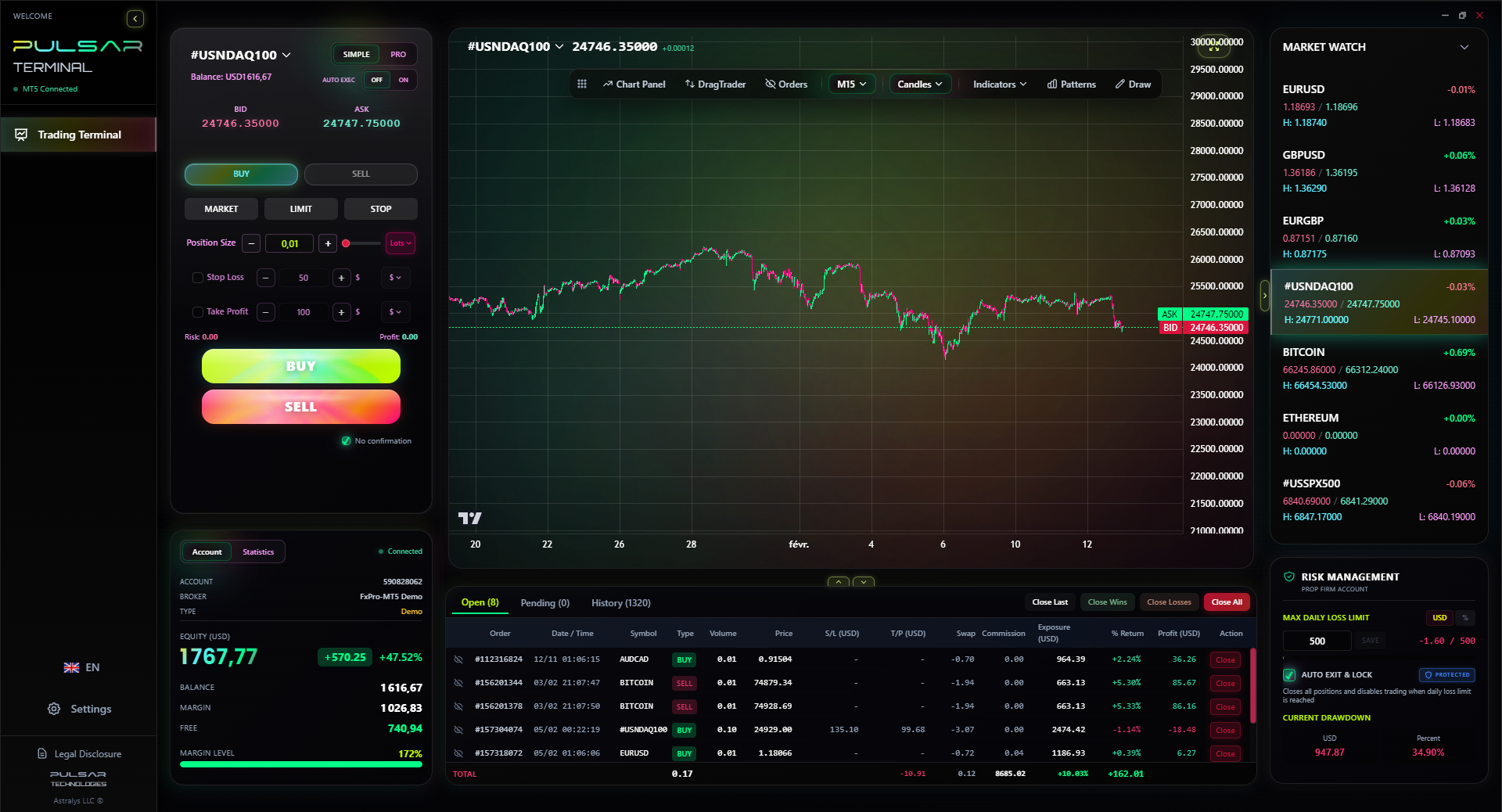
Managing the high volume of trades needed to clear bonus conditions is tedious; Pulsar Terminal's grid trading feature can automate opening multiple micro-lot positions according to your plan.
Pulsar Terminal
Alat MT5 all-in-one: order drag-and-drop, multi-TP/SL, trailing stop, grid trading, Volume Profile, dan perlindungan prop firm. Digunakan 1.000+ trader setiap hari.
“Use their capital to learn, verify their services, and if you're disciplined, extract a small profit.”
If the terms of free start up bonus forex offers feel too restrictive (because they are), consider these more straightforward paths to start trading in South Africa.
1. Start with a Proper Demo Account. This is the best advice I can give any new trader. A demo account gives you unlimited virtual capital to practice for months. No volume requirements, no time limits, no stress. Develop a profitable strategy here first. All the good FSCA brokers offer unlimited demo accounts.
2. Use a Broker with a Very Low Minimum Deposit. This is often smarter than a bonus. Brokers like XM ($5) or Khwezi Trade (R500) let you open a live account with real money for less than the cost of a nice dinner. Trading with your own R500 teaches you real emotional control from day one. The lessons you learn are worth far more than any bonus.
3. Focus on Skill Development. Instead of spending hours parsing bonus T&Cs, spend that time learning. Understand how to use the RSI indicator to spot overbought conditions. Study what drives the EUR/USD guide or the XAU/USD guide. Build a trading journal. These skills will make you money long after any bonus is forgotten.
I made more consistent progress in my first year by trading a R1,000 live account with Pepperstone (check our Pepperstone review for their conditions) than I ever did juggling five different bonus accounts. The pressure of losing my own money, even a small amount, focused my mind like nothing else.
So, are free start up bonuses worth it? Yes, but only under very specific conditions.
Claim a bonus IF:
- The broker is FSCA-licensed (verify this yourself).
- You want to test their platform execution in a live environment.
- You can commit to a micro-lot grinding strategy without emotional attachment.
- You have the patience to read and fully understand every term.
- You see it as a paid learning exercise, not a lottery ticket.
Skip the bonus and go straight to a live account IF:
- You find the terms overly complex or restrictive.
- The broker's standard spreads are high.
- You want to start building your real trading psychology from day one.
- You value simplicity and clear costs.
The South African forex market is growing fast, projected to be worth nearly $7 billion by 2033. Brokers are competing hard for your attention. A bonus is their hook. Your job is to be the smart fish that takes the bait without getting caught. Use their capital to learn, verify their services, and if you're disciplined, extract a small profit. Then, move on to building your own capital with a broker you've vetted, trading a strategy you've mastered. That's how you turn 'free start up bonus forex' from a marketing gimmick into a genuine step forward in your trading journey.
FAQ
Q1Can I actually get rich from a no-deposit bonus in South Africa?
Realistically, no. The terms (volume requirements, profit caps, time limits) are designed to make this nearly impossible. View it as a risk-free way to test a broker and maybe make a few hundred Rand, not a path to wealth.
Q2Is it legal to use forex bonuses in South Africa?
Yes, it's legal. The FSCA regulates these offers to ensure they are not misleading. However, you must only use bonuses from FSCA-licensed brokers to ensure you have legal recourse and your funds are segregated.
Q3What's the best free start up bonus for a complete beginner?
XM's $30 no-deposit bonus is the most accessible for a true beginner because it requires no own deposit. However, the 'best' bonus is from the broker with the best overall trading conditions (like tight spreads) that you plan to use long-term, such as Tickmill's Welcome Account or a low-minimum-deposit account with a local broker like Khwezi Trade.
Q4How do I check if a broker is FSCA regulated?
Go to the official FSCA website (www.fsca.co.za). Use their 'Search' function for 'Financial Services Providers' (FSPs). Enter the broker's company name or FSP number (which should be on their website). Do not rely on badges or claims on the broker's site alone.
Q5Why did my broker cancel my bonus when I requested a withdrawal?
This is a common clause. Some brokers' terms state that requesting a withdrawal automatically forfeits any remaining bonus funds. This is why you must withdraw all eligible funds at once and ensure your profit meets their minimum withdrawal threshold first.
Q6Are there any FSCA brokers with truly free, no-strings-attached bonuses?
No. Any legitimate, regulated broker will attach conditions to a bonus. The FSCA requires transparency on these terms. A 'no-strings-attached' offer is a major red flag and likely from an unregulated entity.
Q7Should I use use with a bonus account?
Extreme caution is needed. While use can help generate the required trading volume faster, it dramatically increases risk. A small move against you can wipe out the bonus instantly. Stick to very low use (like 1:10 or 1:20) and micro lots to maintain control.
Pelajaran Prof. Winston
Poin Penting:
- ✓Always verify FSCA registration independently.
- ✓The bonus capital itself is never withdrawable.
- ✓Volume requirements demand a micro-lot grind.
- ✓Withdraw eligible profits immediately.
Seberapa bermanfaat artikel ini?
Klik bintang untuk menilai
Wawasan Trading Mingguan
Analisis & strategi mingguan gratis. Tanpa spam.
Tentang Penulis
David van der Merwe
Trader Pasar Berkembang
Trader berbasis Johannesburg dengan 11 tahun di mata uang pasar berkembang. Spesialis pasangan ZAR, trading berregulasi FSCA, dan analisis pasar Afrika Selatan.
Komentar
Peringatan Risiko
Perdagangan instrumen keuangan mengandung risiko signifikan dan mungkin tidak cocok untuk semua investor. Kinerja masa lalu tidak menjamin hasil di masa depan. Konten ini hanya untuk tujuan edukasi dan tidak boleh dianggap sebagai nasihat investasi. Selalu lakukan riset Anda sendiri sebelum trading.
Anda mungkin juga suka

Cara Trading Forex Sukses: 7 Prinsip dari Trader Profesional
Cara trading forex sukses dengan 7 prinsip trader pro: manajemen modal, disiplin, journal trading, backtest. Data nyata, bukan janji profit palsu.
Jam Trading Forex Terbaik untuk Trader Indonesia: Panduan Lengkap dengan Tabel Waktu
Panduan jam trading forex untuk trader Indonesia. Tabel 4 sesi dunia, jam emas 20:00-00:00, sesi mana yang harus dihindari. Data akurat + tips dari trader berpengalaman.
Top 5 Sàn Forex Uy Tín Nhất 2026: Review Jujur dari Trader Indonesia
Top 5 sàn forex uy tín 2026 untuk trader Indonesia. Review jujur: spread, deposit, withdraw, dukungan lokal. Exness, XM, IC Markets & lebih.
Dapatkan Pulsar Terminal
Semua kalkulator ini terintegrasi dalam Pulsar Terminal dengan data real-time dari akun MT5 Anda.
Dapatkan Pulsar Terminal