


Most people asking 'how can I invest in forex' are looking for a magic button to press for instant wealth.

Olumide Adeyemi
Pelopor Trading Afrika Barat ·  Nigeria
☕ 11 mnt baca
Yang akan Anda pelajari:
Most people asking 'how can I invest in forex' are looking for a magic button to press for instant wealth. They get sold a dream of Lamborghinis funded by a few clicks. I'm here to tell you that's a fast track to losing your money. Real forex investment isn't gambling; it's a disciplined business with specific rules, especially here in Nigeria. Let's cut through the noise and build a plan that actually works, factoring in our 10% capital gains tax and the new SEC rules.
Before you place a single trade, you need to understand the playing field. It's not the wild west anymore, and pretending it is will get you into trouble.
The New SEC Rules (ISA 2025)
The biggest change is the Investments and Securities Act (ISA) 2025. It's now an offense for any platform to offer online forex trading in Nigeria without registering with the SEC. This is huge. It means the era of completely unregulated, fly-by-night brokers operating here should be ending. Your first filter for any broker should be: are they complying with this? If they're not even registered, walk away. The SEC's move is meant to protect you, even if the framework is still fresh.
The 10% Tax You Can't Ignore
Here's the cold, hard number every Nigerian trader must plan for: a 10% capital gains tax on your gross profits. Not net, gross. Let's say you make a ₦500,000 profit on a great EUR/USD trade. The taxman wants ₦50,000 of that. You must factor this into your profit targets and position size calculator. If your strategy only barely breaks even before tax, you're actually losing money. I learned this the hard way early on, celebrating a ₦200,000 month only to realize my actual take-home was ₦180,000. It changes your entire risk-reward math.
What the CBN Says
Remember, the Central Bank of Nigeria (CBN) prohibits using official foreign exchange windows to fund trading accounts for speculation. You fund your account through your broker's provided channels - bank transfers, cards, or electronic wallets. This rule keeps speculative trading separate from the formal forex needed for imports and business.

Warning: Never use a Bureau de Change or unofficial channel to get dollars for trading. It's against CBN policy and opens you up to massive fraud. Always use your broker's direct deposit methods.
“Real forex investment isn't gambling; it's a disciplined business with specific rules, especially here in Nigeria.”
This is where most Nigerians get it wrong. They chase the broker with the highest use or the flashiest bonuses. That's like choosing a surgeon because they have the shiniest scalpel. You need safety first.
Regulation is Your Armor
Since local SEC registration is new, your safest bet is a reputable international broker that accepts Nigerian clients and is regulated by a top-tier foreign authority. Think CySEC (Cyprus), FCA (UK), ASIC (Australia), or FSCA (South Africa). This gives you a layer of protection for your funds. I only keep serious capital with brokers holding one of these licenses.
Here’s a quick comparison of brokers popular in Nigeria:
| Broker | Key Regulation | Min. Deposit (Approx.) | Notable Feature for Nigerians |
|---|---|---|---|
| Exness | Seychelles FSA, etc. | $10 | Offers Naira accounts, very popular locally. |
| XM | CySEC, ASIC, FCA | $5 | Strong educational resources, low barrier. |
| IC Markets | ASIC, CySEC | $200 | Raw spreads, fantastic for scalping strategy. |
| Pepperstone | ASIC, FCA, etc. | $0 | Great technology, tight spreads. |
| HF Markets | FCA, FSCA | $5 (or ₦4000) | Offers NGN accounts explicitly. |
Costs That Eat Your Profits
You're not just trading against the market; you're trading against costs.
- Spread: The difference between buy and sell price. On EUR/USD, a 1.0 pip definition spread is high, 0.5 is okay, and 0.1 or lower is excellent.
- Commission: On ECN accounts, you pay a small fee per lot. $3-$7 per round lot is standard.
- Swap Fees: Interest for holding positions overnight. Can be a cost or a credit.
I made a mistake in 2018 using a broker with a "zero commission" account. Their EUR/USD spread was consistently 1.8 pips. My scalping strategy needed moves of 5 pips to be profitable. The spread alone consumed over a third of my target. I switched to a raw spread broker like IC Markets review and my performance improved immediately.

Pro Tip: Open a demo account with 2-3 brokers. Watch the live spreads on the EUR/USD during London and New York sessions. The one with the most consistent, tightest spreads is usually the better choice for active trading.

💡 Tips Winston
Your first profit target should be to survive for 6 months without blowing up your account. Consistency beats a single lucky win every time.
“With $10, even at 1:500 use, a 2-pip move against you on a micro lot could wipe out a significant chunk. You have no room for error.”
You'll see ads saying "Start with $10!" Technically, you can. Practically, you'll almost certainly blow up. Here’s why.
With $10, even at 1:500 use, a 2-pip move against you on a micro lot could wipe out a significant chunk. You have no room for error or for proper position size calculator use. You're forced to risk a huge percentage of your account on every trade, which is the number one killer of trading accounts.
From my experience and coaching hundreds of traders, a realistic starting amount is between $500 and $1,000. Why?
- It allows you to trade mini lots (10,000 units) or micro lots (1,000 units) without over-leveraging.
- You can risk 1-2% per trade ($5-$20) and still have a meaningful position.
- It gives you the psychological buffer to withstand a few losses without going into panic mode.
- After accounting for the 10% tax on profits, your gains need to be substantial enough to be worth the effort. Trying to grind out $10 profits from a $50 account is a waste of time once tax is considered.
Let's do the math. With a $500 account, risking 2% ($10) on a trade with a 1:2 risk-reward, your target profit is $20. After 10% tax, that's $18 net. That's a sensible, sustainable building block. Trying to do that with a $50 account is chaos.

Example:
- Account: $500
- Risk per Trade: 2% = $10
- Stop Loss: 10 pips
- Position Size: ($10) / (10 pips * $1 per pip on micro lot) = 1 micro lot.
- Target Profit: 20 pips = $20.
- Net Profit After 10% Tax: $18. This is a business, not a lottery ticket.
“With $10, even at 1:500 use, a 2-pip move against you on a micro lot could wipe out a significant chunk. You have no room for error.”
Investing in forex means having a repeatable, rules-based approach. Here are two frameworks that work, contrasted with what doesn't.
What Doesn't Work (For Most)
- 24/7 Trading: The market has rhythms. Trading during low-volume Asian sessions with wide spreads is a great way to lose money.
- Chasing News Blindly: "Buy the rumor, sell the news" exists for a reason. Volatility spikes can trigger your stop loss before the move goes your way.
- Over-Reliance on Indicators: Stacking 10 indicators on your chart creates confusion, not clarity. I used to have charts so cluttered with MACD indicator, RSI indicator, and Bollinger Bands I couldn't see the price action. It was paralyzing.
A Simple Swing Trading Approach
Swing trading suits Nigerians who can't watch screens all day. You hold trades for days to weeks, capturing larger market swings.
- Find the Trend: Use the daily chart. Is price mostly making higher highs and higher lows (uptrend) or the opposite (downtrend)?
- Wait for a Pullback: In an uptrend, wait for price to dip back towards a key support level or a moving average.
- Look for a Reversal Signal: This could be a bullish candlestick pattern (like a hammer or engulfing) at the support area.
- Enter with a Stop Loss: Place your stop loss below the recent swing low. Your position size should be calculated so that if the stop is hit, you only lose 1-2% of your account.
- Manage the Trade: You could set a fixed take-profit at a 1:2 or 1:3 risk-reward ratio, or trail your stop higher as the trend continues.
The Importance of Price Action
All indicators do is process past price data. Learning to read raw price action - support/resistance, candlestick patterns, chart patterns - is a fundamental skill. It's like learning to read the road instead of just staring at your car's dashboard. My most consistent profits have come from simple setups: a clear rejection (a long wick) at a major support level on the XAU/USD guide daily chart, for instance.
💡 Tips Winston
If you can't write down your exact entry, stop loss, and take-profit rules before you click 'buy,' you're not trading. You're gambling.
“You can have a mediocre strategy and excellent risk management and still be in the game years later. The reverse is never true.”
This is the chapter that separates the survivors from the sob stories. You can have a mediocre strategy and excellent risk management and still be in the game years later. The reverse is never true.
The 1-2% Rule
Never, ever risk more than 2% of your current account balance on a single trade. I prefer 1%. This means if you have a $1,000 account, your maximum loss per trade is $10-$20. This protects you from a string of losses destroying your capital. In 2015, I broke this rule. I was down for the month, saw a "sure thing" on GBP/USD, and risked 8% of my account. The trade went sideways, then slowly bled against me. That one loss took me weeks to recover from psychologically and financially. It was a brutal lesson.
Use a Stop Loss. Always.
A stop loss is not a suggestion; it's a pre-planned exit for when you're wrong. Not using one is like driving without brakes. Your stop loss distance (in pips) directly determines your position size via the position size calculator.
Understand use, Don't Worship It
use is a tool, not a trophy. A 1:500 use means you can control $500,000 with $1,000. It also means a 0.2% move against you wipes out your entire margin. High use tempts you to over-size your positions. For swing trading, I rarely use more than 1:10 or 1:20. For day trading, maybe 1:50. Anything higher is usually unnecessary risk.
Warning: A margin call happens when your losses eat up your available margin. With excessive use and poor position sizing, this can happen long before your stop loss is hit, especially during gaps. Keeping your use in check is the best prevention.
This is where tools that help automate protection are useful. Managing multiple trades and moving stops manually is error-prone.
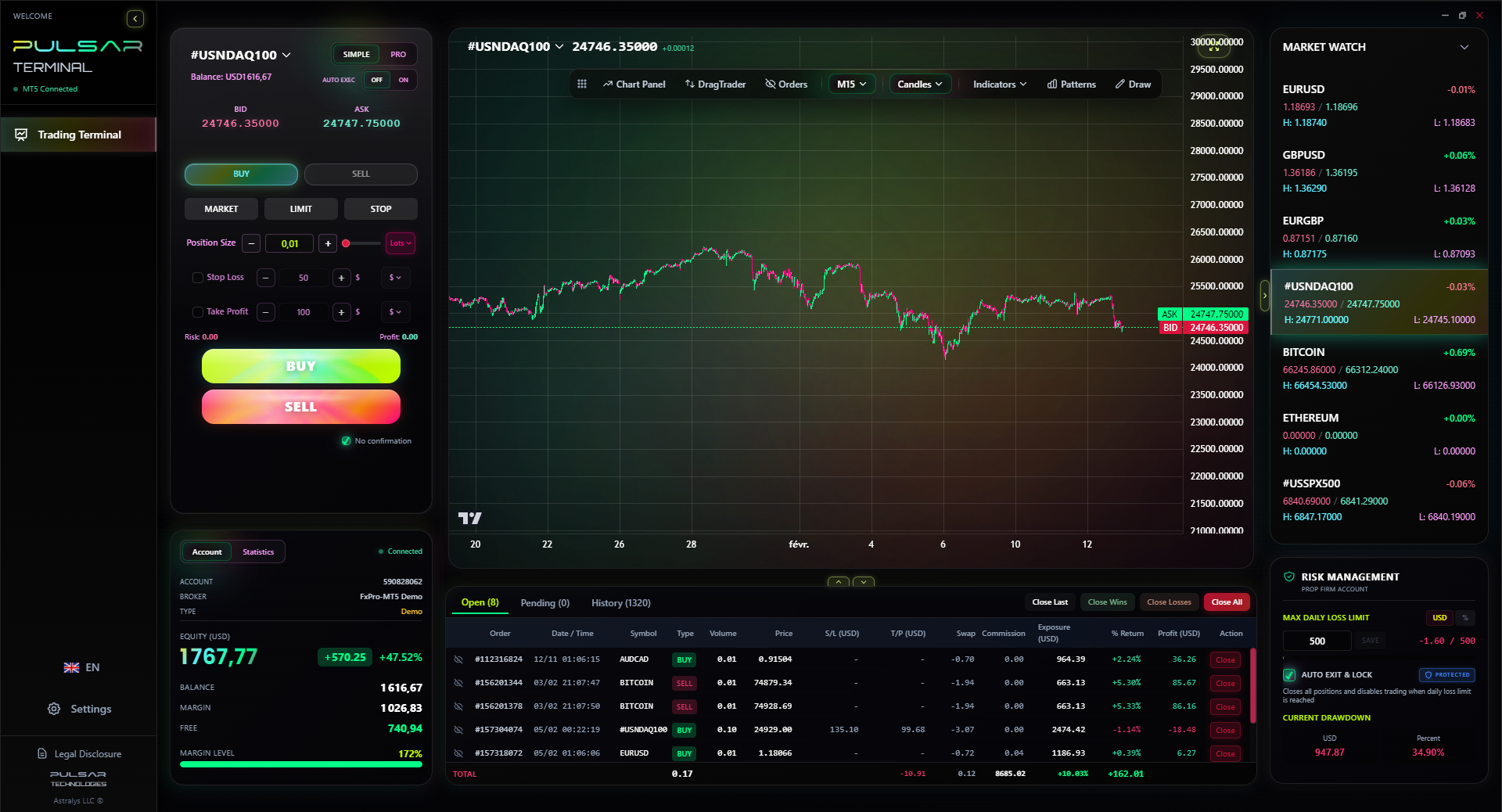
Manually moving stops and managing multiple trades is where most errors happen; a tool like Pulsar Terminal automates trailing stops, breakeven moves, and multi-level exits directly on your MT5 chart, enforcing your risk rules without emotion.
Pulsar Terminal
Alat MT5 all-in-one: order drag-and-drop, multi-TP/SL, trailing stop, grid trading, Volume Profile, dan perlindungan prop firm. Digunakan 1.000+ trader setiap hari.
“You can have a mediocre strategy and excellent risk management and still be in the game years later. The reverse is never true.”
Your biggest enemy isn't the market or your broker. It's the person in the mirror. Trading amplifies every personality flaw you have: impatience, greed, ego, fear.
Treat It Like a Business
You are the CEO, risk manager, and analyst of a one-person firm. That means:
- You have a business plan (your trading plan).
- You have fixed operating costs (spreads, commissions).
- You have a profit target and a maximum allowable loss for the day/week.
- You pay taxes (that 10%).
When I started viewing my trading terminal as my office and not a casino screen, my discipline improved dramatically.
Embrace Being Wrong
Your job is not to be right on every trade. Your job is to manage risk so that when you are wrong (which will be 40-60% of the time), you lose small. Your wins just need to be bigger than your losses on average. Detach your self-worth from the outcome of a single trade.
Keep a Trading Journal
This is non-negotiable. Log every trade: entry, exit, reason for entry, emotional state, screenshots. Review it weekly. My journal showed me I had a consistent losing pattern on Friday afternoons - I was tired and forcing trades to end the week "in profit." I now stop trading after lunch on Fridays. The data doesn't lie.
💡 Tips Winston
The 10% tax isn't a penalty, it's a business expense. Factor it into your profit targets from day one, and you'll never be surprised.
“Your biggest enemy isn't the market or your broker. It's the person in the mirror.”
Let's turn this into a clear, actionable checklist.
- Education First: Spend at least a month learning on a demo account. Understand what a pip definition is, how spread definition works, and how to place basic orders. Don't rush.
- Choose a Regulated Broker: Pick one from the list above, like Exness review or XM review, and open a demo account. Get familiar with their platform (likely MT4 or MT5).
- Develop a Simple Plan: Start with one strategy. Maybe it's trading pullbacks to the 50-period moving average on the EUR/USD guide 4-hour chart. Define your entry, stop loss, and take-profit rules precisely.
- Practice on Demo: Trade your plan on demo for 2-3 months. Aim for consistency, not huge profits. Your goal is to execute your rules without deviation.
- Secure Your Capital: Save up a realistic starting amount ($500-$1000). This is your business capital. Only use money you can afford to lose completely.
- Fund a Live Account: Start small. Deposit maybe 20% of your planned capital initially. The psychology changes when real money is on the line.
- Trade Micro Lots: Your first 50 live trades should be with the smallest possible position size. Your goal is to prove you can follow your plan under real pressure.
- Review and Scale: After 3-6 months of consistent, disciplined trading, then consider adding more capital to your account. Scale slowly.
Remember, 'how can I invest in forex' is a marathon question, not a sprint. The market will be here tomorrow. Your job is to make sure you are too.
FAQ
Q1Is Forex trading legal and safe in Nigeria?
Yes, it's legal for individuals. Safety depends entirely on you. It's safe if you use a reputable, internationally regulated broker, have a solid education, and practice strict risk management. It's unsafe if you chase get-rich-quick schemes, use unregulated platforms, or trade with money you can't afford to lose. The new ISA 2025 law aims to make the local environment safer by requiring platform registration with the SEC.
Q2How much money do I need to start Forex trading in Nigeria?
You can technically open an account with as little as $5-$10. However, to trade seriously and apply proper risk management, a realistic starting amount is between $500 and $1,000. This allows you to risk 1-2% per trade on micro or mini lots without being over-leveraged and wiped out by a few small losses.
Q3How do I pay the 10% capital gains tax on Forex profits?
You are responsible for declaring and paying this tax yourself to the Federal Inland Revenue Service (FIRS). Keep detailed records of all your trades (profits and losses). At the end of the tax year, you calculate your total gross profits from trading and pay 10% of that amount. It is not automatically deducted by international brokers.
Q4Which is the best Forex broker for Nigerians?
There's no single 'best' broker. The right broker for you depends on your trading style. Look for brokers with strong international regulation (like CySEC, FCA, ASIC) that accept Nigerian clients, offer Naira payment options or NGN accounts, and have competitive spreads. Popular and reliable choices include Exness, XM, IC Markets, and HF Markets. Always test their service with a demo account first.
Q5Can I make a living from Forex trading in Nigeria?
A very small percentage of traders do, but it's extremely difficult and takes years of dedication, discipline, and significant starting capital. You should not expect to make a living from forex when you start. Treat it first as a part-time skill to be developed. Focus on consistent profitability over months and years before ever considering it a primary income source.
Q6What is the most important skill for a Forex trader?
Risk management. It's not analysis, not prediction, not finding secret indicators. It's the disciplined ability to control your losses on every single trade. Mastering position sizing and the emotional fortitude to always use a stop loss is what keeps you in the game long enough to succeed.
Pelajaran Prof. Winston
Poin Penting:
- ✓Risk a maximum of 1-2% of your account on any single trade.
- ✓Factor Nigeria's 10% capital gains tax into all profit calculations.
- ✓Choose brokers with top-tier international regulation first.
- ✓Start with at least $500 to allow for proper position sizing.
- ✓A trading plan without risk management is just a wish list.
Seberapa bermanfaat artikel ini?
Klik bintang untuk menilai
Wawasan Trading Mingguan
Analisis & strategi mingguan gratis. Tanpa spam.
Tentang Penulis
Olumide Adeyemi
Pelopor Trading Afrika Barat
Salah satu edukator trading forex paling aktif di Nigeria. 8 tahun pengalaman trading dari Lagos. Spesialis strategi modal rendah dan tantangan prop firm untuk trader Afrika.
Komentar
Peringatan Risiko
Perdagangan instrumen keuangan mengandung risiko signifikan dan mungkin tidak cocok untuk semua investor. Kinerja masa lalu tidak menjamin hasil di masa depan. Konten ini hanya untuk tujuan edukasi dan tidak boleh dianggap sebagai nasihat investasi. Selalu lakukan riset Anda sendiri sebelum trading.
Anda mungkin juga suka

Cara Trading Forex Sukses: 7 Prinsip dari Trader Profesional
Cara trading forex sukses dengan 7 prinsip trader pro: manajemen modal, disiplin, journal trading, backtest. Data nyata, bukan janji profit palsu.
Jam Trading Forex Terbaik untuk Trader Indonesia: Panduan Lengkap dengan Tabel Waktu
Panduan jam trading forex untuk trader Indonesia. Tabel 4 sesi dunia, jam emas 20:00-00:00, sesi mana yang harus dihindari. Data akurat + tips dari trader berpengalaman.
Top 5 Sàn Forex Uy Tín Nhất 2026: Review Jujur dari Trader Indonesia
Top 5 sàn forex uy tín 2026 untuk trader Indonesia. Review jujur: spread, deposit, withdraw, dukungan lokal. Exness, XM, IC Markets & lebih.
Dapatkan Pulsar Terminal
Semua kalkulator ini terintegrasi dalam Pulsar Terminal dengan data real-time dari akun MT5 Anda.
Dapatkan Pulsar Terminal