


Here’s the brutal truth most trading courses won’t tell you: between 51% and 89% of retail CFD traders lose money.

David van der Merwe
Trader Pasar Berkembang ·  South Africa
☕ 10 mnt baca
Yang akan Anda pelajari:
Here’s the brutal truth most trading courses won’t tell you: between 51% and 89% of retail CFD traders lose money. In South Africa, with the Rand’s volatility and FSCA use capped at 30:1, the odds are stacked against you from the start. Success isn't about finding a secret indicator; it's about surviving long enough to let probability work in your favour. I’ve blown accounts, celebrated false victories, and learned that how to be successful in forex is 90% risk management and 10% everything else. Let’s cut through the noise.
Trading here isn't the Wild West. The Financial Sector Conduct Authority (FSCA) runs a tight ship, and that's a good thing for you. It means your broker has to keep your money separate from theirs (client fund segregation) and can't offer you suicidal use like 1000:1. The cap is 30:1 for major pairs, which feels restrictive but honestly saves more accounts than it hurts.
You must trade with an FSCA-licensed broker. Full stop. Checking their FSP number on the regulator's website takes two minutes. I learned this the hard way early on with a "too good to be true" offshore outfit; getting my R5,000 deposit back was a six-month nightmare. Stick with known entities like IG, XM, or AvaTrade who are properly licensed here.
Then there's SARS. They don't see your trading profits as a casual hobby. If you're trading frequently, it's considered income and taxed at your marginal rate. Keep a careful log of every trade, deposit, and withdrawal. I use a simple spreadsheet, but a dedicated journal works. The tax man cometh, and he loves spreadsheets more than you do.

Warning: The FSCA is actively cracking down. In 2024, they fined and debarred a individual over R1 million for selling unlicensed trading signals. Your first line of defence is verifying your broker's license.

💡 Tips Winston
Your first R10,000 in the market is tuition, not investment. Expect to learn, not to earn. If any of it survives, you're ahead of the curve.
“Success isn't about finding a secret indicator; it's about surviving long enough to let probability work in your favour.”
Your broker isn't a charity. They make money from you, and if you don't know where, you're already at a disadvantage. The biggest cost for most South African traders isn't commissions, it's the spread - the difference between the buy and sell price.
Let's get specific. On a major pair like EUR/USD:
- A low-cost, commission-based account (like Tickmill's Raw account) might show a spread of 0.11 pips but charge a $4 commission per lot. Your effective cost is that spread plus the commission.
- A spread-only account (like Plus500 or a standard account at FP Markets) might have a spread of 1.3 pips with no commission.
You need to do the math for your typical trade size. For a 1-lot (100,000 unit) trade, a 1.3 pip spread costs you $13 before the market even moves. That's real money.
Overnight Fees and the ZAR Account Trap
Holding a trade past 10 PM SAST? You'll pay or receive a swap fee. These are based on global interest rate differentials. Going long on a currency with a lower interest rate than the one you're shorting will cost you daily. It adds up, especially for swing trading positions.
Many brokers offer ZAR-denominated accounts. This is great to avoid bank forex fees on deposits/withdrawals. But check if the underlying asset prices are converted at a fair rate. Sometimes the convenience hides a slightly worse exchange rate. Always compare the mid-market rate on Google with your broker's quoted rate for a quick sense check.

Example: Let's say you trade 1 standard lot of EUR/USD on a spread-only account with a 1.3 pip spread. Your immediate cost is 1.3 pips * $10 (per pip for a standard lot) = $13, or about R240. You need the market to move 1.3 pips in your favour just to break even on the trade entry.
“Your primary job is capital preservation. The market is a mechanism for transferring wealth from the impatient to the patient.”
This is where 95% of traders fail. They focus on making money. You need to focus on not losing money. Your primary job is capital preservation. My mentor, an old JSE floor trader, used to say, "The market is a mechanism for transferring wealth from the impatient to the patient." He was right.
I want you to internalise one statistic: if you lose 50% of your account, you need a 100% return just to get back to breakeven. Drawdowns are a killer. Your first, second, and third rules should be about limiting losses.
This means every single trade has a predetermined stop-loss before you enter. No exceptions. Not having one is like driving without brakes because you're only planning to go forward. I once watched a USD/ZAR trade go 300 pips against me because I was "sure" it would reverse. It didn't. That R9,000 loss taught me more than any winning trade ever did.
Emotion is your enemy. Fear and greed will distort your judgement. The only antidote is a written trading plan. What pairs do you trade? What's your daily loss limit? What's your strategy for entering and exiting? If it's not written down, it's not a plan, it's a wish.

Pro Tip: Your daily loss limit should be a percentage of your account, not a Rand amount. Hitting a R1,000 loss feels different on a R10,000 account (10% gone!) versus a R100,000 account (1% gone). I never risk more than 1% of my capital on a single trade and shut down for the day if I hit a 3% total loss.
“Your primary job is capital preservation. The market is a mechanism for transferring wealth from the impatient to the patient.”
You can't control the markets. You can't predict the next SARB interest rate decision with certainty. The only thing you have 100% control over is how much you risk. This is your edge.
Position Sizing is Everything
This is the most important calculation you'll do. Never base your lot size on how much you want to make. Base it on how much you can afford to lose. Use a position size calculator. Here's the formula I live by: Risk (in ZAR) = (Account Balance * Risk Percentage per Trade) Position Size = Risk (in ZAR) / (Stop-Loss in Pips * Pip Value)
Let me give you a real example from last month. My account was R50,000. My risk per trade is 1%, so R500. I saw a setup on GBP/USD with a logical stop-loss 25 pips away. The pip value for a standard lot on GBP/USD is roughly $10 (about R185). My position size = R500 / (25 pips * R185) = 0.11 lots. That's it. Not 1 lot because I "felt good," but 0.11 lots. It keeps me in the game.
The Magic of a Risk-Reward Ratio
Aim for trades where your potential profit is at least 1.5 to 2 times your potential loss. If your stop-loss is 20 pips away, your take-profit should be 30-40 pips away. This means you can be wrong more than half the time and still be profitable. It forces you to look for quality setups, not just any price movement.
Ignoring this is why people get "whipsawed" - they take 10-pip profits but let losses run 50 pips. That's a surefire path to a margin call.
💡 Tips Winston
The 'trend is your friend' until it ends. But a tight risk-reward ratio is your family. It never leaves you.
“You can't control the markets. The only thing you have 100% control over is how much you risk. This is your edge.”
You don't need to trade everything. The USD/ZAR is incredibly volatile and sensitive to local politics and load-shedding news. It's tempting because you 'understand' it, but that volatility can wipe you out fast. Major pairs like EUR/USD or GBP/USD often have tighter spreads and more predictable liquidity.
Start with one or two pairs. Master them. Understand their average daily range, what moves them (interest rates, economic data from the US/EU), and when they are most active (London and New York sessions).
As for strategy, you have to find what fits your personality. Are you glued to the screen, or do you check once a day?
- Scalping: Trying to grab 5-10 pips many times a day. Requires intense focus, a very good broker with tight spreads (like IC Markets or Pepperstone), and iron discipline. Most fail at this. I did.
- Swing Trading: Holding trades for days or weeks, aiming for 100+ pip moves. This suits most South Africans with day jobs. You can analyse in the evening, set orders, and manage risk without staring at charts all day. This is where I've found my consistency, using basic support/resistance and indicators like the MACD for confluence.
Pick one. Backtest it on historical data (MT4/MT5 have this feature). Don't jump from strategy to strategy every time you have a losing week.
Warning: Avoid the 'indicator overload' trap. I used to have 12 different indicators on my chart. It was confusing and always gave late signals. Now I use price action (support/resistance) and maybe one or two indicators like the RSI for confirmation. Clean charts lead to clear decisions.
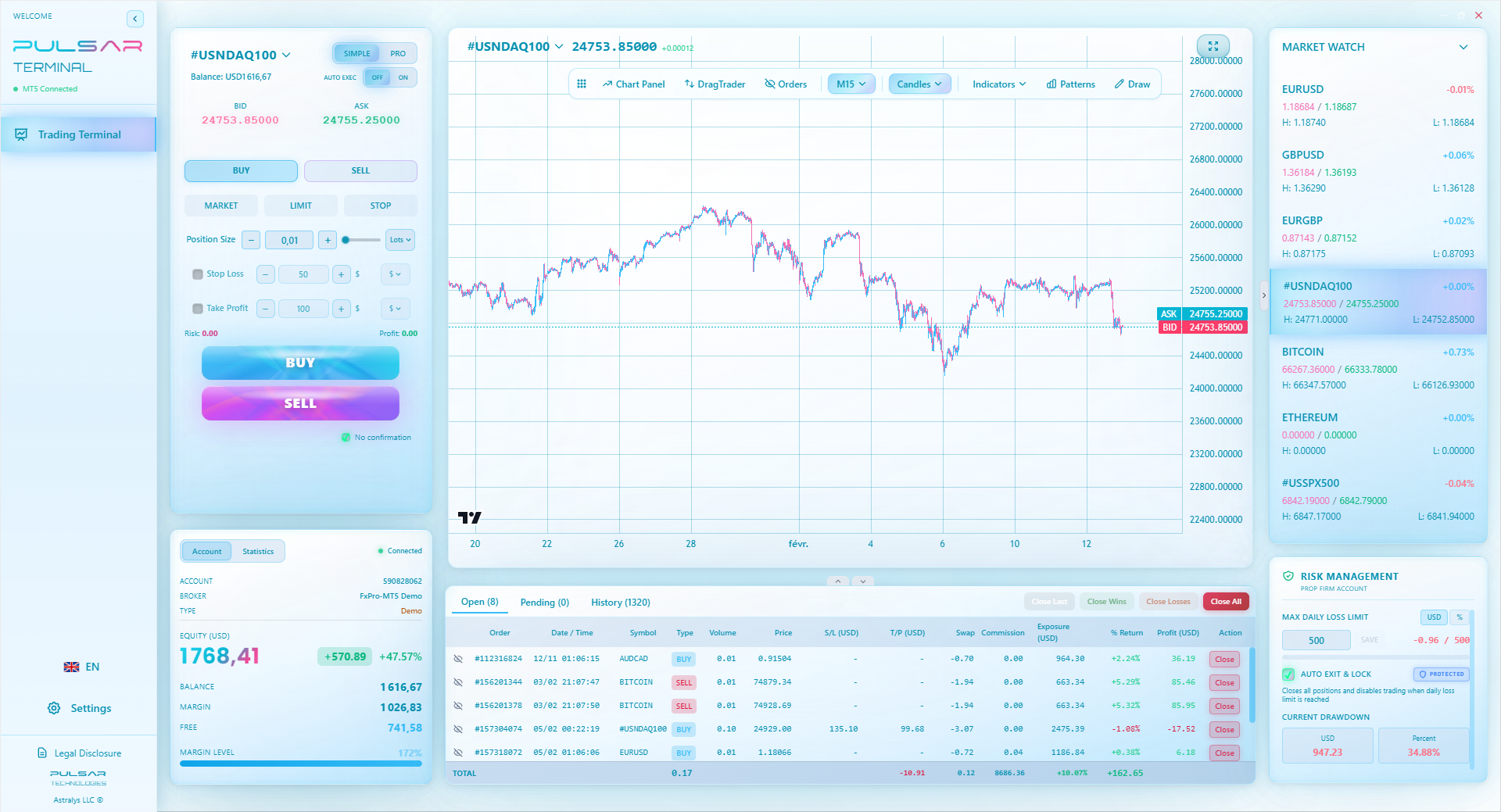
Executing a disciplined swing trading plan requires managing multiple orders and stops efficiently, which is where a tool like Pulsar Terminal for MT5 excels.
Pulsar Terminal
Alat MT5 all-in-one: order drag-and-drop, multi-TP/SL, trailing stop, grid trading, Volume Profile, dan perlindungan prop firm. Digunakan 1.000+ trader setiap hari.
“You can't control the markets. The only thing you have 100% control over is how much you risk. This is your edge.”
Let's make this practical. Here’s what a disciplined week looks like for me now, versus my chaotic early days.
| Activity | The Old Me (Blowing Up) | The Current Me (Surviving & Growing) |
|---|---|---|
| Sunday Evening | Worrying about Monday, no plan. | Review weekly economic calendar (US CPI, SARB speeches). Mark key support/resistance on my 2 pairs. No trading yet. |
| Trade Entry | See a spike, FOMO in with 2 lots. No stop-loss. | Wait for price to test my pre-drawn level. Enter with 0.15 lots. Stop-loss set immediately at 25 pips. Take-profit set at 40 pips (1.6:1 reward-risk). |
| During the Trade | Constantly check, move stop-loss, panic on retracements. | Walk away. The plan is set. I might check once at London open. |
| After a Loss | Revenge trade immediately, double the size. | Review the trade journal. Was the setup valid? Did I follow my rules? If yes, it's a good loss. I stop for the day if I hit my daily loss cap. |
| After a Win | Feel like a genius, increase lot size for next trade. | Log it. The next trade uses the exact same position size formula. No deviation. |
| Record Keeping | None. A nightmare for tax season. | Every trade logged in a journal: reason, entry/exit, screenshot, P&L. Easy SARS reporting. |
The difference is structure. The market is chaotic; your process cannot be. This structure is what finally showed me how to be successful in forex, not as a get-rich-quick scheme, but as a skilled profession with measurable, slow progress.
💡 Tips Winston
If you can't explain your trade setup in one simple sentence, you don't have a setup. You have a hope.
“The market is chaotic; your process cannot be.”
Success in forex for a South African trader isn't about buying a Lamborghini in a year. It's about consistently applying sound principles, protecting your capital from the Rand's swings and your own emotions, and grinding out a small edge over hundreds of trades.
It means choosing an FSCA-regulated broker with fair costs, using a position size calculator for every single trade, and having the humility to accept that you will be wrong often. Your goal is to make your losses small and manageable, and your winners, when they come, meaningful.
Forget the Instagram traders. Focus on your spreadsheet, your risk parameters, and your weekly review. The market will always be there tomorrow. Make sure your trading account is too. That's the only definition of success that matters in the long run.
FAQ
Q1What is the minimum amount I need to start forex trading in South Africa?
Technically, you can start with R70-R150 on a micro account. But realistically, to trade with proper risk management (not risking more than 1-2% per trade), you need at least R5,000. A more comfortable starting point for a standard account is R10,000 to R20,000. Starting with too little forces you to use excessive use to see meaningful gains, which is the fastest path to blowing up.
Q2Is forex trading taxable in South Africa?
Yes. SARS generally views frequent forex trading as income from a business, taxed at your marginal income tax rate (which can be up to 45%), not as capital gains. You must declare your net profits (total profits minus total losses and allowable expenses). Keep detailed records of all trades, deposits, and withdrawals.
Q3Can I use international brokers like IC Markets or Pepperstone as a South African?
Yes, but you must ensure they are licensed by the FSCA to offer services to South African residents. Both IC Markets and Pepperstone have global entities, but you need to specifically open an account under their FSCA-regulated entity. Always verify their FSP number on the FSCA's website before depositing any money.
Q4What's better for a beginner: a spread-only account or a commission-based account?
For a beginner with smaller trade sizes, a spread-only account is often simpler and more predictable. You see one cost (the spread). On a commission-based account with ultra-low spreads, your costs become spread + commission, which can be cheaper for larger trade sizes but adds complexity. Start simple, focus on learning, then optimize costs later.
Q5How do I avoid scams and unlicensed signal providers?
Only take advice from FSCA-licensed financial service providers. The FSCA regularly issues public warnings and fines unlicensed operators (like the R1 million fine in 2024). If someone promises guaranteed returns or secret strategies for a fee, it's a red flag. Your broker should provide execution, not financial advice, unless they are specifically licensed for it.
Q6Why is the USD/ZAR considered risky to trade?
The Rand (ZAR) is an emerging market currency prone to high volatility. It can swing wildly on local political news, credit rating announcements, Eskom updates, and global risk sentiment. The spread is also typically much wider than on majors like EUR/USD. This combination makes it easy to get stopped out quickly or incur large, unexpected losses.
Q7What is the single most important habit for a new trader?
Using a stop-loss on every single trade, without exception. It's non-negotiable. It defines your risk upfront and removes emotion from the decision. Not using one is the most common reason for catastrophic account losses.
Pelajaran Prof. Winston
Poin Penting:
- ✓Risk a maximum of 1% of your capital per trade.
- ✓Always use a stop-loss - no exceptions.
- ✓Aim for a minimum 1.5:1 risk-reward ratio.
- ✓Verify your broker's FSCA FSP number.
- ✓Log every trade for SARS and review.
Seberapa bermanfaat artikel ini?
Klik bintang untuk menilai
Wawasan Trading Mingguan
Analisis & strategi mingguan gratis. Tanpa spam.
Tentang Penulis
David van der Merwe
Trader Pasar Berkembang
Trader berbasis Johannesburg dengan 11 tahun di mata uang pasar berkembang. Spesialis pasangan ZAR, trading berregulasi FSCA, dan analisis pasar Afrika Selatan.
Komentar
Peringatan Risiko
Perdagangan instrumen keuangan mengandung risiko signifikan dan mungkin tidak cocok untuk semua investor. Kinerja masa lalu tidak menjamin hasil di masa depan. Konten ini hanya untuk tujuan edukasi dan tidak boleh dianggap sebagai nasihat investasi. Selalu lakukan riset Anda sendiri sebelum trading.
Anda mungkin juga suka

Cara Trading Forex Sukses: 7 Prinsip dari Trader Profesional
Cara trading forex sukses dengan 7 prinsip trader pro: manajemen modal, disiplin, journal trading, backtest. Data nyata, bukan janji profit palsu.
Jam Trading Forex Terbaik untuk Trader Indonesia: Panduan Lengkap dengan Tabel Waktu
Panduan jam trading forex untuk trader Indonesia. Tabel 4 sesi dunia, jam emas 20:00-00:00, sesi mana yang harus dihindari. Data akurat + tips dari trader berpengalaman.
Top 5 Sàn Forex Uy Tín Nhất 2026: Review Jujur dari Trader Indonesia
Top 5 sàn forex uy tín 2026 untuk trader Indonesia. Review jujur: spread, deposit, withdraw, dukungan lokal. Exness, XM, IC Markets & lebih.
Dapatkan Pulsar Terminal
Semua kalkulator ini terintegrasi dalam Pulsar Terminal dengan data real-time dari akun MT5 Anda.
Dapatkan Pulsar Terminal