


Most Nigerian traders get lot sizing wrong, and it's the single fastest way to turn a ₦500,000 account into a ₦50,000 memory.

Olumide Adeyemi
Pelopor Trading Afrika Barat ·  Nigeria
☕ 10 mnt baca
Yang akan Anda pelajari:
- 1What the Hell is a 'Lot' and Why Should You Care?
- 2The Only Formula You Need to Memorize (Seriously)
- 3Risk Per Trade: The 1-2% Rule Isn't a Suggestion
- 4Your Pre-Trade Checklist (Don't Skip This)
- 5Nigerian Broker use: A Double-Edged Sword
- 6Mistakes I've Made (So You Don't Have To)
- 7From Theory to Practice: A Live Trade Walkthrough
Most Nigerian traders get lot sizing wrong, and it's the single fastest way to turn a ₦500,000 account into a ₦50,000 memory. They focus on the potential profit, not the potential loss. I've seen it a hundred times. This isn't about fancy strategies; it's about survival arithmetic. I'll show you the exact math I use, why your stop loss distance is more important than your entry, and how to apply it with the brokers and regulations we deal with here.
A 'lot' is just the size of your trade. It's the multiplier on everything: your potential profit, and more importantly, your potential loss. Think of it like the throttle on a bike. Too much and you crash; too little and you go nowhere.
Forex brokers break this down into standard sizes so everyone's speaking the same language. Forget the technical jargon for a second. Here's what you're actually dealing with:
| Lot Type | Units of Base Currency | What a 10-pip move means (EUR/USD) | Good For... |
|---|---|---|---|
| Standard Lot | 100,000 | About $100 | Big accounts, institutional money. Crazy for most of us. |
| Mini Lot | 10,000 | About $10 | The sweet spot for serious retail traders. |
| Micro Lot | 1,000 | About $1 | Perfect for beginners and precise position sizing. |
| Nano Lot | 100 | About $0.10 | Testing strategies with real money, tiny accounts. |
When I started, I thought trading 1.0 lots was the mark of a pro. My first 'pro' trade was a standard lot on GBP/USD. I lost 23 pips. That was $230 gone in under an hour. On a $2,000 account. That's an 11.5% loss on one stupid trade. I felt sick. That lesson cost me more than any course ever did. That's why you need to know how to calculate lot size in forex before you even think about clicking 'buy' or 'sell'.


💡 Tips Winston
Your first job is to protect your capital. Your second job is to grow it. The lot size formula is your bodyguard for job number one.
Here it is. Write this down, stick it on your monitor:
Lot Size = (Account Risk in Naira or $) / (Stop Loss in Pips × Pip Value per Standard Lot)
Let's break that down with a Nigerian example. You have a $500 account (roughly ₦750,000). You've decided you're only willing to risk 2% of that on your next EUR/USD trade. Smart.
- Account Risk: 2% of $500 = $10.
- Stop Loss Distance: You analyze the chart and place your stop loss 25 pips away from your entry. Your Stop Loss in Pips = 25.
- Pip Value for EUR/USD: For a standard lot (100,000 units), 1 pip = $10. (For GBP/USD, it's roughly $10. For USD/JPY, it's about $9. Your platform's position size calculator will tell you).
Now, plug it in: Lot Size = $10 / (25 pips × $10) = $10 / $250 = 0.04
That's 0.04 standard lots, which is the same as 4 micro lots. That's your trade size. Not 0.1, not 0.5. 0.04. This formula ties your trade size directly to where your stop loss is. A wider stop means a smaller lot. It forces you to trade the chart, not your greed.

Example: Let's say you're trading USD/NGN (yes, some brokers have it). The pip value is different because it's not a major pair. If your platform says 1 pip for a standard lot = ₦500, and you're risking ₦15,000 (2% of ₦750k) with a 50-pip stop: Lot Size = ₦15,000 / (50 pips × ₦500) = ₦15,000 / ₦25,000 = 0.6 lots. See how the math adapts?
“Your stop loss is the most important part of the lot size equation. Pick it first, based on the chart, not your desired position size.”
Why 1-2% is Your Lifeline
I can hear you now: "2%? That's slow! I want to make money!" I get it. But trading is a probability game. Even the best strategy has losing streaks. If you risk 10% per trade and hit three losers in a row (which happens all the time), you're down 30%. You need a 43% gain just to break even. The psychology becomes impossible.
Risking 2% means you can weather 10 consecutive losses and still have 80% of your capital. It lets you sleep at night. In Nigeria, with the volatility of our own economy, you need that discipline more than anyone.
How Your Stop Loss Dictates Everything
This is the secret most miss. Your lot size isn't about your account balance alone; it's about where you place your stop. A tight 10-pip scalp on a scalping strategy allows for a bigger lot size for the same dollar risk. A 100-pip swing trading stop on the same pair forces a much smaller lot.
I learned this trading Gold (XAU/USD). Gold moves in $10-$50 chunks. A 50-pip ($5) stop is tight. Early on, I used my usual forex lot size. A 50-pip loss on Gold wiped out a week of forex profits. The XAU/USD guide wasn't wrong, I was. I had to recalculate the pip value and adjust my lots down by about 80%. Your stop loss is the most important part of the how to calculate lot size in forex equation. Pick it first, based on the chart, not your desired position size.
- Check the Spread: Before you calculate anything, look at the live spread. If you're trading EUR/USD and your broker's spread is 2 pips, that's an immediate "cost" on your trade. If your profit target is only 8 pips, the spread just ate 25% of your potential. This is crucial with brokers here. Check reviews for typical spreads on IC Markets or Pepperstone.
- Determine Your Stop Loss: Use support/resistance, ATR, whatever your method is. Let's say it's 30 pips. Write that down.
- Know Your Pip Value: Use your trading platform's tool or a simple online calculator. For a standard lot of EUR/USD, it's $10. For a micro lot, it's $1.
- Apply the Formula: Account Balance ($1000) × Risk % (0.02) = $20 Risk. $20 / (30 pips × $1 per micro lot pip) = 0.666. Round down to 6 micro lots (0.06 standard).
- Check Margin & use: With 1:500 use on a $1000 account, a 0.06 lot on EUR/USD might use about $12 in margin. You're fine. But if your calculation said 2.0 lots, that's $4000 notional value. Your $1000 account with 1:500 use only has $500,000 in buying power... but a bad move will trigger a margin call instantly. High use is a tool, not a target.

Pro Tip: I keep a simple Excel sheet open. I input my account balance, risk %, stop loss pips, and the pair. It spits out the lot size. It takes 5 seconds and removes all emotion. Do this until it's muscle memory.
💡 Tips Winston
If you feel excited about a large lot size, it's probably wrong. Good position sizing feels boring, almost too small.
“High use is a tool, not a target. It should never be the reason you increase your lot size.”
Here's the local context. International regulators (like the FCA in the UK) cap use at 1:30 for retail clients. In Nigeria, because the SEC's framework is still evolving under the new ISA 2025 act, many offshore brokers serving our market offer 1:500, 1:1000, or even 'unlimited' use.
This feels like a superpower. "I can control $10,000 with just $20!" Yes, and you can lose that $20 just as fast. use amplifies your lot size. If you don't adjust your risk percentage down, you will blow up.
My rule: I decide my position size using the formula first, ignoring use. Then I check if my account equity can support the required margin. use just lets me trade that size with less locked-up capital. It should never be the reason you increase your lot size.
A common trap with local funding methods: You deposit ₦150,000. The broker converts it to $100 at their rate. You see 1:1000 use and think you're a big shot. You trade a 0.5 lot on EUR/USD. That's a $5 move per pip. A 20-pip move against you is $100... your entire account. Game over in minutes. The broker isn't cheating you; your lot size was suicidal. The new ISA 2025 rules aim to curb platform abuses, but they can't save you from bad math.
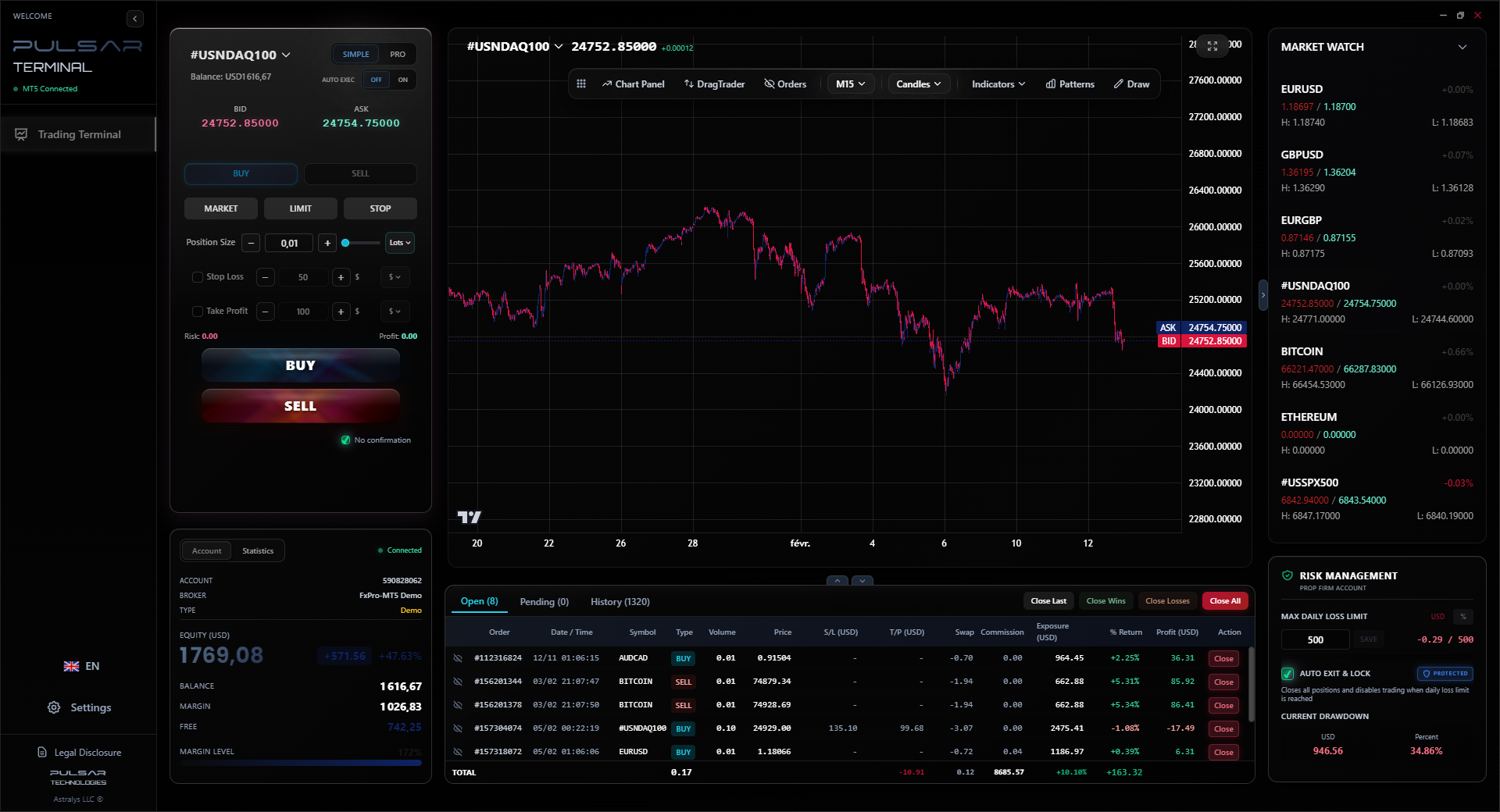
Managing high-leverage trades and precise stop losses is stressful; Pulsar Terminal's drag-and-drop order tools and automated trailing stops on MT5 take the emotion out of execution.
Pulsar Terminal
Alat MT5 all-in-one: order drag-and-drop, multi-TP/SL, trailing stop, grid trading, Volume Profile, dan perlindungan prop firm. Digunakan 1.000+ trader setiap hari.
Mistake 1: The Round Number Addiction. My calculation would say 0.037 lots. I'd think, "That's messy," and round it up to 0.04. Seems tiny. But over 100 trades, that rounding adds up to extra, uncompensated risk. Trade the exact number. Platforms allow it.
Mistake 2: Changing the Stop to Fit the Lot. This is the killer. You want to trade 0.1 lots because it feels right. The formula says with your 50-pip stop, you should only trade 0.05. So you move your stop to 25 pips to make the math work. Now your stop is in a stupid place, gets hit by market noise, and you lose. The stop loss is sacred. It comes from the market structure. Adjust the lot, never the stop.
Mistake 3: Ignoring Correlation. I once had a 'well-sized' long EUR/USD trade and a 'well-sized' short GBP/USD trade open at the same time. They're highly correlated. When the dollar ripped higher, both went against me. I wasn't risking 2%; I was risking 4% on one dollar move. Now, I use a correlation matrix and mentally add up my exposure.
Mistake 4: Not Accounting for Volatility. The lot size for a London session EUR/USD trade shouldn't be the same as for a major news event like the NFP. Higher volatility means wider probable stops. I either reduce my lot size further or stay out. Tools like the ATR indicator help here.
💡 Tips Winston
Review your trades. If your biggest loss is more than 3x your average win, your lot sizing or stop placement is broken.
“Growing a small account is about consistency and compounding, not home runs.”
Let's walk through a trade I took last month. It's in my journal.
Pair: EUR/USD (check my usual EUR/USD guide for context) Account Balance: $2,150 My Max Risk: 1.5% (I was in a drawdown, so I reduced from 2%). 1.5% of $2,150 = $32.25 risk. Chart Analysis: I entered a buy at 1.0725. The nearest clear support was at 1.0690. That's a 35-pip stop loss. Pip Value: $10 per standard lot, $1 per micro lot.
Calculation: Lot Size = $32.25 / (35 pips × $1 per micro lot pip) = $32.25 / $35 = 0.921 micro lots.
I entered 0.92 micro lots (which is 0.0092 standard lots). My platform (MT5) allows this precision.
What happened? The trade went my way. I moved my stop to breakeven at +20 pips, then trailed it. I eventually took profit at 1.0820 for a 95-pip gain.
Profit: 95 pips × $0.92 per pip (value of my 0.92 micro lot) = $87.40.
That's a 4% gain on my account from one trade, with risk tightly controlled. The lot size wasn't sexy, but the outcome was. That's the power of knowing how to calculate lot size in forex. It's boring. It's mechanical. And it's the only thing separating the consistent from the busted.
FAQ
Q1What is a good lot size for a $100 account in Nigeria?
With a $100 (approx. ₦150k) account, you should almost exclusively be trading in micro lots (0.01). If you risk 2% ($2) with a 20-pip stop on EUR/USD, your lot size would be $2 / (20 pips * $1) = 0.1 micro lots. That's tiny, but it's safe. This is why many start with Cent accounts or higher use brokers, but the principle remains: risk a tiny percentage.
Q2How does use affect my lot size calculation?
It doesn't, directly. First, calculate your lot size using your account balance and risk percentage. use then determines how much of your own money (margin) is required to open that trade. High use doesn't mean you should trade bigger lots; it just means you can with less cash locked up. Never increase your lot size just because your use allows it.
Q3I use Naira. Should I convert everything to USD first for the formula?
Yes, for simplicity. Most international brokers denominate accounts in USD, EUR, or GBP. Even if you deposit Naira, it's converted. Do all your calculations in your account's currency. If your broker offers a NGN account, use Naira values: a pip might be worth ₦50 for a standard lot. Use the same formula: (Account Balance in ₦ × Risk %) / (Stop Loss in Pips × Pip Value in ₦).
Q4What's the difference between lot size and position size?
In everyday talk, they're the same. Technically, 'lot size' refers to the standardized unit (micro, mini, standard). 'Position size' is the total volume of your trade, which is expressed in lots. When we 'calculate lot size,' we're really calculating the required position size and then expressing it in lots.
Q5How do I calculate pip value for exotic pairs like USD/NGN?
The formula is: (One Pip in decimal form * Trade Size) / Market Rate. For USD/NGN, if 1 pip is 0.01 (since it's quoted to two decimals), your trade size is 100,000 units (1 standard lot), and the rate is 1500, then Pip Value = (0.01 * 100,000) / 1500 = 1000 / 1500 = ₦0.666. Most platforms have a built-in calculator or display it on the order window - always verify.
Q6Is the 1-2% rule realistic for small Nigerian accounts?
It's the most realistic thing you can do. A small account trying to risk 5-10% to 'grow fast' has a 99% chance of dying fast. Growing a small account is about consistency and compounding, not home runs. Risking 2% on a ₦100,000 account means risking ₦2,000 per trade. That keeps you in the game long enough to learn.
Q7Do prop firms in Nigeria change how I calculate lot size?
Absolutely, and it's stricter. Prop firms have maximum daily loss limits (e.g., 5% of your starting challenge balance). Your risk per trade must be a fraction of that. If your max daily loss is $500, you might risk only 0.5% ($50) per trade to allow for multiple attempts. The calculation is the same, but your 'account balance' in the formula is effectively your maximum allowed loss for the day or phase.
Pelajaran Prof. Winston
Poin Penting:
- ✓Always calculate lot size using risk % (1-2%) before entering a trade.
- ✓Your stop loss distance dictates your lot size, not the other way around.
- ✓A $10 risk with a 50-pip stop means a 0.02 lot on EUR/USD.
- ✓Nigerian high use demands stricter risk control, not bigger trades.
- ✓Use micro lots (0.01) for precision and small account safety.
Seberapa bermanfaat artikel ini?
Klik bintang untuk menilai
Wawasan Trading Mingguan
Analisis & strategi mingguan gratis. Tanpa spam.
Tentang Penulis
Olumide Adeyemi
Pelopor Trading Afrika Barat
Salah satu edukator trading forex paling aktif di Nigeria. 8 tahun pengalaman trading dari Lagos. Spesialis strategi modal rendah dan tantangan prop firm untuk trader Afrika.
Komentar
Peringatan Risiko
Perdagangan instrumen keuangan mengandung risiko signifikan dan mungkin tidak cocok untuk semua investor. Kinerja masa lalu tidak menjamin hasil di masa depan. Konten ini hanya untuk tujuan edukasi dan tidak boleh dianggap sebagai nasihat investasi. Selalu lakukan riset Anda sendiri sebelum trading.
Anda mungkin juga suka

Cara Trading Forex Sukses: 7 Prinsip dari Trader Profesional
Cara trading forex sukses dengan 7 prinsip trader pro: manajemen modal, disiplin, journal trading, backtest. Data nyata, bukan janji profit palsu.
Jam Trading Forex Terbaik untuk Trader Indonesia: Panduan Lengkap dengan Tabel Waktu
Panduan jam trading forex untuk trader Indonesia. Tabel 4 sesi dunia, jam emas 20:00-00:00, sesi mana yang harus dihindari. Data akurat + tips dari trader berpengalaman.
Top 5 Sàn Forex Uy Tín Nhất 2026: Review Jujur dari Trader Indonesia
Top 5 sàn forex uy tín 2026 untuk trader Indonesia. Review jujur: spread, deposit, withdraw, dukungan lokal. Exness, XM, IC Markets & lebih.
Dapatkan Pulsar Terminal
Semua kalkulator ini terintegrasi dalam Pulsar Terminal dengan data real-time dari akun MT5 Anda.
Dapatkan Pulsar Terminal