


I remember my first real forex order like it was yesterday.

David van der Merwe
Trader Pasar Berkembang ·  South Africa
☕ 12 mnt baca
Yang akan Anda pelajari:
- 1The South African Forex Landscape: Rules You Can't Ignore
- 2Picking Your Platform: Where to Place Those Orders
- 3Market, Limit, Stop: The Three Orders You Actually Need
- 4A Walkthrough: Placing Your First Real Trade
- 5How South African Traders Mess Up Orders (I've Done It All)
- 6From Basic Orders to a Trading Plan
I remember my first real forex order like it was yesterday. It was 2013, USD/ZAR was at 10.25, and my hand was shaking so much I nearly clicked 'Buy' instead of 'Sell'. I didn't understand half the buttons on the MT4 platform. That trade, a messy 0.1 lot sell, ended up netting me R800 after a sleepless night. More importantly, it taught me that knowing how to place an order on forex is the difference between a planned execution and a costly mistake. Let's get you past the shaky-hands phase.
Before you even think about clicking that buy button, you need to know the local playing field. Trading forex is completely legal here, but we have our own set of rules, courtesy of the Financial Sector Conduct Authority (FSCA).
First, the big one: you cannot speculate directly against the Rand. That means no shorting USD/ZAR just because you think the Rand is going to strengthen. This rule trips up so many new traders. You can trade other major pairs like EUR/USD or GBP/USD, or even exotic pairs that don't involve the ZAR, but betting against your own currency is a no-go.
The FSCA also capped use at 30:1 for retail traders a few years back. Some international brokers might offer you more, but if they're FSCA-regulated, they have to stick to this limit. It's actually not a bad thing. Higher use is a one-way ticket to a margin call for most beginners. On a R10,000 account, 30:1 gives you enough power to make decent moves without turning a small dip into an account-ending event.
Then there's tax. SARS wants its share. Your trading profits are considered income, not capital gains. Keep a careful record of every trade, win or loss. You can deduct your trading-related expenses - data fees, broker commissions, even a portion of your internet bill - against that income. I learned this the hard way in my second year and had to scramble to reconstruct my trading history.

Warning: Trading with an international broker not regulated by the FSCA means you forfeit local regulatory protection. If they go under or there's a dispute, your recourse is limited. Always check the FSCA's public register first.
Finally, getting your money in and out. You can use your single discretionary allowance (R1 million per year) to fund an international broker account through your bank. For amounts over that, you're looking at using your foreign capital allowance (R10 million) with more paperwork. It's smoother to use an FSCA-regulated broker that accepts ZAR deposits directly.

💡 Tips Winston
Your first ten trades with real money should be 0.01 lots. The goal isn't profit; it's to prove you can follow your own rules without emotion. If you can't, you're not ready.
“Knowing how to place an order on forex is the difference between a planned execution and a costly mistake.”
Your broker is your gateway to the markets. In South Africa, you've got a mix of global giants with local licenses and dedicated local players. The choice dictates your costs, the tools you get, and how easily you can deposit your Rands.
Regulation is Non-Negotiable
Your first filter should be FSCA regulation. I don't care how good the spreads look. An unregulated broker is a risk you don't need. Look up the FSP number on the FSCA website. For example, AvaTrade is registered under FSP No. 45984. This is your safety net.
Understanding the Real Costs
The advertised 'minimum deposit' is often a trap. Sure, you can start with $5 (about R90) on XM or $10 on Exness. But try trading seriously with that. You'll be over-leveraged in seconds. A realistic starter amount is R1,500 to R5,000. This lets you trade sensible position sizes and survive the inevitable drawdowns.
The real cost is in the spread and commissions. You'll see two main account types:
- Spread-Only Accounts: The broker's profit is built into the difference between the buy and sell price. Easy to understand, but spreads can widen during news events.
- Raw Spread/Commission Accounts: You get razor-thin spreads (sometimes 0.0 pips on EUR/USD) but pay a commission per lot traded.
Let's break it down with a real example from early 2024. I was comparing entries on EUR/USD:
| Broker | Account Type | Avg. EUR/USD Spread | Commission | Effective Cost per 1 Lot (Round Turn) |
|---|---|---|---|---|
| Broker A (Standard) | Spread-Only | 0.9 pips | $0 | $9.00 |
| Tickmill (Raw) | Raw/Commission | 0.1 pips | $6 ($3 per side) | $7.00 |
For a high-frequency scalping strategy, the Raw account saved me money. For a swing trading position I'd hold for days, the spread-only account was fine. Always do the math.
Platform and Tools
Most brokers offer MT4 or MT5. They're the industry standard for a reason. Some, like IG, have their own powerful platforms. Check if they offer local ZAR bank transfer deposits and withdrawals without crazy fees. There's nothing worse than winning R5,000 and losing R500 of it to currency conversion and wire fees.

Pro Tip: Open demo accounts with 2-3 FSCA-regulated brokers. Test their order execution speed during volatile market opens (like London at 10:00 SAST). Slippage on a demo can reveal real-world execution problems.
“A 0.1 lot trade with no stop can turn a R1,500 account negative in the blink of an eye.”
This is the core of how to place an order on forex. You don't need to know all 15 fancy order types. Master these three, and you're set for 99% of your trading.
1. Market Order: This is 'buy now' or 'sell now' at the best available price. You click, you're in. It's simple but dangerous. In fast markets, the price you get (execution price) can be different from the price you saw (quoted price). This is slippage. I once entered a market buy on GBP/JPY during a news spike expecting 155.00 and got filled at 155.40. That's 40 pips of instant loss before the trade even started. Use market orders only when you absolutely must get in immediately, and accept that slippage is part of the deal.
2. Limit Order: This is your 'buy low, sell high' order. You set a price better than the current market price.
- Buy Limit: Set below the current price. It means "Buy EUR/USD, but only if it drops to 1.0850 first."
- Sell Limit: Set above the current price. "Sell GBP/USD, but only if it rallies to 1.2800."
This is perfect for entering on pullbacks. Say Gold (XAU/USD) is in an uptrend but pulling back. You believe $2340 is a key support area. Instead of chasing it, you place a Buy Limit at $2340.50. If price hits it, your order triggers. If not, you don't enter. No stress, no chasing. I use this constantly for my XAU/USD trades.
3. Stop Order (Stop-Entry): This is your 'breakout' order. You set a price worse than the current market price.
- Buy Stop: Set above the current price. "Buy USD/ZAR if it breaks above 18.5000 resistance."
- Sell Stop: Set below the current price. "Sell EUR/USD if it breaks below 1.0750 support."
Remember our rule about not speculating against the ZAR? This is how you'd trade a USD/ZAR breakout in the direction of the trend if you were allowed (using a non-ZAR pair as an example).
Stop-Loss vs. Take-Profit: These aren't entry orders, but they're attached to your entry. Your Stop-Loss (SL) is your emergency exit. Your Take-Profit (TP) is your profit target. Always, always set them the moment you place the trade. Hoping to 'move your stop later' is how R10,000 losses happen.
💡 Tips Winston
The 'At Price' box for a pending order is where most mistakes happen. Double-check it. A Buy Limit at 1.0850 is very different from a Sell Limit at 1.0850.
“Complexity without understanding is a great way to confuse yourself into a loss.”
Let's run through a concrete example. It's a Tuesday morning, and you're looking at EUR/USD on your MT5 platform from Pepperstone.
Scenario: Price is currently 1.0720. Your analysis shows strong support at 1.0700 and resistance at 1.0760. You think it will bounce off support and head towards resistance.
Step 1: The Decision You decide you want to BUY EUR/USD at 1.0705 (just above the key support), with a stop-loss at 1.0685 (20 pips risk), and a take-profit at 1.0755 (50 pips target). That's a 1:2.5 risk/reward ratio. Solid.
Step 2: Opening the Order Window Right-click on the chart or find the 'New Order' button. The ticket pops up. It'll ask for:
- Symbol: EUR/USD (already selected if you're on that chart).
- Volume: This is your lot size. This is CRITICAL. Don't just guess. Use a position size calculator.
Let's say your account is R20,000, and you only want to risk 1% of it on this trade (R200). Your stop-loss is 20 pips. On EUR/USD, 1 pip on a standard lot (100,000 units) is $10. But your account is in ZAR, so you need to convert.
R200 risk / (20 pips * $10 per pip per lot * ZAR/$ exchange rate ~18.5) = Approximately 0.05 lots.
So, you'd enter '0.05' in the volume field. This precise calculation prevents one bad trade from wrecking you.
Step 3: Setting the Order Type You don't want to buy at the current price (1.0720). You want to buy lower. So, you change the 'Type' from 'Market Execution' to 'Pending Order'. Then, select 'Buy Limit' from the dropdown.
Step 4: Filling in the Details
- At Price: You set this to 1.0705 (your desired entry).
- Stop Loss: You set this to 1.0685.
- Take Profit: You set this to 1.0755.
Step 5: Review and Place Check everything. Volume: 0.05. Type: Buy Limit. Price: 1.0705. SL: 1.0685. TP: 1.0755. Click 'Place'. Your order is now live in the market, waiting. You can close your platform. If price drops to 1.0705, it will trigger automatically, with the SL and TP attached. If price never drops, the order expires (you can set an expiry date) or you cancel it.

Example: That R200 risk on a 0.05 lot trade. If your TP hits at 1.0755, you make 50 pips. 50 pips * $0.50 per pip (on a 0.05 lot) = $25 profit. At ZAR 18.50/$, that's about R462.50. You risked R200 to make a potential R462.50.
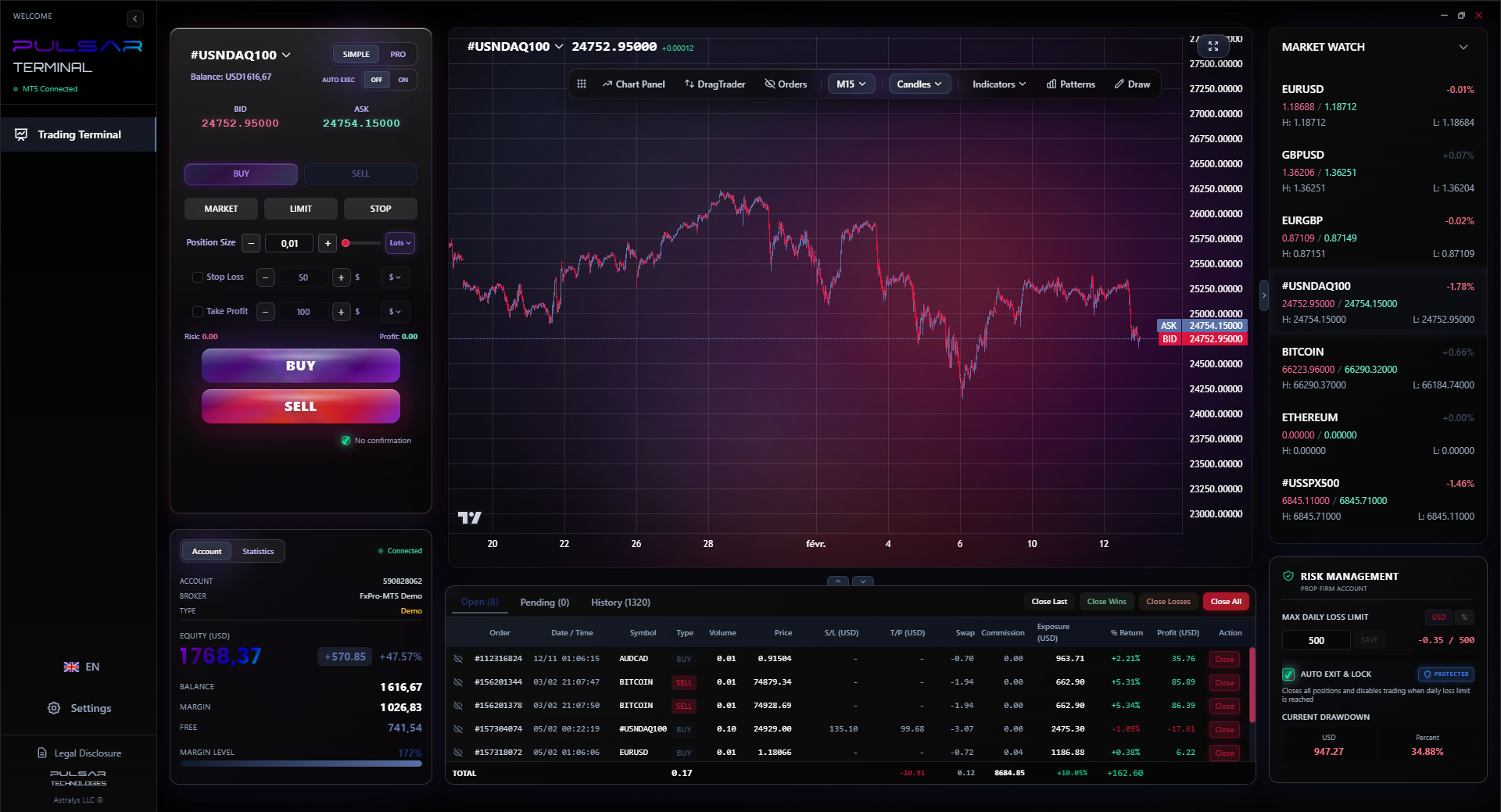
Managing multiple take-profit levels and a trailing stop on a single trade is complex, but tools like Pulsar Terminal simplify this with drag-and-drop order management directly on your MT5 charts.
Pulsar Terminal
Alat MT5 all-in-one: order drag-and-drop, multi-TP/SL, trailing stop, grid trading, Volume Profile, dan perlindungan prop firm. Digunakan 1.000+ trader setiap hari.
“Complexity without understanding is a great way to confuse yourself into a loss.”
Let's save you some money and heartache by learning from my (expensive) errors.
Mistake 1: Ignoring the ZAR Conversion. You calculate your risk in Rands, but your platform shows profit/loss in Dollars. You think you're risking R500, but with a shifting USD/ZAR rate, your actual Rand risk could be R550 or R450. Either use a broker that offers a ZAR-denominated account, or always do the conversion manually when calculating position size. I once had a great week in $ terms, but a weakening Rand wiped out 30% of my profit when I withdrew.
Mistake 2: Chasing the Market with Market Orders. You see EUR/USD shooting up. FOMO kicks in. You hammer the market buy button. You get filled at the worst possible price, right before a reversal. This is how you buy the top. Use a limit order to enter on a retracement, or have the discipline to wait for the next setup.
Mistake 3: Not Using a Stop-Loss. Ever. This is the account killer. "I'll just watch it closely." No, you won't. The market can move 100 pips in minutes during news. A 0.1 lot trade with no stop can turn a R1,500 account negative in the blink of an eye. The FSCA's 30:1 use rule helps, but it's not a substitute for your own stop-loss. Attach it immediately.
Mistake 4: Misunderstanding Swap Fees. You open a long-term buy trade on AUD/JPY because the MACD indicator looks good. You hold it for two weeks and wonder why you're being charged a few dollars every night. That's the swap (or rollover) fee, based on the interest rate difference between the two currencies. It can eat into profits or add to losses on long-held positions. Check your broker's swap rates calendar.
Mistake 5: Overcomplicating It. You don't need to set 5 take-profit levels and a trailing stop on your first trade. Keep it simple: one entry, one stop, one target. Master that flow first. Complexity without understanding is a great way to confuse yourself into a loss.
💡 Tips Winston
If you find yourself constantly moving your stop-loss further away, you're not trading. You're gambling. Your initial stop-loss calculation is a promise to yourself. Keep it.
“Your first real trade shouldn't be a 1.00 lot monster. Make it a 0.01 lot trade. The goal is to execute your plan perfectly.”
Placing a single order is a skill. Placing orders as part of a consistent strategy is a profession. Here's how to bridge that gap.
Your Trading Plan is Your Rulebook. It should answer:
- What pairs do I trade? Don't trade 28 pairs. Master 2-3. Maybe EUR/USD for its liquidity and GBP/USD for its volatility.
- What's my entry signal? Is it a specific RSI indicator reading? A candlestick pattern at a support level? Be specific. "It looks good" is not a signal.
- What order type do I use? If your signal is a breakout above yesterday's high, you'll use a Buy Stop. If it's a bounce off a moving average, you'll use a Buy Limit.
- Where is my stop-loss? Base it on market structure, not an arbitrary number of pips. Place it beyond the recent swing low (for a buy) or swing high (for a sell).
- Where is my take-profit? Do you take profit at the next resistance? Do you use a risk-reward ratio of 1:1.5? Decide beforehand.
Journal Every Single Order. Not just "won R500." Log: Date, Pair, Order Type (Buy Limit), Entry Price, Lot Size, Stop Price, Target Price, Exit Price, P&L in Rands, and most importantly - Reason for Trade. Did you follow your plan? A few months of journaling will show you if your Buy Limit orders are working better than your Market Orders, or if you keep making the same mistake.
Practice, Then Practice More. Use a demo account for at least 2-3 months, or until you can have 3 profitable months in a row. Treat the virtual R100,000 as if it were real. This is where you build the muscle memory of correctly placing an order on forex without emotion. When you switch to real money, start small. Your first real trade shouldn't be a 1.00 lot monster. Make it a 0.01 lot trade. The goal is to execute your plan perfectly, not to get rich on the first click.
The market will always be there. Your job is to be prepared, precise, and patient with every order you place.
FAQ
Q1What is the minimum amount I need to start trading forex in South Africa?
While some brokers let you start with as little as $5 (roughly R90), that's a trap. You'll be over-leveraged instantly. For sustainable trading where you can properly manage risk, a minimum of R1,500 to R5,000 is realistic. This allows for sensible position sizing and lets you weather normal market fluctuations without a single trade wiping you out.
Q2Can I use a foreign broker like Exness or XM from South Africa?
Yes, you can. Many South Africans do. However, you must understand that if the broker is not regulated by the South African FSCA, you will not have the protections offered under local law. It's safer to choose a broker that holds an FSCA license, as this ensures they comply with local use limits (30:1) and client fund segregation rules. Always verify their FSP number on the FSCA website.
Q3What's the difference between a spread and a commission?
A spread is the difference between the buy (ask) and sell (bid) price, and it's how many brokers make their money. A commission is a separate fee charged per lot traded, usually on accounts with very low 'raw' spreads. You need to calculate the total cost. For example, a 0.1 pip spread plus a $6 commission might be cheaper overall than a 0.9 pip spread with no commission, especially if you trade larger volumes.
Q4Is it better to use a market order or a limit order?
It depends on your strategy. Use a market order when you need instant execution and are willing to accept potential slippage (getting a worse price). Use a limit order when you have a specific, better price in mind for entry. For most retail traders, limit orders are better because they enforce discipline - you only get in at your predetermined price, preventing emotional, chase-the-market entries.
Q5How do I calculate my position size correctly?
You must use a position size calculator or the formula: (Account Risk in Rands) / (Stop-Loss in Pips * Pip Value in Rands). First, decide what percentage of your account you'll risk (e.g., 1%). On a R20,000 account, that's R200. If your stop-loss is 25 pips on EUR/USD, and 1 pip = ~R1.85 (depending on USD/ZAR), your position size should be roughly R200 / (25 * R1.85) = about 0.04 lots. Never trade without this calculation.
Q6What happens if I don't set a stop-loss?
You are giving the market a blank cheque against your account balance. A fast-moving market can cause losses far beyond your initial deposit, leading to a margin call where your broker automatically closes your positions at a huge loss, and you may even owe them money. Always set a stop-loss. It's not a suggestion; it's the most important part of how to place an order on forex.
Q7How are my forex trading profits taxed in South Africa?
SARS views forex trading profits as income from a business or speculative activity, not capital gains. This means profits are added to your other income and taxed at your marginal rate. The good news is you can deduct legitimate trading expenses (broker fees, data subscriptions, a portion of home office costs) against this income. Keep detailed, auditable records of every trade and expense.
Pelajaran Prof. Winston
Poin Penting:
- ✓Always verify FSCA regulation before funding any broker.
- ✓Use a position size calculator for every single trade.
- ✓Attach your stop-loss the moment you place the entry order.
- ✓Limit orders enforce discipline; market orders often enable emotion.
- ✓Journal the 'Reason for Trade' to find your true edge.
Seberapa bermanfaat artikel ini?
Klik bintang untuk menilai
Wawasan Trading Mingguan
Analisis & strategi mingguan gratis. Tanpa spam.
Tentang Penulis
David van der Merwe
Trader Pasar Berkembang
Trader berbasis Johannesburg dengan 11 tahun di mata uang pasar berkembang. Spesialis pasangan ZAR, trading berregulasi FSCA, dan analisis pasar Afrika Selatan.
Komentar
Peringatan Risiko
Perdagangan instrumen keuangan mengandung risiko signifikan dan mungkin tidak cocok untuk semua investor. Kinerja masa lalu tidak menjamin hasil di masa depan. Konten ini hanya untuk tujuan edukasi dan tidak boleh dianggap sebagai nasihat investasi. Selalu lakukan riset Anda sendiri sebelum trading.
Anda mungkin juga suka

Cara Trading Forex Sukses: 7 Prinsip dari Trader Profesional
Cara trading forex sukses dengan 7 prinsip trader pro: manajemen modal, disiplin, journal trading, backtest. Data nyata, bukan janji profit palsu.
Jam Trading Forex Terbaik untuk Trader Indonesia: Panduan Lengkap dengan Tabel Waktu
Panduan jam trading forex untuk trader Indonesia. Tabel 4 sesi dunia, jam emas 20:00-00:00, sesi mana yang harus dihindari. Data akurat + tips dari trader berpengalaman.
Top 5 Sàn Forex Uy Tín Nhất 2026: Review Jujur dari Trader Indonesia
Top 5 sàn forex uy tín 2026 untuk trader Indonesia. Review jujur: spread, deposit, withdraw, dukungan lokal. Exness, XM, IC Markets & lebih.
Dapatkan Pulsar Terminal
Semua kalkulator ini terintegrasi dalam Pulsar Terminal dengan data real-time dari akun MT5 Anda.
Dapatkan Pulsar Terminal