


You want to know how to sell and buy on forex? Good.

David van der Merwe
Trader Pasar Berkembang ·  South Africa
☕ 9 mnt baca
Yang akan Anda pelajari:
- 1The Nuts and Bolts: What 'Buy' and 'Sell' Actually Mean
- 2Your First Trade: A Walkthrough with Real Numbers
- 3Why Most Traders Blow Up: It's Not What You Think
- 4Analysis Paralysis: Finding a Signal You Can Actually Trust
- 5Trading from South Africa: The Local Realities
- 6Putting It All Together: A Routine That Doesn't Fail
You want to know how to sell and buy on forex? Good. But let's be honest, you're probably asking the wrong question. The real question isn't 'how do I click the button,' it's 'how do I do this without losing my shirt in the first six months?' I've seen it a thousand times. The excitement of that first trade, followed by the slow, painful drain of an account. This isn't about finding a magic bullet. It's about understanding the machinery so you don't get crushed by it. Let's talk about what actually works, and more importantly, what doesn't.
Forget the textbook definitions for a second. When you 'buy' EUR/USD, you're not buying euros like you buy bread. You're making a bet. You're betting that the value of the euro will go UP relative to the US dollar. The price you see? That's how many dollars it costs to buy one euro.
When you 'sell' EUR/USD, you're betting the opposite. You're betting the euro will go DOWN against the dollar. You're selling something you don't own first, hoping to buy it back later at a cheaper price. It's called going short, and it's where most new traders freeze up. They only think about buying things going up. In forex, you can profit from chaos and collapse just as easily.
The quote is always in pairs. For USD/ZAR, the first currency (USD) is the 'base.' The price tells you how many South African Rands (the 'quote' currency) one US Dollar is worth. If USD/ZAR is 18.50, you need R18.50 to buy $1. If you think the Rand will strengthen (the pair will fall), you sell. If you think the Dollar will strengthen (the pair will rise), you buy. It's that simple, and that complex.

Warning: The biggest mental hurdle isn't the mechanics. It's accepting that 'sell' isn't a dirty word. Some of my most profitable trades have been short sells during a market panic, while everyone else was trying to catch a falling knife by buying.

“The real question isn't 'how do I click the button,' it's 'how do I do this without losing my shirt in the first six months?'”
Let's run through a real example with a South African twist. You're using a broker like IC Markets or Pepperstone, you've funded your account, and you're looking at the USD/ZAR chart.
The Setup
You've done your analysis (we'll get to that minefield later) and believe the US Federal Reserve is going to be hawkish. You think USD/ZAR will rise from its current price of 18.7500. You decide to BUY.
You click 'New Order' on your platform. A ticket pops up. Here’s where you make your first big decisions:
- Symbol: USDZAR
- Volume: This is your position size. You have a R20,000 account. A rookie mistake is to throw R5,000 at this. Don't. Let's use a sane 1% risk. We'll use a position size calculator later, but for now, let's say you choose 0.5 lots (a 'mini lot').
- Stop Loss (SL): You set this at 18.6500. This is non-negotiable. It means if the trade goes against you by 1000 points (or pips), you're out. You're defining your maximum pain upfront. A pip on USD/ZAR is usually 0.0010.
- Take Profit (TP): You set this at 19.0000, aiming for a 2500 pip gain.
You click 'Buy'. Your trade is live. The platform will show your floating P&L. The spread (the difference between buy and sell price) is your immediate cost.
What Happens Next
Scenario A (You're right): Price climbs. It hits 19.0000, your trade closes automatically, and you bank a profit. Scenario B (You're wrong): Price drops to 18.6500, your stop loss triggers, and you take a controlled, planned loss.
I once bought GBP/JPY on a 'sure thing' news play. Didn't set a stop loss because 'I was watching it.' A surprise announcement hit, and it moved 300 pips against me in 90 seconds. I lost 15% of my account sitting there, frozen. That lesson cost me real money. Always use the stop loss.

Example: On that USD/ZAR trade, with 0.5 lots, each pip of movement is worth roughly R5. A 100-pip move = R500. Your 100-pip stop loss risk is R500 (2.5% of R20k – a bit high, but you see the math). Your 250-pip target profit would be R1,250.

💡 Tips Winston
Your stop loss isn't a suggestion. It's a pre-paid admission ticket that you were wrong. Use it.
“When you 'sell' EUR/USD, you're betting the euro will go DOWN against the dollar. You're selling something you don't own first, hoping to buy it back later at a cheaper price.”
The button is easy. The psychology is hard. After 12 years, I can tell you the number one reason accounts go to zero: poor position sizing and no risk management. It's boring, but it's true.
You get three trades wrong in a row with 5% of your account each time. That's a 15% drawdown. To get back to even, you need to make about 17.6% on your now-smaller capital. The hole gets deeper fast. This is why prop firms have such strict daily loss limits, a rule you can automate with tools like Pulsar Terminal.
Another classic blow-up move: revenge trading. You take a R1,000 loss. Your ego is bruised. You immediately jump into a trade twice the size to 'make it back fast.' You're now emotionally compromised, trading not the chart, but your anger. This is how a R1,000 loss becomes a R5,000 disaster.
Then there's the 'martingale' or averaging down trap. Your USD/ZAR buy trade goes against you. 'It's a bargain now!' you think, and you buy more at 18.7000 to lower your average price. It drops again to 18.6500. You buy even more. You've now tied up most of your capital in a single losing idea, waiting for a miracle. This isn't investing. It's hoping. And hope is not a strategy. It's a direct path to a margin call.

Pro Tip: Your first job is capital preservation, not capital appreciation. Risk 1% or less of your account on any single trade. If that feels too small, your account is too small for the lot sizes you want to trade. Build it up slowly.
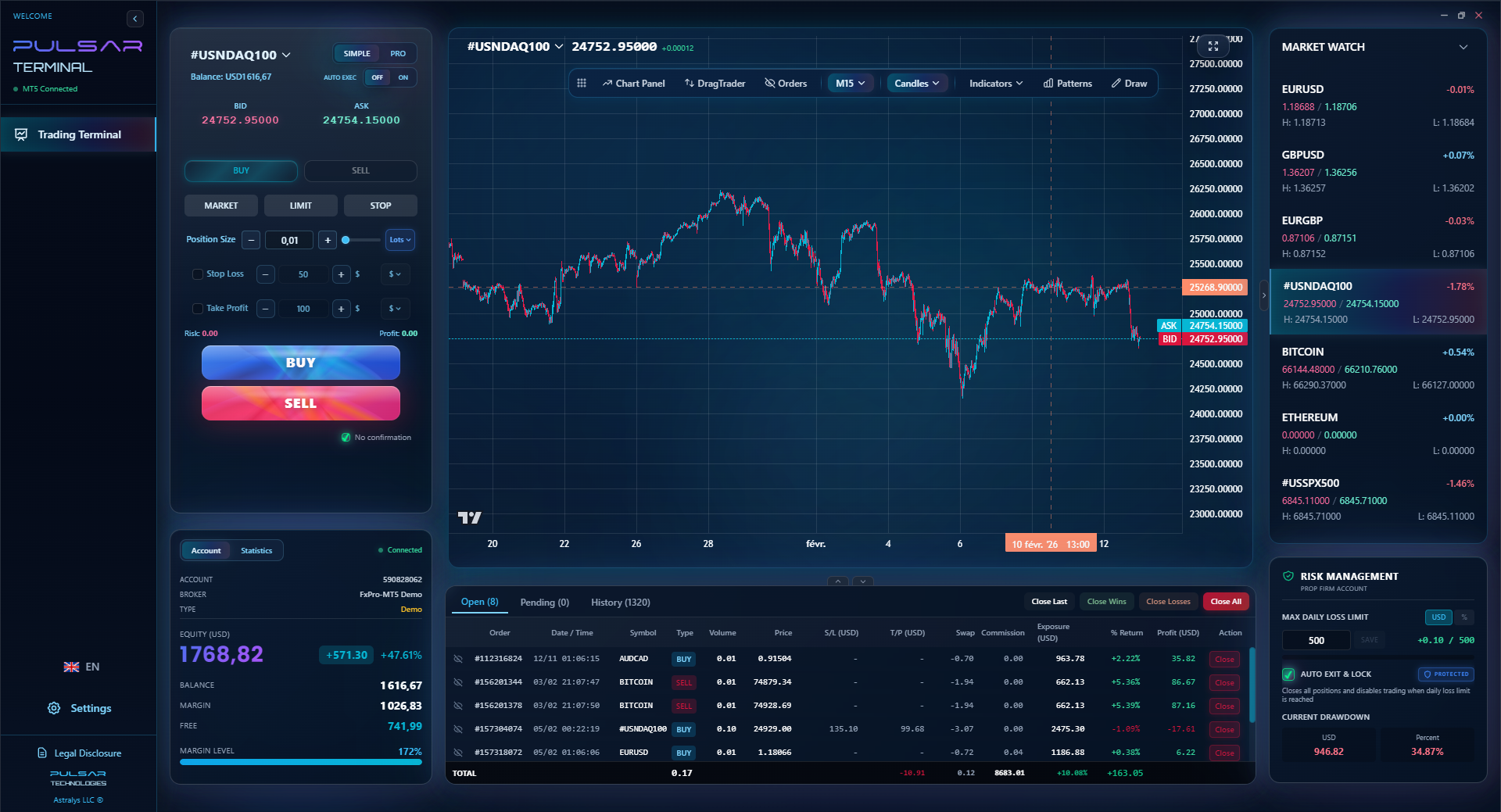
Managing risk and protecting your capital from emotional errors is the core challenge, which is why tools like Pulsar Terminal automate stop losses, trailing stops, and even prop firm daily loss limits directly on your MT5 platform.
Pulsar Terminal
Alat MT5 all-in-one: order drag-and-drop, multi-TP/SL, trailing stop, grid trading, Volume Profile, dan perlindungan prop firm. Digunakan 1.000+ trader setiap hari.
“I lost 15% of my account sitting there, frozen. That lesson cost me real money. Always use the stop loss.”
So how do you decide when to pull the trigger? This is the swamp of indicators, strategies, and guru nonsense. You need a simple, repeatable process.
Price Action: This is reading the raw chart. Look for key levels where price has bounced or broken before (support and resistance). A pin bar rejection at a major level can be a cleaner signal than three conflicting indicators. For a deeper view of where volume is concentrated at these levels, some traders use Volume Profile tools.
Indicators as Context, Not Crystal Balls: Use an indicator like the RSI indicator to see if a market is overbought or oversold. Use the MACD indicator to gauge momentum and potential trend changes. But never, ever trade solely because an RSI is below 30. It can stay there for a long time in a strong downtrend.
The News Trap: South African traders must watch USD and local SA events. A SARB interest rate decision can send the Rand flying. But trading the news is brutal. The spread widens massively, liquidity dries up, and price can spike in both directions instantly. I learned this the hard way trying to trade a US Non-Farm Payrolls report. Got the direction right on EUR/USD, but a 15-pip spike against me first took me out via my stop loss before it rocketed to my profit target. I was right, and I still lost.
Your edge doesn't come from a secret indicator. It comes from disciplined execution of a simple plan, again and again. Whether you're scalping for 10-pip moves or swing trading for 200-pip moves, the principles are identical.
💡 Tips Winston
If you can't write down your trade plan in one sentence before you click, you have no plan. You have a guess.
“Your first job is capital preservation, not capital appreciation.”
Trading from SA isn't the same as trading from London or New York. You have to deal with a few unique headaches.
The Rand Pairs: USD/ZAR, EUR/ZAR, GBP/ZAR. These are exotic pairs. They typically have much wider spreads than majors like EUR/USD. That means your trade starts in a deeper hole, making short-term scalping very difficult. The spreads can also gap wildly during local political news or liquidity crunches.
Broker Choice: You need a broker that accepts South African clients, offers ZAR accounts, and has reliable deposit/withdrawal methods. I've used Exness and XM for this, as they localize well. Check their regulation and if they offer the specific instruments you want. Don't just go for the one with the flashiest ads.
Time Zones: The most liquid sessions (London and New York overlap) are in our late afternoon and evening. If you have a day job, this can be a benefit or a curse. You might miss the Asian session open, but you can catch the big moves after work. Plan your strategy around when you can actually be at the screen.
Tax: Don't ignore this. In South Africa, profits from trading are generally considered capital gains for individuals. You have an annual exclusion (around R40,000). Keep careful records of every trade. The taxman doesn't care about your losing streak.
“I was right, and I still lost. The market doesn't award points for being conceptually correct.”
Knowing how to sell and buy on forex is pointless without a system. Here's a bare-bones routine you can start with today.
- Morning Check (5 mins): Don't look at charts first. Look at an economic calendar. What major events are due today? Is it a day to trade or a day to avoid? If SARB Governor Kganyago is speaking, maybe you sit out USD/ZAR until after.
- Find Your Level (10 mins): Open your 1-hour and 4-hour charts. Draw your key support and resistance lines. Where is price relative to these levels? Is it consolidating or trending?
- Define the Trade: If you see a setup (e.g., price bouncing off support with momentum), write it down. Literally. 'BUY USD/ZAR if 1-hour candle closes above 18.8000. SL: 18.7500. TP: 18.9500.'
- Calculate Your Size: Use your position size calculator. Account Balance: R20,000. Risk %: 1% = R200. Stop Loss Distance: 500 pips (18.8000 - 18.7500). Pip Value: You calculate this based on your lot size. The calculator will tell you your max lot size is 0.4 lots to keep your risk at R200.
- Execute and Walk Away: Place the trade with the stop and limit orders. Then close the platform. Go for a walk. You've done your job. The machine will now do its work. Micromanaging a live trade only leads to emotional exits.
This routine forces discipline. It separates analysis from the heat of the moment. The difference between a pro and an amateur isn't the win rate. It's how they handle the losses. Your system must account for a string of losses and still keep you in the game.
💡 Tips Winston
The market doesn't care about your rent, your ego, or your 'sure thing.' Trade the price you see, not the story in your head.
FAQ
Q1Is forex trading legal in South Africa?
Yes, forex trading is legal for South African residents. However, you must use a broker that is either licensed by the South African Financial Sector Conduct Authority (FSCA) or a reputable international regulator. Trading with unregulated entities is extremely risky.
Q2How much money do I need to start trading forex in South Africa?
You can start with a few thousand Rand. Many brokers offer accounts with low minimum deposits. But the real question is: how much are you willing to lose while you learn? Never start with money you need for rent or bills. Start small, with an amount you can afford to lose completely, and focus on learning the process, not making profits.
Q3What's better for a beginner, buying or selling?
There's no inherent 'better' direction. The problem is that beginners are psychologically wired to only 'buy,' thinking markets only go up. Learning to identify and act on sell (short) opportunities is a crucial skill. Start by practicing both in a demo account until the 'sell' button feels as normal as the 'buy' button.
Q4Why did my trade close at a loss even though the price moved in my direction?
This is almost always due to the spread. If you BUY, you enter at the higher 'Ask' price. The trade is immediately in a small loss equal to the spread. The price must move in your direction by more than the spread before you are in profit. This is why trading very short-term on pairs with wide spreads (like many ZAR pairs) is so difficult.
Q5How many trades should I take per day?
As many as your system signals, and zero if it doesn't. Forcing trades because you're bored or feel you 'should' be trading is a guaranteed way to lose. Some days, the best trade is no trade. Quality over quantity, always.
Q6Can I make a living trading forex from South Africa?
A very small percentage of traders do. It requires significant capital (so that 1-2% returns are meaningful), years of disciplined practice, and a strong psychological makeup. For 99% of people, it should be approached as a skill-building side activity, not a primary income source, especially in the beginning.
Pelajaran Prof. Winston
Poin Penting:
- ✓A stop loss is non-negotiable on every trade.
- ✓Risk 1% or less of your capital per trade.
- ✓Practice selling (shorting) as much as buying.
- ✓Wider spreads on ZAR pairs punish short-term scalping.
- ✓Your trading plan must be written down before execution.
Seberapa bermanfaat artikel ini?
Klik bintang untuk menilai
Wawasan Trading Mingguan
Analisis & strategi mingguan gratis. Tanpa spam.
Tentang Penulis
David van der Merwe
Trader Pasar Berkembang
Trader berbasis Johannesburg dengan 11 tahun di mata uang pasar berkembang. Spesialis pasangan ZAR, trading berregulasi FSCA, dan analisis pasar Afrika Selatan.
Komentar
Peringatan Risiko
Perdagangan instrumen keuangan mengandung risiko signifikan dan mungkin tidak cocok untuk semua investor. Kinerja masa lalu tidak menjamin hasil di masa depan. Konten ini hanya untuk tujuan edukasi dan tidak boleh dianggap sebagai nasihat investasi. Selalu lakukan riset Anda sendiri sebelum trading.
Anda mungkin juga suka

Cara Trading Forex Sukses: 7 Prinsip dari Trader Profesional
Cara trading forex sukses dengan 7 prinsip trader pro: manajemen modal, disiplin, journal trading, backtest. Data nyata, bukan janji profit palsu.
Jam Trading Forex Terbaik untuk Trader Indonesia: Panduan Lengkap dengan Tabel Waktu
Panduan jam trading forex untuk trader Indonesia. Tabel 4 sesi dunia, jam emas 20:00-00:00, sesi mana yang harus dihindari. Data akurat + tips dari trader berpengalaman.
Top 5 Sàn Forex Uy Tín Nhất 2026: Review Jujur dari Trader Indonesia
Top 5 sàn forex uy tín 2026 untuk trader Indonesia. Review jujur: spread, deposit, withdraw, dukungan lokal. Exness, XM, IC Markets & lebih.
Dapatkan Pulsar Terminal
Semua kalkulator ini terintegrasi dalam Pulsar Terminal dengan data real-time dari akun MT5 Anda.
Dapatkan Pulsar Terminal