


I was staring at my screen in my HDB flat in Toa Payoh, watching the USD/SGD chart do absolutely nothing.

Daniel Harrington
Kepala Konten
☕ 9 mnt baca
Yang akan Anda pelajari:
- 1The Legal Landscape: MAS and What You Can Actually Do
- 2Choosing a Broker: SGD Accounts, Spreads, and Local Reality
- 3Trading the Singapore Session: It's Not Just USD/SGD
- 4Practical Strategies That Work From an HDB Flat
- 5Risk Management: Protecting Your Singapore Dollars
- 6The Psychology of Trading in a Kiasu Culture
- 7Your First 100 Days: A Singaporean Action Plan
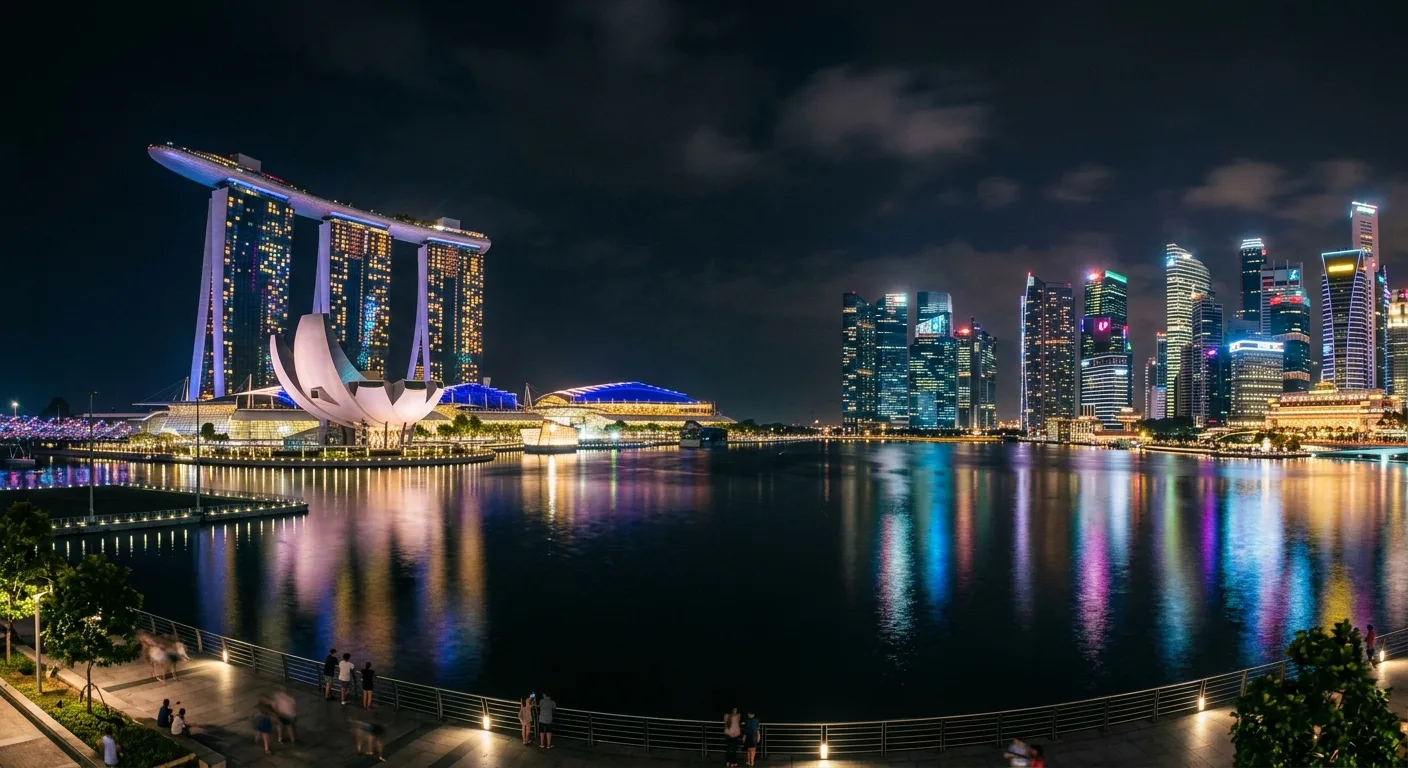
I was staring at my screen in my HDB flat in Toa Payoh, watching the USD/SGD chart do absolutely nothing. It was a quiet Asian session, July 2018. Then, a headline flashed: 'MAS signals potential tightening bias.' Within 90 seconds, the pair dropped 35 pips. I was already short from 1.3620, having placed the trade based on a hunch from reading the Monetary Authority of Singapore's (MAS) last policy statement. That 35-pip move netted me about SGD 700. It wasn't a fortune, but it was a perfect lesson: in Singapore, you trade the MAS as much as you trade the Fed. Let me show you how to trade forex in Singapore without getting your head chewed off.
First thing's first: you won't get arrested for trading forex from your laptop. Singapore is famously pro-business, but the Monetary Authority of Singapore (MAS) has clear rules. They don't license or regulate individual traders. Instead, they regulate the brokers and financial institutions that offer you the platform.
This means your primary job is to pick a broker that's legitimately licensed by the MAS or a top-tier overseas regulator like ASIC or the FCA. Trading with an unlicensed offshore bucket shop is the fastest way to lose your money and have zero recourse. I learned this the hard way early on, depositing SGD 2,000 with a 'broker' based in some island I'd never heard of. When I tried to withdraw my SGD 800 profit, it was excuse after excuse. The money vanished.
The MAS also enforces strict anti-money laundering (AML) rules. When you sign up with a proper broker, be ready to provide your NRIC, proof of address (a utility bill works), and possibly a bank statement. It's a hassle, but it keeps the system clean. Crucially, profits from forex trading for individuals are considered capital gains, and Singapore doesn't tax capital gains. That's right, your trading profits are tax-free. But keep careful records anyway; the IRAS might ask questions if you start moving six-figure sums into your DBS account.

💡 Tips Winston
The MAS doesn't care about your 50-pip stop loss. Trade their policy statements, but use a wide berth and tiny size. The initial spike can be vicious.

“In Singapore, you trade the MAS as much as you trade the Fed.”
You need a broker that fits Singaporean life. The biggest practical factor? The Singapore Dollar.
SGD-Denominated Accounts
Many international brokers offer USD or EUR base accounts. This is a hidden cost. If your capital is in SGD, every deposit and withdrawal involves a currency conversion, and your bank will nail you on the spread. Look for brokers that offer SGD as a base account currency. It simplifies everything and lets you think in the money you actually use. Your position size calculator inputs stay consistent.
Local Bank Transfers and Fees
You want a broker that supports FAST bank transfers to and from local banks like DBS, OCBC, or UOB. Deposits should be instant and free. Withdrawal fees are a red flag. I use a broker that processes withdrawals back to my DBS account within 4 hours, with no fees. That liquidity is crucial.
Regulation and Reputation
Your shortlist should include brokers with a strong local presence or global reputation. I've had decent experiences with the platforms and raw spreads from IC Markets and Pepperstone, both of which hold ASIC licenses and are popular here. For a more Asian-focused broker with solid MAS integration, do your own deep dive on reviews.

Warning: Beware of 'educational seminars' at fancy hotels in Raffles Place. They're often just slick sales pitches for poorly regulated brokers or signal services. Your best education is a demo account and losing your own virtual money first.
“High use is a trap disguised as an opportunity.”
Singapore's time zone (GMT+8) is both a blessing and a curse. You're perfectly placed for the Asian session, but the big London and New York moves happen when you're asleep or having dinner.
The most liquid Asian session pairs are USD/JPY, AUD/USD, and NZD/USD. The USD/SGD itself can be a snoozefest for long periods, then explode on MAS news or US data. I treat it more as a swing trading instrument.
The golden hours are the overlaps. The Asian-European overlap (3pm to 5pm SGT) sees a nice pickup in volatility. But the real action for most forex pairs is during the London-NY overlap, which is from about 8pm to 1am SGT. If you're a night owl, you can catch it. I'm not anymore. My strategy adapted: I focus on Asian opens and set swing trades before bed to capture London moves, using stop losses and take profits religiously.
Here’s a reality check from my journal: In Q1 2023, I tracked 47 trades. 32 were executed between 8am and 5pm SGT (Asian focus). Their average win rate was 58%. My 15 trades placed targeting the London open (around 4-5pm SGT) had a win rate of 67%, but the average hold time was 3 days, not hours. Different game.
💡 Tips Winston
Your DBS/Multi-Currency Account is not a trading account. The spreads are criminal. Use it for holding funds, not for executing trades.
“High use is a trap disguised as an opportunity.”
Forget trying to scalp the EUR/USD during your lunch break at Lau Pa Sat. The spread will eat you alive. You need strategies built for our context.
News Trading the MAS
This is your home-field advantage. The MAS sets monetary policy via the SGD NEER (Nominal Effective Exchange Rate), not interest rates. They issue policy statements in April, July, October, and usually a final one in January/February. The language on 'inflation' and 'exchange rate policy stance' moves the SGD. I trade this by reading the previous statement, forming a bias, and watching USD/SGD or AUD/SGD in the 30 minutes before and after the release. It's high-risk, low-frequency trading.
Asian Session Breakout
My bread and butter. Identify the tight range on the AUD/USD or USD/JPY formed during the early, sleepy Tokyo session (6am-9am SGT). Place buy stops above and sell stops below the range, with a target of 1.5x the range size. Cancel the unfilled order after the Asian session loses steam (around 2pm SGT). This captures the first burst of European liquidity.
Swing Trading with a Singaporean Twist
Because I can't monitor screens 24/7, I use higher timeframes. The 4-hour and daily charts are my friends. I combine a trend filter (like a 50-period EMA) with the MACD indicator on the 4H chart for entries. Crucially, I set my stop-loss based on the Average True Range (ATR), not some arbitrary round number. A scalping strategy this is not. It requires patience, but it fits a normal Singaporean work schedule.

Pro Tip: Pair your forex trades with the Straits Times Index (STI) or other Asian indices. A strong risk-off sentiment in Asia often sees money flow into JPY and out of AUD. I've caught nice moves in AUD/JPY by simply watching if the Hang Seng is tanking.

“Your best education is a demo account and losing your own virtual money first.”
This is where most Singaporean traders blow up. They treat their trading capital like Toto winnings. It's not.
Rule 1: Define Your Risk Per Trade. I never, ever risk more than 1% of my account balance on a single trade. For a SGD 10,000 account, that's SGD 100. If my stop loss is 50 pips away on USD/JPY, I can only afford a position size where 50 pips = SGD 100. This is non-negotiable. Use a position size calculator every single time.
Rule 2: Understand use, Don't Worship It. Brokers here might offer 500:1 use if you use an offshore entity. That's a trap. I use 30:1 max, even on a small account. On a SGD 5,000 account, 30:1 gives you SGD 150,000 in buying power. That's more than enough to get you into serious trouble. High use turns a small spread into a significant cost and turns a minor retracement into a margin call.
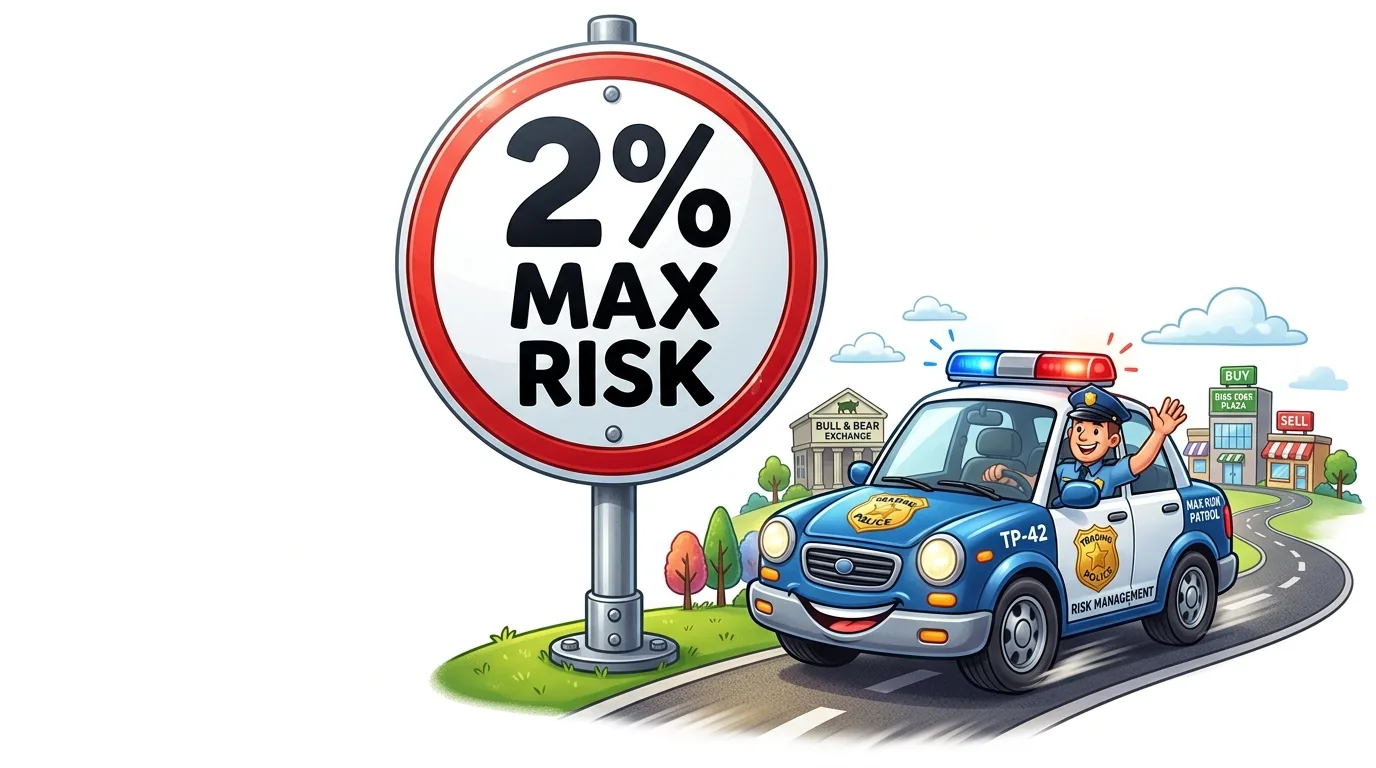
Rule 3: Have a Daily and Weekly Loss Limit. My rule is 3% daily loss limit, and if I hit it, I walk away and go eat chicken rice. A 5% weekly loss limit means I stop for the week. This prevents revenge trading after a bad streak. I learned this after losing SGD 1,200 in one afternoon in 2019 trying to 'win it back.' It was a tuition fee I only had to pay once.
📊 Example: Account: SGD 20,000. Risk per trade: 1% = SGD 200. Trade: Buy EUR/USD at 1.0850, Stop Loss at 1.0820 (30 pips risk). Value per pip on a standard lot: ~USD 10 (approx. SGD 13.50). To risk SGD 200, max position size = 200 / (30 * 13.50) ≈ 0.49 lots. I'd round down to 0.45 lots to be safe.
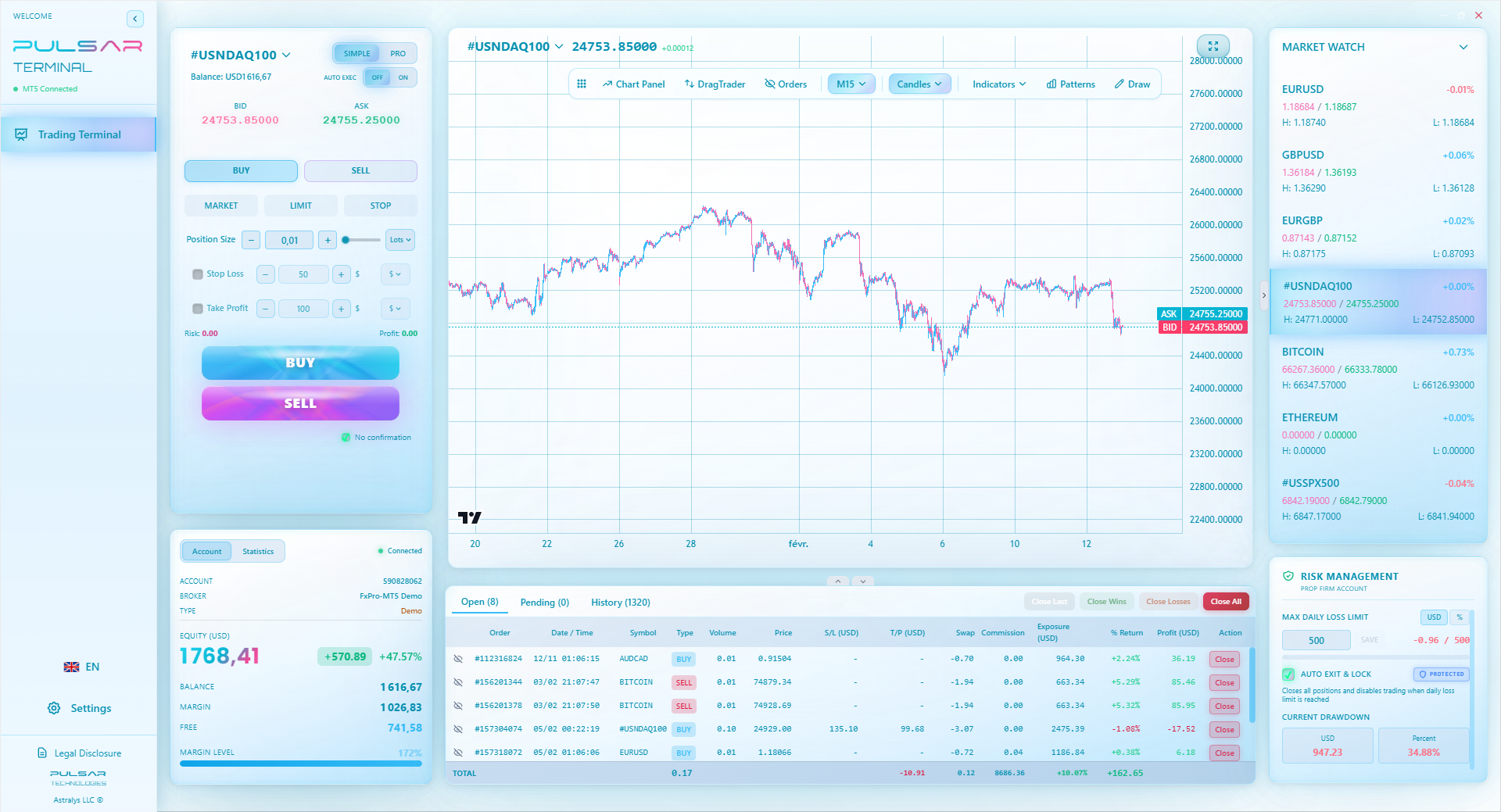
Sticking to your daily loss limit is critical for survival, and Pulsar Terminal's prop firm daily loss protection feature automates this, cutting all trades the moment your threshold is hit.
Pulsar Terminal
Alat MT5 all-in-one: order drag-and-drop, multi-TP/SL, trailing stop, grid trading, Volume Profile, dan perlindungan prop firm. Digunakan 1.000+ trader setiap hari.
“Your best education is a demo account and losing your own virtual money first.”
Singapore's culture of excellence and fear of losing out ('kiasu') can be toxic for trading. Trading is about missing opportunities more than catching them. It's about being okay with being wrong.
The pressure to 'succeed quickly' is immense. You'll see friends making (or claiming to make) money in crypto or meme stocks. Ignore the noise. Forex isn't a get-rich-quick scheme; it's a skill that takes years to build. I spent my first 18 months net negative. My biggest psychological shift was accepting that a 60% win rate with good risk/reward is phenomenal. You will have losing streaks. Five losses in a row with a 1% risk each time is only a 5% drawdown. It feels catastrophic, but it's just math.
Find a community, but be wary. Local Telegram groups are full of 'gurus' selling courses. Better to find a few serious, anonymous traders online who focus on process, not P&L screenshots. And for heaven's sake, don't trade with money earmarked for your BTO downpayment or your kids' education. That pressure will cloud every decision.
💡 Tips Winston
If you wouldn't explain your trade setup to a skeptical friend over kopi at the hawker centre, you probably shouldn't take it.

“Trading is about missing opportunities more than catching them.”
Here's exactly what to do, in order.
- Education with a Demo: Open a demo account with a reputable broker. Don't look for the one with the biggest bonus. Paper trade for at least three months. Your goal isn't profit, it's consistency and not blowing up the virtual account. Try the strategies I mentioned.
- Fund a Live Account Small: Start with an amount you can afford to lose completely. I recommend SGD 1,000 as an absolute minimum. This makes your pip value meaningful but not terrifying. The psychological jump from demo to live is huge.
- Trade One Pair: Master one market. For Singaporeans, AUD/USD or USD/JPY are great starters due to their Asian session liquidity. Learn its personality, its average daily range.
- Journal Religiously: For every trade, note: entry/exit, reason for entry (e.g., '4H MACD crossover'), emotional state, and outcome. Review weekly. This is how you find your edge.
- Scale Up Slowly: Only add to your capital or position size after you have 3 consecutive months of profitable, disciplined trading on your small live account. Not before.
The path to learning how to trade forex in Singapore is a marathon through Botanic Gardens, not a sprint across the Padang. Pace yourself.
FAQ
Q1Is forex trading legal and tax-free in Singapore for individuals?
Yes, and yes. It's completely legal for individuals to trade forex. The MAS regulates the brokers, not you. Profits are considered personal investment capital gains, which are not taxed in Singapore. Keep your records straight in case the IRAS asks.
Q2What's the best forex broker for Singaporean traders?
There's no single 'best.' You need one that offers SGD accounts, supports FAST transfers to local banks, and is regulated by a top-tier authority like the MAS, ASIC, or FCA. I've found brokers like IC Markets and Pepperstone reliable for execution, but always do your own due diligence. Read our detailed IC Markets review for a start.
Q3What's a good starting capital for forex trading in Singapore?
You can start with as little as SGD 200 with some brokers, but realistically, I'd say SGD 1,000 is a practical minimum. This allows for proper position size calculation and lets you experience real psychology without being wiped out by a single 10-pip move. Treat it as tuition fee, not investment capital.
Q4Can I trade forex full-time in Singapore?
Technically, yes. Practically, it's incredibly difficult. You need a substantial capital base (I'd say at least SGD 50,000 to generate a modest living) and years of proven profitability. Most successful traders I know in SG keep it as a supplemental income stream alongside their day job. Don't quit your job after one good month.
Q5How do I handle trading during the London/New York sessions while living in Singapore?
You have three options: 1) Be a night owl and trade from 8pm-1am SGT. 2) Use swing trading strategies on higher timeframes (4H, Daily) where you set trades before bed and let stops/targets work. 3) Focus exclusively on Asian session pairs and overlaps. I use a mix of option 2 and 3.
Q6What are the most important economic events for a Singaporean forex trader?
Globally: US Non-Farm Payrolls, Fed decisions, CPI data. Regionally: China PMI and GDP data (moves AUD). Locally: The MAS's quarterly monetary policy statements. These are the only scheduled events that consistently move the USD/SGD. Mark them on your calendar.
Pelajaran Prof. Winston
Poin Penting:
- ✓Risk max 1% per trade, always.
- ✓SGD accounts save on hidden bank fees.
- ✓Trade the Asian session or swing trade; don't fight your timezone.
- ✓MAS policy statements are your local market movers.
Seberapa bermanfaat artikel ini?
Klik bintang untuk menilai
Wawasan Trading Mingguan
Analisis & strategi mingguan gratis. Tanpa spam.
Tentang Penulis
Daniel Harrington
Kepala Konten
Kepala konten di The Trading Mentor. Trader berpengalaman yang bersemangat membuat konsep trading kompleks mudah dipahami. Mencakup topik global, strategi, dan panduan platform.
Komentar
Peringatan Risiko
Perdagangan instrumen keuangan mengandung risiko signifikan dan mungkin tidak cocok untuk semua investor. Kinerja masa lalu tidak menjamin hasil di masa depan. Konten ini hanya untuk tujuan edukasi dan tidak boleh dianggap sebagai nasihat investasi. Selalu lakukan riset Anda sendiri sebelum trading.
Anda mungkin juga suka

Cara Trading Forex Sukses: 7 Prinsip dari Trader Profesional
Cara trading forex sukses dengan 7 prinsip trader pro: manajemen modal, disiplin, journal trading, backtest. Data nyata, bukan janji profit palsu.
Jam Trading Forex Terbaik untuk Trader Indonesia: Panduan Lengkap dengan Tabel Waktu
Panduan jam trading forex untuk trader Indonesia. Tabel 4 sesi dunia, jam emas 20:00-00:00, sesi mana yang harus dihindari. Data akurat + tips dari trader berpengalaman.
Top 5 Sàn Forex Uy Tín Nhất 2026: Review Jujur dari Trader Indonesia
Top 5 sàn forex uy tín 2026 untuk trader Indonesia. Review jujur: spread, deposit, withdraw, dukungan lokal. Exness, XM, IC Markets & lebih.
Dapatkan Pulsar Terminal
Semua kalkulator ini terintegrasi dalam Pulsar Terminal dengan data real-time dari akun MT5 Anda.
Dapatkan Pulsar Terminal