


Ever stared at a chart, wondering where the market might turn next? You're not alone.

David van der Merwe
Trader Pasar Berkembang ·  South Africa
☕ 11 mnt baca
Yang akan Anda pelajari:
- 1What Are Pivot Points, Really?
- 2Core Trading Strategies with Pivot Points
- 3Trading Pivots from South Africa: The Local Angle
- 4Making Pivots Powerful: What to Combine Them With
- 5Mistakes I've Made (So You Don't Have To)
- 6A Real Trade Walkthrough: EUR/USD
- 7Which Pivot Timeframe is Right for You?
- 8Your Action Plan to Start Trading Pivots
Ever stared at a chart, wondering where the market might turn next? You're not alone. For years, I chased complex indicators, convinced the secret was in some obscure formula. Then I rediscovered pivot points. They're not flashy, but for spotting potential support and resistance, they're one of the most reliable tools in my kit. This guide isn't about theory. It's about how to trade pivot points forex for real, from a ZAR-based perspective, with all the mistakes and lessons I've learned along the way.
Let's cut through the jargon. A pivot point is simply a calculated price level, derived from the previous day's high, low, and close. It's not magic, it's math. The core idea is that yesterday's price action gives us a clue about today's potential battle zones between buyers and sellers.
The main pivot point (PP) is the anchor. The market's reaction to this level tells you the immediate sentiment. Price above PP? Generally bullish bias. Price below? Bearish. From that PP, we calculate support (S1, S2) and resistance (R1, R2) levels. Think of them as potential floors and ceilings for the day's price movement.
Most platforms like MT4 or MT5 will calculate these for you automatically. You don't need to do the math yourself, but knowing the formula helps you understand what you're looking at. The standard calculation is:
- Pivot Point (PP) = (Previous High + Previous Low + Previous Close) / 3
- Support 1 (S1) = (PP x 2) - Previous High
- Resistance 1 (R1) = (PP x 2) - Previous Low
- Support 2 (S2) = PP - (Previous High - Previous Low)
- Resistance 2 (R2) = PP + (Previous High - Previous Low)

Example: If EUR/USD had a High of 1.0850, Low of 1.0800, and Close of 1.0820 yesterday, today's PP would be (1.0850 + 1.0800 + 1.0820) / 3 = 1.0823. Your S1 would be at (1.0823 x 2) - 1.0850 = 1.0796.
The beauty for us in South Africa is their objectivity. Unlike drawing your own trendlines (which can be subjective), everyone using the same formula sees the same levels. This creates self-fulfilling prophecy zones where many traders are watching the same price.
The Bounce Trade
This is the classic. You wait for price to approach a pivot level (S1, R1, etc.) and look for a rejection. The key is confirmation. Don't just buy because price hits S1. I learned that the hard way, losing R800 on a USD/ZAR trade by jumping in on a mere touch. Wait for a bullish candlestick pattern (like a hammer or engulfing bar) to form at the support level. Then enter with a stop loss just below that S1 level. Your initial target is the next pivot level up, often the PP or R1.
The Breakout Trade
Sometimes, price doesn't bounce. It smashes through. A clean break and close above R1, for example, can signal strong buying momentum. The trick here is the retest. Often, price will surge, then pull back to retest that broken resistance level (which should now act as support). That retest is your entry signal. I caught a great 90-pip move on GBP/USD this way last month. It broke R1 at 1.2650, pulled back to 1.2648, and I went long. My stop was below the breakout level.
Using the Central Pivot for Bias
The main Pivot Point (PP) is your daily sentiment gauge. If the London open happens and price is trading solidly above the PP, I'll be looking for long opportunities on pullbacks to the PP or S1. If it's stuck below, I'm a bear. It filters out a lot of noise. Combining this with a simple indicator like the RSI indicator for overbought/oversold conditions at these levels can be powerful.

Warning: Never trade pivot points in isolation during major news events (like SARB announcements or US Non-Farm Payrolls). The sheer volume can blow straight through these levels like they're not there. I've been stopped out in seconds that way.

💡 Tips Winston
The market doesn't owe you a bounce. If price hesitates at a pivot level without a clear reversal pattern, walk away. The best trade is often the one you don't take.
“Pivot points gave me structure in a chaotic market.”
Trading from SA isn't just about the Rand pairs. It's about timing, costs, and rules. Our market hours mean we're active during the tail end of Asia, all of Europe, and the start of the US session. This is perfect for pivot trading, as the most reliable reactions often happen during the London open (10:00 SAST).
use Rules: Remember, the FSCA caps use at 30:1 for major forex pairs for retail clients. This isn't a suggestion, it's the law. A good FSCA-regulated broker like Exness or IC Markets will enforce this automatically. This limit forces smarter position sizing, which pairs perfectly with pivot trading. You can't just YOLO a huge position because "S1 has to hold." You must use a position size calculator every single time.
Costs Matter: The spread is your enemy, especially on the ZAR pairs like USD/ZAR. A wide spread can mean price needs to move several pips just for you to break even. When your profit target is the 15-20 pips to the next pivot level, a 5-pip spread eats a huge chunk. I stick to majors like EUR/USD or XAU/USD (Gold) for my pivot strategies because their spreads are tight, often under a pip with brokers like Pepperstone.
Tax Implications: Keep a detailed journal. SARS views trading profits as income if you're trading frequently (which you likely are with pivots). Those small, consistent wins from hitting your R1 targets add up, and you need to account for them.
Pivot points are a fantastic framework, but they're not a crystal ball. You need confluence.
- Candlestick Patterns: This is my number one filter. A doji or pin bar at R2? That's a strong sell signal. A bullish engulfing candle at S1? Much better than a vague "bounce."
- Volume: If price hits R1 on low volume and stalls, that's weak resistance. If it hits R1 on a huge volume spike and reverses, that's a strong signal. Most MT5 platforms have volume built in.
- Moving Averages: I keep the 50 and 200-period EMAs on my chart. If price is at S1 and that S1 is near the rising 50 EMA, that's a high-probability long setup. The pivot and the EMA are telling the same story.
- Momentum Oscillators: The MACD indicator can show divergence. If price makes a new high above R1, but the MACD makes a lower high, that's a warning sign the breakout might fail.
My biggest leap in profitability came from waiting for two or three of these factors to align with a pivot level. It means fewer trades, but the ones I take have a much higher success rate. It's the difference between guessing and having a real edge.
“Knowing where you're wrong is just as valuable as hoping you're right.”
Let me be brutally honest about where I've blown up accounts using pivots.
Mistake 1: Treating Every Level as Holy. S2 is not a guaranteed floor. I once watched USD/JPY slice through S1, S2, and S3 like a hot knife through butter because of a sudden risk-off move. I kept "adding to my losing position" at each level, believing it had to bounce. Result? A margin call and a lost week's profit. Always use a stop loss.
Mistake 2: Ignoring the Higher Time Frame. The daily pivot levels are great, but if the 4-hour chart shows price is in a strong downtrend and we're just bouncing to a daily R1, that's probably a sell opportunity, not a breakout buy. I got caught in a nasty scalping trap on the Aussie dollar this way. Align your pivot bias with the higher timeframe trend.
Mistake 3: Chasing the Move. Price rockets from PP to R1 in 15 minutes. "It's so strong!" I'd think, and buy at R1 hoping for R2. Nine times out of ten, I was buying the exhaustion. Pivot levels are for anticipating reactions, not chasing them after the move is done. Be patient. Let price come to you.
Mistake 4: Forgetting the Session. Pivot reactions are cleanest during liquid sessions. Trying to trade them during the dead Tokyo session or late New York session is messy. The spreads widen, and the moves are choppy. I schedule my pivot review for the London open and the US open overlap. The rest of the time, I'm analyzing or away from the screen.
💡 Tips Winston
Always calculate your position size based on the distance to your stop loss (the pivot level), not the dream of your profit target. Risk management isn't a feature of trading; it *is* trading.
Let's look at a trade from my journal last Tuesday. This is how the plan came together.
Setup:
- Previous Day's Data: High: 1.0725, Low: 1.0670, Close: 1.0690.
- Calculated Pivots: PP: 1.0695, S1: 1.0665, R1: 1.0720.
- Context: The overall trend on the 4-hour chart was bearish.
The Play: Price opened near the PP at 1.0695 and drifted lower. By the London open, it was testing S1 at 1.0665. This aligned with the bearish trend. I didn't enter immediately.
I waited for confirmation. A small bullish candle tried to form, but then a strong bearish engulfing candle appeared right at the S1 level. This showed sellers were overwhelming buyers at support - a sign of weakness. This was my signal.
Execution:
- Entry: Sell at 1.0663 (just after the engulfing candle closed).
- Stop Loss: Placed at 1.0678 (just above the S1 level and the recent minor high). Risk: 15 pips.
- Profit Target: S2 was at 1.0635. I set my take-profit there: a 28-pip target.
Risk Management: My account was R20,000. My risk-per-trade rule is 1%. That's R200. With a 15-pip stop, my position size calculator told me to sell 1.33 mini lots. I rounded down to 1.3 lots to be safe.
Result: Price sank steadily, hit S2, and my take-profit was triggered. Profit: 28 pips x 1.3 lots = $36.40, or roughly R680 at the time. It worked because I had confluence (pivot S1, bearish trend, confirming candlestick) and strict risk management. Not every trade is this clean, but this is the blueprint.
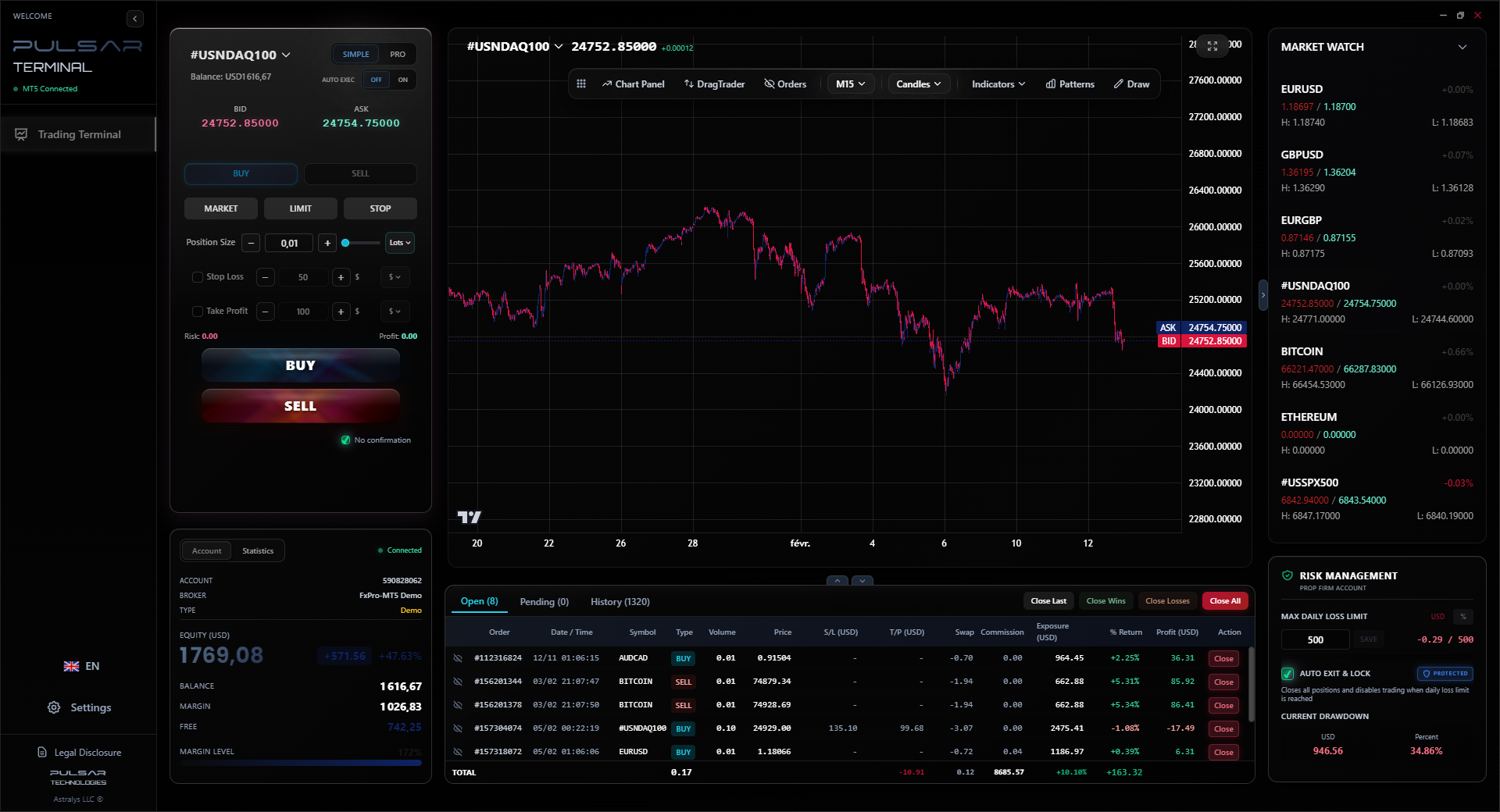
Executing a precise pivot-based trade with multiple take-profit levels is much easier with a tool that lets you drag and drop orders directly onto your chart.
Pulsar Terminal
Alat MT5 all-in-one: order drag-and-drop, multi-TP/SL, trailing stop, grid trading, Volume Profile, dan perlindungan prop firm. Digunakan 1.000+ trader setiap hari.
“I learned that the hard way, losing R800 on a USD/ZAR trade by jumping in on a mere touch.”
You can calculate pivots for any period: daily, weekly, monthly, even intraday. Your choice depends on your trading style.
| Timeframe | Best For | What It Tells You | SA Trader Consideration |
|---|---|---|---|
| Daily (Most Common) | Swing trading & day trading | Key levels for the next 24 hours. | Perfect for our timezone. Set at midnight GMT, active all through our trading day. |
| Weekly | Swing & position traders | Major support/resistance for the week. | Great for planning the week ahead on a Sunday night. A weekly R1 is a much bigger deal than a daily R1. |
| Monthly | Long-term investors & macro traders | Monumental levels. | Breaking a monthly pivot often signals a major trend change. |
| Intraday (e.g., 1-Hour) | Scalpers & hyper-active day traders | Micro levels for the next few hours. | Can be noisy. I find them less reliable than daily pivots because they're based on less data. |
I start with the weekly pivot to see the big picture, then use the daily pivots for my actual trade entries and exits. Trying to watch all of them at once is a recipe for confusion and paralysis. Pick one framework and master it first.
- Pick Your Broker & Platform: Ensure you're with a reputable, FSCA-regulated broker. Most, like XM or IC Markets, have pivot point indicators built into their MT4/MT5 platforms. You just need to add it to your chart from the "Insert > Indicators" menu.
- Go to Demo: For the next two weeks, don't risk a cent. Apply the daily pivots to your charts. Watch how price behaves at these levels during the London open. Practice identifying bounces and breakouts without the pressure of real money.
- Journal Religiously: Note the pivot levels each day. Mark where price reacted. Did it bounce at R1? Did it break S2? This builds your intuition.
- Add One Filter: Once comfortable, add one confirmation tool. Maybe it's waiting for a two-candle reversal pattern. Maybe it's checking the 1-hour trend. Don't add five things at once.
- Start Small: When you go live, start with a position size so small you can't even feel the win or loss. The goal is to practice the process and build confidence in your ability to execute the plan, not to get rich on day one.
Pivot points gave me structure in a chaotic market. They won't make you right 100% of the time - nothing will. But they give you a clear, objective plan for where to look for opportunities and, more importantly, where to place your stops. In this game, knowing where you're wrong is just as valuable as hoping you're right.
FAQ
Q1Are pivot points a leading or lagging indicator?
They're a leading indicator. They're calculated before the trading day begins, using the previous period's data, to predict future support and resistance. This is different from a moving average, which trails behind the current price.
Q2What's the best time of day to trade pivot points in South Africa?
The most reliable reactions occur during high-liquidity sessions. The London open (10:00 SAST) is prime time. The overlap between London and New York (15:00 - 17:00 SAST) is also excellent. Avoid the late New York and Tokyo sessions, as moves can be erratic and spreads wide.
Q3Can I use pivot points for scalping?
Yes, but carefully. Daily pivots can work on very short timeframes (like 1-minute or 5-minute charts) for scalping, as price will often respect these major levels. However, the noise is high. It's better to use them as a general guide for the day's bias and then use smaller, intraday support/resistance for precise scalping entries.
Q4How do I handle a situation where price blows straight through all pivot levels?
This happens during major news or panic events. Your first job is survival: your stop loss should already be in place. Do not try to "catch the falling knife" by buying at a lower support level. Wait for the volatility to settle. Often, price will retrace back to test one of those broken levels, which then becomes a new trading opportunity in the direction of the breakout.
Q5Do pivot points work on USD/ZAR and other emerging market currencies?
They work, but with a caveat. USD/ZAR is more volatile and prone to gaps due to local and global risk sentiment. The levels are still valid, but the reactions can be sharper and spreads are wider. I prefer to use them on major pairs like EUR/USD for cleaner signals and then apply the broader market sentiment to my ZAR pair views.
Q6Is there a difference between classic, Fibonacci, and Woodie's pivot points?
Yes. The formulas differ slightly, calculating the support/resistance levels in different ways. The classic (standard) method, which this guide covers, is the most widely used and therefore has the strongest self-fulfilling effect. I'd recommend mastering the classic pivots first before experimenting with others.
Pelajaran Prof. Winston
Poin Penting:
- ✓Wait for candlestick confirmation at pivot levels.
- ✓Align daily pivot bias with the higher timeframe trend.
- ✓Use the 30:1 use limit to enforce smart position sizing.
- ✓The London open (10:00 SAST) is prime time for pivot reactions.
Seberapa bermanfaat artikel ini?
Klik bintang untuk menilai
Wawasan Trading Mingguan
Analisis & strategi mingguan gratis. Tanpa spam.
Tentang Penulis
David van der Merwe
Trader Pasar Berkembang
Trader berbasis Johannesburg dengan 11 tahun di mata uang pasar berkembang. Spesialis pasangan ZAR, trading berregulasi FSCA, dan analisis pasar Afrika Selatan.
Komentar
Peringatan Risiko
Perdagangan instrumen keuangan mengandung risiko signifikan dan mungkin tidak cocok untuk semua investor. Kinerja masa lalu tidak menjamin hasil di masa depan. Konten ini hanya untuk tujuan edukasi dan tidak boleh dianggap sebagai nasihat investasi. Selalu lakukan riset Anda sendiri sebelum trading.
Anda mungkin juga suka

Cara Trading Forex Sukses: 7 Prinsip dari Trader Profesional
Cara trading forex sukses dengan 7 prinsip trader pro: manajemen modal, disiplin, journal trading, backtest. Data nyata, bukan janji profit palsu.
Jam Trading Forex Terbaik untuk Trader Indonesia: Panduan Lengkap dengan Tabel Waktu
Panduan jam trading forex untuk trader Indonesia. Tabel 4 sesi dunia, jam emas 20:00-00:00, sesi mana yang harus dihindari. Data akurat + tips dari trader berpengalaman.
Top 5 Sàn Forex Uy Tín Nhất 2026: Review Jujur dari Trader Indonesia
Top 5 sàn forex uy tín 2026 untuk trader Indonesia. Review jujur: spread, deposit, withdraw, dukungan lokal. Exness, XM, IC Markets & lebih.
Dapatkan Pulsar Terminal
Semua kalkulator ini terintegrasi dalam Pulsar Terminal dengan data real-time dari akun MT5 Anda.
Dapatkan Pulsar Terminal