


So you want to know what indices trading really means? You're not alone.

Rajesh Sharma
Analis Forex Senior ·  India
India
☕ 12 mnt baca
Yang akan Anda pelajari:
So you want to know what indices trading really means? You're not alone. Most new traders in India hear about 'trading the Nifty' and think it's just another stock. But here's the truth: you can't actually buy the Nifty 50 index like you buy a share of Reliance. The real meaning of indices trading is speculating on the collective movement of a basket of stocks through derivatives. It's betting on whether the overall market will go up or down, without owning any of the individual companies. Let me break down exactly how this works in our Indian context, what it costs, and how you can approach it without getting burned.
Let's clear up the biggest confusion first. When we talk about the indices trading meaning in India, we're talking about derivatives. You're not buying the index itself. You're trading contracts that derive their value from the index's price movement.
Think of the Nifty 50 like a cricket team's average score. You can't buy the 'average' - you can only bet on whether it will be higher or lower in the next match. That's exactly what index futures and options let you do.
The two main indices you'll deal with are the Nifty 50 (National Stock Exchange's top 50 companies) and the Sensex (BSE's 30 blue-chip stocks). There are others like Nifty Bank for banking stocks or Nifty IT for tech, but Nifty 50 is where most of the action happens.

Warning: Don't confuse index trading with stock trading. With stocks, you're analyzing individual companies. With indices, you're analyzing market sentiment, economic data, and broad sector movements. It's a different game entirely.
I made this mistake early on. Back in 2018, I was crushing it with individual stocks but got absolutely hammered trying to trade Nifty futures the same way. The psychology is different. When you're trading the index, you're trading against every fund manager, algorithm, and news outlet in the country. It's humbling.
Here's the practical reality: most retail traders in India access indices through futures and options (F&O). You can go long (buy) if you think the index will rise, or short (sell) if you think it will fall. There's also something called an index ETF, but that's more for long-term investors. For active trading, F&O is where you'll be.

💡 Tips Winston
The market can stay irrational longer than you can stay solvent. Never add to a losing index position hoping to 'average down.'
The Instruments: Futures & Options
You have two main vehicles: futures and options. A futures contract is an agreement to buy or sell the index at a specific price on a future date. An options contract gives you the right (but not the obligation) to do the same.
Futures are straightforward but carry more risk. If the market moves against you, your losses can keep mounting. Options are more complex but your risk is limited to the premium you pay. Most beginners start with futures because they seem simpler, but I'd argue options are safer if you understand them.
The Trading Process
You open a trading account with a broker that offers F&O trading (like Exness or IC Markets for international brokers, or any SEBI-registered domestic broker). You deposit margin money - this isn't the full contract value, just a security deposit. For one lot of Nifty futures, the margin requirement can range from ₹1.2 lakh to ₹1.8 lakh depending on volatility.
Then you place your order: buy if bullish, sell if bearish. The contract expires monthly, on the last Thursday. This expiry cycle creates specific patterns - volatility often increases in the expiry week.
A Real Trade Example
Let me give you a real example from last month. On March 10th, Nifty was at 22,150. I noticed strong support at 22,000 and bullish divergence on the hourly RSI indicator. I bought one April Nifty futures contract at 22,160.
My total margin was ₹1,42,000. I set a stop loss at 21,950 (210 points risk). My target was 22,500. The trade worked perfectly - Nifty rallied to 22,480 by March 18th. I exited at 22,470 for a 310-point profit.
Profit calculation: 310 points × 50 (Nifty lot size) = ₹15,500. Minus brokerage and taxes (about ₹120), net profit: ₹15,380. Return on margin: about 10.8% in 8 days.

Example: That 10.8% sounds great, but remember the risk. If my stop loss was hit, I'd have lost ₹10,500 (210 points × 50). That's over 7% of my margin gone in one trade. This is why position size calculator tools are non-negotiable.
“The real meaning of indices trading is speculating on the collective movement of a basket of stocks through derivatives.”
This is where most guides gloss over the details. Trading indices isn't free, and the costs add up faster than you think. Let's break down every rupee you'll pay.
First, the big one: Securities Transaction Tax (STT). The government takes this on every trade. As of April 2026:
- For futures: 0.05% on the sell side (up from 0.02%)
- For options: 0.15% on the premium when you sell (up from 0.10%)
That increase matters. On a ₹1 lakh options premium, you now pay ₹150 STT instead of ₹100.
Then there's brokerage. Discount brokers charge around ₹20 per executed order for F&O. Some go as low as ₹10 after promotions. Full-service brokers might charge a percentage, which gets expensive fast.
Exchange charges are tiny but exist: about 0.003% of trade value for futures, 0.035% on options premium.
SEBI turnover fee: 0.0001% (basically negligible).
Stamp duty: Varies by state, roughly 0.002% on futures buy side, 0.003% on options.
GST: 18% on brokerage and exchange charges.
Let me show you what this looks like on a real trade:
I recently sold one Nifty 22,500 Call option for a premium of ₹120. Lot size 50, so total premium = ₹6,000.
Cost breakdown:
- STT: ₹6,000 × 0.15% = ₹9
- Brokerage: ₹20
- Exchange charge: ₹6,000 × 0.03503% = ₹2.10
- SEBI fee: ₹0.006 (yes, less than a paisa)
- Stamp duty: ₹6,000 × 0.003% = ₹0.18
- GST on brokerage+exchange: 18% of ₹22.10 = ₹3.98
Total cost: about ₹35. That's 0.58% of my premium gone before the trade even moves. If the option expires worthless, I keep ₹5,965. If it moves against me immediately, I'm starting in the hole.

Pro Tip: Always calculate your breakeven point including all costs. That ₹35 means the option needs to decay by 0.7 points just for you to break even. Many traders forget this and wonder why they're consistently losing small amounts.
SEBI has been tightening rules, and if you don't understand margins, you'll get a margin call faster than you can say 'Nifty'.
The minimum contract size for index F&O is now ₹15-20 lakhs. This doesn't mean you need ₹20 lakh to trade - it means the notional value of one contract should be around that range. For Nifty trading around 22,000, one lot (50 shares) is ₹11 lakh notional. Close enough.
What you actually need is the margin. This is your security deposit with the broker. For one Nifty futures contract, initial margin is typically 10-15% of contract value. So for that ₹11 lakh contract, you'd need ₹1.1-1.65 lakh in your account.
But here's the kicker: there's also extreme loss margin (ELM). On expiry days, if you're short options, an extra 2% margin applies. So your total margin for at-the-money options might jump from 11% to 13%.
Let me tell you about my worst margin experience. In September 2023, I was short Nifty 19,500 Puts (thinking the market wouldn't crash). Then Adani news hit, and Nifty dropped 400 points in an hour. My broker's intraday margin requirement spiked. I didn't have enough extra funds, so they squared off my position at a ₹42,000 loss. If I'd had more buffer, I could have held - the market recovered most of the drop by day's end.
The lesson? Always maintain at least 30% extra over your required margin. That buffer saves you from forced liquidations during volatility spikes.
Also, remember position limits. For index options, the market-wide position limit is higher than for stocks, but your broker will have their own limits based on your capital and experience.
Warning: Never use more than 50% of your account for margin on open positions. If all your capital is tied up in margin, one bad move leaves you with no room to maneuver. A margin call is a trader's nightmare - it means selling at the worst possible time.
💡 Tips Winston
Track the Dollar Index (DXY) alongside Nifty. A sharply rising dollar often pressures emerging market indices like ours.
“Always maintain at least 30% extra over your required margin. That buffer saves you from forced liquidations during volatility spikes.”
After 12 years, I've settled on a strategy that works consistently for Indian indices. It's not sexy, but it makes money.
I combine three elements:
- Market structure (support/resistance on daily chart)
- Option flow analysis (what big players are doing)
- Volatility contraction/expansion cycles
Here's my weekly routine:
Monday morning: I check where Nifty closed relative to key weekly levels. Is it above or below 22,000? That psychological level matters more than people admit.
Tuesday-Thursday: I look for consolidation. Indian indices often move in 2-3 day ranges before breaking out. During consolidation, I sell options (premium decays). During breakout, I buy options or futures.
Friday/Expiry week: I reduce position size. Expiry week is unpredictable.
My Favorite Setup: The Volatility Squeeze
When the Bollinger Bands (20,2) contract to their narrowest point in 20 days, and Nifty is at a clear support or resistance, I prepare for a move. I wait for the breakout candle to close outside the bands, then enter in that direction.
Last month, Nifty consolidated between 21,950 and 22,150 for four days. Bollinger Bands were tight. On the fifth day, it broke above 22,150 with volume. I bought futures at 22,170. Target: previous high at 22,450. Stop: below consolidation at 21,900.
Result: 280-point gain. ₹14,000 profit after costs.
What Doesn't Work
Don't try to scalping strategy Nifty futures unless you're sitting at the screen all day with a direct feed. The slippage will kill you.
Don't trade around budget or RBI announcements unless you're already positioned. The gap risk is too high.
And for god's sake, don't hold futures overnight without a stop loss. I learned this in 2016 when I was long Nifty futures and the US market crashed overnight. I opened 4% down - a ₹40,000 loss on one contract before I could blink.
For most traders, a swing trading approach on indices works best. Capture the 300-500 point moves that happen every few weeks, not the 20-point intraday noise.
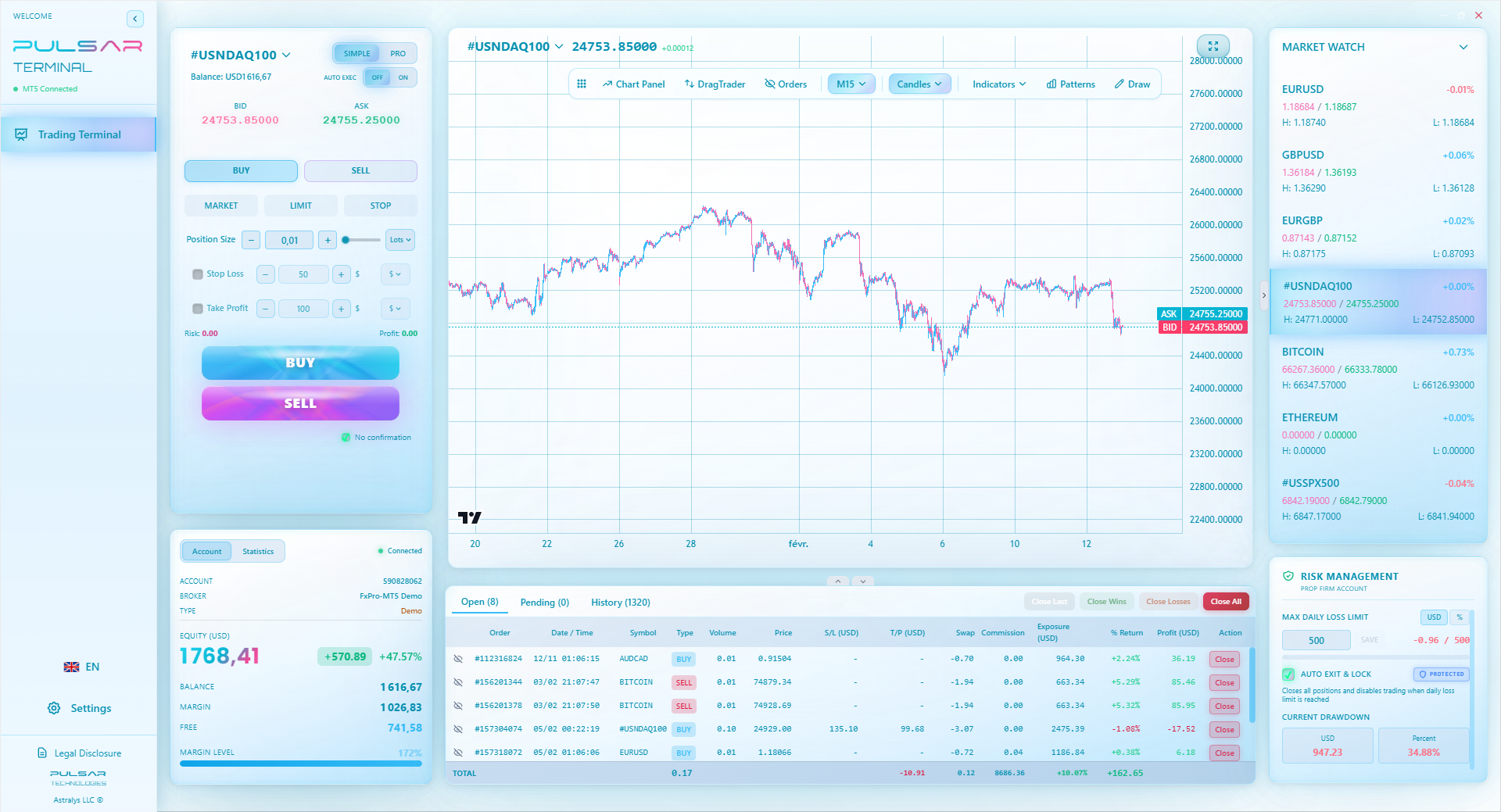
Managing multiple targets and stops on index trades is complex, but Pulsar Terminal lets you set them all with one drag-and-drop order directly on MT5.
Pulsar Terminal
Alat MT5 all-in-one: order drag-and-drop, multi-TP/SL, trailing stop, grid trading, Volume Profile, dan perlindungan prop firm. Digunakan 1.000+ trader setiap hari.
You need two things: a reliable broker and a platform that doesn't freeze during volatility.
For domestic brokers, look for:
- SEBI registration (non-negotiable)
- Low brokerage (₹20 or less per order)
- Good margin policies (some brokers offer lower margins than others)
- Reliable mobile and web platforms
Many traders use Zerodha, Upstox, or Angel One. They're all fine. The differences are in margin rates, platform features, and customer service.
For international brokers offering Indian indices as CFDs, check XM review or Pepperstone review. They often have lower minimum deposits but different regulatory protections.
Platform Features That Matter
- Advanced charting: You need at least 10 indicators, multiple timeframes, and drawing tools.
- Option chain analysis: Essential for seeing open interest and option flows.
- Quick order placement: During volatile moves, seconds matter.
- Reliable alerts: Price alerts that actually work.
I use TradingView for analysis and my broker's platform for execution. The split works well - TradingView has better charts, but the broker platform has faster execution.
A Word on Demat Accounts
For trading index F&O in India, you need a trading account, not necessarily a Demat account. Demat is for holding stocks. Your F&O positions are cash-settled - no physical delivery. So if a broker pushes you to open a Demat account just for indices, they might be upselling.
Pro Tip: Test the broker's platform during market hours before funding. See how fast orders execute, check if charts update in real-time, and try their customer service. Many brokers have great marketing but buggy platforms when you actually need to trade.
💡 Tips Winston
The first 30 and last 30 minutes of trading account for a disproportionate amount of directional movement. Have a plan for these windows.
“A strategy that shows 55% wins in backtesting might be breakeven after costs. Always include all costs in your calculations.”
I've made all these mistakes. Learn from my losses.
1. Trading without understanding expiry. Index options expire monthly. The last week sees accelerated time decay (theta). New traders buy options too close to expiry and watch them evaporate. Solution: For buying options, give yourself at least 3 weeks to expiry. For selling options, the last week can be profitable if you know what you're doing.
2. Ignoring volatility. India VIX (volatility index) matters. When VIX is below 12, markets are complacent - breakouts often fail. When VIX is above 20, expect big moves. I once sold options when VIX was at 10 (low premium) and got wiped out when it spiked to 22 overnight. Now I check VIX daily.
3. Overleveraging on futures. Because margins are lower than stock trading, traders take positions too large for their account. A 1% move against you can wipe out 10% of your margin. Use a position size calculator religiously. Never risk more than 2% of your account on one trade.
4. Chasing losses with doubles. You lose ₹5,000 on a Nifty trade, so you take double the position to make it back quickly. This is how accounts blow up. I did this in 2019 - lost ₹18,000 trying to recover a ₹4,000 loss in one afternoon.
5. Not accounting for all costs. As we discussed earlier, STT, brokerage, GST - they add up. A strategy that shows 55% wins in backtesting might be breakeven after costs. Always include all costs in your calculations.
The biggest psychological mistake? Treating index trading like a casino. It's not. It's a probability game with known edges if you're disciplined. The indices trading meaning isn't about getting rich quick - it's about consistently capturing small edges in market direction.
FAQ
Q1Can I directly buy the Nifty 50 index like a stock?
No, you cannot buy the index directly. You trade derivatives (futures and options) that derive their value from the index, or you can invest in index ETFs for long-term exposure. For active trading, futures and options are the primary instruments.
Q2What is the minimum amount needed to start trading Nifty futures?
You need enough to cover the margin requirement, not the full contract value. For one lot of Nifty futures (50 units), the margin typically ranges from ₹1.2 lakh to ₹1.8 lakh depending on market volatility. However, you should have additional capital for risk management and to avoid margin calls.
Q3What's the difference between trading Nifty and trading a stock like Reliance?
Trading Nifty means you're trading the overall market direction, influenced by macroeconomic factors, sector rotations, and foreign investor flows. Trading Reliance means analyzing one company's fundamentals, management, and sector news. Index trading is generally less prone to company-specific shocks but moves with broader sentiment.
Q4How are profits from index trading taxed in India?
Profits from index futures and options are treated as speculative business income and added to your total income. They are taxed according to your income tax slab. You can offset losses against other speculative income, and carry forward losses for up to 8 years to set off against future speculative profits.
Q5Is it better to trade index futures or options as a beginner?
Options can be safer for beginners because your risk is limited to the premium paid. However, options are more complex. Futures are simpler but riskier as losses can be unlimited. I recommend starting with small option buying strategies to understand price movement without excessive risk.
Q6What time can I trade Nifty derivatives?
Nifty futures and options trade from 9:15 AM to 3:30 PM Indian Standard Time, Monday through Friday, matching equity market hours. There is also a pre-open session from 9:00 AM to 9:15 AM.
Q7Can I trade Indian indices from outside India?
Yes, through international brokers that offer Nifty or Sensex as CFD (Contract for Difference) products. However, you won't be trading on the actual Indian exchanges (NSE/BSE), and the contract specifications, regulation, and tax treatment will differ.
Pelajaran Prof. Winston
Poin Penting:
- ✓You trade index derivatives, not the index itself
- ✓STT increased to 0.05% for futures, 0.15% for options
- ✓Maintain 30% extra buffer above margin requirements
- ✓Never risk more than 2% of capital per trade
Seberapa bermanfaat artikel ini?
Klik bintang untuk menilai
Wawasan Trading Mingguan
Analisis & strategi mingguan gratis. Tanpa spam.
Tentang Penulis
Rajesh Sharma
Analis Forex Senior
Berpengalaman lebih dari 10 tahun di pasar India dan Asia Selatan. Memulai dari derivatif mata uang NSE sebelum beralih ke forex internasional. Spesialis pasangan USD/INR dan pasar negara berkembang.
Komentar
Peringatan Risiko
Perdagangan instrumen keuangan mengandung risiko signifikan dan mungkin tidak cocok untuk semua investor. Kinerja masa lalu tidak menjamin hasil di masa depan. Konten ini hanya untuk tujuan edukasi dan tidak boleh dianggap sebagai nasihat investasi. Selalu lakukan riset Anda sendiri sebelum trading.
Anda mungkin juga suka

Cara Trading Forex Sukses: 7 Prinsip dari Trader Profesional
Cara trading forex sukses dengan 7 prinsip trader pro: manajemen modal, disiplin, journal trading, backtest. Data nyata, bukan janji profit palsu.
Jam Trading Forex Terbaik untuk Trader Indonesia: Panduan Lengkap dengan Tabel Waktu
Panduan jam trading forex untuk trader Indonesia. Tabel 4 sesi dunia, jam emas 20:00-00:00, sesi mana yang harus dihindari. Data akurat + tips dari trader berpengalaman.
Top 5 Sàn Forex Uy Tín Nhất 2026: Review Jujur dari Trader Indonesia
Top 5 sàn forex uy tín 2026 untuk trader Indonesia. Review jujur: spread, deposit, withdraw, dukungan lokal. Exness, XM, IC Markets & lebih.
Dapatkan Pulsar Terminal
Semua kalkulator ini terintegrasi dalam Pulsar Terminal dengan data real-time dari akun MT5 Anda.
Dapatkan Pulsar Terminal