


Most Nigerian traders get long forex completely wrong.

Olumide Adeyemi
Pelopor Trading Afrika Barat ·  Nigeria
☕ 11 mnt baca
Yang akan Anda pelajari:
- 1What 'Long Forex' Actually Means for a Nigerian Trader
- 2The Legal & Tax Rules You Can't Ignore (2026 Update)
- 3Picking a Broker to Go Long: Costs & use Traps
- 4A Simple Strategy to Find Long Entries
- 5Managing Your Long Trade: Risk, Exits & Psychology
- 6Common Mistakes Nigerian Traders Make Going Long
- 7Long Forex vs. Stocks & Crypto: Where Does It Fit?
Most Nigerian traders get long forex completely wrong. They treat it like a get-rich-quick scheme, ignoring the Naira's 40.9% depreciation in 2024 and the 10% tax waiting for them. I did the same thing for years. This guide isn't about hype; it's about the sober, strategic process of buying a currency pair with the expectation it will rise, tailored for our unique market. I'll show you the legal framework, the real costs, and a simple method I use to find high-probability long entries, so you can stop gambling and start trading.
When you go 'long' in forex, you're buying one currency and selling another. You profit if the price of the pair goes up. For us in Nigeria, this simple concept has layers.
First, you're almost never trading the Naira directly on international platforms. You're trading major pairs like EUR/USD or GBP/USD, or crosses like EUR/GBP. Your capital is in USD, and your profit is in USD. Only when you withdraw to your Nigerian bank account does the exchange rate drama begin. That N1,535/$ official rate (or the parallel market rate) becomes your final conversion hurdle.
Second, going long is a vote of confidence. You're saying, "I believe the base currency will strengthen against the quote currency." If you buy EUR/USD at 1.0850, you're betting the Euro will gain value against the US Dollar. It's a pure speculation on relative economic strength.
I learned this the hard way in 2023. I went long on USD/JPY because "the Fed was hiking." I ignored the price action, which was showing clear exhaustion. I entered at 141.50, and the pair proceeded to fall to 137.80 over two weeks. I was right about the fundamental story but dead wrong on the timing and price. The market didn't care about my analysis. That loss taught me that going long requires more than a hunch; it needs a concrete trigger in the price itself.

Pro Tip: In your mind, replace 'long' with 'buy.' You are buying the pair. This mental shift makes it clearer. You wouldn't buy a phone without checking its condition; don't buy a currency pair without checking its chart condition first.

💡 Tips Winston
A 'long' trade is a hypothesis. Your stop loss is the point where that hypothesis is proven wrong. Never delete or move a stop loss further away. Accept you were wrong and live to trade another day.
Let's clear the air: forex trading is legal for individuals in Nigeria. The fear and confusion come from the Central Bank of Nigeria (CBN) restricting financial institutions from facilitating speculative forex transactions. That doesn't apply to you opening an account with an international broker like Exness or IC Markets. They are not Nigerian financial institutions.
The New FX Code
The big change is the Nigeria Foreign Exchange (FX) Code, introduced in late 2024. It's not aimed at stopping retail traders like you and me. It's for institutional players and banks to bring more transparency and efficiency to the overall market. For you, it means the broader system is (theoretically) becoming more stable, which is good. You don't need to file reports, but knowing this code exists shows the landscape is evolving.
The 10% Tax Reality
This is the non-negotiable part. The Federal Inland Revenue Service (FIRS) expects a 10% capital gains tax on your gross trading profits. It doesn't matter if your broker is in Cyprus or your money is in a Seychelles account. If you're a Nigerian resident and you profit, that tax liability exists.
Let's do the math. Say you make a net profit of $5,000 in a year from your long forex trades. Your capital gains tax would be 10% of $5,000, which is $500. At an exchange rate of N1,535/$, that's about N767,500. You are responsible for declaring and paying this. I set aside 10% of every profitable withdrawal into a separate account. It's not fun, but treating it as a business cost from day one saves massive headaches later.

Warning: Ignoring the 10% tax is the fastest way to turn a successful trading career into a legal problem. Budget for it from your first profitable trade. The lack of specific retail forex regulation doesn't mean a lack of tax law.
“High use amplifies your mistakes, not your genius.”
Your broker is your gateway. Choosing wrong can make profitable long trades unprofitable before they even start. Here’s what to look for, with real numbers from our market.
Minimum Deposit & Spreads: You can start very small. Brokers like XM and Exness let you in with $5-$10. This is perfect for learning without risk. But watch the spreads - the difference between the buy and sell price. A tight spread is crucial for a scalping strategy where you go long for small moves. For EUR/USD, look for average spreads under 0.8 pips. Some brokers offer raw spreads from 0.0 pips but charge a commission (e.g., $6 per lot). Do the math for your typical trade size.
The use Monster: This is where Nigerian traders get slaughtered. Because our local regulation is light, brokers offer insane use - up to 1:2000. It's a trap dressed as an opportunity.
Let me give you a personal example. Early on, I used 1:500 use on a $200 account. I went long on GBP/USD. A 20-pip move against me (a tiny blip on the chart) wiped out over 40% of my account due to the margin call. The trade eventually went my way, but I was already out. High use amplifies your mistakes, not your genius.
For going long as a strategy, I rarely use more than 1:30 use now. It forces me to be more selective with my entries and manage my position size properly. A broker like Pepperstone or IC Markets, which offers sensible use tiers, is a better partner than one flaunting 1:2000.
| Broker Aspect | What to Look For | Nigerian Reality Check |
|---|---|---|
| Regulation | ASIC, FCA, CySEC, FSCA | Your main protection. Avoid unregulated 'offshore' brands. |
| use | 1:30 to 1:100 | Enough for power, not enough for suicide. Ignore the 1:2000 ads. |
| Spreads on EUR/USD | Under 0.8 pips average | Directly eats into long trade profit. Compare before funding. |
| Deposit/Withdrawal | Local bank transfer, USDT | Fast, low-cost Naira deposits are key. Check broker reviews for this. |
Forget complicated indicators. The core of going long is buying in a market that is already trying to go up. Here's a two-step framework I've used for years.
Step 1: Find the Trend with Price Structure Don't guess. Look at the daily chart. An uptrend (where you want to go long) is defined by higher highs and higher lows. Draw lines connecting the recent swing lows and recent swing highs. If both are sloping up, you have a candidate. If the chart is a messy sideways chop, step away. Going long in a ranging market is a recipe for getting whipsawed.
Step 2: Wait for the Pullback & Trigger Markets don't go straight up. They rise, pull back, then rise again. Your job is to buy during or right after the pullback. I use two tools here:
- A Key Moving Average: The 50-period or 100-period Exponential Moving Average (EMA) on the 4-hour chart often acts as dynamic support in an uptrend.
- The RSI Indicator: I wait for the RSI to dip into oversold territory (below 30) during the pullback in the overall uptrend. This shows the selling pressure is exhausting.
The trigger is when price touches or slightly breaches the EMA, the RSI is oversold, and then a bullish candlestick pattern (like a hammer or bullish engulfing) forms. That's your signal to go long.

Example: In early 2024, EUR/USD was in a clear daily uptrend. On the 4-hour chart, it pulled back to the 100 EMA. The RSI hit 28. A bullish engulfing candle formed right at the EMA. I entered a long at 1.0785. My stop loss was placed just below the recent swing low at 1.0750 (35 pips risk). The trade rode the trend back up to 1.0880 for a 95-pip gain. The trend did the heavy lifting; I just waited for the right bus stop.
💡 Tips Winston
The 10% tax isn't a penalty; it's the cost of doing business as a profitable trader. The fact that you have to pay it means you're winning. Frame it that way.
“Your stop loss isn't a suggestion; it's a pre-paid insurance policy.”
Entering is only 20% of the battle. The other 80% is managing the trade without letting fear or greed take over.
Risk First: Before you click buy, know where you're wrong. Your stop loss isn't a suggestion; it's a pre-paid insurance policy. In the example above, I risked 35 pips. With a standard lot, that's $350. With a mini lot (0.1), it's $35. That decision is made before the trade, using a position size calculator. Never risk more than 1-2% of your account on a single long idea.
Taking Profit: Greed kills more long trades than bad entries. Have a plan. I often use a 2:1 or 3:1 Risk/Reward ratio. For my 35-pip risk, I'm looking for a 70 or 105-pip profit target. You can use technical levels (previous resistance) or a tool like the MACD indicator showing weakening momentum to exit.
The Psychology of Holding: The hardest part is sitting through the pullbacks after you're in profit. You'll watch unrealized gains shrink and scream to close. This is where a trailing stop becomes your best friend. Once the trade is in profit by 1.5x your risk, you can move your stop to breakeven. Now you're playing with the market's money. Then, trail it behind subsequent higher lows.
I once held a long XAU/USD (gold) trade for three weeks using a trailing stop. It was emotionally draining but locking in profits automatically let the trend run until it truly reversed. Manual exits would have cut it short.
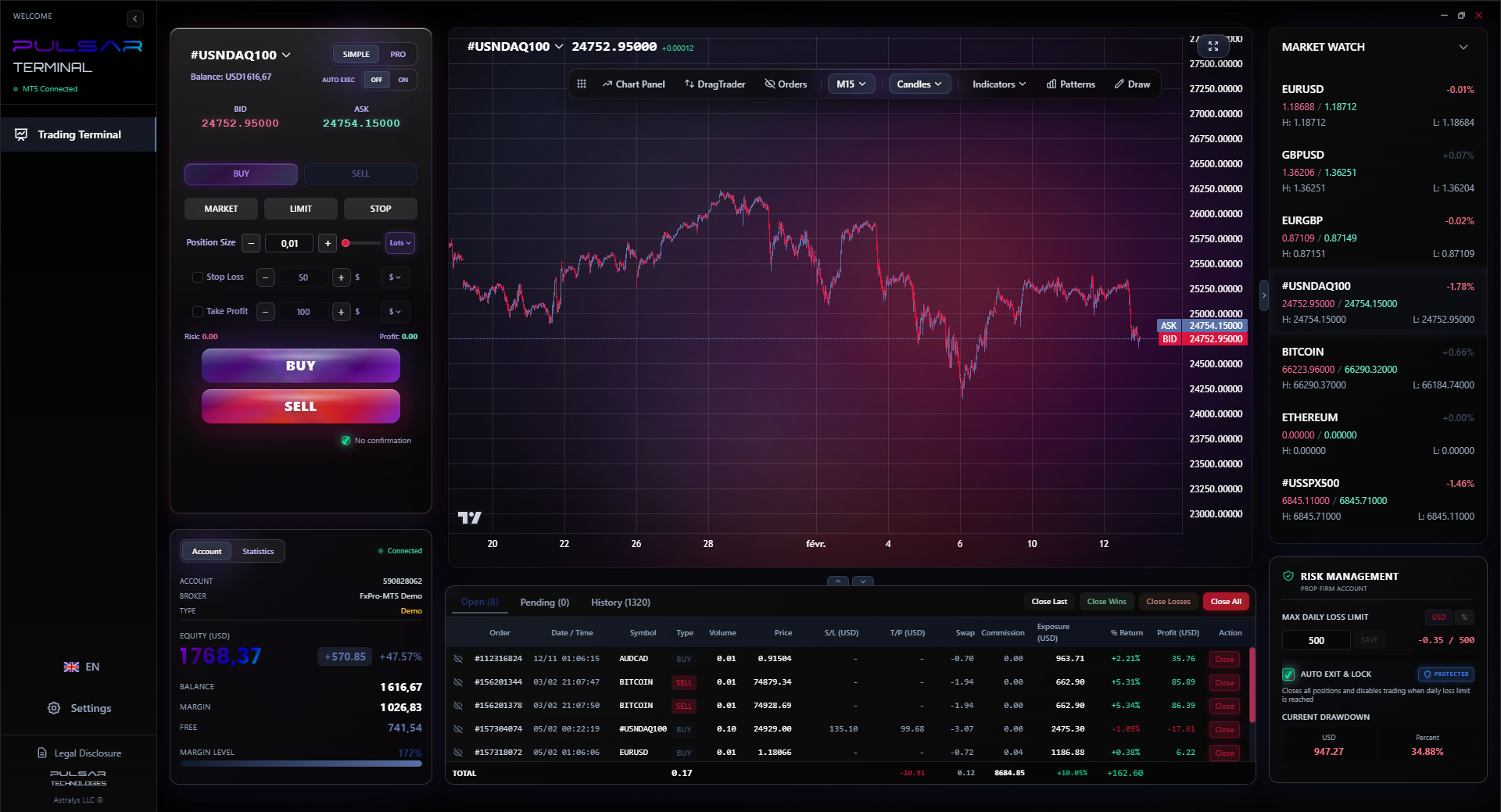
Managing multiple profit targets and trailing stops on long trades is complex, but tools like Pulsar Terminal automate this directly on your MT5 platform.
Pulsar Terminal
Alat MT5 all-in-one: order drag-and-drop, multi-TP/SL, trailing stop, grid trading, Volume Profile, dan perlindungan prop firm. Digunakan 1.000+ trader setiap hari.
I've made every single one of these. Learn from my wasted Naira.
1. Going Long Against the Trend: Because the Naira is so weak, there's a subconscious bias to think "everything must go up against the Dollar." That's not how forex works. If USD is strengthening globally, going long on EUR/USD is fighting a tidal wave. Always trade in the direction of the higher timeframe trend.
2. Over-leveraging on 'Sure Things': You hear a news tip about the ECB and pile into a huge long EUR position with 1:500 use. One contradictory tweet from a Fed official can vaporize your account. use is a tool, not a strategy.
3. Ignoring Total Cost: Between the spread, potential commission, and the 10% tax, your long trade needs to gain enough to cover all that and still be profitable. A 10-pip gain on a wide spread pair might actually be a loss after costs. This is especially critical for scalping.
4. No Stop Loss, 'Because It'll Come Back': The Nigerian 'God dey' mentality has no place in forex. The market doesn't know you exist. A long trade that goes against you can keep going until your account is zero. Always use a stop loss. Always.
The biggest shift in my career was accepting that successful long forex trading is a boring business of risk management, not an exciting hunt for jackpots.
“Successful long forex trading is a boring business of risk management, not an exciting hunt for jackpots.”
As a Nigerian, you have options. Here’s how going long in forex stacks up.
Forex (Going Long a Pair):
- Market Hours: 24/5 from Monday to Friday. You can trade around your job.
- Liquidity: Massive. You can get in and out of major pairs like EUR/USD in milliseconds.
- Focus: Macro-economics, interest rates, geopolitical events.
- Downside: It's purely speculative. You don't own an asset that pays dividends.
Stocks (Going Long a Company):
- Pros: You own a share of a business. Can pay dividends. Can be a long-term wealth builder.
- Cons for Nigerians: Access to international markets (like US stocks) requires specific brokers. Local NGX market has limited liquidity and is heavily influenced by local politics.
Crypto (Going Long Bitcoin):
- Pros: 24/7 market. Potential for explosive gains.
- Cons: Extreme volatility. Largely unregulated. Highly susceptible to sentiment and manipulation. The Naira's volatility plus crypto's volatility is a nerve-shredding combo.
For me, forex is the core. It's the most technically predictable for a swing trading approach. I use a small portion of my capital for long-term stock investments and treat crypto as a high-risk satellite. Forex provides the consistent, structured market where a disciplined long strategy can work year after year.
FAQ
Q1Is it illegal for a Nigerian to go long on forex with an international broker?
No, it is not illegal. While the CBN restricts Nigerian financial institutions from speculative forex, individuals are free to use internationally regulated brokers like IC Markets or Exness. Your responsibility is to comply with tax laws on your profits.
Q2How much tax do I pay on profits from long forex trades?
You are liable for a 10% Capital Gains Tax on your gross trading profits. If you make $1,000 profit in a year, you owe $100 (approximately N153,500 at N1,535/$) to the FIRS. You must declare and pay this yourself.
Q3What's a safe use to use when going long?
For beginners, stick to 1:10 or 1:20. Even experienced traders rarely need more than 1:50 for a long-term swing trade. High use (1:500+) is a major risk, not a benefit. It magnifies losses and can trigger margin calls on small market moves.
Q4What's the minimum amount I need to start long forex trading?
You can start with as little as $5-$10 with brokers like XM or Exness. However, with such a small amount, you must use micro lots and very low use to survive. A more practical starter amount that allows for sensible risk management is $200-$500.
Q5Can I go long on the Naira directly?
Not on major international retail forex platforms. You trade pairs like EUR/USD or GBP/USD. Your exposure to the Naira comes when you deposit or withdraw Naira to/from your broker. You are speculating on other global currencies against each other.
Q6What's the biggest mistake when going long?
Going long in a downtrend or a ranging market. The single most important rule is to only buy when the higher timeframe chart is in a confirmed uptrend (making higher highs and higher lows). Fighting the trend is the fastest way to lose money.
Pelajaran Prof. Winston
Poin Penting:
- ✓Only go long in a confirmed daily chart uptrend.
- ✓Never risk more than 2% of your account on one trade.
- ✓Budget for the 10% capital gains tax from day one.
- ✓Use use of 1:30 or less to stay in control.
- ✓A tight stop loss is non-negotiable for survival.
Seberapa bermanfaat artikel ini?
Klik bintang untuk menilai
Wawasan Trading Mingguan
Analisis & strategi mingguan gratis. Tanpa spam.
Tentang Penulis
Olumide Adeyemi
Pelopor Trading Afrika Barat
Salah satu edukator trading forex paling aktif di Nigeria. 8 tahun pengalaman trading dari Lagos. Spesialis strategi modal rendah dan tantangan prop firm untuk trader Afrika.
Komentar
Peringatan Risiko
Perdagangan instrumen keuangan mengandung risiko signifikan dan mungkin tidak cocok untuk semua investor. Kinerja masa lalu tidak menjamin hasil di masa depan. Konten ini hanya untuk tujuan edukasi dan tidak boleh dianggap sebagai nasihat investasi. Selalu lakukan riset Anda sendiri sebelum trading.
Anda mungkin juga suka

Cara Trading Forex Sukses: 7 Prinsip dari Trader Profesional
Cara trading forex sukses dengan 7 prinsip trader pro: manajemen modal, disiplin, journal trading, backtest. Data nyata, bukan janji profit palsu.
Jam Trading Forex Terbaik untuk Trader Indonesia: Panduan Lengkap dengan Tabel Waktu
Panduan jam trading forex untuk trader Indonesia. Tabel 4 sesi dunia, jam emas 20:00-00:00, sesi mana yang harus dihindari. Data akurat + tips dari trader berpengalaman.
Top 5 Sàn Forex Uy Tín Nhất 2026: Review Jujur dari Trader Indonesia
Top 5 sàn forex uy tín 2026 untuk trader Indonesia. Review jujur: spread, deposit, withdraw, dukungan lokal. Exness, XM, IC Markets & lebih.
Dapatkan Pulsar Terminal
Semua kalkulator ini terintegrasi dalam Pulsar Terminal dengan data real-time dari akun MT5 Anda.
Dapatkan Pulsar Terminal