


I lost ₦280,000 in under 90 seconds.

Olumide Adeyemi
Pelopor Trading Afrika Barat ·  Nigeria
☕ 9 mnt baca
Yang akan Anda pelajari:
- 1What Volatility Actually Means (It's Not Just 'Movement')
- 2What Causes Volatility (The Nigerian Edition)
- 3How to Measure and Trade Volatility (Tools You Can Use)
- 4The Double-Edged Sword: Opportunities and Real Risks
- 5A Nigerian Trader's Volatility Management Plan
- 6Volatility Trading Mistakes I've Made (So You Don't Have To)
I lost ₦280,000 in under 90 seconds. It was 2021, and I was short on USD/NGN, thinking the CBN would hold the line. Then a rumor hit the market - unconfirmed, just a whisper on Twitter - that a major policy shift was coming. The pair, which had been crawling, suddenly spiked. My stop-loss was obliterated before the platform could even register the fill. That wasn't just a price move. That was volatility, in its rawest, most expensive form. It taught me that in Nigeria, understanding the meaning of volatility in forex isn't academic. It's the difference between building wealth and watching your capital evaporate.
Most beginners think volatility just means 'the market is moving.' That's like saying Lagos traffic is just 'some cars.' It's an understatement that misses the entire point.
In forex, volatility measures the rate and size of price changes over a specific time. Think of it as the market's heartbeat. A steady, predictable rhythm is low volatility. A wild, erratic spike is high volatility. We measure this statistically using standard deviation, but you don't need a calculator to feel it. You feel it when your profit turns to loss before you can blink.
Here's the key for us in Nigeria: volatility represents uncertainty. When the Naira swings from ₦1,400 to ₦1,700 to the dollar and back, that's the market pricing in massive uncertainty about inflation, interest rates, and dollar liquidity. High volatility doesn't tell you the direction, only that the move - whichever way it goes - will likely be violent.

Warning: Don't confuse volatility with opportunity. A volatile market has bigger swings, but it also has wider spreads, more frequent slippage, and a higher chance your stop-loss will get taken out by a random spike. I learned this the hard way trying to scalping strategy during a CBN press conference. The spreads on EUR/NGN blew out so wide my planned 5-pip profit was impossible.
For a practical measure, look at the Average True Range (ATR) indicator. If the ATR on USD/NGN is 50 pips, expect normal daily moves around that size. If it jumps to 150 pips, strap in. The market's engine is overheating.

💡 Tips Winston
Volatility isn't your enemy. Ignorance of volatility is. Know the ATR of your pair before you place a single order.
“In Nigeria, understanding volatility isn't academic. It's the difference between building wealth and watching your capital evaporate.”
The textbooks list economic data and geopolitics. In Nigeria, we have our own special blend of catalysts.
Central Bank of Nigeria (CBN) Policy & Announcements
This is the number one driver. When the CBN Governor speaks, the Naira dances. Interest rate decisions (like the 875 basis points of hikes in 2024) are major events. The shift to a unified exchange rate window in 2024 created historic volatility. You must follow the Monetary Policy Committee (MPC) meeting calendars like a religion.
FX Liquidity & Market Reforms
When the CBN cleared the $4.2 billion FX backlog, it reduced uncertainty and lowered volatility for a period. Conversely, when dollar liquidity dries up at the official windows, the parallel market (the 'black market') goes haywire, and that spreads to the traded pairs. The new Electronic Foreign Exchange Matching System (EFEMS) aims to reduce this, but any teething problems will cause spikes.
Political & Social Events
Elections, protests, and even rumors about government policy can trigger moves. The 2023 election period saw massive swings. Social media rumors, like the one that cost me money, are a potent, if frustrating, source of short-term chaos.
Global Events with a Local Twist
Oil price moves (Brent Crude) directly impact Nigeria's dollar earnings. A 10% drop in oil can hammer the Naira. Also, watch US Federal Reserve decisions. When US rates go up, it often pulls capital out of emerging markets like Nigeria, weakening the Naira and increasing volatility across all Naira pairs.

Example: On a day with a CBN rate decision AND a major US jobs report, the volatility on USD/NGN isn't just added together, it's multiplied. The ATR can easily triple. Your normal position size calculator settings will be too aggressive for this environment.
“High volatility doesn't tell you the direction, only that the move - whichever way it goes - will likely be violent.”
You can't manage what you don't measure. Here are the tools I actually use, not just the ones textbooks mention.
ATR (Average True Range): Your best friend. It gives volatility in pips. If USD/NGN has an ATR(14) of 120 pips, a 60-pip stop-loss is probably too tight. I size my stops at 1.5x to 2x the ATR to avoid getting whipped out.
Bollinger Bands: These bands widen when volatility increases and contract when it falls. A 'squeeze' (bands coming close together) often precedes a big volatile breakout. I use this to prepare for a move, not to predict its direction.
Economic Calendars: Volatility is scheduled. You know when the US Non-Farm Payrolls or Nigerian inflation data is due. I simply don't open new positions 15 minutes before these high-impact news events. The spread definition becomes meaningless as brokers widen them to insane levels.
My Personal Rule: I have a volatility dashboard. It shows the current ATR for my top 5 pairs (like XAU/USD guide and EUR/USD guide) compared to their 20-day average. If current volatility is >150% of the average, I cut my position size by half. No arguments. This single rule saved my account during the March 2024 Naira crash.
Trading high volatility isn't about being a hero. It's about adapting. In low volatility, you might aim for 50-pip targets on EUR/USD. In high volatility, that same move can happen in 10 minutes. Your strategy needs to flex. Sometimes, the best trade is to step aside and watch the fireworks. A broker with reliable execution like IC Markets review or Pepperstone review is crucial here, as requotes and slippage will kill you.
“The first spike after news is often a trap. Wait for the consolidation.”
Volatility is where fortunes are made and lost. Let's be brutally honest about both sides.
The Opportunity (The Lure): Bigger moves mean bigger potential profits. If you catch a 500-pip move on GBP/NGN, that's life-changing money for a Nigerian account. Strategies like breakout trading or momentum trading come alive in volatile markets. When the MACD indicator gives a signal in a quiet market, it might fizzle. In a volatile trend, that same signal can run for days.
The Real Risks (The Reality):
- Slippage: Your order gets filled at a worse price than you wanted. During the Naira's freefall in late 2024, I had a buy limit on USD/NGN at ₦1,450. The price skipped from ₦1,448 to ₦1,470. My fill? ₦1,465. I was in a losing trade from the second it opened.
- Widened Spreads: Brokers aren't charities. They widen spreads to protect themselves. That 0.6 pip spread on EUR/USD can become 10 pips at 2:30 pm Nigerian time when US data drops. Your trade starts 10 pips in the red.
- Stop-Loss Hunting: In thin, volatile markets (like exotic pairs), price can briefly spike to trigger a cluster of stop-losses before reversing. It feels personal, but it's just liquidity.
- Emotional Turbulence: This is the biggest risk. Watching your P&L swing +/-₦50,000 in minutes leads to panic selling or greedy overholding.

Pro Tip: In extreme volatility, use limit orders instead of market orders. You define the worst price you'll accept. Also, consider a swing trading approach with wider stops during volatile periods, rather than trying to scalp the chaos. It's less stressful and often more profitable.
💡 Tips Winston
When the market gets wild, your first instinct should be to get smaller, not to get even. Cut your position size in half. Survival first.
“The first spike after news is often a trap. Wait for the consolidation.”
Theory is nice. Here's my practical, 4-step plan for trading in our volatile market.
Step 1: The Pre-Check (Before You Trade) Check the economic calendar. Is there CBN news today? US CPI? If yes, note the time. Check the current ATR vs. average. If it's high, I automatically reduce my lot size by 50%. I calculate my position size using a risk of 0.5% of my account, not 1%, on high-volatility days.
Step 2: Order Placement I avoid placing trades 15 minutes before and 30 minutes after major news (NFP, CPI, MPC). If I must have a stop-loss during this time, I place it further away than usual, acknowledging the wider noise. I also split my position. Instead of one 1-lot trade, I might do two 0.5-lot trades with different entry points to average in.
Step 3: Active Management I watch my trades more closely, but I interfere less. I set alerts, not market orders. If volatility is causing a strong trend, I might use a trailing stop to let profits run. The key is having a plan before the market gets crazy.
Step 4: The Post-Mortem After a high-volatility period (like post-MPC), I review every trade. Did my stops hold? Was my sizing correct? How much slippage did I get? This review is how I adjusted my baseline ATR multiples for Naira pairs.
Remember, brokers like Exness review or XM review offer different account types. An ECN/RAW account with a small commission but tighter raw spreads is often better for volatile news trading than a standard account with a wide, variable spread.
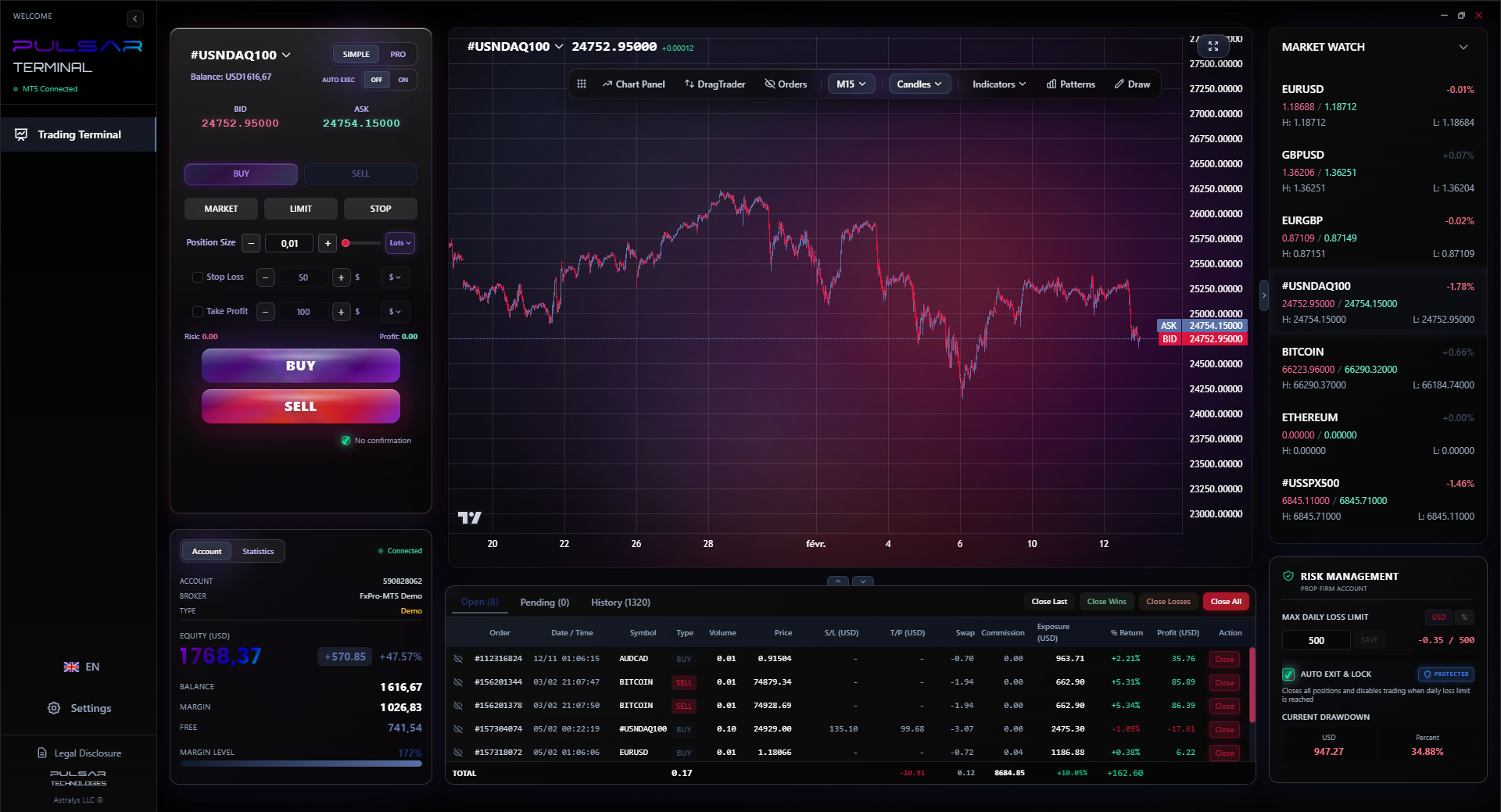
Managing volatile trades requires precise order tools, and Pulsar Terminal's drag-and-drop orders and multi-TP/SL features let you adapt your plan instantly on MT5.
Pulsar Terminal
Alat MT5 all-in-one: order drag-and-drop, multi-TP/SL, trailing stop, grid trading, Volume Profile, dan perlindungan prop firm. Digunakan 1.000+ trader setiap hari.
“Your job isn't to control the market's temperature, but to dress appropriately for it.”
Let me save you some money by sharing my scars.
Mistake 1: Chasing the News. The US Fed hikes rates, USD/NGN rockets. I FOMO buy at the very top. The 'sell the fact' reversal happens instantly, and I'm stuck. Lesson: The first spike after news is often a trap. Wait for the consolidation.
Mistake 2: Tight Stops in a Wide Market. I once set a 20-pip stop on USD/NGN when its daily ATR was 180 pips. It was like using a paper umbrella in a hurricane. I was stopped out 8 times in a day, on a trade that eventually went my way. Lesson: Match your stop to the market's noise level, not your desired risk.
Mistake 3: Ignoring Overnight/Weekend Gaps. I held a GBP/NGN trade over a weekend when UK election polls shifted. It opened Monday 300 pips against me. I hadn't considered the weekend risk. Lesson: For volatile pairs, consider closing positions before major weekends or events you can't react to. Or, ensure your account has enough buffer to avoid a margin call.
Mistake 4: Overleveraging. This is the killer. High volatility + high use = account explosion. When the Naira was moving 5% a day, I was using 1:100 use. A 1% move against me wiped out 100% of my margin. Lesson: In high volatility, reduce your use. Use 1:10 or 1:20, not 1:500. The goal is survival, not a one-trade jackpot.
The meaning of volatility in forex, for a Nigerian trader, boils down to this: it's the market's temperature. Your job isn't to control the temperature, but to dress appropriately for it. Wear a thick coat (wider stops, smaller size) in the cold, volatile storms.
FAQ
Q1Is high volatility good or bad for forex traders in Nigeria?
It's neither inherently good nor bad; it's a condition you must adapt to. It's good if you have a strategy that exploits large swings (like trend following) and you manage risk tightly. It's bad if you use strategies meant for calm markets, like certain scalp setups, or if you let your emotions take over. The high volatility of the Naira creates opportunity but demands extreme discipline.
Q2What is the most volatile currency pair for Nigerian traders?
Pairs involving the Nigerian Naira (NGN), like USD/NGN, GBP/NGN, or EUR/NGN, are often the most volatile due to local economic factors, CBN policy, and sometimes lower liquidity compared to majors. Among major pairs, GBP/JPY and AUD/JPY are traditionally more volatile. Always check the current ATR to see what's moving most right now.
Q3How does CBN policy affect forex volatility?
It's the primary driver. An unexpected interest rate hike, a change in FX allocation to BDCs, or a new guideline (like the Revised NFEM Guidelines of 2024) can cause immediate and dramatic swings in the Naira's value. The CBN's actions directly influence dollar liquidity, which is the lifeblood of the Naira's price stability. Traders must watch MPC meetings and CBN circulars closely.
Q4Should I avoid trading during high volatility?
Beginners absolutely should. If you're new, high-volatility periods are a minefield. Even experienced traders often choose to reduce position size or wait for the initial storm to pass. There's no shame in sitting out scheduled high-impact news like US Non-Farm Payrolls. Preserving capital is a valid trading strategy.
Q5What's the best indicator for measuring volatility?
The Average True Range (ATR) is the most straightforward and useful. It gives you a numerical value in pips, telling you the average range the pair has been moving. Bollinger Bands are also excellent for visualizing volatility - when the bands widen, volatility is high; when they contract (a 'squeeze'), volatility is low and a breakout may be coming.
Q6How can I protect my account from sudden volatility spikes?
- Always use a stop-loss. 2. Size your positions conservatively. Risk 0.5-1% of your account per trade, and reduce this on high-volatility days. 3. Mind the news calendar. Don't hold unchecked positions into major events. 4. Use lower use. High use magnifies volatility's damage. 5. Consider brokers with guaranteed stop-losses (GSLOs) if you're very concerned about gaps, though these usually come with a premium.
Q7Can I make money from volatility without predicting direction?
Yes, with caution. Some strategies, like straddles (buying both a call and put option) around news events, profit from a big move in either direction. In spot trading, you can look for breakouts from consolidation zones (Bollinger Band squeezes) with a pending order on each side, though this requires careful risk management. It's an advanced concept.
Pelajaran Prof. Winston
Poin Penting:
- ✓Check the ATR before every trade.
- ✓Cut position size by 50% on high-vol days.
- ✓Avoid trading 15 mins before major news.
- ✓Use limit orders, not market orders, in chaos.
- ✓High volatility demands lower use.
Seberapa bermanfaat artikel ini?
Klik bintang untuk menilai
Wawasan Trading Mingguan
Analisis & strategi mingguan gratis. Tanpa spam.
Tentang Penulis
Olumide Adeyemi
Pelopor Trading Afrika Barat
Salah satu edukator trading forex paling aktif di Nigeria. 8 tahun pengalaman trading dari Lagos. Spesialis strategi modal rendah dan tantangan prop firm untuk trader Afrika.
Komentar
Peringatan Risiko
Perdagangan instrumen keuangan mengandung risiko signifikan dan mungkin tidak cocok untuk semua investor. Kinerja masa lalu tidak menjamin hasil di masa depan. Konten ini hanya untuk tujuan edukasi dan tidak boleh dianggap sebagai nasihat investasi. Selalu lakukan riset Anda sendiri sebelum trading.
Anda mungkin juga suka

Cara Trading Forex Sukses: 7 Prinsip dari Trader Profesional
Cara trading forex sukses dengan 7 prinsip trader pro: manajemen modal, disiplin, journal trading, backtest. Data nyata, bukan janji profit palsu.
Jam Trading Forex Terbaik untuk Trader Indonesia: Panduan Lengkap dengan Tabel Waktu
Panduan jam trading forex untuk trader Indonesia. Tabel 4 sesi dunia, jam emas 20:00-00:00, sesi mana yang harus dihindari. Data akurat + tips dari trader berpengalaman.
Top 5 Sàn Forex Uy Tín Nhất 2026: Review Jujur dari Trader Indonesia
Top 5 sàn forex uy tín 2026 untuk trader Indonesia. Review jujur: spread, deposit, withdraw, dukungan lokal. Exness, XM, IC Markets & lebih.
Dapatkan Pulsar Terminal
Semua kalkulator ini terintegrasi dalam Pulsar Terminal dengan data real-time dari akun MT5 Anda.
Dapatkan Pulsar Terminal