


Staring at the download page, wondering if you should finally make the jump from MetaTrader 4 to MetaTrader 5? You're not alone.

Sarah Collins
Ahli Strategi Trading ·  Australia
☕ 9 mnt baca
Yang akan Anda pelajari:
Staring at the download page, wondering if you should finally make the jump from MetaTrader 4 to MetaTrader 5? You're not alone. In Australia, with our unique ASIC rules and trading culture, it's not a simple upgrade. It's a strategic choice. I've traded on both for years, lost money on both, and made money on both. Let's cut through the marketing fluff and look at what really matters for your bottom line.
Most brokers will tell you MT5 is the newer, better version of MT4. That's only half true. It's like comparing a dedicated sports car to a versatile ute. They're built for different jobs.
MT4 was engineered for one thing: spot forex. Its entire architecture, from order execution to the way it handles pricing, is optimized for the currency market. It's lean, fast, and does that one job brilliantly. I've had orders fill on MT4 during major news events when other platforms choked. That reliability is why it's still the king for pure forex traders.
MT5, on the other hand, was built as a multi-asset platform from the ground up. It's designed to handle not just forex, but stocks, futures, options, and commodities on a single terminal. This requires a different internal structure. The most critical change for you is the order accounting system. MT4 uses a FIFO (First In, First Out) hedging model that allows you to have multiple positions in the same pair, a style many Aussie traders love. MT5 uses a netting system by default, where opposing positions on the same instrument cancel each other out. This feels restrictive if you're used to the MT4 way.

Warning: Many offshore brokers offering MT5 to Australians enable a 'hedging mode' to mimic MT4. It's a workaround, not the native design. Always check with your specific broker if you rely on complex hedging strategies.
The bottom line? MT4 is a specialist. MT5 is a generalist. Your choice starts here.

💡 Tips Winston
Platform loyalty is for football teams, not traders. Use the tool that fits your current strategy, not the one you used last year.
Let's talk dollars and cents, because in a game where 74-89% of retail accounts lose money (as reported by brokers like Pepperstone and IC Markets), every pip counts.
Spreads and Commissions
In my experience across multiple ASIC brokers, the raw trading costs between MT4 and MT5 are virtually identical for forex. If you're on a Raw/ECN account at a place like FP Markets or Pepperstone, you're looking at spreads from 0.0 pips plus that standard AU$3.50 commission per side, per lot, on both platforms. The difference isn't in the fee structure, but in potential hidden costs.
MT5's more complex back-end can sometimes lead to slightly higher data fees for brokers offering extensive stock CFDs, which might be passed on. For pure forex, though, it's a wash. I once ran a parallel test for a month on EUR/USD with identical lot sizes on MT4 and MT5 accounts at the same broker. The total cost difference was less than a tenner. Not enough to decide on.
The Swap Rate Surprise
This is where you need to pay attention. MT5 calculates swap rates (overnight financing) differently. It uses a modern formula that can account for triple swaps on Wednesdays more accurately. In practice, I've seen my long-term carry trades on AUD/JPY show slightly different overnight charges between the two platforms. It's rarely a deal-breaker, but if you're a multi-week swing trader, you should check the swap details for your specific instruments.

Example: Let's say you're using a position size calculator for a 1-lot trade. The calculator gives you the risk, but your net profit over a week will be impacted by these small differences in swap calculation. It's a rounding error on a single trade, but it compounds.
“MT4 is a specialist. MT5 is a generalist. Your choice starts here.”
Trading in Australia isn't the wild west. ASIC has our backs, but also ties our hands - for good reason. The 2021 use caps fundamentally changed how we use any platform.
With max use of 30:1 on major pairs and 20:1 on gold, the old MT4 mentality of "crank it to 500:1 and hope" is dead. This actually levels the playing field between MT4 and MT5. Both platforms now have to work within the same margin constraints. The fancy order types in MT5 don't let you magically bypass ASIC's 5:1 use on share CFDs.
Where regulation does influence your choice is in broker selection. A true ASIC-regulated entity (like the ones in our IC Markets review or Pepperstone review) will offer both platforms under the same strict rules: negative balance protection, segregated accounts, no dodgy bonuses.
However, some brokers give you an option: an ASIC account (with low use) or an offshore entity account (with use up to 1:500). This is a critical fork in the road. That offshore account might only be available on MT4, as it's the global standard for high-use retail forex. Choosing the platform can sometimes mean choosing the regulatory environment. My rule? Always prefer the ASIC-regulated side. I learned that the hard way in 2015 when a non-ASIC broker 'requoted' me into a massive loss on a GBP flash crash. Protection is worth more than use.
This is where the rubber meets the road. You stare at these charts for hours. Which one feels better?
MT4's charting is classic, simple, and incredibly fast. It has 30 built-in indicators, which is all 99% of traders will ever need. Drawing a trendline, dropping in an RSI indicator or MACD indicator, and managing a trade is second nature to millions. For scalping strategy where every millisecond and clean visual matters, MT4's simplicity is a weapon.
MT5's charting is objectively more powerful. It has 38 indicators, more timeframes (including 11 minute-based ones like M2, M3, M4, M6, M10, M12, M20), and better graphical objects. The economic calendar is integrated. Backtesting is light-years ahead with a multi-threaded strategy tester that can use real tick data. If you're a quant or an EA developer, MT5 is the only serious choice.
But here's my honest take: most retail traders don't use 10% of that power. I spent two years forcing myself to use MT5 exclusively. I used more timeframes, sure, but did my profitability increase? Not really. The core skills of reading price action and managing risk don't change with the platform. The fanciest hammer won't make you a better carpenter.
One tangible MT5 win: the Depth of Market (DOM) window. It's a proper Level II data view, which is fantastic for futures or equity CFDs. For forex, it's less useful unless you have direct market access, which most of us don't.
💡 Tips Winston
The time you spend tweaking platform settings is time not spent analysing the market. Choose simple and master it.
“Don't switch platforms hoping it will make you a better trader. It won't.”
This is the deal-breaker for many, and it's where the MT4 vs MT5 debate gets tribal.
MT4 uses MQL4, its own programming language. The environment is enormous. There are thousands of free and paid EAs, indicators, and scripts out there. If you can imagine a trading robot, someone has probably coded it for MT4. I bought a grid-trader EA for MT4 back in 2017 for $500. It worked (until it blew up my account during a low-liquidity period, but that's another story). The point is, the resources are vast.
MT5 uses MQL5. It's a more modern, powerful language. It supports object-oriented programming, more complex calculations, and native access to that superior strategy tester. However, the library of ready-made stuff is much smaller. That awesome EA you found for MT4? It won't run on MT5. It needs to be rewritten from scratch.
If you are a coder or hire one, MT5 is the superior foundation. If you rely on buying or downloading pre-made automation, MT4's library is an unbeatable advantage. I've seen too many traders switch to MT5 only to find their entire automated trading system is obsolete. Don't be that guy. Check your toolbox first.

Pro Tip: Before you commit to MT5, search for the specific EAs or indicators you depend on. If they don't have an MQL5 version, and you can't code one, your decision is made for you. Stick with MT4.
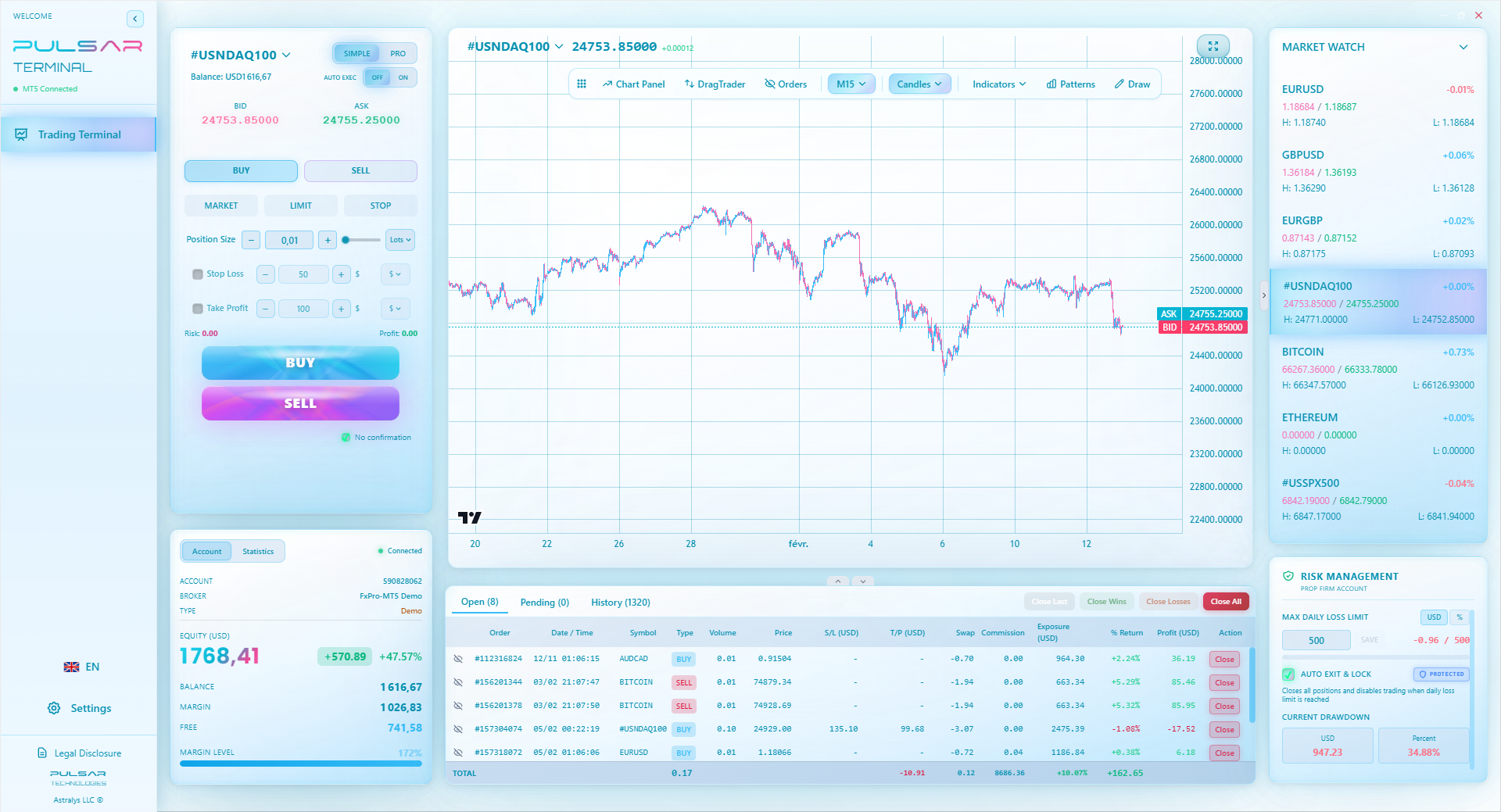
Managing complex trades with multiple take-profits and trailing stops is a headache on vanilla MT4/5, which is where a tool like Pulsar Terminal automates the entire process.
Pulsar Terminal
Alat MT5 all-in-one: order drag-and-drop, multi-TP/SL, trailing stop, grid trading, Volume Profile, dan perlindungan prop firm. Digunakan 1.000+ trader setiap hari.
Enough theory. Let's get practical. Who should use which platform?
Stick with MetaTrader 4 IF:
- You trade primarily forex and maybe gold.
- You use a classic swing trading or scalping style based on common indicators.
- You rely on pre-built Expert Advisors or custom scripts you found online.
- You value simplicity, speed, and a platform that feels like a worn-in pair of boots.
- You trade with an offshore entity offering very high use (though I still advise against this).
Make the Switch to MetaTrader 5 IF:
- You actively trade ASX share CFDs, indices, or commodities alongside forex.
- You are a systems trader who develops and backtests complex algorithms. The testing suite is worth the switch alone.
- You need more sophisticated order types (like stop-limit) for trading instruments outside of forex.
- You're starting fresh with no legacy attachment to MT4 tools.
- Your broker (like FP Markets or IC Markets) offers a superior range of instruments exclusively on MT5.
For most Aussie traders starting out, I still recommend MT4. Get good at trading first. Learn what a pip definition really means for your P&L, understand spread definition costs, and survive your first margin call. Then, if your strategy evolves beyond simple forex, MT5 is there waiting.
My personal setup? I run both. MT4 for my core forex EUR/USD guide swing trades and a few trusted EAs. MT5 for trading the ASX 200 index and for developing new strategies in its tester. There's no law saying you can't have both installed.
💡 Tips Winston
If you can't explain why you need MT5's extra features, you don't need them. Complexity is the enemy of execution.
“The problem was the bloke behind the keyboard, not the software.”
Twelve years ago, I'd have told you MT4 was the only platform you'd ever need. Five years ago, I'd have said MT5 is the inevitable future and to jump ship immediately. Today, I'm more pragmatic.
The market has fragmented. MT4 remains the undisputed champion for retail forex. MT5 is the capable, more powerful platform for the multi-asset trader. In Australia, our regulated environment makes the raw speed advantage of MT4 less critical, but the familiarity and vast environment keep it relevant.
Don't switch platforms hoping it will make you a better trader. It won't. Your psychology, risk management, and edge are platform-agnostic. I once blew a $5,000 account on MT5 using the same reckless strategy that blew a $5,000 account on MT4. The problem was the bloke behind the keyboard, not the software.
Choose the tool that best fits the assets you trade and the way you automate. For pure forex, MT4 is often still the sharper tool. For everything else, or if you're building complex systems, MT5 is the more strong foundation. And remember, the best platform in the world is useless without a solid broker. Do your homework on that front first.
Now, go look at your trading journal. Your answer is probably already in there.
FAQ
Q1Can I run my MT4 Expert Advisor on MT5?
No, you cannot. MT4 EAs are written in MQL4 and MT5 uses MQL5. They are completely incompatible. The EA needs to be manually rewritten/ported by a programmer, which can be costly. This is the single biggest barrier to switching for many traders.
Q2Do all Australian brokers offer both MT4 and MT5?
Most major ASIC-regulated brokers like Pepperstone, IC Markets, and FP Markets offer both. However, the range of instruments available can differ. A broker might offer 10,000+ share CFDs on MT5 but only 60+ on MT4. Always check the specific instrument list for the platform you intend to use.
Q3Is MT5 really faster than MT4?
In raw computational power for backtesting and data processing, yes, MT5 is significantly faster due to multi-threading. For order execution speed on a live forex trade, the difference is negligible for most retail traders. Your broker's servers and your internet connection are far bigger factors.
Q4Does ASIC regulate MT4 or MT5 differently?
No. ASIC regulates the broker and the financial product (CFDs), not the trading platform software itself. The same ASIC rules on use, negative balance protection, and client money segregation apply regardless of whether you're using MT4, MT5, or a web platform.
Q5I'm new to trading in Australia. Which should I start with?
Start with MetaTrader 4. The learning resources, free indicators, and community support are vastly larger. It's less overwhelming. Once you understand the basics of placing trades, reading charts, and managing risk on MT4, you can always evaluate MT5 later with a clearer idea of what you need.
Q6Can I hedge on MT5 like I can on MT4?
By default, MT5 uses a netting system where opposite positions on the same instrument cancel out. However, many brokers (including most serving Australians) offer a 'Hedging Option' for MT5 accounts. You must request this from your broker specifically. It's not the native mode, but it mimics MT4's behavior.
Pelajaran Prof. Winston
Poin Penting:
- ✓MT4's environment for forex EAs is still unmatched.
- ✓MT5's backtester is essential for serious system developers.
- ✓ASIC's 30:1 use cap makes MT4's raw speed less critical.
- ✓Always verify hedging capabilities with your broker on MT5.
Seberapa bermanfaat artikel ini?
Klik bintang untuk menilai
Wawasan Trading Mingguan
Analisis & strategi mingguan gratis. Tanpa spam.
Tentang Penulis
Sarah Collins
Ahli Strategi Trading
Ahli strategi trading berbasis London dengan 12 tahun di pasar keuangan. Mantan analis di perusahaan pialang City of London. Mencakup pasangan GBP, pasar Eropa, dan trading berregulasi FCA.
Komentar
Peringatan Risiko
Perdagangan instrumen keuangan mengandung risiko signifikan dan mungkin tidak cocok untuk semua investor. Kinerja masa lalu tidak menjamin hasil di masa depan. Konten ini hanya untuk tujuan edukasi dan tidak boleh dianggap sebagai nasihat investasi. Selalu lakukan riset Anda sendiri sebelum trading.
Anda mungkin juga suka

Cara Trading Forex Sukses: 7 Prinsip dari Trader Profesional
Cara trading forex sukses dengan 7 prinsip trader pro: manajemen modal, disiplin, journal trading, backtest. Data nyata, bukan janji profit palsu.
Jam Trading Forex Terbaik untuk Trader Indonesia: Panduan Lengkap dengan Tabel Waktu
Panduan jam trading forex untuk trader Indonesia. Tabel 4 sesi dunia, jam emas 20:00-00:00, sesi mana yang harus dihindari. Data akurat + tips dari trader berpengalaman.
Top 5 Sàn Forex Uy Tín Nhất 2026: Review Jujur dari Trader Indonesia
Top 5 sàn forex uy tín 2026 untuk trader Indonesia. Review jujur: spread, deposit, withdraw, dukungan lokal. Exness, XM, IC Markets & lebih.
Dapatkan Pulsar Terminal
Semua kalkulator ini terintegrasi dalam Pulsar Terminal dengan data real-time dari akun MT5 Anda.
Dapatkan Pulsar Terminal