


You want to trade forex from Nigeria.

Olumide Adeyemi
Pelopor Trading Afrika Barat ·  Nigeria
☕ 11 mnt baca
Yang akan Anda pelajari:
You want to trade forex from Nigeria. You've seen the ads promising quick millions from your phone. But you're smart enough to know there's more to it. What's the real story? How do you actually make this work from Lagos, Abuja, or Port Harcourt without getting scammed or blowing your account? I've traded here for over a decade, made every mistake you can think of, and learned a few hard lessons. This isn't a get-rich-quick pitch. It's a straight talk on what naija forex really looks like.
Let's start with the cold, hard truth. The environment here is different. It's not London or New York. Your first enemy isn't the market, it's the noise. The WhatsApp groups promising 100% weekly returns, the 'gurus' selling signals, the constant pressure to 'hustle' and make it big fast. I fell for it early on. I joined a group in 2015, followed a 'master trader' who claimed he had a secret algorithm. I put in $500, copied his trades for two weeks, and watched it become $180. The secret? He was just gambling on high-use news events and posting his wins, hiding his losses. That $320 loss taught me more than any win.
The infrastructure matters too. Power outages can kill a trade. Internet reliability isn't a given. I once had a perfect scalping strategy setup on EUR/NGN (before the CBN changes), got my entry, and then NEPA took the light. By the time my inverter kicked in, I was stopped out for a full 2% loss. You have to plan for chaos. Your strategy must account for the fact that you might get disconnected. This means wider stops sometimes, or avoiding ultra-short timeframes if your power is unreliable.
Then there's the psychological pressure. Family and friends hear 'forex' and think it's gambling or a scam. When you have a losing month (and you will), the side-eyes and 'I told you so' comments can get to you. You need a mindset of steel, and that starts with treating this as a real business, not a side hustle.

💡 Tips Winston
Your first profit target should always be to move your stop loss to breakeven. Protecting capital is job one. A trade that can't go to breakeven rarely deserves to be a winner.
This is the most important section. Get this wrong, and you can lose everything. The Central Bank of Nigeria (CBN) has a complex relationship with retail forex trading. They don't license international brokers for retail spot forex. Let me repeat that: No international broker like Exness or IC Markets is officially licensed by the CBN to offer forex trading to Nigerians. They operate from offshore jurisdictions (Cyprus, Seychelles, Australia).
So, is it illegal for you to trade with them? Not exactly. You're not breaking Nigerian law by having an account with a regulated foreign entity. The issue is funding and withdrawing. The CBN restricts the flow of Naira for the purpose of international margin trading. This is where it gets tricky.
How Funding Actually Works
You'll almost always use cryptocurrencies or bank transfers to a foreign account. Most brokers accept crypto deposits (USDT is king). This is the most common path. You buy USDT from a local P2P platform with Naira, then send it to your broker. Withdrawals are the reverse. It works, but you're exposed to P2P exchange rate fluctuations and the occasional shady counterparty.

Warning: Never, ever use a broker that isn't regulated by a top-tier authority like ASIC (Australia), FCA (UK), or CySEC (Cyprus). The 'offshore' brokers in unregulated islands are a minefield of price manipulation and withdrawal issues. I learned this the hard way with a 'Seychelles-regulated' broker that simply vanished with my $1,000 test deposit.
The NAFEX Rate and Your Trades
You're not trading the official CBN rate. You're trading the Nigerian Autonomous Foreign Exchange Rate (NAFEX), which is the benchmark for investors and exporters. This is the rate you see on your trading platform for USD/NGN pairs. It's more volatile and reflects market forces more than the official rate. When you're analyzing USD/NGN, you're analyzing NAFEX.
“Your first enemy isn't the market, it's the noise.”
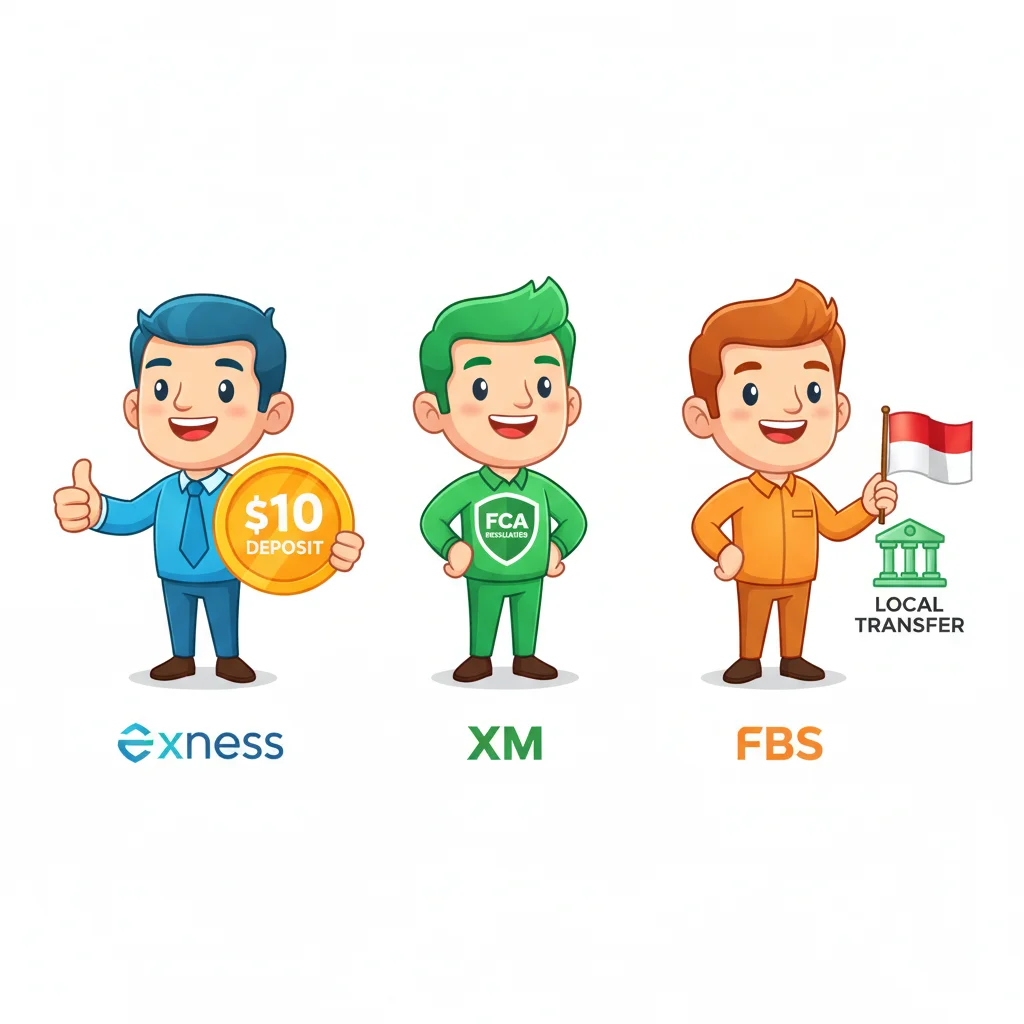
Your broker choice in Nigeria isn't about who has the flashiest bonuses. It's about who can reliably get your money in and out, and who won't manipulate your trades. I've tested over a dozen. Here's my breakdown.
| Broker | Why it Works for Naija | The Catch |
|---|---|---|
| Exness | Hugely popular here. Crypto deposits/withdrawals are smooth, often under an hour. Local support. | Spreads can widen significantly on exotic pairs. The very popularity means their servers can get hammered during high volatility. |
| IC Markets | Raw spreads, great execution. My go-to for scalping. Accepts crypto. | Less localised than Exness. Customer support isn't as Nigeria-savvy. |
| XM | Good for beginners. Lots of educational resources that are actually helpful. Crypto funding available. | Spreads are generally higher than IC Markets or Pepperstone. Not the best for ultra-low-cost strategies. |
| Pepperstone | Top-tier execution and Razor account for tight spreads. Very professional. | Funding can be slightly more cumbersome than Exness. A better choice for experienced traders. |
My personal setup? I use IC Markets for my main EUR/USD and Gold (XAU/USD guide) trading because I need that tight spread. I keep an Exness account for smaller, experimental trades because the funding is so frictionless.

Pro Tip: Always do a test withdrawal before you fund a large account. Deposit the minimum ($50-$100), trade a little, then request a withdrawal back to your crypto wallet. If that process takes days or has hidden fees, walk away. This simple test saved me from two problematic brokers.
Forget copying strategies from traders in the US with fiber internet and no power worries. Your strategy must be built for your conditions.
Timeframes and Session Trading
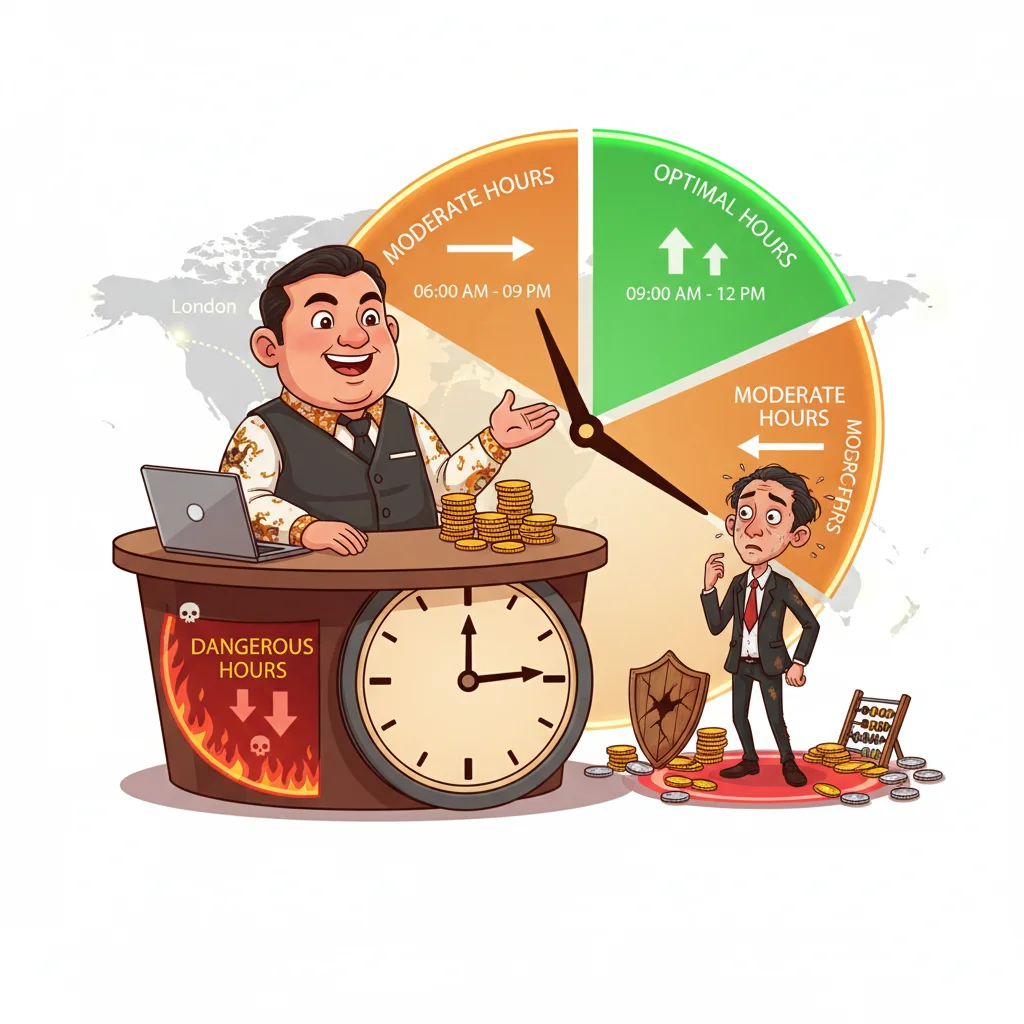
If your power is unstable, avoid 1-minute and 5-minute charts. A generator or inverter switchover can take 30 seconds, a lifetime for a scalper. I shifted from scalping to 1-hour and 4-hour chart swing trading years ago, and my consistency improved dramatically. I trade the London and New York session overlaps (2pm - 5pm Nigerian time). The liquidity is high, and I'm less likely to be caught off-guard by a random blackout in the middle of the night.
Instrument Selection
Stick to the majors. EUR/USD, GBP/USD, USD/JPY. Their spreads are tight, and they're less prone to wild, broker-induced slippage than exotic pairs. I love Gold (XAU/USD), but it's volatile. You need a wider stop, which means a smaller position size. Use a position size calculator religiously. My biggest single loss was on Gold in 2020. I got greedy, didn't adjust my lot size for the wider stop, and a $15 sudden move against me wiped out a week's profits. That was a $2,300 lesson in humility and risk management.
Simple Beats Complex
In a noisy environment, a complex strategy with 10 indicators will fail you when you're stressed. I use two, maybe three. Price action (support/resistance), the MACD indicator for trend confirmation, and the RSI indicator for overbought/oversold zones. That's it. I spent years complicating my charts. Now, clarity is my edge.

Example: Here's my basic swing setup for EUR/USD. I wait for price to approach a clear 4-hour support zone. I check the daily trend is still up. I look for the MACD histogram to be ticking up from below its signal line, and the RSI to be under 40 (but not oversold below 30). Entry on a 1-hour bullish candle close. Stop loss 15 pips below the support low. Take profit at the next resistance. Risk is never more than 1% of my account. Boring? Yes. Profitable over time? Absolutely.
💡 Tips Winston
If you wouldn't show your trade history and journal to a skeptical banker asking for a loan, you're not treating this as a business. Professionalism starts with your own records.
“High use is a trap. I never use more than 1:50, even on a small account.”
This isn't just a section. It's the entire game. In Nigeria, with the added pressures, poor risk management will destroy you faster than a bad trade.
The 1% Rule is Non-Negotiable. Never risk more than 1% of your trading capital on a single trade. If you have a $1,000 account, your max loss per trade is $10. This protects you from the emotional revenge trading after a loss. I violated this in my second year. Had three losing trades in a row, got angry, and quadrupled my position on the fourth trade to 'make it back.' It was another loser. I lost 12% of my account in one stupid afternoon. It took me a month of disciplined trading to recover.
Understand use, Don't Worship It. High use (like 1:1000 offered by some brokers) is a trap. It amplifies your gains and your losses. I never use more than 1:50, even on a small account. use is for controlling position size with less capital, not for magnifying bets. Using high use with poor risk management is the fastest path to a margin call.
Have a Daily Loss Limit. Mine is 3%. If I lose 3% of my account in a day, I shut down the platform. No questions, no 'one more trade.' This rule has saved me from countless downward spirals. Your psychology is your weakest link. This rule protects it.
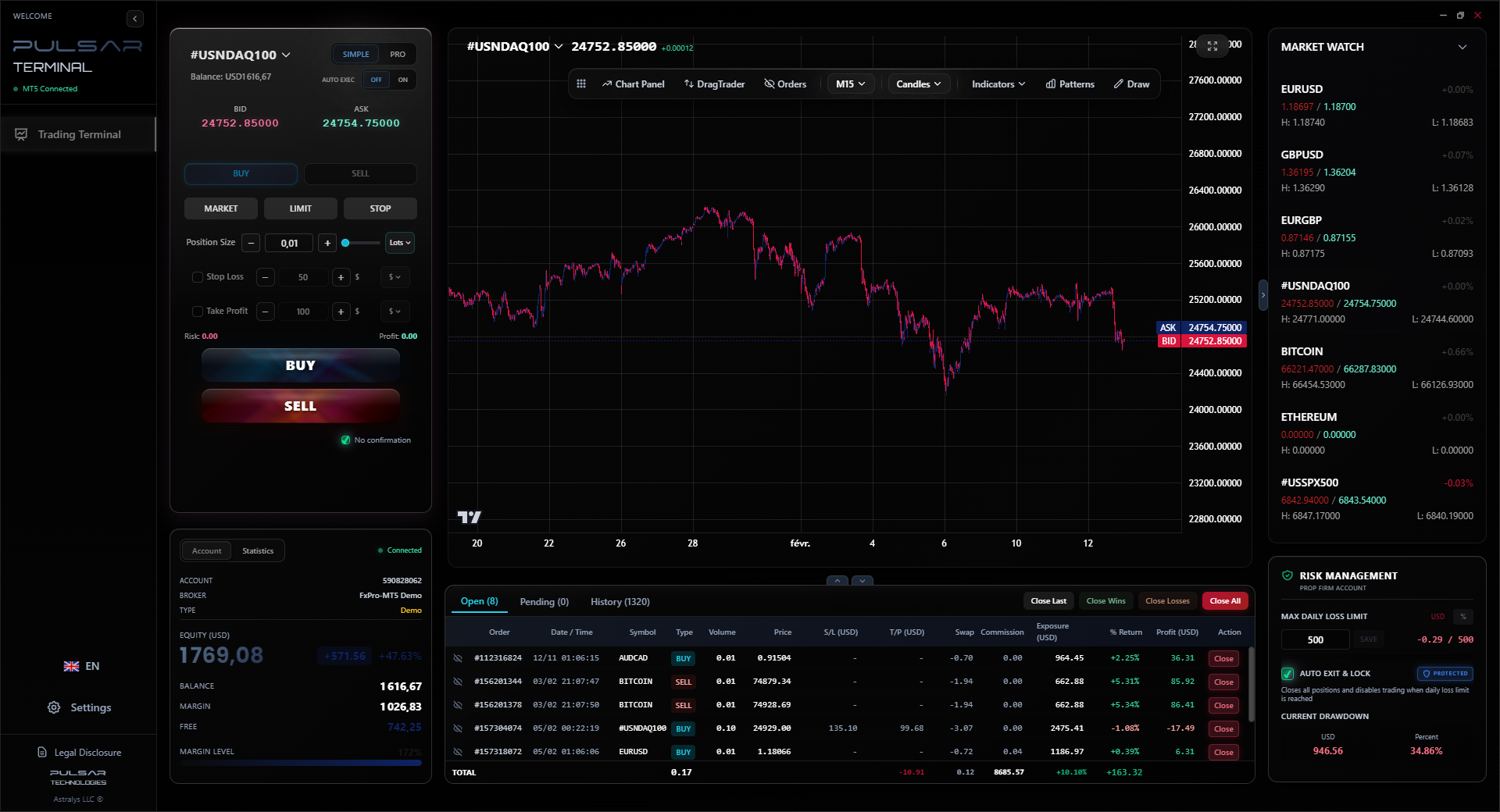
Tools like a trailing stop or a breakeven function are vital for locking in profits and managing open trades without staring at the screen all day. Automating this part of your process removes emotion.
Managing risk and emotions is hard enough without platform limitations; Pulsar Terminal automates trailing stops, breakeven moves, and multi-level take-profits directly on your MT5, so your strategy executes even when you can't watch the screen.
Pulsar Terminal
Alat MT5 all-in-one: order drag-and-drop, multi-TP/SL, trailing stop, grid trading, Volume Profile, dan perlindungan prop firm. Digunakan 1.000+ trader setiap hari.
Trading psychology is universal, but the Nigerian flavor is unique. The 'get rich quick' mentality is pervasive. You have to actively fight against it. This is a marathon, not a sprint.
Separate Your Trading Capital. This money should be considered 'gone' for all other purposes. It is not for school fees, not for a new phone, not for aso ebi. The moment you need that money for an emergency, you'll trade with fear and make terrible decisions. I keep my trading account completely separate from my savings and bills account.
Ignore the Noise. Leave the WhatsApp groups full of 'guys buy GBP/USD now!!!' messages. Mute the 'gurus' on Twitter. Their goal is engagement, not your profitability. Create your own quiet space to analyze the market. My best decision was leaving all trading groups in 2019. My performance improved because I was following my plan, not the herd's panic.
Track Everything. Keep a trading journal. Not just wins and losses, but your emotional state, what distracted you, the time of day. I noticed I made most of my mistakes after 10pm Nigerian time, when I was tired. So I banned myself from trading after 8pm. Simple fix, massive impact.
Remember, consistency over months and years is what builds wealth. One big win means nothing. A steady, small positive return, compounded, means everything. That's the real naija forex success story nobody wants to talk about because it's not sexy. But it's the only one that lasts.
“One big win means nothing. A steady, small positive return, compounded, means everything.”
Okay, you're convinced. Here's a step-by-step plan for your first month. Don't skip steps.
- Week 1: Education & Demo. Don't touch real money. Read up on basic terms: pip, spread, lot size. Open a demo account with Exness or XM. Practice placing trades, setting stops and targets. Get comfortable with the platform. Try the position size calculator.
- Week 2: Strategy Practice. Pick one major pair (EUR/USD is perfect). On your demo, practice the simple strategy I mentioned earlier. Don't modify it yet. Just follow the rules for 20 trades. Record every outcome in a notebook or spreadsheet.
- Week 3: Broker Setup & Tiny Funding. If your demo results are breakeven or better (you're not blowing it up), choose a broker. Open a real account. Fund it with the ABSOLUTE MINIMUM. For Exness, that's like $10. This is now your 'live training' account. The money is real, but the amount is small enough that losing it won't hurt.
- Week 4: Live Execution. Trade your strategy on this micro account. Your goal is not to make money. Your goal is to execute your plan perfectly, with real emotions involved. Did you move your stop loss? Did you take profit early? This month is about building discipline, not profit.
If you can end 30 days with a disciplined process and your micro account still has most of its capital, you're ahead of 90% of people who start. Now you can think about gradually scaling up. This slow, boring approach is your shield against the chaos of naija forex.
FAQ
Q1Is forex trading legal in Nigeria?
Trading forex with international, offshore brokers is not illegal for individuals. However, the Central Bank of Nigeria (CBN) does not license these brokers for retail trading, and there are restrictions on using official banking channels to fund such accounts. Most traders use cryptocurrency (like USDT) for deposits and withdrawals.
Q2What is the minimum amount to start forex trading in Nigeria?
You can start with as little as $10 (about ₦15,000) with some brokers. However, I strongly advise starting with a demo account for at least two weeks, then funding a live account with a small amount you are 100% prepared to lose - think ₦20,000-₦50,000 - solely for the purpose of learning live execution without financial pressure.
Q3Which broker is best for Nigerian traders?
There's no single 'best.' Exness is popular for its easy crypto funding and local support. IC Markets is excellent for low spreads and professional execution. XM is great for beginners due to its education. Your choice depends on your trading style and priority (funding ease vs. trading costs). Always verify their international regulation (ASIC, CySEC).
Q4How do I withdraw my forex profits in Nigeria?
The most common and reliable method is via cryptocurrency withdrawal. You request a withdrawal from your broker to your personal crypto wallet (e.g., Trust Wallet, Binance). Then, you sell the USDT or other crypto on a local P2P platform (like Binance P2P or Patricia) for Naira, which is sent to your bank account.
Q5Can I make a living from forex trading in Nigeria?
It's possible, but it's incredibly difficult and takes years of disciplined practice. Most who try fail. Do not quit your job to trade. Start as a side activity, treat it as a serious skill to learn, and only consider it a primary income source once you have at least 2-3 years of consistent, documented profitability and a large enough capital base to withstand drawdowns.
Q6What time is best to trade forex in Nigeria?
The most liquid and active sessions are the London session (1 PM - 10 PM Nigerian Time) and the overlap with the New York session (2 PM - 5 PM Nigerian Time). This is when spreads are tightest and price movement is most predictable for many strategies. Avoid the quiet Asian session unless your strategy specifically targets it.
Pelajaran Prof. Winston
Poin Penting:
- ✓Fund with crypto, withdraw with crypto. It's the naija forex lifeline.
- ✓Never risk more than 1% per trade. Your survival depends on it.
- ✓Trade the London/New York overlap (2-5 PM WAT) for the cleanest moves.
- ✓If your power is bad, avoid scalping. Swing trade on higher timeframes.
- ✓Your strategy must be simple enough to execute during 'NEPA light.'
Seberapa bermanfaat artikel ini?
Klik bintang untuk menilai
Wawasan Trading Mingguan
Analisis & strategi mingguan gratis. Tanpa spam.
Tentang Penulis
Olumide Adeyemi
Pelopor Trading Afrika Barat
Salah satu edukator trading forex paling aktif di Nigeria. 8 tahun pengalaman trading dari Lagos. Spesialis strategi modal rendah dan tantangan prop firm untuk trader Afrika.
Komentar
Peringatan Risiko
Perdagangan instrumen keuangan mengandung risiko signifikan dan mungkin tidak cocok untuk semua investor. Kinerja masa lalu tidak menjamin hasil di masa depan. Konten ini hanya untuk tujuan edukasi dan tidak boleh dianggap sebagai nasihat investasi. Selalu lakukan riset Anda sendiri sebelum trading.
Anda mungkin juga suka

Cara Trading Forex Sukses: 7 Prinsip dari Trader Profesional
Cara trading forex sukses dengan 7 prinsip trader pro: manajemen modal, disiplin, journal trading, backtest. Data nyata, bukan janji profit palsu.
Jam Trading Forex Terbaik untuk Trader Indonesia: Panduan Lengkap dengan Tabel Waktu
Panduan jam trading forex untuk trader Indonesia. Tabel 4 sesi dunia, jam emas 20:00-00:00, sesi mana yang harus dihindari. Data akurat + tips dari trader berpengalaman.
Top 5 Sàn Forex Uy Tín Nhất 2026: Review Jujur dari Trader Indonesia
Top 5 sàn forex uy tín 2026 untuk trader Indonesia. Review jujur: spread, deposit, withdraw, dukungan lokal. Exness, XM, IC Markets & lebih.
Dapatkan Pulsar Terminal
Semua kalkulator ini terintegrasi dalam Pulsar Terminal dengan data real-time dari akun MT5 Anda.
Dapatkan Pulsar Terminal