


Here's a statistic that should make you rethink your entire trading approach: 89% of all forex trades involve the US dollar, yet most traders are staring at lagging indicators instead of the raw price action driving that volume.
James Mitchell
Analis Trading Senior
☕ 12 mnt baca
Yang akan Anda pelajari:
- 1What Is Naked Forex (And Why It Actually Works)
- 2Core Principles: Reading the Language of Price
- 3High-Probability Naked Setups
- 4Applying These Techniques in the US Market Context
- 5Risk Management: The Naked Trader's Armor
- 6Building Your Naked Trading Routine
- 7Common Pitfalls (And How I Blew Money Learning Them)
Here's a statistic that should make you rethink your entire trading approach: 89% of all forex trades involve the US dollar, yet most traders are staring at lagging indicators instead of the raw price action driving that volume. Naked forex - trading with nothing but price, volume, and time - isn't some mystical art. It's how the big money actually operates. I spent years drowning in RSI divergences and MACD crossovers before realizing the cleanest signals were right there on the chart, hiding in plain sight. This guide will show you the high-probability techniques that work when you strip everything else away.
Naked forex is exactly what it sounds like: trading without the clutter of technical indicators. No moving averages, no Bollinger Bands, no stochastic oscillators. Just you, the raw price chart, and the story it's telling. It's about reading supply and demand directly from how price moves, not from a derived mathematical formula that's always one step behind.
The reason it works, especially in a market as dominant as the USD, is simple. Price action is the first derivative of all market information. Every news event, every central bank whisper, every large institutional order gets digested and reflected in the price before any indicator can catch up. I learned this the hard way in 2015 during the Swiss Franc unpegging. My indicators were frozen in disbelief while the EUR/CHF chart was painting a historic collapse in real time. The only traders who survived that day were the ones watching price, not their screens full of red lines.
For US traders, this approach has a particular edge. With use capped at 1:50 and the FIFO rule in play, you need precision, not lag. A naked approach forces you to identify clear, institutional-level support and resistance where real orders sit, not some arbitrary level suggested by a 200-period moving average. It's about trading the market's memory, not its momentum.
Before you can trade naked, you need to understand the alphabet. Price action has a vocabulary, and it's more nuanced than just 'up' and 'down.'
The Three Pillars: Price, Volume, and Time
These are your only inputs. Price tells you what is happening. The sequence of highs and lows defines the trend. Volume (or tick volume in forex) tells you how convincingly it's happening. A breakout on high volume is a shout; one on low volume is a whisper you should ignore. Time gives you context - is this a 5-minute spike or a 4-hour grind?
Market Structure is Everything
This is your foundation. You must be able to identify, without any doubt:
- Higher Highs (HH) & Higher Lows (HL): The basic structure of an uptrend.
- Lower Highs (LH) & Lower Lows (LL): The structure of a downtrend.
- Ranges (or Consolidation): When HH/HL or LH/LL sequences break down, and price moves sideways between clear horizontal levels.
I once took a nasty loss on GBP/USD because I mistook a lower high in a new downtrend for a pullback in an uptrend. The chart was screaming 'sell,' but I was listening to an old narrative. The market's structure had changed, and I was too slow to see it.

Warning: Don't confuse volatility with structure. A sharp, news-driven spike that immediately reverses doesn't change the underlying market structure. Wait for the dust to settle and see where price actually accepts value.
Candlestick Patterns That Matter (And Ones That Don't)
Forget the 50+ obscure Japanese candlestick patterns. In naked trading, you need about five.
- Pin Bars (aka Rejection Candles): A long wick with a small body, showing price was forcefully rejected from an area. High probability at key levels.
- Engulfing Candles: A full-bodied candle that completely 'engulfs' the range of the prior candle. Shows a strong shift in control.
- Inside Bars: A candle with a high and low contained within the prior candle's range. Indicates consolidation and often precedes a breakout.
- Two-Bar Reversals (or Key Reversal Patterns): When a strong bar in one direction is immediately followed by a stronger bar in the opposite direction.
That's largely it. A 'three stars in the south' pattern might look cool, but it's useless noise 99% of the time.

💡 Tips Winston
The market's most important moves often start from areas where nothing seems to be happening. Watch for tight consolidation (a series of inside bars) at a key level. That's compression before the explosion.
“Price action is the first derivative of all market information. Everything else is a lagging commentary.”
These are the bread-and-butter trades. They work because they align with how institutional order flow operates.
1. The False Break (or Stop Hunt)
This is my personal favorite. Price makes a clear, convincing-looking break of a known support or resistance level, sucking in all the breakout traders, only to reverse sharply and close back inside the range.
How to trade it: Identify a strong, multi-touch horizontal level. Wait for price to break it, preferably on a news spike or during a thin session. The break should look real. Then, watch for a strong rejection candle (like a pin bar) closing back through the level. Enter on a break of that rejection candle, with a stop just beyond its extreme. Your target is the opposite side of the range.
Real Example: On EUR/USD in March of last year, there was a clear resistance at 1.0950. Price spiked to 1.0965 during the London open, took out a bunch of stops, then formed a massive 4-hour pin bar closing at 1.0930. I sold at 1.0928, stopped at 1.0975, and took profit at 1.0850 for a 78-pip gain. The position size calculator was crucial here to keep the risk sane.
2. Breakout & Retest of Structure
This is a trend-continuation play. After price breaks a key level (like a swing high in an uptrend), it often comes back to retest that same level, now acting as support.
How to trade it: Don't chase the initial breakout. Wait for the pullback. Look for the retest to hold the old breakout level with a clear rejection pattern (small-bodied candle, pin bar). Enter on confirmation, with a stop below the retest low. This is a classic swing trading technique that works on all timeframes.
3. Range Fade
In a clear, well-defined horizontal range, you simply buy at support and sell at resistance. It sounds simple, but the discipline is in the execution.
Rules: Only trade at the extreme boundaries of the range. The range must have been tested at least twice at both top and bottom. Enter on a rejection candle at the level, not before. Your profit target is the opposite boundary. This strategy kills you if you try to predict a breakout. You're not a prophet; you're a range-bound opportunist.

Pro Tip: The first pullback to a newly broken level after a prolonged trend is often the highest probability trade you'll get. It's the market confirming the old regime is dead. I've found this more reliable than any MACD indicator crossover.
Trading naked in the US isn't just about charts; it's about navigating a specific regulatory reality. Those 1:50 use caps and the FIFO rule change the game.
use & Position Sizing: With max 1:50 use, you can't just throw money at a hunch. Your position sizing becomes your most important tool. A naked trade might have a wider initial stop because you're trading off cleaner, higher-timeframe levels. This means you must trade smaller position sizes to keep your dollar risk the same. If you normally risk 1% on a 30-pip stop with indicators, and a naked setup has a 50-pip stop, you need to reduce your position by 40%. Use a position size calculator religiously. Every. Single. Time.
FIFO & No Hedging: This kills the classic 'hedge and wait' strategy. In naked trading, it means you must be absolutely certain of your directional bias before entering. You can't open a sell to hedge a buy that's going against you. This forces cleaner trade management - you either move your stop to breakeven or you take the loss. It's brutal but effective discipline.
Broker Choice Matters: You need a broker with clean, reliable feeds and minimal slippage. Your edge is reading pure price action; if your chart is repainting or quotes are slow, you're dead. US-regulated brokers like FOREX.com and OANDA provide stable platforms like MT4/MT5 which are perfect for naked charting. I avoid any platform that can't display simple candlesticks without lag.
Session Overlaps: The New York/London overlap (8 AM - 12 PM EST) is pure price action heaven. Volume is high, moves are decisive, and false breaks are often cleaned up quickly. This is when I do most of my analysis and place my trades for the day.
💡 Tips Winston
If you can't state your trade thesis in one simple sentence (e.g., 'Selling the false break of the weekly high'), you don't have a trade. You have a hope.
“The best trade is often no trade. I've made more money sitting on my hands in quiet markets than I ever have forcing trades in chop.”
Trading without indicators feels exposed. That's why your risk rules must be ironclad. You have no 'oversold' RSI reading to give you false comfort.
1. Stop-Loss Placement: This is an art. Your stop should be placed where your trade idea is proven wrong, not at a random dollar amount. For a false break setup, your stop goes beyond the extreme of the false breakout candle. For a range fade, it goes beyond the range boundary. If price goes there, your read of the market structure was incorrect. Period. Accept it.
2. Profit Targets: Use the market's own structure. Your first target should be the next obvious support/resistance level or a measured move based on the recent range. A great technique is to take partial profits (e.g., 50% of position) at the first target and then trail the remainder. This is where tools that automate partial closures are worth their weight in gold, as manually moving stops on volatile pairs can be a nightmare.
3. The Daily Loss Limit: This saved my account. I have a hard rule: down 2% in a day, I'm done. No revenge trades, no 'one more set-up.' The market will be there tomorrow. This is non-negotiable, especially when trading the raw emotion of price action.
Real Mistake: Early on, I caught a beautiful false break on AUD/USD. I was up 45 pips quickly. Greed took over. I moved my stop to breakeven and watched price reverse all the way back, hit my breakeven stop, and then rocket to my original target. I made nothing on a perfect trade. Now, I always take at least partial profit at a logical level.
Warning: A margin call is a failure of risk management, not a market event. With naked trading's potentially wider stops, calculating your max position size based on your account equity and stop distance is the most important calculation you'll do.
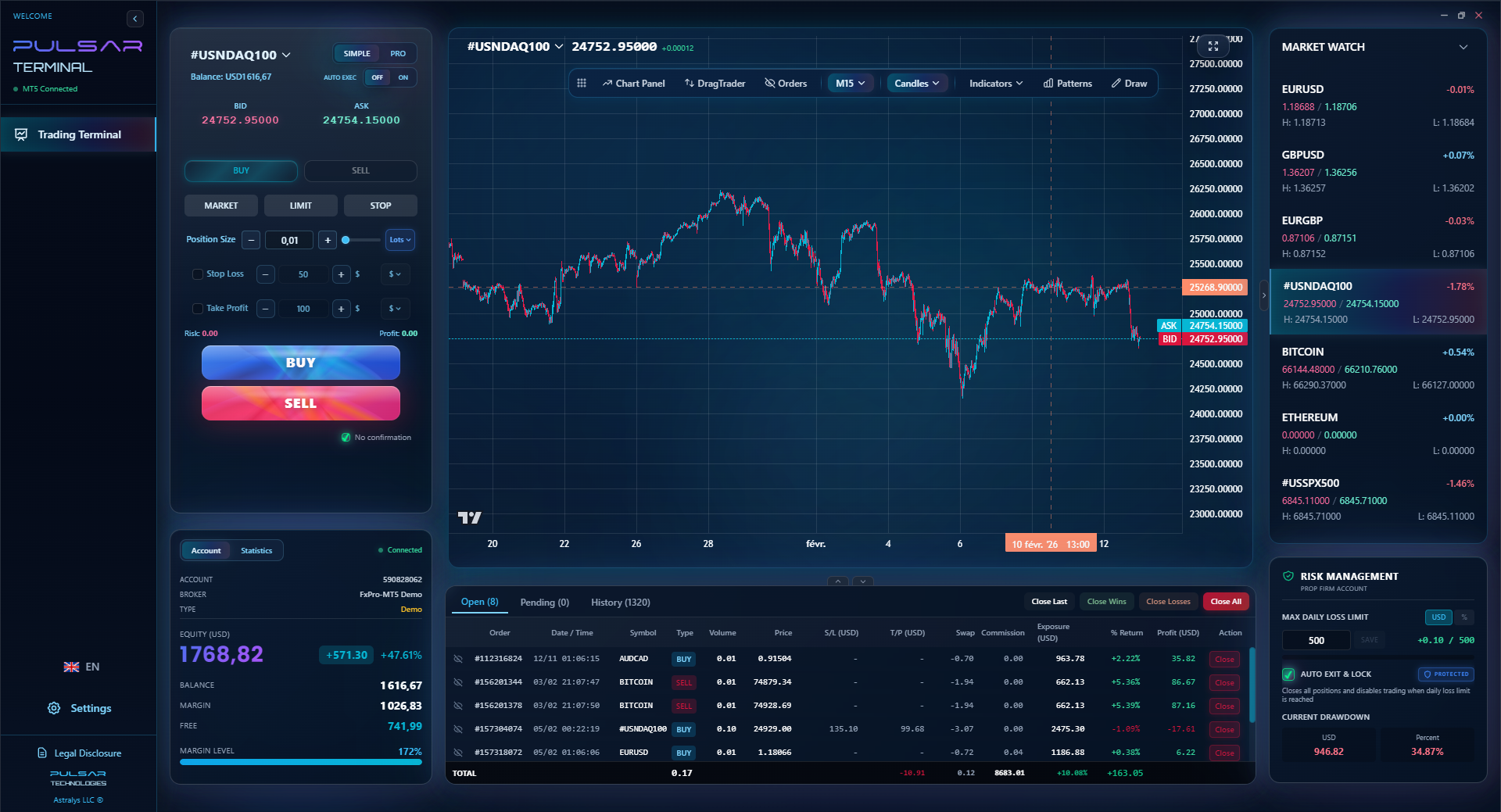
Managing multiple profit targets and trailing stops on pure price action trades is complex, but tools like Pulsar Terminal automate this directly on your MT5 charts, letting you focus on reading the market.
Pulsar Terminal
Alat MT5 all-in-one: order drag-and-drop, multi-TP/SL, trailing stop, grid trading, Volume Profile, dan perlindungan prop firm. Digunakan 1.000+ trader setiap hari.
Consistency beats brilliance every time. Here's the routine I've used for the past 8 years.
The Daily Scan (15-30 mins):
- Start High: Look at the Weekly and Daily charts of the 6-7 major pairs (especially USD pairs). Identify the clear, obvious support and resistance levels. Draw horizontal lines. Note the current trend structure.
- Drill Down: Move to the 4-hour and 1-hour charts. Are there any price action setups (pin bars, engulfing candles) forming at those key higher-timeframe levels? That's where your edge is.
- Session Context: What session is coming up? Is there major news scheduled? (I use an economic calendar). Naked trading doesn't mean ignoring news; it means understanding the potential for volatility that could create or destroy your setups.
The Trade Plan: For any potential setup, write down:
- The Key Level: (e.g., Daily Resistance 1.1050)
- The Setup Type: (e.g., False Break Sell)
- Entry Trigger: (e.g., Break of pin bar low at 1.1035)
- Stop Loss: (e.g., Above pin bar high at 1.1067)
- Profit Target 1: (e.g., Previous support at 1.0980)
- Profit Target 2: (Trail below 1hr swings)
- Position Size: (Calculated based on 32-pip stop and 2% risk)
Journaling: This is mandatory. After every trade - win or loss - take a screenshot. Note what you saw, why you entered, and how you managed it. Over time, you'll see patterns in your own behavior, not just the market's. I realized I was terrible at range trades but excellent at false breaks. I stopped taking the former.
This routine removes emotion. You're not a trader staring at a blinking screen; you're a detective reviewing evidence and executing a pre-defined plan.
💡 Tips Winston
Your first profit target should always be the nearest level that would make the market's structure look different. If hitting your target doesn't change the chart's story, you're aiming too far.
“With naked trading, your stop-loss isn't a suggestion; it's the line where your hypothesis about the market is proven definitively wrong.”
Let's get honest about where you'll screw up.
Pitfall 1: Seeing Patterns Everywhere (Pareidolia). Your brain is wired to find patterns. In a random chart, you'll see pin bars and head-and-shoulders everywhere. Solution: Only trade levels and setups that are obvious. If you have to squint or convince yourself it's a setup, it's not. Wait for the market to shout.
Pitfall 2: Ignoring the Higher Timeframe Trend. This is the classic mistake. You see a beautiful pin bar buy signal on the 15-minute chart, but it's forming right into a brick wall of daily resistance. Solution: Always, always check the next two higher timeframes. A 1-hour setup in the direction of the 4-hour trend, which is itself in line with the daily trend, is a powerhouse trade.
Pitfall 3: Moving Stops Too Early (Fear). You get a 10-pip profit and panic, moving your stop to breakeven, only to watch the trade run 100 pips without you. Solution: Your initial stop is sacred. Only move it to breakeven after price has clearly moved in your favor and reached a logical interim level (e.g., a minor swing point). Some platforms offer automated breakeven functions, which remove the emotion entirely.
Pitfall 4: Overtrading in a Range. In a choppy, directionless market, naked charts can look boring. You'll be tempted to 'manufacture' trades on lower timeframes. Solution: If the 4-hour and 1-hour charts are a messy range with no clean levels, walk away. Go read a book. The best trade is often no trade. I've made more money sitting on my hands in quiet markets than I ever have forcing scalping trades in chop.
Remember, the goal of naked forex isn't to be in the market all the time. It's to be in the market only when the probability is overwhelmingly in your favor, and to manage that bet with surgical precision.
FAQ
Q1Is naked forex trading legal in the United States?
Yes, absolutely. Naked forex is just a trading methodology, not a regulated product. You are free to trade using any chart-based approach you want. The activity of forex trading itself is heavily regulated by the CFTC and NFA, with rules on use (max 1:50), FIFO, and broker registration. The strategy itself is completely legal.
Q2What's the best timeframe for naked forex trading?
Start with the 1-hour and 4-hour charts. They provide a clean balance between market noise and actionable signals. However, you should always perform your primary analysis on the Daily chart to identify the major trend and key levels, then use the lower timeframes for precise entry triggers. Avoid going below the 15-minute chart as a beginner; the noise will eat you alive.
Q3Can I use naked trading with the low use allowed for US traders?
Not only can you, but the low use mandates it. With max 1:50 use, you can't afford sloppy, indicator-lagged entries with wide stops. Naked trading forces you to identify high-probability, institutional-level support/resistance for tighter risk definition. It actually pairs perfectly with restrictive use because it emphasizes precision and patience over reckless speculation.
Q4Do I need a special broker or platform for naked trading?
You need a reliable platform with clean, fast charts. MetaTrader 4 (MT4) or MetaTrader 5 (MT5) are perfectly suited - they allow you to strip away all indicators and draw clean horizontal lines. Most major US-regulated brokers like FOREX.com and OANDA offer MT4/MT5. The platform is less important than your discipline in not adding indicators back on.
Q5How long does it take to become profitable with naked forex?
It takes at least 6-12 months of dedicated screen time and journaling to rewire your brain away from indicator dependency. The first few months will be frustrating as you learn to 'see' price structure. Don't focus on profits initially; focus on correctly identifying 3-5 high-probability setups per week and journaling them. Consistency in process leads to consistency in results.
Q6What's the biggest advantage of naked forex over indicator-based trading?
Clarity and leading signals. Indicators are derivatives of price; they lag. Naked trading focuses on the source: price itself. This allows you to see supply and demand imbalances as they happen, spot institutional order blocks, and identify false breaks in real time. It removes the confusion of conflicting indicator signals and gives you a clearer, more objective view of the market's intent.
Q7How do I handle news events with a naked trading approach?
With respect and distance. Major news (NFP, CPI, central bank decisions) creates volatility that can distort pure price action and blow through your technical levels. The naked approach is to identify key levels ahead of the news, but not trade the initial spike. Wait for the post-news consolidation (often 15-60 mins later) and see how price reacts to those levels. The rejection or acceptance after the news settles is a far higher probability signal than trying to catch the initial rocket.
Pelajaran Prof. Winston
Poin Penting:
- ✓Trade only obvious setups at clear higher-timeframe levels.
- ✓Use the 1-hour & 4-hour charts for execution, but the Daily for direction.
- ✓Max 1:50 US use demands precision, which naked trading provides.
- ✓Your daily loss limit (e.g., -2%) is more important than any setup.
- ✓Journal every trade with a screenshot and a one-sentence thesis.
Seberapa bermanfaat artikel ini?
Klik bintang untuk menilai
Wawasan Trading Mingguan
Analisis & strategi mingguan gratis. Tanpa spam.
Tentang Penulis
James Mitchell
Analis Trading Senior
Berbasis di New York dengan lebih dari 9 tahun pengalaman trading. Fokus pada pasangan USD utama, tantangan prop firm, dan lanskap regulasi AS.
Komentar
Peringatan Risiko
Perdagangan instrumen keuangan mengandung risiko signifikan dan mungkin tidak cocok untuk semua investor. Kinerja masa lalu tidak menjamin hasil di masa depan. Konten ini hanya untuk tujuan edukasi dan tidak boleh dianggap sebagai nasihat investasi. Selalu lakukan riset Anda sendiri sebelum trading.
Anda mungkin juga suka

Cara Trading Forex Sukses: 7 Prinsip dari Trader Profesional
Cara trading forex sukses dengan 7 prinsip trader pro: manajemen modal, disiplin, journal trading, backtest. Data nyata, bukan janji profit palsu.
Jam Trading Forex Terbaik untuk Trader Indonesia: Panduan Lengkap dengan Tabel Waktu
Panduan jam trading forex untuk trader Indonesia. Tabel 4 sesi dunia, jam emas 20:00-00:00, sesi mana yang harus dihindari. Data akurat + tips dari trader berpengalaman.
Top 5 Sàn Forex Uy Tín Nhất 2026: Review Jujur dari Trader Indonesia
Top 5 sàn forex uy tín 2026 untuk trader Indonesia. Review jujur: spread, deposit, withdraw, dukungan lokal. Exness, XM, IC Markets & lebih.
Dapatkan Pulsar Terminal
Semua kalkulator ini terintegrasi dalam Pulsar Terminal dengan data real-time dari akun MT5 Anda.
Dapatkan Pulsar Terminal