


Most South African traders think a Nedbank Forex Card is a smart way to handle travel money.

David van der Merwe
Trader Pasar Berkembang ·  South Africa
☕ 10 mnt baca
Yang akan Anda pelajari:
- 1What Exactly Is This Card? (It's Not What You Think)
- 2The Real Cost Breakdown: Where They Get You
- 3SARB Regulations: The Invisible Handcuffs
- 4Nedbank Card vs. Real-World Alternatives
- 5The Headache of Unused Funds & Inactivity
- 6If You Still Want One: A Step-by-Step Guide
- 7Final Verdict: Should a Trader Use the Nedbank Forex Card?
Most South African traders think a Nedbank Forex Card is a smart way to handle travel money. They're wrong. It's a convenience tool with a price tag, and if you're not careful, that 1.2% commission will quietly eat into your trading capital. I've seen too many students load up a card before a trading conference, only to realize they paid a premium for the privilege. Let's strip away the marketing and look at what this card actually does for someone who understands spreads, commissions, and opportunity cost.
First, let's kill a myth. The Nedbank Forex Card isn't some magic financial instrument. It's a prepaid Mastercard you load with foreign currency before you travel. Think of it as a digital wallet with specific, rigid rules set by the South African Reserve Bank (SARB). You're not getting a line of credit or building a profile. You're exchanging your rands for dollars, euros, or pounds upfront and locking them onto a piece of plastic.
For a trader, this should set off alarm bells. You're taking a directional bet on the ZAR the moment you load the card. If the rand strengthens after you buy dollars, you've already lost on that conversion. It's a spot forex trade with a 1.2% transaction cost, and you're forced to hold the position until you spend it. I learned this the hard way before a trip to London in 2023. I loaded GBP at R23.50, convinced the rand was weak. It rallied to R22.80 within a month. That "travel money" had effectively lost 3% before I even bought a coffee at Heathrow. A simple credit card transaction later would have saved me that loss.
The card supports multiple currencies in separate wallets, which is its main selling point. But managing those wallets feels clunky compared to the real-time portfolio management you're used to in your swing trading platform.
Nedbank's fee sheet looks simple. Too simple. The headline grabber is the 1.20% commission to buy (load) currency and another 1.20% to sell (cash out) unused funds. That's a 2.4% round-trip cost if your travel plans change. But the quiet killers are elsewhere.
The ATM Trap
That $3.65 (or equivalent) ATM withdrawal fee is a flat tax on accessing your own money. If you take out $200, that's a 1.83% fee on top of everything else. Do it a few times and you've vaporized a decent chunk of change. Need to check your balance first? That's another $1.10. These are the kinds of friction costs that erode capital, something you should be hyper-aware of from managing your position size calculator.
The Cross-Currency Landmine
This is the big one. The 3.10% cross-currency conversion fee. Let's say you have a euro wallet but pay for something in Japanese yen. If your card can't default to USD for the conversion (and it often doesn't), they'll hit you with this massive fee. It's the equivalent of getting a terrible fill on a trade because you didn't set your parameters right. For a trader traveling to multiple countries, this fee structure is a nightmare to navigate.

Warning: That "free" card swipe at a point-of-sale (POS) isn't always free. If the merchant's terminal does a dynamic currency conversion (DCC) and charges you in rand, you'll get slaughtered by their awful exchange rate, potentially worse than Nedbank's 3.1% fee. Always choose to pay in the local currency.
Here’s a quick comparison of the major pain points:
| Fee Type | Cost (from Jan 2026) | Why It Hurts Traders |
|---|---|---|
| Load/Sell Commission | 1.20% each way | Erodes capital on both entry and exit, like a bad broker spread. |
| ATM Withdrawal | $3.65 flat | A fixed cost that punishes small, frequent withdrawals. |
| Cross-Currency Fee | 3.10% | A hidden spread wider than any major EUR/USD guide would tolerate. |
| Inactivity Fee | $3.10/month after 1 year | A penalty for poor capital allocation - your money should never sit idle. |

💡 Tips Winston
A 1.2% fee isn't 'low.' It's a guaranteed loss on your capital the second you click 'load.' Would you enter a trade with a 12-pip spread?
“The Nedbank Forex Card is a spot forex trade with a 1.2% transaction cost, and you're forced to hold the position until you spend it.”
This is where it gets serious. Using the Nedbank Forex Card doesn't exempt you from exchange control. You are personally responsible for staying within the limits. Blaming Nedbank won't save you from a SARB audit.
The key rule is the Single Discretionary Allowance (SDA). As of early 2026, it's R2 million per year for adults. Every dollar, euro, or pound you load onto that card counts against this limit. Planning a big international training course or prop firm challenge? That expense comes out of your SDA. It also shares the limit with any other foreign investments or purchases you make.
Other non-negotiable rules:
- No Early Buying: You can't buy travel forex more than 60 days before you leave. This kills any strategic "averaging in" if you think the rand is cheap.
- 30-Day Sell Rule: When you get back, you have 30 days to convert any leftover foreign cash on the card back to rands. There's no holding a dollar wallet as a hedge against ZAR weakness. I once forgot this rule with about $800 left after a trip. By the time I remembered, I was outside the window and had to provide a small mountain of documentation (passport stamps, boarding passes) to convert it. A huge hassle.
- Strict Use Case: Forget using this for online trading deposits, gambling, or funding offshore accounts. It's for travel spending, full stop. Trying to get clever will get your transaction blocked and potentially flag your profile.

Pro Tip: Keep immaculate records. Scan your passport entry/exit stamps, flight tickets, and accommodation invoices. If SARB ever questions your card usage, this paper trail is your only defense. Treat it with the same discipline as your trade journal.
So, is it ever the right tool? Let's compare it to what you probably already use.
Vs. Your South African Credit/Debit Card: Your local Visa/Mastercard works almost everywhere. The exchange rate used is the wholesale interbank rate (usually good) plus a small margin from your bank (often 2-2.5%). The total cost can be very close to the Nedbank card's 1.2% load fee + the interbank rate. The huge advantage? No money is locked up early. You carry the ZAR risk until the moment you spend, which can be good or bad, but it's flexible. You also earn rewards points on some cards.
Vs. Global Digital Wallets (Revolut, Wise): This is where the Nedbank card looks archaic. I started using Wise (formerly TransferWise) for travel in 2024 and haven't looked back. You get a digital card on your phone instantly. You convert money at the real mid-market rate with a transparent, tiny fee (often 0.4-0.6%). Holding multiple currencies is seamless. The big difference for a trader? Speed and control. It feels like a modern trading app, not a bank's legacy system. The downside? It's not offered by a South African registered bank, so funding it from your SA account counts as a cross-border transfer and uses your SDA. It's also not a physical card you can get instantly at a branch.
Vs. Cold Hard Cash: Exchanging rands for physical dollars/euros at a forex bureau has its place for small amounts or emergencies. But you get a poor rate, carry theft risk, and have the same 60-day purchase rule. It's almost always a worse option than a card.
The Verdict: The Nedbank Forex Card is for the traveler who wants a fixed budget, is nervous about using their primary card abroad, and values the perceived security of a prepaid limit. For a trader, who should be comfortable with currency risk and hunting for efficiency, it's a blunt instrument. Your international debit card or a digital wallet like Wise will likely serve you better.
“For a trader, who should be comfortable with currency risk and hunting for efficiency, it's a blunt instrument.”
This is a classic capital allocation problem. You return from your trip with $150.42 on the card. What do you do?
You have 30 days to convert it back to rands, paying another 1.20% commission on the sell. So you immediately lose value. If you wait, hoping to use it on your next trip, you're making a micro-forex trade. You're long that foreign currency against the ZAR. If you're wrong, you lose. If you forget about it for 12 months, they start charging a $3.10 monthly inactivity fee, which will slowly drain the balance to zero.
I see this as a failure of strategy. In trading, you don't let small, odd-lot positions sit in your account causing admin and small losses. You close them out and re-deploy the capital cleanly. The same principle applies here. The emotional urge to "keep it for next time" is outweighed by the friction cost and mental baggage of tracking a tiny, dormant position.
The efficient move? As soon as you're back, log into the Nedbank portal, sell the leftover currency back to ZAR, and be done with it. Take the 1.2% hit as the cost of a clean slate. That capital, now in rands, can go back into your savings, your trading account, or anywhere more productive than a dormant forex wallet. Letting it sit is how you get a margin call on your travel budget.
💡 Tips Winston
The 30-day sell rule forces you to close your 'travel position.' Good traders don't let sentimental, leftover trades clutter their books. Close it, move on.
Alright, you've heard the downsides but want the card for its specific use case. Here's how to do it with your eyes open.
- Apply: Do it online via the Nedbank Money app or in-branch. You'll need your ID and proof of residence. The card itself is free.
- Load It (The Trade): This is your execution. Do this within 60 days of travel. Decide how much of each currency you need. Be realistic. Loading is done via the app or online banking. You'll see the exchange rate and the 1.20% commission before you confirm. This is your "fill price." Note it down.
- Use It Abroad: Always choose to pay in the local currency at POS terminals to avoid DCC scams. Use ATMs sparingly due to the fee. Monitor your balances on the app.
- The Exit Trade (Post-Trip): Within 30 days of return, log in and sell all unused foreign currency back to ZAR. Accept the 1.20% cost as your exit commission. Close the position.
- Destroy the Card (If Inactive): If you have no upcoming travel, cut up the card once the balance is zero. This prevents fraud and stops you from thinking about the inactivity fee.

Example: You load $1,000 for a US trip at an offered rate of R18.50/$ (including the 1.2%). Your cost is R18,500. You spend $900. You return and sell the remaining $100 at a bid rate of R18.30/$ (after the 1.2% fee). You get back R1,830. Your total cost for accessing $900 was R18,500 - R1,830 = R16,670. That's an effective rate of about R18.52 per dollar spent. Could you have done better with another method? Probably.
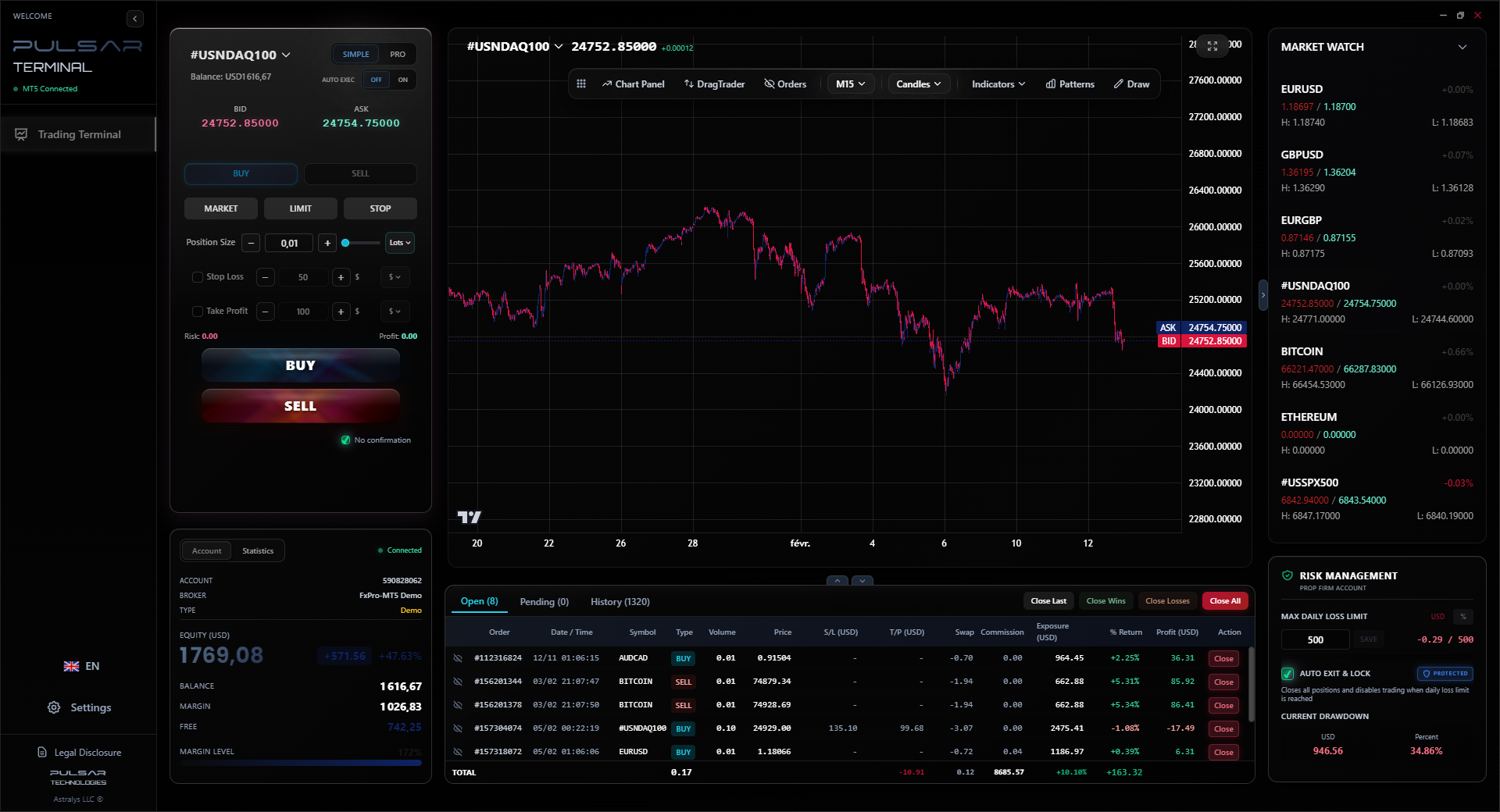
Just as you need precise control over trade entries and exits, managing a tool like the Nedbank card requires strict discipline on dates and balances—something Pulsar Terminal's automated trade management brings to your actual trading.
Pulsar Terminal
Alat MT5 all-in-one: order drag-and-drop, multi-TP/SL, trailing stop, grid trading, Volume Profile, dan perlindungan prop firm. Digunakan 1.000+ trader setiap hari.
“Letting leftover funds sit is how you get a margin call on your travel budget.”
My take? It's a niche product.
Consider it IF: You're a very infrequent traveler who wants absolute spending control, you're paranoid about your primary card being skimmed abroad, and you value the physical card you can get from a local branch. It's a psychological security blanket with a defined cost.
Avoid it IF: You travel frequently, are comfortable with financial technology, hate paying unnecessary fees, and understand currency risk. You'll find better tools. The 1.2% load fee is a significant drag, and the regulatory handcuffs (30-day sell rule, 60-day buy rule) are antithetical to a trader's desire for flexibility.
For me, the mindset is the biggest clash. Trading is about seeking an edge, minimizing friction, and managing risk dynamically. The Nedbank Forex Card imposes friction, limits your risk management choices, and offers no edge - just predictable, paid convenience. As someone who scrutinizes spread definition and commission on every scalping strategy trade, I can't ignore those costs when I step away from the trading desk.
Your money, your rules. But now you know the real score.
FAQ
Q1Can I use the Nedbank Forex Card to deposit into my international trading account?
Absolutely not. This is a prohibited transaction under exchange control regulations. The card is strictly for travel-related spending. Funding a trading account, even with a reputable broker like IC Markets review or Pepperstone review, requires a formal cross-border transfer via SWIFT, which uses your Single Discretionary Allowance but is a separate process.
Q2What happens if I don't convert my unused funds within 30 days?
You violate SARB regulations. Nedbank may refuse to convert the funds without substantial documentation (passport stamps, flight tickets) proving your travel. In a worst-case scenario, SARB could impose a penalty. Don't let this happen. Set a calendar reminder for 25 days after you return to sell the balance.
Q3Is the Nedbank Forex Card better than using my FNB or Standard Bank credit card abroad?
"Better" is subjective. It can be cheaper if your bank's foreign transaction fee is high (e.g., 2.5-3%). However, many premium credit cards have fees around 2.2%, and you earn rewards points. The Nedbank card's 1.2% load fee + the interbank rate often results in a total cost very similar to a good credit card's 2.2% fee. The real difference is prepaid vs. post-paid and your personal risk tolerance.
Q4Can I load currencies like Japanese Yen (JPY) or Swiss Francs (CHF) on the card?
Yes, you can load major currencies. However, if you have a CHF wallet and make a transaction in JPY, you'll likely get hit with the 3.10% cross-currency conversion fee unless USD can be used as a default. This makes it inefficient for multi-country trips across diverse currency zones.
Q5How quickly can I get a Nedbank Forex Card?
If you apply in-branch and they have stock of the non-personalised cards, you can walk out with one immediately. A personalised card ordered via the app takes a few days to be delivered, with a possible R135 fee. The digital card details in the Nedbank Money app are available almost instantly after approval.
Q6Does the money on the card earn any interest?
No. It's a prepaid stored value. Your funds earn zero interest while loaded. This is an opportunity cost. That capital could be in a savings account or, for a trader, actively deployed in a market even while you sleep.
Pelajaran Prof. Winston
Poin Penting:
- ✓The 1.2% load fee is a guaranteed drag, similar to a bad broker spread.
- ✓SARB's 30-day sell rule kills any strategic hold on leftover foreign currency.
- ✓The 3.1% cross-currency fee is a hidden trap for multi-country travel.
- ✓Always choose 'local currency' at payment terminals to avoid worse DCC rates.
Seberapa bermanfaat artikel ini?
Klik bintang untuk menilai
Wawasan Trading Mingguan
Analisis & strategi mingguan gratis. Tanpa spam.
Tentang Penulis
David van der Merwe
Trader Pasar Berkembang
Trader berbasis Johannesburg dengan 11 tahun di mata uang pasar berkembang. Spesialis pasangan ZAR, trading berregulasi FSCA, dan analisis pasar Afrika Selatan.
Komentar
Peringatan Risiko
Perdagangan instrumen keuangan mengandung risiko signifikan dan mungkin tidak cocok untuk semua investor. Kinerja masa lalu tidak menjamin hasil di masa depan. Konten ini hanya untuk tujuan edukasi dan tidak boleh dianggap sebagai nasihat investasi. Selalu lakukan riset Anda sendiri sebelum trading.
Anda mungkin juga suka

Cara Trading Forex Sukses: 7 Prinsip dari Trader Profesional
Cara trading forex sukses dengan 7 prinsip trader pro: manajemen modal, disiplin, journal trading, backtest. Data nyata, bukan janji profit palsu.
Jam Trading Forex Terbaik untuk Trader Indonesia: Panduan Lengkap dengan Tabel Waktu
Panduan jam trading forex untuk trader Indonesia. Tabel 4 sesi dunia, jam emas 20:00-00:00, sesi mana yang harus dihindari. Data akurat + tips dari trader berpengalaman.
Top 5 Sàn Forex Uy Tín Nhất 2026: Review Jujur dari Trader Indonesia
Top 5 sàn forex uy tín 2026 untuk trader Indonesia. Review jujur: spread, deposit, withdraw, dukungan lokal. Exness, XM, IC Markets & lebih.
Dapatkan Pulsar Terminal
Semua kalkulator ini terintegrasi dalam Pulsar Terminal dengan data real-time dari akun MT5 Anda.
Dapatkan Pulsar Terminal