


I was checking my news feed in March 2026 when I saw the headline: OANDA was shutting down its proprietary trading program.
James Mitchell
Analis Trading Senior
☕ 10 mnt baca
Yang akan Anda pelajari:
- 1The Brief Life (and Death) of OANDA Prop Trader
- 2The US Regulatory Gray Area (It's Not What You Think)
- 3The Real Numbers: Costs, Success Rates, and Profit Splits
- 4Where Should US Traders Look Now? (2026 Landscape)
- 5Brokerage vs. Prop Firm: Two Completely Different Paths
- 6How to Actually Get Started (Choosing Your Firm)
I was checking my news feed in March 2026 when I saw the headline: OANDA was shutting down its proprietary trading program. It wasn't a huge shock if you'd been watching the space, but it was a definitive end to a short-lived experiment. For two years, from 2024 to 2026, OANDA tried its hand in the prop firm game. Now, if you're looking for an 'OANDA prop firm,' you need to understand that it doesn't exist anymore. The business was sold off to FTMO. Let's talk about what that means for you, why the whole US prop scene is in a weird regulatory gray zone, and where you should actually be putting your attention (and your evaluation fee) in today's market.
OANDA launched its 'Prop Trader' program in January 2024. It was their attempt to grab a slice of the booming prop trading pie. For a regulated broker like OANDA, known for its spreads and core pricing accounts, it was a curious move into a much less regulated side of the business.
It didn't last. By March 2026, OANDA announced it was transitioning the entire prop trading operation over to the FTMO Group. The official line was that OANDA wanted to focus on its core brokerage services. The reality? The prop firm world is a brutal, competitive arena where most revenue comes from traders who fail their challenges, not from sharing profits with the winners. It's a different beast entirely from running a straight-up brokerage.
If you were an OANDA Prop Trader client, you were migrated to FTMO. So, the entity you signed up with is gone. This is a classic example of the consolidation and shakeout that's defined the last few years. Nearly a third of prop firms that existed in 2024 are now inactive. OANDA's exit is just one of the bigger, more visible examples.

Warning: Any website still advertising 'OANDA Prop Trader' in 2026 is likely a scam or severely outdated. The program is defunct. Your search should now be for reputable, standalone prop firms or understanding the FTMO platform you may have been moved to.

Here's the crucial thing most new traders miss: most retail prop firms in the US operate in a regulatory gray area. They're not your typical broker.
OANDA, the broker, is heavily regulated by the CFTC and NFA. They have to follow strict rules on client funds, reporting, and use. But an OANDA prop firm, or any firm like FTMO, Apex, or The5ers? It's different.
How Prop Firms Skirt Direct Regulation
These firms aren't usually registered as broker-dealers. They argue they're providing an evaluation service for a fee. You pay them to take a challenge. If you pass, they let you trade a simulated account with their 'capital.' Your profits and losses are tracked in this sim environment. Only after you prove yourself might they mirror your trades in a live market. Because they're not directly holding your trading capital (just your evaluation fee), they often avoid the direct oversight of the SEC or CFTC.
That doesn't mean it's lawless. They still have to follow basic Anti-Money Laundering (AML) and Know Your Customer (KYC) rules. But the specific rules governing their challenge structures, profit splits, and payout reliability? That's largely based on their own terms of service, not federal trading law.
This gray area led to a 'Wild West' period around 2024-2025. The shakeout we saw, where OANDA bowed out and dozens of smaller firms vanished, was the market cleaning house. By 2026, the expectation is that regulators will step in with clearer rules. We might see licensing requirements or capital standards for these firms. For now, your protection is the firm's reputation and track record for payouts, not a government guarantee.

Pro Tip: Always, always read the Terms of Service. Your rights in a dispute with a prop firm come from that contract, not from federal brokerage regulations. Look for their policy on margin calls and daily loss limits in particular.

💡 Tips Winston
The prop firm's goal is for you to fail the evaluation. Your goal is to pass. Never forget this fundamental conflict of interest. Trade accordingly - with extreme caution and predefined rules.

“Your protection with a prop firm is their reputation for payouts, not a government guarantee.”
Let's get brutally honest with the math. This is where dreams meet reality. When I first looked at prop firms years ago, I made the classic mistake of only seeing the potential upside. I didn't respect the statistics.
Evaluation Fees: You'll pay to play. Fees can range from about $50 for a small account challenge to several hundred. Some firms offer 100% refunds on this fee after your first payout, which is a good sign. Others don't. Consider this fee a sunk cost for your education.
The Harsh Success Rate: This is the big one. Industry insiders consistently say only 5% to 10% of traders pass their evaluations. Some data suggests less than 1% achieve consistent, meaningful payouts. Let that sink in. The prop firm business model is often built on collecting these evaluation fees from the 90%+ who fail. I failed my first two challenges before I finally got a handle on my position size calculator and emotional discipline.
Profit Splits: If you make it, this is your reward. Splits typically range from 70/30 to 90/10 in your favor. Some, like Apex Trader Funding, offer up to 100% on initial profits. FTMO (where OANDA's traders went) offers up to 90%. Don't just look at the top number. Look at how and when you get paid. Monthly is standard, but some offer bi-weekly or even on-demand payouts after your first funded trade.
A Personal Example: In 2025, I passed a challenge with a $500 fee. My first payout cycle, I made a $2,100 profit on the simulated account. With an 80% split, I received $1,680. The fee was refunded, so my net was $2,180. Not bad. But that came after two failed $300 challenges ($600 down the drain). My net track record was positive, but only because I finally learned to treat the challenge like a business, not a lottery ticket.

With the OANDA prop firm gone, you need to look at the dedicated players. The market has matured post-shakeout. The survivors tend to be more transparent, have better tech, and - critically - a proven record of paying out.
Here are the types of firms US traders are using in 2026:
| Firm Type | Examples (2026) | Best For... |
|---|---|---|
| Forex-Focused | FTMO, The5ers, FXIFY | Traders who specialize in major/minor forex pairs. |
| Futures-Focused | Apex Trader Funding, Topstep | Traders interested in indices, commodities (like trading XAU/USD concepts on futures). |
| Multi-Asset / Newer | DNA Funded, BrightFunded, OneFunded | Traders wanting crypto, stock, or forex options, often with more flexible challenge rules. |
My advice? Don't get dazzled by the highest possible profit split. Look for:
- Payout Proof: Search for user payout screenshots on forums and social media.
- Sensible Rules: Reasonable daily loss limits (e.g., 5%), no hidden 'consistency' rules that trap you.
- Platform Choice: Most support MT4/MT5 or TradingView. Ensure they support your preferred platform for your scalping strategy or swing trading approach.
- US-Friendly Payments: They should accept major credit/debit cards and bank transfers without hassle.
FTMO, as the acquirer of OANDA's book, is obviously a major player. They have a strong reputation for payouts. But shop around. Apex is huge in the futures space. The newer firms often run promotions with lower-cost challenges.

Example: Let's say you're comparing a $299 challenge for a $25,000 account with an 80% split to a $499 challenge for a $50,000 account with a 90% split. The second one has a higher upfront cost, but your profit potential per trade is double. If your edge is solid, the higher fee is worth it. If you're still refining your system, start smaller.
💡 Tips Winston
Treat your first evaluation fee as tuition, not an investment. The real ROI comes from the knowledge gained, which you then apply to a second, smarter attempt.
“If you have a proven system and capital, use a broker. If you have skill but no capital, a prop firm is the only path.”
This is a fundamental decision. Since OANDA offers both (brokerage) and offered one (prop firm), it's a perfect case study.
Going with a Broker (Like OANDA):
- You Use: Your own capital. OANDA's US minimum deposit can be $0 for a standard account, but $10,000 for their core pricing account.
- You Keep: 100% of your profits (and absorb 100% of your losses).
- Regulation: High. You get negative balance protection, segregated funds.
- use: Lower for US retail clients due to regulation.
- Costs: You pay the spread (OANDA's EUR/USD avg is ~1.5 pips on standard, ~0.5 pips + commission on core) and/or commissions.
Going with a Prop Firm (Like FTMO, Apex):
- You Use: Their simulated capital after passing their test.
- You Keep: 70-90% of simulated profits; they take the rest.
- Regulation: Low to none on the prop side. Your protection is their reputation.
- use: Often much higher (like 100:1 or more), as they're not bound by retail client rules.
- Costs: You pay the evaluation fee and a share of profits. The trading costs (spreads) are often similar to raw broker rates.
Which is for you? If you have a proven, profitable system and the starting capital, a direct brokerage account is simpler. You're in full control. If you have skill but lack significant capital, or you want to trade with higher use than US retail rules allow, a prop firm is the only viable path. I use both: my own capital in a broker for core positions, and a prop account to aggressively test new strategies with 'house money.'
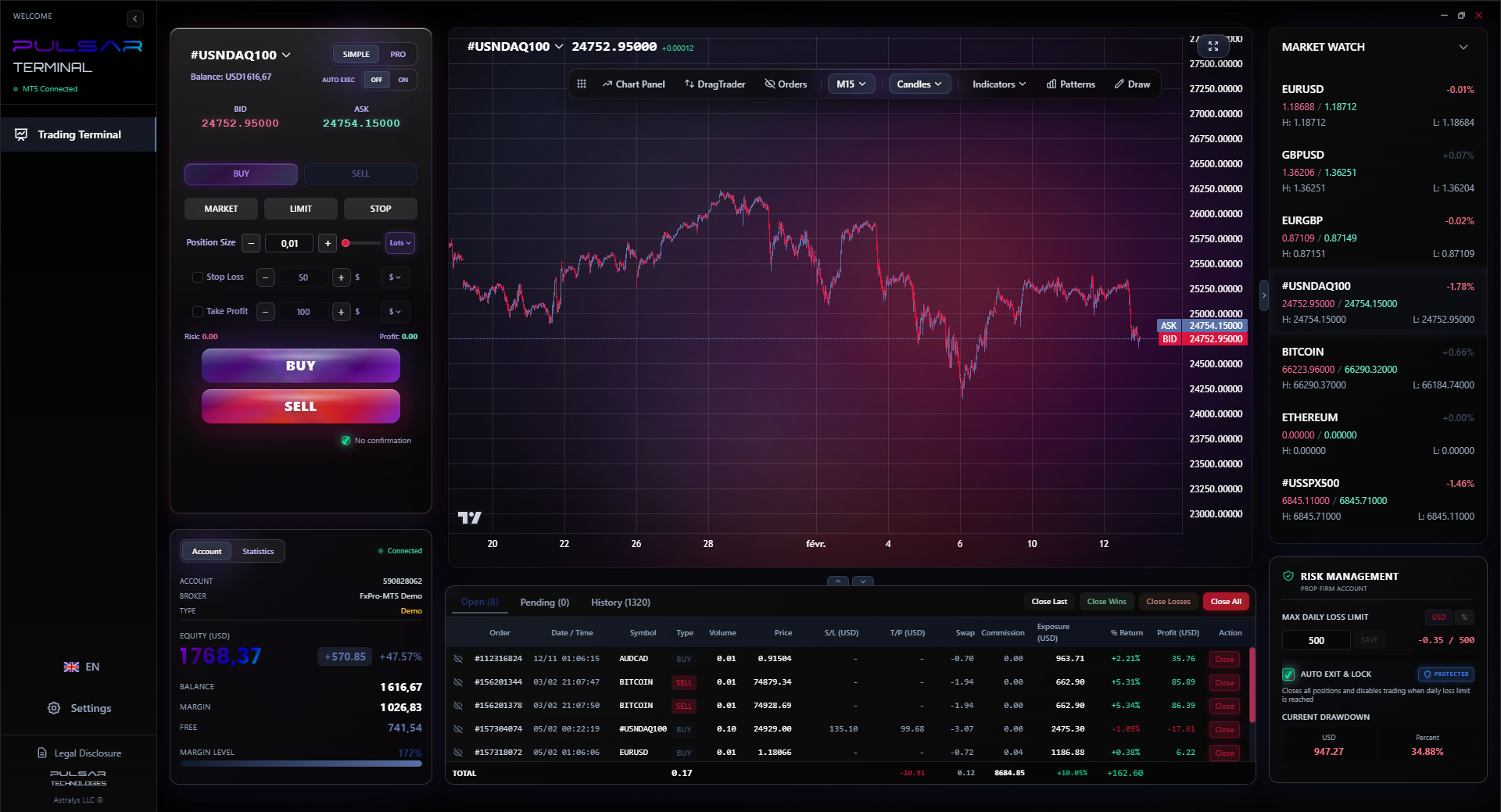
Remember, trading a prop challenge requires a different psychology. The goal isn't just to be profitable; it's to hit specific targets and avoid specific loss limits. It's a game with strict rules. Tools that help manage risk automatically are worth their weight in gold here.
Managing the strict daily loss limits of a prop firm challenge is critical, and Pulsar Terminal's automated trade management tools help enforce those rules directly on your MT5 chart.
Pulsar Terminal
Alat MT5 all-in-one: order drag-and-drop, multi-TP/SL, trailing stop, grid trading, Volume Profile, dan perlindungan prop firm. Digunakan 1.000+ trader setiap hari.
Forget OANDA. Here's your 2026 action plan.
-
Audit Your Trading: Be brutally honest. What's your win rate? Your average risk/reward? Pull your statements. If you're not consistently profitable on a demo or small live account, a prop challenge is an expensive way to fail. Work on your strategy first. Get comfortable with indicators like the RSI indicator or MACD indicator not as signals, but as context.
-
Define Your Niche: Do you trade forex like EUR/USD or gold (XAU/USD)? Or S&P 500 futures? This will point you to forex-focused or futures-focused firms.
-
Research Relentlessly: Go beyond the firm's website. Hit Reddit, Discord, and trading forums. Search for '[firm name] payout' and '[firm name] scam'. Look for consistent complaints. A few disgruntled failures are normal. A pattern of non-payment is a red flag.
-
Start Small: Your first challenge shouldn't be for a $200,000 account. Choose a smaller, cheaper evaluation. The goal is to learn the process and get funded, not to get rich on the first try. I started with a $50k challenge, not a $100k one. The pressure is lower.
-
Read the Entire Rulebook: Know the daily loss limit, the overall drawdown rule, the minimum trading days, and the profit target. Calculate these in dollars, not percentages. If your account size is $50,000 and the daily loss limit is 5%, that's $2,500. That's your absolute red line for any single day.
-
Choose Your Brokerage Partner: Some prop firms have a preferred broker (e.g., many use IC Markets review or Pepperstone review for their raw spreads). Others let you choose. If you have a choice, pick one known for execution speed and low latency, especially if you're scalping. You can check our reviews for Exness review or XM review to compare general broker quality, even if your prop firm uses a different liquidity provider.

FAQ
Q1Can I still join the OANDA prop firm in 2026?
No. OANDA Prop Trader ceased to exist as an OANDA program in March 2026. Its operations and clients were transferred to the FTMO Group. Any website offering 'OANDA Prop Trader' is not legitimate.
Q2Is my money safe with a US prop trading firm?
'Safe' has a different meaning here. Your evaluation fee is at risk if you fail the challenge (which 90%+ do). Your potential profits are not protected by government insurance like FDIC. Your safety depends almost entirely on the firm's financial health and its reputation for honoring payouts. Always research a firm's payout history before paying a fee.
Q3What's the main advantage of a prop firm over a regular broker?
Access to larger trading capital without risking your own savings. For example, you might pay a $300 fee for a chance to trade a $100,000 simulated account. If you lose it, you're out $300. If you lose $100,000 of your own money in a broker, you're in serious trouble. Prop firms also often provide higher use than US retail brokerages can offer.
Q4Why did OANDA's prop firm fail?
OANDA hasn't stated 'failure' as the reason. They cited a strategic decision to focus on core brokerage. However, the prop trading business is highly competitive and operationally distinct from regulated brokerage. The industry shakeout from 2024-2025 saw many firms close. It's likely OANDA found it more efficient to sell the operation to a specialist (FTMO) rather than compete directly.
Q5What's the single most important rule in a prop firm challenge?
The daily loss limit. Violating this is the fastest way to instantly fail your challenge. It forces extreme discipline. You must know this number in dollar terms for your account size before you place a single trade and use a position size calculator to ensure you can never hit it.
Q6Are prop firm profits considered taxable income in the US?
Yes. When a prop firm pays you a share of profits, that income is taxable. They will likely issue you a 1099 form. You are responsible for reporting this income on your tax return. Consult a tax professional familiar with trading income.
Pelajaran Prof. Winston
Poin Penting:
- ✓OANDA Prop Trader is gone; migrated to FTMO in 2026.
- ✓US prop firms operate in a regulatory gray area, not like brokers.
- ✓Only 5-10% of traders pass prop firm evaluations.
- ✓Your safety net is the firm's payout reputation, not the CFTC.
- ✓Always start with a small challenge to learn the rules.
Seberapa bermanfaat artikel ini?
Klik bintang untuk menilai
Wawasan Trading Mingguan
Analisis & strategi mingguan gratis. Tanpa spam.
Tentang Penulis
James Mitchell
Analis Trading Senior
Berbasis di New York dengan lebih dari 9 tahun pengalaman trading. Fokus pada pasangan USD utama, tantangan prop firm, dan lanskap regulasi AS.
Komentar
Peringatan Risiko
Perdagangan instrumen keuangan mengandung risiko signifikan dan mungkin tidak cocok untuk semua investor. Kinerja masa lalu tidak menjamin hasil di masa depan. Konten ini hanya untuk tujuan edukasi dan tidak boleh dianggap sebagai nasihat investasi. Selalu lakukan riset Anda sendiri sebelum trading.
Anda mungkin juga suka

Cara Trading Forex Sukses: 7 Prinsip dari Trader Profesional
Cara trading forex sukses dengan 7 prinsip trader pro: manajemen modal, disiplin, journal trading, backtest. Data nyata, bukan janji profit palsu.
Jam Trading Forex Terbaik untuk Trader Indonesia: Panduan Lengkap dengan Tabel Waktu
Panduan jam trading forex untuk trader Indonesia. Tabel 4 sesi dunia, jam emas 20:00-00:00, sesi mana yang harus dihindari. Data akurat + tips dari trader berpengalaman.
Top 5 Sàn Forex Uy Tín Nhất 2026: Review Jujur dari Trader Indonesia
Top 5 sàn forex uy tín 2026 untuk trader Indonesia. Review jujur: spread, deposit, withdraw, dukungan lokal. Exness, XM, IC Markets & lebih.
Dapatkan Pulsar Terminal
Semua kalkulator ini terintegrasi dalam Pulsar Terminal dengan data real-time dari akun MT5 Anda.
Dapatkan Pulsar Terminal