


I remember the first time I heard the name Prince Mazibuko.

David van der Merwe
Trader Pasar Berkembang ·  South Africa
☕ 9 mnt baca
Yang akan Anda pelajari:

I remember the first time I heard the name Prince Mazibuko. It was 2018, and I was nursing a R4,200 loss on a USD/ZAR trade that had gone completely sideways. I'd chased a rumor, ignored my own rules, and got burned. Frustrated, I started searching for local traders who'd actually made it work. That's when I found stories about Prince Mazibuko, a South African trader whose journey from Soweto to consistent profitability was becoming legendary in our circles. His story isn't just motivational fluff, it's a blueprint built on specific, repeatable actions. Let's break down what he did, what he teaches, and how you can apply those lessons without falling for the hype.
Prince Mazibuko is a professional forex trader and educator from Soweto, South Africa. His story resonates deeply because it's authentically South African. He didn't start with a trust fund or a fancy degree. He started with a dream, a lot of grit, and a willingness to learn the hard way. He's become a prominent figure by showing that success in this game is possible from anywhere, even with the unique challenges we face here - like load-shedding affecting trading sessions and navigating the volatile ZAR pairs.
His public narrative focuses on discipline, psychology, and a systematic approach. He often talks about the 'mental game' being 80% of trading. While that's a common trope, what sets him apart are the concrete steps he advocates for, like strict journaling and predefined daily loss limits. He's built a community around practical education, moving beyond the 'get rich quick' fantasy that traps so many new traders.

Warning: Be wary of any educator, Prince Mazibuko included, who promises guaranteed results. His real value is in demonstrating a viable process, not in being a shortcut. Your success will depend on your own execution of that process.
From analyzing his interviews and teachings, Mazibuko's philosophy rests on three non-negotiable pillars. This is where the real lessons are.
1. Discipline Over Prediction
He doesn't claim to predict the market. Instead, he emphasizes having a rule-based system and sticking to it, trade after trade. This means your entry, exit, and position size calculator settings are decided before you click buy or sell. The goal is to be consistent, not psychic. A losing trade where you followed your plan is better than a winning trade where you gambled.
2. Risk Management as a Religion
This is the cornerstone. Mazibuko is known for advocating extremely strict risk parameters, especially for beginners. We're talking about risking 1% or even 0.5% of your capital per trade. I made the mistake of ignoring this early on. In one brutal week, I risked 5% on three trades, lost them all, and wiped out 15% of my account. It took months to recover. His approach prevents that death spiral. Understanding your margin call level is part of this sacred practice.
3. Continuous, Structured Learning
He frames trading as a skill to be developed, not a lottery ticket. This means daily chart review, analyzing both wins and losses, and constantly refining your approach. It's a marathon of self-improvement. A tool that aids this structured review, like a strong trading journal or advanced charting software, becomes useful.

💡 Tips Winston
A plan you don't follow is just a wish list. Print your risk rules and tape them to your monitor.

“His story isn't just motivational fluff, it's a blueprint built on specific, repeatable actions.”
Let's get tactical. While Mazibuko doesn't give away a secret 'holy grail' indicator, he discusses common-sense strategy components that any serious trader uses.
Price Action & Key Levels: He focuses on identifying clear support and resistance levels. The idea is simple: buy near support in an uptrend, sell near resistance in a downtrend. It sounds basic, but most losses come from ignoring these levels. I once shorted EUR/USD right at a major weekly support level because my MACD indicator gave a signal. The price bounced instantly, and I took a 35-pip loss. The lesson? Indicators confirm, but price levels command.
Trend Following: He advocates trading in the direction of the higher timeframe trend. On a 4-hour chart trending up? Look for buy opportunities on the 1-hour or 15-minute charts. This aligns with the classic 'trade with the trend' wisdom that improves your odds significantly.
High-Probability Setups: He waits for specific conditions. This might be a price bounce from a key level with a confirming candle pattern, or a breakout from consolidation with increasing volume. The key is patience. Most of your time should be spent waiting, not trading. For those interested in faster-paced action, understanding the principles of a scalping strategy is useful, but it requires even greater discipline.

Example: Let's say you're watching GBP/ZAR. You identify strong support at R23.00. The 4-hour trend is up. Price dips to R23.05, forms a bullish engulfing candle, and starts rising. That's a high-probability setup Mazibuko would respect. Your entry is at R23.10, stop loss at R22.95 (150 pips risk), and take profit at R23.60 (500 pips reward). That's a solid 1:3.3 risk-reward ratio.
This is the critical part you won't get from international gurus. Applying a disciplined philosophy here comes with local flavor.
Broker Choice is Critical: You need a broker that's reliable during load-shedding, offers tight spreads on ZAR pairs, and has a solid local support. I've had good experiences with IC Markets review for their raw spreads and Pepperstone review for their platform stability. Always check their latency to South African servers.
Trading the ZAR: Pairs like USD/ZAR and EUR/ZAR are incredibly volatile. A 100-pip move is a regular Tuesday. This volatility can mean bigger profits but also faster losses. Your position sizing must be even more conservative. If you'd normally risk 1% on EUR/USD, consider 0.7% on USD/ZAR. The spread definition is also crucial here, as ZAR pairs often have wider spreads, which eats into short-term profits.
Managing Infrastructure: Have a UPS for your router and monitor. Know your broker's mobile app inside out. I was once in a profitable USD/ZAR trade when the lights went out. By the time I fumbled for my phone and logged in, half my profit was gone. Plan for the blackouts before they happen.
Mindset for the Long Haul: The South African market can feel isolating. Stories like Prince Mazibuko's are important because they provide local proof of concept. But remember, his years of work happened behind the scenes. Your journey will too. Focus on building your skills over months and years, not your balance over days.
💡 Tips Winston
The market doesn't know your name, your story, or your margin. It only knows your orders. Trade accordingly.

“A losing trade where you followed your plan is better than a winning trade where you gambled.”
Learning from Prince Mazibuko also means learning from the mistakes he warns against. Here are the big ones, straight from my own trading journal.
Overtrading: This is the killer. No clear setup? Stay out. I used to feel I had to be in the market to be a 'real trader.' One Wednesday, I took 5 mediocre trades out of boredom, lost on 4, and gave back a week's gains. Mazibuko's emphasis on quality over quantity is the cure.
Revenge Trading: You take a loss, get angry, and jump right back in to make it back. This is how R500 losses become R5,000 drawdowns. His rule? After two consecutive losses, walk away. Close the platform. The market will be there tomorrow.
Ignoring the Economic Calendar: South African data releases (CPI, SARB decisions, budget speeches) can cause wild swings in ZAR pairs. Trading blindly into these events is gambling. I learned this the hard way shorting USD/ZAR just before a surprisingly hawkish SARB statement. The 300-pip spike against me was not fun.
Confusing Motivation with Strategy: It's easy to watch a motivational video from Prince Mazibuko, feel pumped, and then make an impulsive trade. The motivation should fuel your discipline to follow your checklist, not replace it. The real work is boring and systematic. For a different, more patient approach, see how swing trading strategies handle the market.
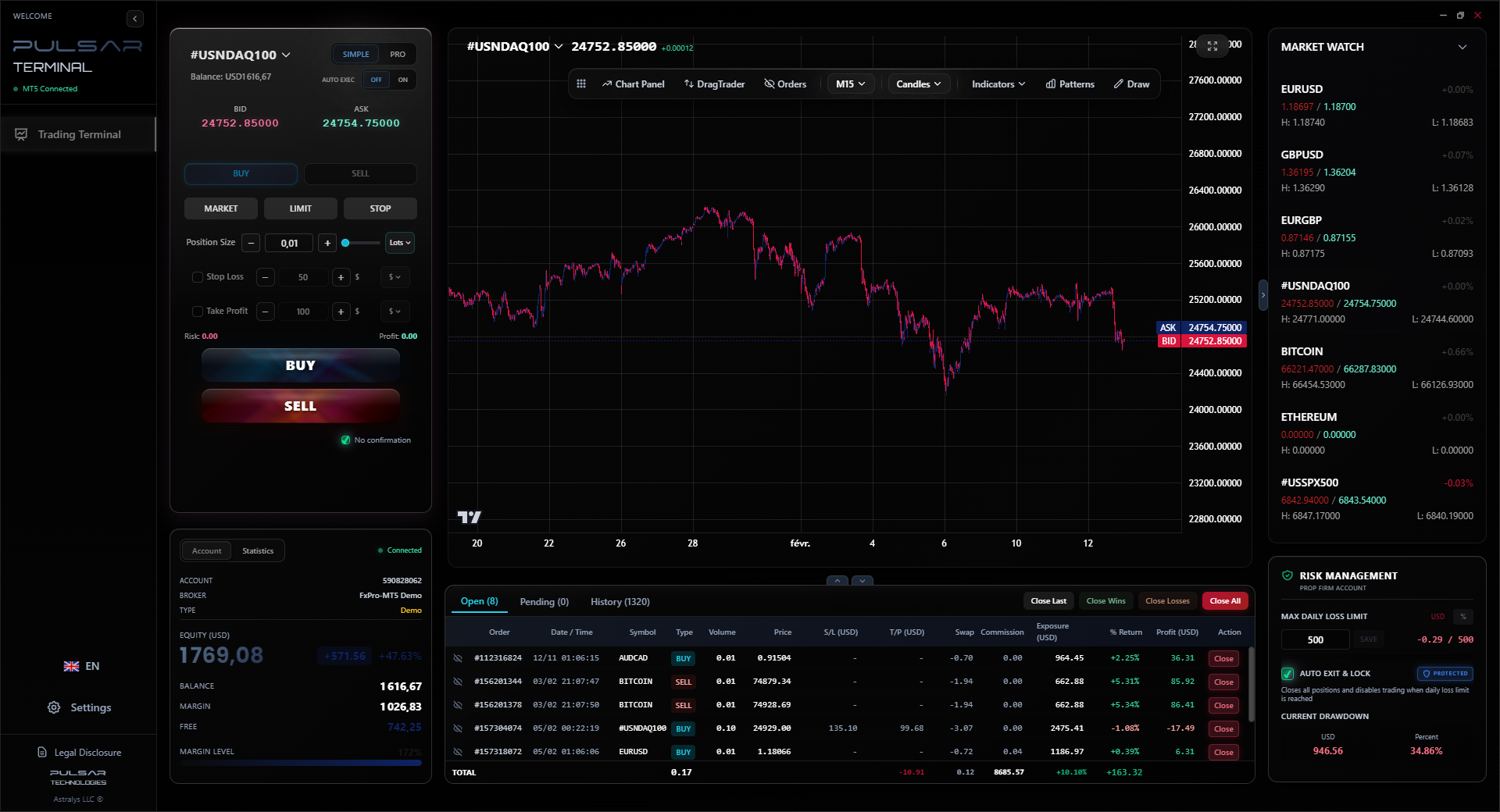
Sticking to a strict daily loss limit, as Mazibuko advocates, is easier when a tool like Pulsar Terminal can automate it and protect your capital directly on your MT5 platform.
Pulsar Terminal
Alat MT5 all-in-one: order drag-and-drop, multi-TP/SL, trailing stop, grid trading, Volume Profile, dan perlindungan prop firm. Digunakan 1.000+ trader setiap hari.
The ultimate takeaway from the Prince Mazibuko forex trader narrative is this: you need your own written plan. His provides a template, but you must fill in the blanks.
- Your Instrument: Will you focus on major forex like EUR/USD guide, commodities like gold (XAU/USD guide), or tackle the ZAR pairs? Don't try to master them all at once.
- Your Strategy: Define your entry triggers with absolute clarity. Is it a break of a 50-period EMA? A specific RSI indicator reading above 70 or below 30? Write it down.
- Your Risk Rules: This is non-negotiable. Maximum risk per trade (e.g., 1%). Maximum daily loss (e.g., 3%). Weekly loss limit (e.g., 7%). Stick to these like your financial life depends on it (it does).
- Your Journal: Every trade gets logged. Entry, exit, reason for entry, emotional state, screenshot. Review this weekly. This is where you grow.

Pro Tip: Your first plan will be wrong. That's okay. The goal isn't perfection, it's to have a framework to test and refine. Backtest your plan on historical data for at least 50 trades before risking real money. It will save you thousands.
💡 Tips Winston
Your best teacher is your last losing trade. Journal it with more detail than your winners.
“The path from Soweto to trading success is paved with patience, resilience, and an unwavering commitment to the process.”
The story of Prince Mazibuko is powerful because it shows what's possible. But here's the raw truth: you are not Prince Mazibuko. You have your own psychology, your own risk tolerance, and your own life circumstances. His greatest lesson is the framework, not the specific trades.
Use his emphasis on discipline and risk management as your foundation. Then, build a system that fits you. Maybe you're better with longer timeframes than he uses. Perhaps you prefer different technical tools. That's fine. The goal is consistency, not imitation.
Start small. Start with a demo account, then a tiny live account. Treat every trade as a lesson. The path from Soweto to trading success is paved with patience, resilience, and an unwavering commitment to the process. Your path will be too, one carefully managed trade at a time. Now, go write your plan.

FAQ
Q1What broker does Prince Mazibuko use?
He hasn't publicly endorsed a specific broker in recent years. The important lesson is to choose a reputable, well-regulated broker with low latency for South Africa. Do your own research on platforms like Exness review or XM review, focusing on spreads, execution speed, and local deposit/withdrawal options.
Q2How much money did Prince Mazibuko start with?
Exact figures aren't publicly confirmed, but his story emphasizes starting with what you can afford to lose - often a very small amount. The principle is that mastering risk management on a R2,000 account is the same skill needed for a R200,000 account. The size of the seed capital matters less than the quality of the process.
Q3Does he offer mentorship or courses?
Yes, Prince Mazibuko runs educational programs and mentorship. As with any paid education, do thorough due diligence. Look for transparent testimonials and clear outlines of what is taught. Remember, no course can guarantee profits; its value is in shortening your learning curve and providing structure.
Q4Is his strategy suitable for scalping?
His publicly discussed philosophy leans more towards swing trading and capturing larger moves by following trends. While the core principles of discipline apply to any style, scalping requires even tighter risk controls and faster execution. If you're interested in that pace, study a dedicated scalping strategy after mastering the basics.
Q5How do I manage ZAR volatility with his methods?
You adjust your position size. The higher the volatility (like in USD/ZAR), the smaller your position should be for the same percentage risk. This keeps your potential loss in rands consistent. Always be aware of the pip definition value for ZAR pairs, as it's usually higher, meaning each pip movement costs you more.
Q6What's the biggest mistake beginners make when following his advice?
They focus on the motivational success story and skip the boring, rigorous practice. They want the confidence he has without putting in the thousands of hours of screen time, journaling, and emotional control he did. They jump into live markets with a half-formed plan and are surprised when they lose money.
Pelajaran Prof. Winston
Poin Penting:
- ✓Risk management is not a tactic, it's your survival mechanism.
- ✓Discipline means doing it right when you least feel like it.
- ✓Trade the price on the screen, not the story in your head.
- ✓A 1% risk rule protects you from yourself.
Seberapa bermanfaat artikel ini?
Klik bintang untuk menilai
Wawasan Trading Mingguan
Analisis & strategi mingguan gratis. Tanpa spam.
Tentang Penulis
David van der Merwe
Trader Pasar Berkembang
Trader berbasis Johannesburg dengan 11 tahun di mata uang pasar berkembang. Spesialis pasangan ZAR, trading berregulasi FSCA, dan analisis pasar Afrika Selatan.
Komentar
Peringatan Risiko
Perdagangan instrumen keuangan mengandung risiko signifikan dan mungkin tidak cocok untuk semua investor. Kinerja masa lalu tidak menjamin hasil di masa depan. Konten ini hanya untuk tujuan edukasi dan tidak boleh dianggap sebagai nasihat investasi. Selalu lakukan riset Anda sendiri sebelum trading.
Anda mungkin juga suka

Cara Trading Forex Sukses: 7 Prinsip dari Trader Profesional
Cara trading forex sukses dengan 7 prinsip trader pro: manajemen modal, disiplin, journal trading, backtest. Data nyata, bukan janji profit palsu.
Jam Trading Forex Terbaik untuk Trader Indonesia: Panduan Lengkap dengan Tabel Waktu
Panduan jam trading forex untuk trader Indonesia. Tabel 4 sesi dunia, jam emas 20:00-00:00, sesi mana yang harus dihindari. Data akurat + tips dari trader berpengalaman.
Top 5 Sàn Forex Uy Tín Nhất 2026: Review Jujur dari Trader Indonesia
Top 5 sàn forex uy tín 2026 untuk trader Indonesia. Review jujur: spread, deposit, withdraw, dukungan lokal. Exness, XM, IC Markets & lebih.
Dapatkan Pulsar Terminal
Semua kalkulator ini terintegrasi dalam Pulsar Terminal dengan data real-time dari akun MT5 Anda.
Dapatkan Pulsar Terminal