


Let's cut through the noise right now: if you're searching for 'RAF Wayne Forex' hoping to find a magic broker or guru, you're already on the wrong path.

David van der Merwe
Trader Pasar Berkembang ·  South Africa
☕ 11 mnt baca
Yang akan Anda pelajari:
- 1The 'RAF Wayne' Red Flag: Why This Search is a Warning Sign
- 2Real South African Forex Basics: Rules, Costs, and the Rand
- 3Picking Your SA Broker: FSCA Regulation is Non-Negotiable
- 4Trading the ZAR Like a Local: Strategies That Work Here
- 5The SA Trader's Psychology: Unique Pitfalls to Avoid
- 6Building a Real SA Trading Plan (Forget the Gurus)
- 7Tools and Resources That Actually Matter in 2026
- 8Final Word: Stay Safe, Stay Profitable
Let's cut through the noise right now: if you're searching for 'RAF Wayne Forex' hoping to find a magic broker or guru, you're already on the wrong path. In my 12 years, I've seen countless traders get distracted by names and promises instead of focusing on the boring, regulated reality that actually makes money. That search term is a red flag - it typically leads to unregulated, risky territory. This guide is what you actually need: a brutally honest, local's look at how to trade forex properly from South Africa, using FSCA-regulated brokers, understanding ZAR volatility, and building a real edge. I'll show you why chasing ghosts like 'RAF Wayne' can cost you, and what to do instead.
Here's the hard truth I learned the expensive way early on: if you can't easily verify a broker or educator through the official Financial Sector Conduct Authority (FSCA) register, run. The term 'RAF Wayne Forex' pops up in forums and desperate searches, but there's no FSCA-licensed entity by that name. That's your first and biggest clue.
I remember a guy in a Johannesburg trading group back in 2017 who was bragging about his "insider signals" from some unregistered outfit. He blew two accounts in three months. The FSCA exists for a reason - to protect you from exactly this kind of opaque operation. When the FSCA fines someone R1 million and debars them for 10 years (like they did to a signals provider in 2024), it's for operating without a license, preying on hopeful traders.

Warning: Any "broker" or "service" not listed on the FSCA's Financial Service Provider Register is operating illegally in South Africa. You have zero legal recourse if they disappear with your deposit. It's that simple.
Your time is better spent researching known, regulated brokers. The peace of mind is worth more than any promised "secret strategy" from a shady source. Start with the FSCA website. It's not glamorous, but it's the foundation of everything that follows.

💡 Tips Winston
The most expensive lesson is the one learned with real money. If you can't find a broker on the FSCA register in 5 minutes, you've just saved yourself that tuition fee.
Trading from SA isn't like trading from London or New York. We have our own rules, costs, and a famously volatile domestic currency. You need to know this stuff cold.
The Regulatory Lay of the Land
The FSCA calls the shots. They capped use at 30:1 for retail traders a few years back. Some folks moaned, but honestly? It probably saved more accounts than it hurt. It forces you to use sensible position size calculator and not get wiped out by a single ZAR spike. You also need to be tax-compliant with SARS to use your full foreign investment allowance (up to ZAR 10 million per year to move offshore).
What It Actually Costs to Trade
Forget the 'from 0 pips' marketing hype until you read the fine print. Costs come in three flavors:
- The Spread: The difference between buy and sell. On EUR/USD, you can get under 0.3 pips with a broker like IC Markets on a raw account. But on our beloved USD/ZAR? Don't expect that. Spreads of 50-100 pips are normal because it's an exotic pair. That's not the broker ripping you off; it's the market's liquidity.
- Commissions: Often charged on raw spread accounts. Something like $3-$5 per lot, per side. So a round turn on one standard lot might cost you $7.
- Swap Fees: Holding a ZAR pair overnight? The swap can be huge. I once held a short USD/ZAR position over a weekend and paid about ZAR 450 in swap fees on a single lot. It eats into profits on longer swing trading holds.
Here’s a quick comparison of what you might see locally:
| Broker Type | Typical EUR/USD Spread | Typical USD/ZAR Spread | Minimum Deposit | Good For... |
|---|---|---|---|---|
| Int'l Raw Spread (e.g., IC Markets) | 0.0 - 0.1 pips + commission | ~45-60 pips | $200 (ZAR ~3,700) | Scalpers, low-cost majors trading |
| Int'l Standard (e.g., XM) | 0.8 - 1.0 pips | ~55-70 pips | $5 (ZAR ~90) | Beginners, smaller accounts |
| Local SA Broker (e.g., Khwezi) | 1.5 - 2.0 pips | ~40-50 pips | ZAR 500 | ZAR-based accounts, local support |
The ZAR is a Beast
Trading USD/ZAR or EUR/ZAR isn't for the faint-hearted. Political news, load-shedding rumors, commodity prices - they all whip the Rand around. This volatility is where opportunity and danger live. A 500-pip move in a day isn't uncommon. You need wider stops, and your margin call risk is higher if you're over-leveraged.
“Trading USD/ZAR or EUR/ZAR isn't for the faint-hearted. A 500-pip move in a day isn't uncommon.”
This is the most important decision you'll make after your strategy. I've traded with a bunch over the years, both good and bad.
Your broker must be FSCA regulated. Full stop. But within that, you have choices. Big international names like Exness and Pepperstone have FSCA licenses and offer fantastic technology and tight spreads on majors. They're great if you're focused on EUR/USD or XAU/USD (gold).
Then you have dedicated local brokers like Khwezi Trade. Their big advantage? You can deposit and withdraw in Rands directly, no currency conversion fuss. Their spreads on ZAR pairs can be super competitive because it's their home turf. I use a local broker specifically for my ZAR trades for this reason.
Here's a personal mistake: I once funded an account with a well-known international broker that wasn't FSCA-regulated for South Africans (they had a different global entity). When I had a withdrawal issue, my recourse was to some overseas ombudsman. It took weeks to resolve. Never again. Now, I only use the specific FSCA-licensed entity of any broker.

Pro Tip: Don't just check if a broker is regulated. Check which entity is regulated for South Africa. On the FSCA register, it should list a South African address and FSP number. If it points to Cyprus or the Seychelles for SA clients, that's a problem.
Deposits are easier than ever. Most brokers accept instant EFT, credit cards, and even PayPal. Starting capital? You can genuinely start with $5 at XM or $10 at Exness. But be realistic - with that amount, you're learning, not earning a living. A couple hundred dollars gives you much more breathing room.
Copying a London trader's EUR/USD scalping strategy won't work well on USD/ZAR. The market rhythm is different. Here’s what I’ve found works in our timezone and with our currency.
Trading USD/ZAR or EUR/ZAR? You're trading a sentiment gauge on South Africa. Key times are Johannesburg open (7 AM SAST) when local banks and corporates get active, and often during London session overlap when global flow meets local interest. Big moves often happen around local political announcements, budget speeches, or SARB interest rate decisions.
I made one of my best trades shorting USD/ZAR in late 2022. Entered at 18.4500 after a massive over-extension on global dollar strength, with a stop at 18.6500. My target was 17.9000. The trade ran for two weeks, and I closed half at 18.0000 and the rest at 17.9500. The key was the wide stop - 200 pips - which the volatility required. A 50-pip stop would have been guaranteed suicide.
For Major Pairs (EUR/USD, etc.): Your edge might be trading the London or New York sessions from SA. You can get set up before the European open. I often use the Asian session range break as a setup for the London drive. Tools like the MACD indicator on the 1-hour chart, combined with simple support/resistance, work well for capturing these directional moves.

Example: If EUR/USD ranges between 1.0850 and 1.0880 during the Asian session, I might place a buy stop at 1.0885 and a sell stop at 1.0845, targeting a 15-20 pip move on the break. This is a classic volatility breakout play that suits our market access times.
Mind the Gaps: ZAR pairs can gap massively over weekends or after overseas holidays. If you're holding over a weekend, especially with high use, you're taking a real risk. I learned this by getting stopped out on a Sunday night opening 150 pips below where Friday closed. Now, I either reduce position size for weekend holds or just close out.
💡 Tips Winston
A 50-pip stop loss on USD/ZAR is a wish, not a strategy. Your stop must be placed where the market structure invalidates your idea, not where your fear dictates.
“Boring makes money. Excitement blows accounts.”
We face specific mental hurdles trading from the southern tip of Africa.
The 'Get-Rich-Quick' Infection: It's rampant here. Maybe it's the economic pressure, but I see so many new traders trying to turn ZAR 5,000 into ZAR 50,000 in a month. They chase things like 'RAF Wayne Forex' or similar mystery boxes. This leads to over-leveraging. With 30:1 max use, if you use it all on a volatile ZAR pair, a 3.3% move against you wipes your account. That can happen in an hour.
Isolation: We're not in the global financial hubs. This can create a feeling of being behind the curve. You aren't. The charts are the same on your screen in Cape Town as they are in London. But you need to be extra diligent about news sources and economic calendars because local news can impact your ZAR trades disproportionately.
A personal pitfall: I used to revenge trade after load-shedding knocked out my internet and a stop-loss couldn't get placed. I lost ZAR 8,000 in one afternoon trying to 'win it back.' The solution? A UPS for your router and PC, and a strict rule to never trade emotionally after a technical glitch. Walk away.
The most successful SA traders I know are patient, treat it like a business, and specialize. They either become experts in EUR/USD technicals, or they become masters of the ZAR's fundamentals. They don't jump at every shadowy opportunity.
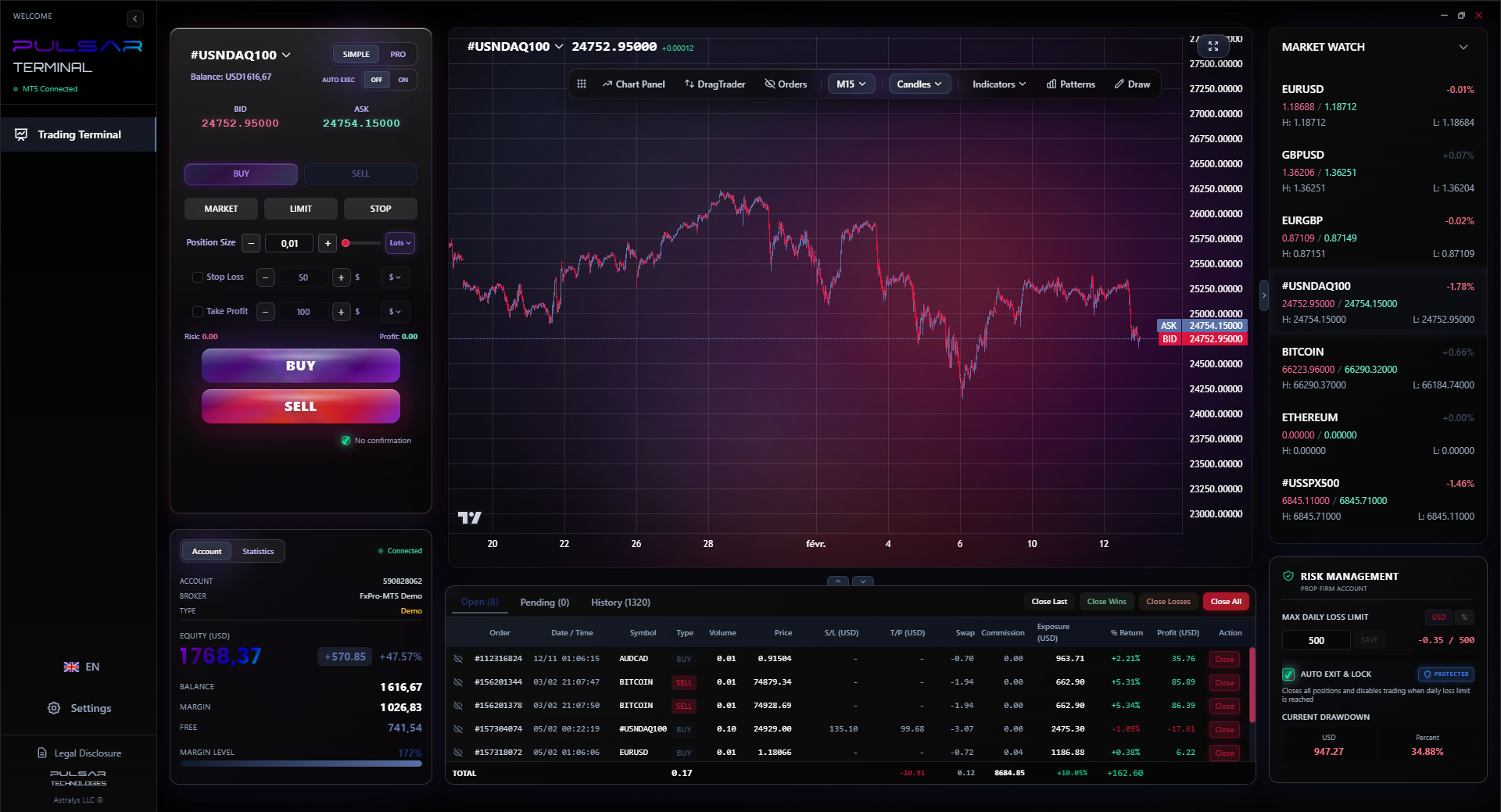
Managing multiple trades and complex stop-loss strategies on volatile pairs like USD/ZAR is stressful, but tools like Pulsar Terminal automate this directly on your MT5 platform.
Pulsar Terminal
Alat MT5 all-in-one: order drag-and-drop, multi-TP/SL, trailing stop, grid trading, Volume Profile, dan perlindungan prop firm. Digunakan 1.000+ trader setiap hari.
Your plan is your blueprint. Without it, you're just gambling. Here’s a skeleton to build on, tailored for our context.
1. Market & Session: Decide what you trade. "I trade USD/ZAR during the Jo'burg and London overlap using 1-hour and 15-minute charts." Or, "I trade EUR/USD breakouts during the first 2 hours of the London session." Be specific.
2. Entry Trigger: What gets you in? Is it a break of the Asian high? A pullback to the 50-period EMA with RSI indicator support? Write it down. My USD/ZAR trigger might be: "Price rejects a key daily support/resistance level with a 4-hour pin bar."
3. Risk Management: This is king.
- Risk per Trade: Never risk more than 1-2% of your account. On a ZAR 20,000 account, that's ZAR 200-400 per trade.
- Stop-Loss: Place it at a logical level where your trade idea is wrong. On USD/ZAR, that might be 80-150 pips away. Calculate your position size based on that distance.
- Take Profit: Aim for a risk-to-reward of at least 1:1.5. If your stop is 100 pips, your target should be 150 pips away.
4. Review: Every Sunday night, review your past week's trades. What worked? What didn't? I keep a journal. It's boring, but it turned me from a consistent loser to a consistent winner.
This plan is boring. It's not a "RAF Wayne Forex secret system." But boring makes money. Excitement blows accounts.
“The real path is transparent, regulated, and requires effort.”
Let's talk about the tech that gives you an edge, not the flashy nonsense.
Platforms: MT4 and MT5 are still the gold standard here. Every broker supports them. The real power comes from how you use them. Learn to use the strategy tester properly. Backtest your ideas. I spent a whole weekend backtesting a simple moving average crossover on USD/ZAR over 5 years of data. The result? It was barely break-even after spreads. That saved me months of live losses.
Charting & Analysis: Beyond the basic indicators, understanding volume and market structure is key. This is where advanced tools come in.
Economic Calendars: Essential. Mark SARB meetings, South African CPI and budget data, and major US/EU events. These are the catalysts for the big ZAR moves.
Community: Find a serious trading community, not a signal-chatting WhatsApp group. One where people discuss market structure and risk, not their latest Lambo dream. This is useful for overcoming that isolation I mentioned.
The right tools automate the boring stuff and let you focus on analysis. If you're manually calculating lot sizes for every trade, you're wasting mental energy.
💡 Tips Winston
Your trading plan isn't a document you write once. It's a living system you refine every week based on what the charts actually did, not what you hoped they'd do.
If you take one thing from this guide, let it be this: legitimacy is everything. The search for shortcuts with unverified names like 'RAF Wayne Forex' is a trap set for desperate or uninformed traders. The real path is transparent, regulated, and requires effort.
Stick with FSCA-regulated brokers. Respect the Rand's volatility. Build a boring, strong trading plan. Manage your risk like your financial life depends on it - because it does.
South Africa has a vibrant, growing trading community with daily volumes now over $21 billion. The opportunity is real. But it's captured by the disciplined, not the dreamers. Do the work, use the right tools, and you can build something serious from right here at home. Forget the ghosts. Trade the chart in front of you.
FAQ
Q1Is 'RAF Wayne Forex' a legitimate broker or trading educator in South Africa?
No. There is no entity named 'RAF Wayne Forex' that is licensed as a Financial Service Provider (FSP) by the Financial Sector Conduct Authority (FSCA). Searching for this term often leads to unregulated, risky sources. You should only engage with brokers and educators who have a verifiable FSCA license number, which you can check on the official FSCA register.
Q2What is the best forex broker for South African traders?
There's no single 'best' broker - it depends on your needs. For low-cost trading on major pairs, FSCA-regulated international brokers like IC Markets or Pepperstone are excellent. For trading ZAR pairs with local support and ZAR accounts, a licensed South African broker like Khwezi Trade can be ideal. The critical factor is FSCA regulation. Always verify the broker's specific FSCA-licensed entity meant for SA clients.
Q3Why are spreads on USD/ZAR so much higher than on EUR/USD?
USD/ZAR is an exotic currency pair, meaning it has lower trading volume and liquidity compared to major pairs like EUR/USD. The wider spread (often 40-100 pips) compensates market makers for the higher risk and cost of facilitating trades in a less liquid market. It's a normal characteristic of the pair, not necessarily a broker markup.
Q4How much money do I need to start forex trading in South Africa?
You can technically start with as little as $5 (ZAR ~90) with some brokers. However, with such a small amount, your risk management options are extremely limited, and you're primarily in a learning phase. A more practical starting point for serious learning while being able to apply proper risk management is between ZAR 5,000 and ZAR 10,000. This allows you to risk small, sensible amounts per trade (1-2%) while experiencing real market conditions.
Q5Do I pay tax on my forex trading profits in South Africa?
Yes. Profits from forex trading are considered taxable income by the South African Revenue Service (SARS). You are required to declare these profits in your annual tax return. It's crucial to keep detailed records of all your trades, deposits, and withdrawals for tax purposes. Also,, being tax-compliant is necessary to use your full foreign investment allowance to fund international trading accounts.
Q6What is the maximum use I can use in South Africa?
For retail traders, the FSCA has set a maximum use limit of 30:1. This means for every ZAR 1 in your account, you can control a position worth ZAR 30. This rule is designed to protect traders from catastrophic losses. Some brokers may offer lower maximums. Professional clients may qualify for higher use, but the criteria are strict.
Q7Can I use international brokers like Exness or XM from South Africa?
Yes, absolutely, but with one vital condition: you must use the specific entity of that broker that is licensed by the FSCA to offer services in South Africa. For example, both Exness and XM have FSCA-regulated entities. Do not sign up under their global or other offshore licenses. Always check the 'Regulation' section of their website for South Africa and verify the FSP number on the FSCA register.
Pelajaran Prof. Winston
Poin Penting:
- ✓FSCA regulation is your first and most important filter.
- ✓USD/ZAR spreads are wide for a reason - factor in 50-100 pips.
- ✓Never risk more than 1-2% of your capital on a single trade.
- ✓Use a position size calculator for every entry.
- ✓Your weekend ZAR gap risk is real - plan for it.
Seberapa bermanfaat artikel ini?
Klik bintang untuk menilai
Wawasan Trading Mingguan
Analisis & strategi mingguan gratis. Tanpa spam.
Tentang Penulis
David van der Merwe
Trader Pasar Berkembang
Trader berbasis Johannesburg dengan 11 tahun di mata uang pasar berkembang. Spesialis pasangan ZAR, trading berregulasi FSCA, dan analisis pasar Afrika Selatan.
Komentar
Peringatan Risiko
Perdagangan instrumen keuangan mengandung risiko signifikan dan mungkin tidak cocok untuk semua investor. Kinerja masa lalu tidak menjamin hasil di masa depan. Konten ini hanya untuk tujuan edukasi dan tidak boleh dianggap sebagai nasihat investasi. Selalu lakukan riset Anda sendiri sebelum trading.
Anda mungkin juga suka

Cara Trading Forex Sukses: 7 Prinsip dari Trader Profesional
Cara trading forex sukses dengan 7 prinsip trader pro: manajemen modal, disiplin, journal trading, backtest. Data nyata, bukan janji profit palsu.
Jam Trading Forex Terbaik untuk Trader Indonesia: Panduan Lengkap dengan Tabel Waktu
Panduan jam trading forex untuk trader Indonesia. Tabel 4 sesi dunia, jam emas 20:00-00:00, sesi mana yang harus dihindari. Data akurat + tips dari trader berpengalaman.
Top 5 Sàn Forex Uy Tín Nhất 2026: Review Jujur dari Trader Indonesia
Top 5 sàn forex uy tín 2026 untuk trader Indonesia. Review jujur: spread, deposit, withdraw, dukungan lokal. Exness, XM, IC Markets & lebih.
Dapatkan Pulsar Terminal
Semua kalkulator ini terintegrasi dalam Pulsar Terminal dengan data real-time dari akun MT5 Anda.
Dapatkan Pulsar Terminal