


Let's be honest: most South Africans trading 'retail sales forex' are just gambling with the Rand.

David van der Merwe
Trader Pasar Berkembang ·  South Africa
☕ 11 mnt baca
Yang akan Anda pelajari:
- 1What 'Retail Sales Forex' Actually Means (And What It Doesn't)
- 2The Rules of the Game: FSCA, SARB, and What You Can Actually Do
- 3The Real, Hidden Costs of Trading in South Africa
- 4Choosing a Broker & Platform: The Local vs Offshore Debate
- 5Trading Strategies for ZAR Volatility
- 6The Top 5 Mistakes South African Forex Traders Make
- 7Your Action Plan: Getting Started the Right Way
Let's be honest: most South Africans trading 'retail sales forex' are just gambling with the Rand. They see the use, ignore the FSCA warnings, and blow accounts funding international brokers. I've seen it a hundred times. This guide isn't about getting rich quick. It's about understanding the actual rules, the real costs of trading ZAR pairs like USD/ZAR, and how to not be the sucker in the market. I'll prove that trading here is less about fancy strategies and more about managing regulation and psychology.
First, let's kill a misconception. 'Retail sales forex' doesn't mean you're trading data releases like US Retail Sales (though that's a strategy). In the South African context, it means you, the individual retail trader, are buying and selling currency pairs. You're not a bank or a hedge fund. You're a small fish in the biggest ocean on the planet.
The core product is a Contract for Difference (CFD) on a currency pair. You don't own the actual dollars or euros. You're speculating on the price movement. When you trade USD/ZAR, you're betting on whether the Rand will strengthen or weaken against the Dollar. It's that simple, and that complex.
Why do so many get it wrong? They confuse access with edge. Just because you can open an account with R500 and get 500:1 use from an offshore broker doesn't mean you should. The FSCA capped use at 30:1 for a reason - they were tired of cleaning up the mess. I learned this the hard way early on. I put R10,000 into a high-use account, traded USD/ZAR like it was a slot machine, and was down 40% in a week. My mistake wasn't the analysis; it was using a sledgehammer (extreme use) to crack a nut.

Warning: Trading ZAR pairs is a direct bet on South Africa's economic and political stability. It's highly volatile and sensitive to local news, Eskom, and credit rating announcements. It's not for the faint-hearted.

💡 Tips Winston
Your first R10,000 in the market is tuition, not capital. Expect to pay it to learn. The goal is to keep the tuition fees as low as possible.
“Trading the Rand is a direct bet on South Africa's economic and political stability.”
You can't play the game if you don't know the rules. And in South Africa, the rules are strict, for your protection (even if it feels restrictive).
The Key Regulator: FSCA
The Financial Sector Conduct Authority (FSCA) is your main watchdog. Since 2021, they've enforced a 30:1 use limit for retail traders on major forex pairs. This is a global trend, but it's critical here. Any broker offering you 500:1 is likely not FSCA-regulated, meaning you have little recourse if they vanish with your money. Always check the FSP number on the FSCA's website.
The SARB and Your Money
The South African Reserve Bank (SARB) controls the flow of money across borders. This is the big one for funding your account. As a resident, you have a Single Discretionary Allowance (SDA). Good news: as of February 2026, it's been increased to R2 million per year. You can use this to send money overseas to a broker without a Tax Compliance Status (TCS) pin. This is a significant boost for serious traders.
The Legal Grey Area: Trading Against the ZAR
Here's the technicality: South African residents are generally not permitted to speculate against the Rand. In practice, this is poorly enforced for individuals using international brokers, but it's a risk. Using an FSCA-regulated local broker like Khwezi Trade or IFX Brokers for ZAR pairs keeps you squarely in the legal frame. Using an offshore broker like IC Markets or Exness for USD/ZAR? You're in a grey zone. I structure my trading to keep most of my ZAR-focused activity with local, regulated entities. It's just safer.

Pro Tip: When comparing brokers, your first filter should be 'FSCA Regulation'. Your second should be 'ZAR Account Option'. This eliminates currency conversion fees on your deposit and P&L. Brokers like XM and Exness offer this.
“The 500:1 use offer is a trap. It magnifies losses faster than gains.”
Forget the 'commission-free' marketing. Your profit is eaten by costs before you even make it. Let's break down what you're really paying, using real 2025 numbers.
1. The Spread: This is the broker's cut. On USD/ZAR, a 'tight' spread might be 50 pips (yes, 50). On a standard lot (100,000 units), each pip is worth about R7.40 (depending on the rate). So, your trade is down R370 (50 pips * R7.40) the second you click 'Buy'. Compare that to EUR/USD, where a 0.6 pip spread costs about $6. The difference is staggering.
2. Commissions: Some brokers offer raw spreads + commission. For example, a broker might charge $7 per round turn (open and close) per lot. On a $10,000 account, that adds up fast.
3. Swap Fees (Overnight Financing): If you hold a position past 10 PM SA time, you pay or receive interest. For ZAR pairs, this can be huge. Going long USD/ZAR (betting against the ZAR) often incurs a heavy daily debit because of South Africa's higher interest rates. I once held a USD/ZAR long over a weekend, forgetting about the triple swap charge. It cost me R1,200 on a 2-lot position. A brutal lesson.
4. Bank and Payment Fees: This is the silent killer. Funding an international broker?
- Outgoing international payment (EFT): ~R250
- Receiving a withdrawal back: ~R350 That's R600 gone before you've made a single profitable trade. Use brokers with local ZAR deposit options via Ozow or PayFast whenever possible.
5. Currency Conversion: If your broker account is in USD and you deposit ZAR, they'll convert it at a poor rate, often with a 1-2% fee. Always use a ZAR account if you can.
| Cost Type | Example on USD/ZAR (1 Lot) | Impact on R10,000 Account |
|---|---|---|
| Spread | 50 pips = ~R370 | -3.7% immediately |
| Int'l Payment Fee | R250 (deposit) + R350 (withdraw) | -6.0% on total capital flow |
| Swap Fee (per night) | Can be R50-R200 | Erodes long-term holds |
These numbers make one thing clear: you need a significant edge just to break even. This is why proper position size calculation isn't a suggestion, it's a survival tool.
💡 Tips Winston
The spread isn't a fee, it's a toll bridge. You have to cross it to get to the other side (profit). On wide bridges like USD/ZAR, make sure the destination is worth the toll.
“The 500:1 use offer is a trap. It magnifies losses faster than gains.”
This is your most important decision after deciding to trade. Get it wrong, and you're fighting an uphill battle.
Local FSCA-Regulated Brokers (e.g., Khwezi Trade, IFX Brokers) Pros: Full legal compliance, ZAR accounts, local customer support, easy EFT deposits/withdrawals. Cons: Often fewer instruments, higher spreads on major pairs (like EUR/USD), platforms may be less advanced. Best for: New traders, those focusing primarily on ZAR pairs, traders who value local recourse and simplicity.
Major International Brokers (FSCA-Regulated) (e.g., IG, Pepperstone) Pros: World-class platforms (MT4/MT5, cTrader), tighter spreads on majors, vast range of instruments, strong reputation. Cons: You'll likely need to use your SDA, deal with international bank fees, and customer support isn't local time-zone always. Best for: Experienced traders, those trading global majors like EUR/USD or XAU/USD, algorithmic traders.
The Platform: MetaTrader 5 (MT5) is the professional standard. MT4 is legacy. If your broker only offers MT4, question why. For South Africans, platform stability is key during load-shedding. A web-based platform or a mobile app that works offline is a genuine consideration. My setup? I use MT5 with a major international broker for my global trades, and a separate, smaller ZAR account with a local broker for specific Rand plays. It splits the risk.

Example: Let's say you deposit R20,000. With a local broker, it's in your account in hours, cost R0. With an international broker, you pay R250 to send it, wait 2-5 days, and lose on the conversion. To just get your original R20,000 back, you need to make R250 + another R350 withdrawal fee = R600 in profit. That's a 3% return needed just to get back to zero.
“Your first R10,000 in the market is tuition, not capital.”
Trading the Rand is different. It doesn't always follow textbook technicals because it's driven by local sentiment. Here’s what I’ve found works.
News Trading the Rand
USD/ZAR moves on South African-specific news: SARB interest rate decisions, budget speeches, credit rating announcements, and even political headlines. The key is to be prepared, not reactive. Have your orders set up beforehand. I use a pure scalping strategy around these events, aiming for 20-30 pip moves with very tight stops. The spread is your enemy here, so you need the move to be immediate and decisive.
Technical Analysis Adjustments
Because of the wide spreads, classic day trading or short-term swing trading is harder. You need wider stops, which means smaller position sizes. I use higher time frames (4-hour and daily charts) more for ZAR pairs to filter out the noise. Indicators like the RSI indicator can be useful for spotting overbought/oversold conditions during sustained trends, but they lag. The MACD indicator on a daily chart helped me catch a major USD/ZAR downtrend in 2023, where I rode a 1500-pip move over two months. The wide stop required meant I could only risk 0.5% of my account per trade, but it paid off.
The Most Important Strategy: Risk Management
This isn't a strategy, it's the strategy. With ZAR pairs, a 100-pip stop loss is normal. On 1 lot, that's R740. On a R20,000 account, that's a 3.7% risk on one trade - too high. I never risk more than 1% per trade on these pairs. This often means trading mini or micro lots. Your broker's margin call level is your cliff edge; know it intimately. A sudden spike during a news event can wipe you out if you're over-leveraged.
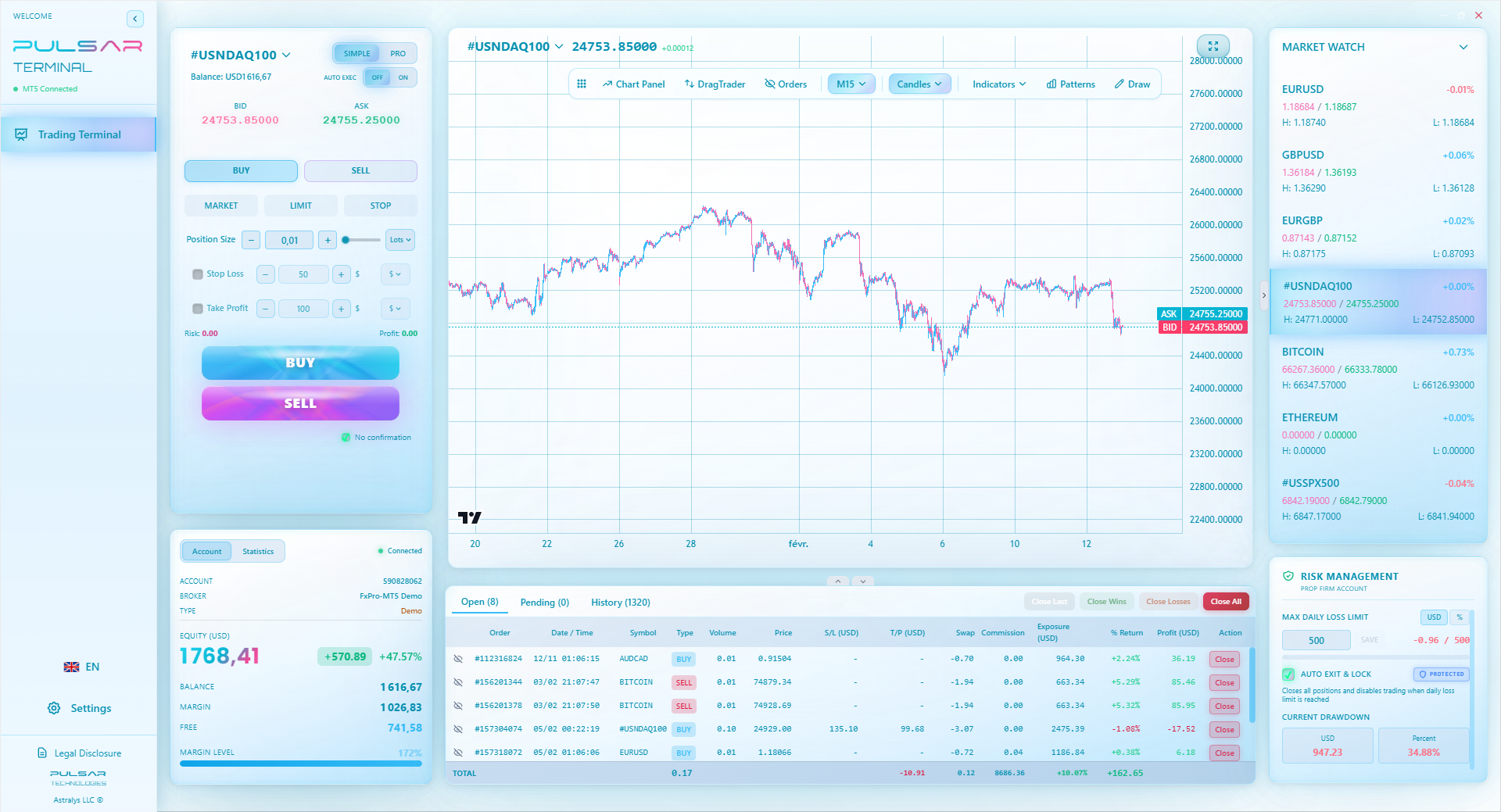
Managing multiple trades on volatile ZAR pairs requires precision; Pulsar Terminal's drag-and-drop order and multi-TP/SL tools on MT5 let you set complex risk profiles in seconds, not minutes.
Pulsar Terminal
Alat MT5 all-in-one: order drag-and-drop, multi-TP/SL, trailing stop, grid trading, Volume Profile, dan perlindungan prop firm. Digunakan 1.000+ trader setiap hari.
“Your first R10,000 in the market is tuition, not capital.”
I've made most of these. Let's save you the money.
- Chasing High use: The 500:1 offer is a trap. It magnifies losses faster than gains. With 30:1, you can still build serious exposure, but it forces discipline. A margin call is a professional embarrassment, not a rite of passage.
- Ignoring Total Cost of Trading: They see a '0.0 pip spread' ad and don't see the $7 commission and the R600 in bank fees. Your trading journal must track all costs, not just P&L from trades.
- Trading During Illiquid Times: The Rand market is dead between New York close and Asian open. Spreads widen massively. Trading then is like swimming in molasses while paying for Olympic pool lanes.
- Not Using a ZAR Account: You're adding a completely unnecessary variable - USD/ZAR exchange risk on your own capital. Keep it simple.
- Emotional Trading on Local News: You read a negative headline about SA and immediately want to short the Rand. So does everyone else. The move often happens before the news hits the public. You're late. Have a plan, don't be a reactionary.
💡 Tips Winston
A trading plan without a loss limit is a bankruptcy plan. Decide your weekly loss cap (I use 5%) and walk away when you hit it. The market will be there tomorrow.
“A trading plan without a loss limit is a bankruptcy plan.”
Here's a step-by-step, no-BS plan. Don't skip steps.
Step 1: Education & Demo Trading (Minimum 3 Months) Don't deposit real money. Open a demo account with a broker like FP Markets or a local one. Learn the MT5 platform. Understand what a pip and spread are. Paper trade through a full SARB monetary policy cycle. Your goal isn't profit; it's consistency and not blowing up the virtual account.
Step 2: Broker Selection & Legal Setup Decide: local or international? Based on your demo experience, choose one FSCA-regulated broker. Get your FICA documents ready (ID, proof of address). If using an international broker, understand the SDA process with your bank.
Step 3: Fund with 'Risk Capital' Only This is money you can afford to lose 100% of. Not your rent, not your savings. Start small. R5,000 is a perfectly sane amount to learn with in a live environment. Deposit using the cheapest method (local EFT for ZAR accounts).
Step 4: Develop a Written Trading Plan This is your constitution. It must include:
- Your strategy (e.g., '4-hour chart swing trading using MACD divergence')
- Your risk per trade (e.g., 'Maximum 1% of account balance')
- Your daily/weekly loss limit (e.g., 'Stop trading for the week if down 5%')
- Your position sizing rules (use that calculator every time)
Step 5: Execute, Journal, and Review Trade the plan. Every single trade goes in a journal: entry, exit, reason, screenshot, emotional state. At the end of the week, review what worked and what didn't. This feedback loop is the only thing that leads to improvement.
The path isn't glamorous. It's administrative, disciplined, and often boring. That's how you know you're doing it right.
FAQ
Q1Is forex trading legal in South Africa?
Yes, it is legal. However, it's regulated by the FSCA. The legal grey area involves South African residents speculating against the Rand (ZAR) using offshore brokers. Using an FSCA-regulated broker, especially for trading ZAR pairs, is the safest and most compliant route.
Q2What is the best forex broker for South Africans?
There's no single 'best' broker. It depends on your needs. For beginners and those focused on ZAR, a local FSCA broker like Khwezi Trade is solid. For advanced traders wanting global markets and tight spreads on majors, an FSCA-regulated international broker like IG or Pepperstone is better. Always prioritize FSCA regulation and consider if they offer a ZAR account.
Q3How much money do I need to start forex trading in South Africa?
You can technically start with R500 with some brokers. But realistically, to trade properly with sensible risk management (not being forced to use extreme use), a starting capital of R5,000 to R10,000 is more practical. Remember, this should be risk capital you can afford to lose entirely.
Q4Why are the spreads on USD/ZAR so high?
Spreads reflect liquidity and risk. The USD/ZAR pair is less liquid than majors like EUR/USD, meaning there are fewer buyers and sellers at any given moment. The broker takes on more risk to hold the position, so they charge a wider spread. It also reflects the higher volatility and perceived country risk associated with the Rand.
Q5Can I use my Single Discretionary Allowance (SDA) to fund a forex trading account?
Yes. The SDA (now R2 million per year) can be used to send funds abroad for investment purposes, which includes funding an international forex brokerage account. You do not need a Tax Compliance Status (TCS) pin for amounts within this allowance. You will need to instruct your bank to process it as an 'SDA' transfer.
Q6What's the difference between MT4 and MT5?
MT5 is the newer, more powerful platform. It has more timeframes, more technical indicators, a built-in economic calendar, and a superior strategy tester for automated trading. MT4 is older but is still widely used, primarily for forex. For new traders, I recommend starting with MT5 as it's the industry's future.
Q7How are my profits taxed in South Africa?
Profits from trading are generally considered capital gains if you're deemed to be an investor (holding periods matter), or income if you're deemed to be a trader (frequent, short-term trades). Capital gains are included in your taxable income, with an annual exclusion (R40,000 for individuals). Trading income is taxed at your marginal income tax rate. You must declare all trading profits to SARS. Consult a tax professional familiar with trading.
Pelajaran Prof. Winston
Poin Penting:
- ✓FSCA's 30:1 use cap exists to protect you from yourself.
- ✓The total cost of trading (spread + commission + bank fees) can easily exceed 5% of a small account.
- ✓Always use a ZAR-denominated account to eliminate unnecessary currency risk.
- ✓Risk a maximum of 1% of your account per trade on volatile ZAR pairs.
Seberapa bermanfaat artikel ini?
Klik bintang untuk menilai
Wawasan Trading Mingguan
Analisis & strategi mingguan gratis. Tanpa spam.
Tentang Penulis
David van der Merwe
Trader Pasar Berkembang
Trader berbasis Johannesburg dengan 11 tahun di mata uang pasar berkembang. Spesialis pasangan ZAR, trading berregulasi FSCA, dan analisis pasar Afrika Selatan.
Komentar
Peringatan Risiko
Perdagangan instrumen keuangan mengandung risiko signifikan dan mungkin tidak cocok untuk semua investor. Kinerja masa lalu tidak menjamin hasil di masa depan. Konten ini hanya untuk tujuan edukasi dan tidak boleh dianggap sebagai nasihat investasi. Selalu lakukan riset Anda sendiri sebelum trading.
Anda mungkin juga suka

Cara Trading Forex Sukses: 7 Prinsip dari Trader Profesional
Cara trading forex sukses dengan 7 prinsip trader pro: manajemen modal, disiplin, journal trading, backtest. Data nyata, bukan janji profit palsu.
Jam Trading Forex Terbaik untuk Trader Indonesia: Panduan Lengkap dengan Tabel Waktu
Panduan jam trading forex untuk trader Indonesia. Tabel 4 sesi dunia, jam emas 20:00-00:00, sesi mana yang harus dihindari. Data akurat + tips dari trader berpengalaman.
Top 5 Sàn Forex Uy Tín Nhất 2026: Review Jujur dari Trader Indonesia
Top 5 sàn forex uy tín 2026 untuk trader Indonesia. Review jujur: spread, deposit, withdraw, dukungan lokal. Exness, XM, IC Markets & lebih.
Dapatkan Pulsar Terminal
Semua kalkulator ini terintegrasi dalam Pulsar Terminal dengan data real-time dari akun MT5 Anda.
Dapatkan Pulsar Terminal