


You've heard the legend.

Rajesh Sharma
Analis Forex Senior ·  India
India
☕ 11 mnt baca
Yang akan Anda pelajari:
- 1Turtle Trading: The Myth vs. The Nifty Reality
- 2The Core Rules: What You Actually Have to Do
- 3Adapting the Turtles for Indian Markets: The 2026 Problem
- 4Risk Management: The Only Lesson That Matters
- 5What to Really Expect: Drawdowns & Patience
- 6Execution in 2026: Tools You Can't Live Without
- 7The Final Verdict: Should You Become a Turtle?
You've heard the legend. Richard Dennis turned a bunch of novices into millionaires with a simple set of rules. The Turtle Trading story is the ultimate trading fairy tale. But here's the real question for you, sitting in Mumbai or Delhi in 2026: can you actually use the Richard Dennis trading strategy to make money in today's Indian markets? Or is it just a nice story that died with pit trading and low transaction costs? I've run these systems live. The answer isn't simple, and the new SEBI rules have changed the game completely. Let's strip away the myth and look at the cold, hard mechanics of making this work where you trade.
The myth goes like this: buy a 55-day high, sell a 20-day low, size your position with volatility, and ride the trend to riches. It sounds easy. The reality, especially on the Nifty or Bank Nifty, is a brutal exercise in psychological torture.
I learned this the hard way in 2019. I backtested a classic Turtle system on Nifty futures. The equity curve looked beautiful - a smooth ride up. Then I traded it live. The first three trades were losses. The fourth was a small win. The fifth, sixth, and seventh were losses again. That's the reality. This strategy has a win rate often below 40%. You will be wrong most of the time. Your friends doing intraday options will mock you. Your own brain will scream at you to quit.
The core of the Richard Dennis trading strategy isn't the entry signal. It's the system. The unbreakable rules that force you to take every signal, and the position sizing that ensures a string of losses doesn't blow up your account. In India's momentum-driven markets, the trends exist. But capturing them requires a level of discipline that 95% of traders simply don't possess.

Warning: If you can't handle 7 consecutive losing trades without doubting the system, Turtle Trading will destroy you. It's not a strategy; it's a psychological endurance test.
The famous experiment proved traders could be made, not born. But Dennis's students were trained like Marines. They had no discretion. Do you?

💡 Tips Winston
The market doesn't care about your intelligence. It tests your obedience. A simple rule followed perfectly will beat a genius idea executed poorly every single time.
“The Richard Dennis trading strategy isn't a strategy; it's a psychological endurance test.”
Let's get specific. The classic Turtle system used two entry systems. Forget the folklore; here's the actionable blueprint.
System 1: The 20-Day Breakout
This is the workhorse. You buy when the price exceeds the high of the previous 20 days. You sell short when it breaks below the low of the previous 20 days. For a Nifty futures trader, this means watching that 20-day high/low level like a hawk. Your entry is a market order on the break. No hesitation. No waiting for a pullback.
System 2: The 55-Day Breakout
This is for the bigger, slower trends. Same logic: buy the 55-day high, sell the 55-day low. These signals are less frequent but aim to catch the major moves. Most retail traders combine both, taking every signal from either system.
The Exit (Where You Make Money)
This is the most overlooked part. Turtles didn't use fancy profit targets. The exit rule for a long trade was to sell when the price fell to a 10-day low. For a short trade, cover at a 10-day high. That's it. You ride the trend until it reverses by that measure. This means giving back a huge chunk of open profits. I once watched a Nifty trade go up 900 points, then reverse and get stopped out at a 10-day low for a gain of only 110 points. It felt like a loss. But that's the rule.
The Fuel: Position Sizing with ATR
This is the secret engine. Your position size isn't based on your account balance alone. It's based on volatility, measured by the Average True Range (ATR). The concept is called the 'Unit.'
- Calculate the ATR (typically 20-day).
- Determine your risk per unit (e.g., 1% of capital).
- The dollar volatility of one Unit is set as 1 ATR.
- Your position size = (Risk per Unit) / (1 ATR in rupees).
When the Nifty is calm (low ATR), you buy more contracts. When it's wild (high ATR, like around budget or earnings), you buy fewer. This automatically adjusts your risk exposure. You must use a position size calculator that incorporates ATR to do this correctly. Guessing will get you killed.
“The rules aren't there to make money; they're there to keep you in the game.”
Trading Nifty futures in 2015 with this system was one thing. Doing it in 2026 is a different beast entirely, thanks to SEBI. The regulatory landscape has fundamentally altered how you can execute a systematic strategy.
First, the F&O changes. The minimum contract size for index derivatives is now ₹15-20 lakhs. The Nifty lot size is 75. For a standard Turtle system that pyramids (adds to winners), the margin requirement can become enormous. A 2-unit position in Nifty can easily tie up ₹4-5 lakhs in margin. This pushes the strategy towards higher net-worth individuals or forces you to trade mini or micro contracts in other instruments.
Second, and more critically, is the algo regulation. The Richard Dennis trading strategy is, by definition, an algorithmic strategy. It's a set of unambiguous rules. As of April 1, 2026, if you want to automate this, you face a wall.
- Your broker is now legally responsible for your algo. You can't just code a Python script on your laptop and connect via an API. Open APIs are banned.
- Your strategy needs exchange approval. You submit your logic - "buy on 20-day high, exit on 10-day low, size by ATR" - to the exchange via your broker. They approve it and assign an Algo ID.
- It must run on your broker's infrastructure. No cloud servers unless fully integrated.
This means the casual coder is locked out. To implement this systematically, you likely need to use your broker's proprietary strategy builder (if it's powerful enough) or work with an empanelled algo platform. The era of the bedroom algo trader executing on Zerodha's API is over. This protects the market but adds friction for retail system traders.

Pro Tip: Look for brokers with strong in-platform automation tools. Some systems allow you to set price-based conditional orders (e.g., "Buy if price > 20-day high"). It's not full automation, but it can help you follow the rules without manual entry. Check our IC Markets review and Pepperstone review for their advanced order capabilities, though remember they primarily serve the international forex market.
For Indian markets, you're looking at manually placing these orders or using semi-automated tools. The pure, fire-and-forget Turtle system is now an institutional game.
“The rules aren't there to make money; they're there to keep you in the game.”
Forget the entries for a second. The single greatest takeaway from the Richard Dennis trading strategy is its obsessive, mathematical approach to risk. This is what saves you when you're wrong 6 times in a row.
The 2% Rule (Actually, it was 1% for Turtles): No single trade could risk more than 1% of the total trading capital. Not 2%, not 5%. 1%. With a 40% win rate, you need that survivability. Let's say you have a ₹10 lakh account. Your max loss per trade is ₹10,000. Your position size and stop loss are calculated backwards from that number.
The Correlated Risk: Turtles traded multiple markets. In India, if you're long Nifty and long Bank Nifty, you're in the same trade. They are highly correlated. The system accounted for this by reducing position size in correlated assets. For you, trading both at full size doubles your real risk. You need to adjust your units down.
The Daily Loss Limit: Some Turtle versions had a rule: if you lose a certain percentage in a day (e.g., 2-3%), you shut down for the day. This prevents death spirals. In today's world of prop firm challenges, this is gospel. A tool that can automatically enforce this daily loss limit is priceless for survival. Managing this manually while in a losing streak is almost impossible.
The psychological weight of these rules is heavy. I violated the 1% rule once in 2020, thinking a Nifty setup was "can't miss." I risked 3%. It missed. That single loss set me back three weeks of disciplined profits. Never again. The rules aren't there to make money; they're there to keep you in the game.
💡 Tips Winston
Your first loss is your smallest loss. The Turtle's exit rule forces you to accept this. The amateur's instinct to 'give it room' is what turns a 1% loss into a 10% disaster.
“Expect equity drawdowns of 20-30%. Can your stomach handle seeing your account drop 30% while you keep trading?”
Let's talk numbers, not dreams. A properly implemented trend-following system like this will have specific characteristics you must accept before you start.
- Win Rate: 35-45%. You will lose more often than you win.
- Average Winner vs. Average Loser: The goal is for your average winning trade to be 2, 3, or 4 times larger than your average loser. This is your profit factor. You lose small, win big.
- Maximum Drawdown: This is the killer. Expect equity drawdowns of 20-30% from a peak. Can your stomach and your finances handle seeing your ₹10 lakh account drop to ₹7 lakh while you keep trading the signals? Most can't.
- Time in the market: You might be in a trade for 2 days or 2 months. This isn't scalping strategy. It's the ultimate form of swing trading.
Here’s a realistic first-year scenario for a ₹10 lakh account:
| Metric | Realistic Expectation | Emotional Impact |
|---|---|---|
| Starting Capital | ₹10,00,000 | Hope & excitement. |
| Peak Capital (Month 4) | ₹11,50,000 | "This is easy!" |
| Trough Drawdown (Month 7) | ₹8,20,000 | Despair, doubt, wanting to quit. |
| Year-End Capital | ₹10,90,000 | Exhausted, but intact. |
A 9% return with a 30% drawdown. That's the reality. The system makes its money in brief, explosive trending periods that make up for months of chop. Your job is to survive the chop.

Example: If your ATR-based stop is 100 points on Nifty (₹7,500 per lot), and you can only risk ₹10,000 per trade, your position size is 1 lot (₹7,500 risk). You cannot buy 2 lots just because you have the margin. The risk dictates the size.
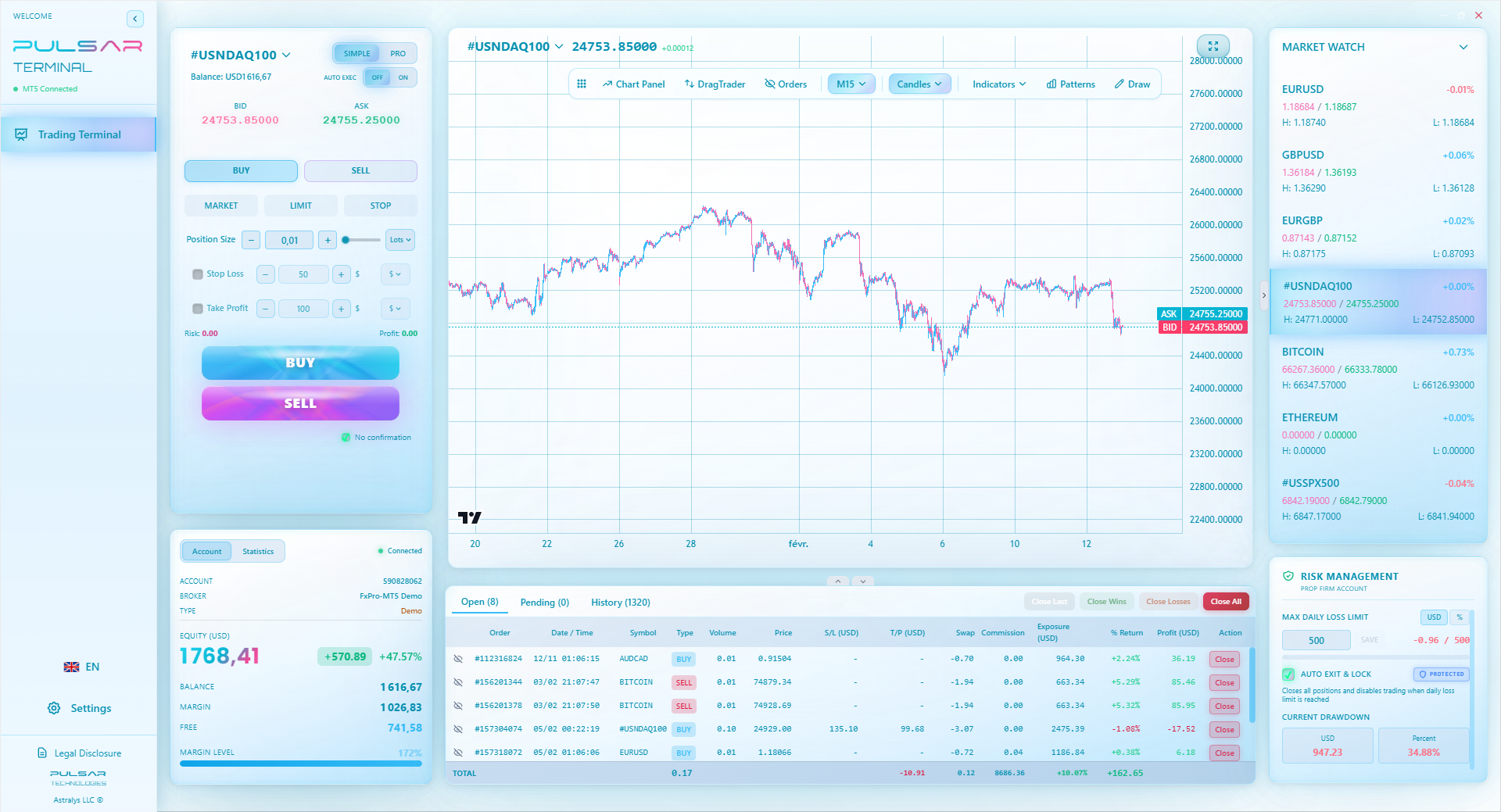
Manually managing ATR-based trailing stops and daily loss limits for a system like this is a full-time job; Pulsar Terminal automates these risk mechanics directly on your MT5 chart, enforcing the discipline the Turtles were famous for.
Pulsar Terminal
Alat MT5 all-in-one: order drag-and-drop, multi-TP/SL, trailing stop, grid trading, Volume Profile, dan perlindungan prop firm. Digunakan 1.000+ trader setiap hari.
“Expect equity drawdowns of 20-30%. Can your stomach handle seeing your account drop 30% while you keep trading?”
Since full automation is complex for retail under SEBI's 2026 rules, your edge comes from execution efficiency and discipline. Manual trading of this system is a recipe for emotional slippage. You need tools that hardwire the rules.
1. Advanced Order Types: You need a platform that lets you set OCO (One-Cancels-the-Other) or bracket orders. Your entry order should automatically set your initial stop-loss based on the ATR calculation. Manually calculating and placing the stop after entry is where mistakes happen.
2. Trailing Stops: While the classic exit is a 10-day low, many modern adaptations use an ATR-based trailing stop. This is mechanically tedious to adjust by hand every day. A tool that can automatically trail your stop by a multiple of ATR is a force multiplier.
3. Portfolio & Risk View: You need to see your total account risk in real-time, especially if you're in multiple positions (e.g., Nifty, a stock future). How correlated are they? What's your total exposure? A single dashboard view prevents accidental over-use.
This is where modern trading terminals that plug into MT5 become essential. They handle the mechanics so you can focus on the discipline. For instance, setting a multi-level exit - where you close part of the position at a first target and trail the rest - is a complex manual task but a simple drag-and-drop with the right software. This kind of partial closure strategy can help manage the psychology of watching big profits evaporate.
💡 Tips Winston
Systematic trading isn't about being right. It's about being right on average, over a hundred trades. Stop looking at P&L after every single signal. Look at it monthly.
“Worship the ruthless adherence to a system. That's what Dennis was really selling.”
The Richard Dennis trading strategy is not a get-rich-quick scheme. It's a get-rich-slow-if-you're-extremely-lucky-and-incredibly-disciplined scheme. It's a philosophical approach to markets more than a checklist.
Who it might work for:
- You have a sizable capital base (₹20 lakh+) to withstand drawdowns and meet contract size requirements.
- You are emotionally detached, almost robotic.
- You have access to tools that minimize manual execution errors.
- You are patient, measuring success in years, not weeks.
- You understand it's a business of risk management, not prediction.
Who will fail:
- Anyone needing consistent monthly income from trading.
- Traders who get bored easily and need action.
- Those who cannot follow a rule after 5 consecutive losses.
- Anyone with less than ₹5 lakh in dedicated risk capital.
My personal take? The core principles are immortal. Trade with the trend. Cut losses short. Let profits run. Size based on volatility. These are the pillars of all successful trading. The specific 20-day/55-day breakout rules are just one manifestation. The real gift of the Turtle experiment is the proof that process beats intuition.
For the Indian trader in 2026, the path is to absorb the philosophy, use modern tools to enforce the discipline that the Turtles had drilled into them, and adapt the mechanics to fit the regulatory box we now operate in. Don't worship the specific rules. Worship the ruthless adherence to a system. That's what Dennis was really selling.
FAQ
Q1What is the most important rule in the Richard Dennis trading strategy?
The single most important rule is the 1% risk rule. No trade can risk more than 1% of your total trading capital. This isn't a suggestion; it's the foundation that makes surviving the strategy's low win rate possible. Everything else - position sizing, entries, exits - is built around this constraint.
Q2Can I automate Turtle Trading in India after SEBI's 2026 rules?
Yes, but it's no longer a simple DIY project. Retail algo trading is now a formally regulated environment. You cannot run your own code on a private server. Your algorithmic strategy (the rules) must be approved by the exchange, run on your broker's infrastructure, and have a unique Algo ID. For most retail traders, this means using broker-provided tools or empanelled platforms, not writing your own code from scratch.
Q3What markets in India are best for this trend-following strategy?
Liquid index futures like Nifty 50 and Bank Nifty are the primary candidates. They have the sustained trends the system needs. Stock futures can work but carry higher idiosyncratic risk (company-specific news) and may be less liquid. The increased lot sizes post-2024 mean capital requirements are significant, so ensure your position sizing still allows for proper diversification without over-leveraging.
Q4How do I calculate position size using ATR like the Turtles did?
First, determine your risk per trade (e.g., 1% of capital). Let's say ₹10,000. Then, find the current ATR (20-period) for the Nifty in points. If ATR is 120 points, and each point is ₹75, then 1 ATR = ₹9,000 in volatility. Your position size in units is (Risk per Trade) / (1 ATR in rupees) = ₹10,000 / ₹9,000 = 1.11 units. Since you can't trade a fraction of a Nifty lot (lot size 75), you round down to 1 unit (1 lot). Never round up. Use a good position size calculator.
Q5What is a typical maximum drawdown I should expect?
You must be prepared for peak-to-trough equity drawdowns of 20% to 30%, and in prolonged sideways markets, it could be even higher. If you start with ₹10 lakh, seeing your account drop to ₹7 lakh while you continue to execute losing trades is a standard, expected part of the strategy. If you cannot emotionally or financially handle that, this strategy is not for you.
Q6Did the Turtles use indicators like RSI or MACD?
No. The classic Turtle system used pure price action (breakouts of highs/lows) and volatility (ATR). They did not use oscillators like the RSI indicator or momentum indicators like the MACD indicator for entries or exits. The system's power is in its simplicity and rule-based nature, avoiding the subjectivity that comes with interpreting multiple indicators.
Pelajaran Prof. Winston
Poin Penting:
- ✓Risk 1% per trade, no exceptions.
- ✓Your win rate will be below 40%. Accept it.
- ✓Size positions using ATR, not guesswork.
- ✓Exit at the 10-day low, not your target.
- ✓Prepare for 30% drawdowns as a cost of business.
Seberapa bermanfaat artikel ini?
Klik bintang untuk menilai
Wawasan Trading Mingguan
Analisis & strategi mingguan gratis. Tanpa spam.
Tentang Penulis
Rajesh Sharma
Analis Forex Senior
Berpengalaman lebih dari 10 tahun di pasar India dan Asia Selatan. Memulai dari derivatif mata uang NSE sebelum beralih ke forex internasional. Spesialis pasangan USD/INR dan pasar negara berkembang.
Komentar
Peringatan Risiko
Perdagangan instrumen keuangan mengandung risiko signifikan dan mungkin tidak cocok untuk semua investor. Kinerja masa lalu tidak menjamin hasil di masa depan. Konten ini hanya untuk tujuan edukasi dan tidak boleh dianggap sebagai nasihat investasi. Selalu lakukan riset Anda sendiri sebelum trading.
Anda mungkin juga suka

Cara Trading Forex Sukses: 7 Prinsip dari Trader Profesional
Cara trading forex sukses dengan 7 prinsip trader pro: manajemen modal, disiplin, journal trading, backtest. Data nyata, bukan janji profit palsu.
Jam Trading Forex Terbaik untuk Trader Indonesia: Panduan Lengkap dengan Tabel Waktu
Panduan jam trading forex untuk trader Indonesia. Tabel 4 sesi dunia, jam emas 20:00-00:00, sesi mana yang harus dihindari. Data akurat + tips dari trader berpengalaman.
Top 5 Sàn Forex Uy Tín Nhất 2026: Review Jujur dari Trader Indonesia
Top 5 sàn forex uy tín 2026 untuk trader Indonesia. Review jujur: spread, deposit, withdraw, dukungan lokal. Exness, XM, IC Markets & lebih.
Dapatkan Pulsar Terminal
Semua kalkulator ini terintegrasi dalam Pulsar Terminal dengan data real-time dari akun MT5 Anda.
Dapatkan Pulsar Terminal