


You want to trade forex, but you're worried about getting scammed or losing your shirt.

David van der Merwe
Trader Pasar Berkembang ·  South Africa
☕ 10 mnt baca
Yang akan Anda pelajari:
- 1What 'Secure Trading' Really Means (It's Not What You Think)
- 2FSCA Regulation: Your Non-Negotiables
- 3Avoiding Scams: Local Red Flags to Know
- 4Building Your Personal Security System
- 5Platforms, Execution, and the Slippage Reality
- 6Taxes and Record Keeping: The Boring Part of Security
- 7Funding, Withdrawals, and SARB Rules
- 8Putting It All Together: Your Secure Trading Plan Checklist
You want to trade forex, but you're worried about getting scammed or losing your shirt. How do you know who to trust with your hard-earned rands? I get it. When I started over a decade ago, I nearly fell for a 'guaranteed returns' scheme that would have wiped out my first deposit. Secure forex trading isn't just about picking the right trades, it's about building your entire approach on a foundation of safety. Let's talk about how to do that right here in SA.
Most new traders think security is just about finding a licensed broker. That's step one, but it's only the beginning. Real security is a three-part system: a regulated environment, a disciplined you, and a strong strategy that protects your capital first.
I learned this the hard way. In 2015, I had an account with a properly FSCA-licensed broker. I felt 'secure.' Then I blew 40% of my account in a week chasing losses on USD/ZAR during a volatile political announcement. The broker was fine. My lack of personal discipline was the security breach. The platform didn't fail me, I failed myself.
True secure forex trading means your broker can't steal from you, your emotions can't hijack your decisions, and your strategy has built-in shock absorbers for when the market gets wild. We'll build that system together.

Warning: A license is a minimum requirement, not a guarantee of success. Between 51% and 89% of retail traders still lose money with fully regulated brokers. The license protects you from fraud; it doesn't protect you from yourself.
This is your first and most important filter. The Financial Sector Conduct Authority (FSCA) is our local watchdog. If a broker isn't on their list, walk away. No excuses.
How to Verify a Broker
Go to the FSCA's website and use their Financial Service Provider Register. You're looking for the broker's exact trading name and a valid FSP number. Don't just trust a logo on their website. I check this every single time, even for brokers I know. In 2020, a clone firm was impersonating a legit broker, and the only difference was one digit in the FSP number.
What FSCA Regulation Actually Gives You
- Segregated Accounts: Your money is held separately from the broker's operating funds. If they go bankrupt (it happens), your capital should be safe and returned. This is non-negotiable.
- use Caps: For retail clients, use is capped at 30:1 on major forex pairs. This is a safety feature, not a limitation. It stops you from taking on suicidal levels of debt.
- Dispute Resolution: You have a formal path to complain if something goes wrong.
A recent shift to note: Some big international brokers, like IG, are now onboarding new SA clients through their global entities, not their local FSCA one. This means you might trade under a different regulator's rules (like CySEC or ASIC). That's not inherently bad - these are good regulators - but you lose the direct, local recourse of the FSCA. For your first account, I'd lean towards a broker whose primary relationship with you is under the FSCA, like AvaTrade or Tickmill.

Pro Tip: When you sign up, you'll fund a client money account with a name like "XYZ Broker Client Trust Account." If you're asked to wire money to a random company name or a personal account, that's a massive red flag. Stop immediately.

💡 Tips Winston
A regulated broker is like a seatbelt. It won't stop you from crashing, but it might just save your life when you do. Never drive without one.
“True secure forex trading means your broker can't steal from you, your emotions can't hijack your decisions, and your strategy has built-in shock absorbers.”
Scammers are clever. They know what we want to hear. Here are the pitches that should make you hit the block button immediately.
The Guarantee: "Earn 15% per month, guaranteed!" Forex is risk. Anyone guaranteeing profits is lying. The FSCA bans this kind of marketing for a reason.
The Rand Speculation Promise: Be very wary of anyone offering you a direct, easy way to 'bet against the Rand' with huge use. The South African Reserve Bank (SARB) has strict exchange controls. While trading major pairs (like EUR/USD) through a regulated broker is fine, specific schemes targeting the ZAR are often shady or outright illegal.
The WhatsApp/Telegram Guru: This is huge here. Someone adds you to a group showing incredible live trade screenshots. They pressure you to deposit into a specific, often unregulated, platform. I've joined these groups undercover. The 'trades' are often fake, using demo accounts or edited screenshots. They make money from your deposit, not your success.
The Pressure Tactic: "This offer is only valid today! Deposit now to secure your bonus!" Legitimate brokers don't need high-pressure sales. They're regulated financial institutions, not timeshare salesmen.
My rule? If it sounds too good to be true in any other part of life, it's definitely too good to be true in forex. Your greatest asset is your skepticism.
Okay, you've picked a solid, regulated broker. Now the real work begins. Your personal security system is about habits and tools.
Start with a Risk-Per-Trade Rule
Before you even think about an entry point, decide what you're willing to lose. I never, ever risk more than 1% of my account balance on a single trade. Most days, it's 0.5%. This isn't a suggestion, it's a rule enforced by my trading plan. If my account is R20,000, my maximum loss on a trade is R200. This means my position size is calculated backwards from my stop-loss. I use a simple position size calculator every single time. This one habit has saved me from ruin more than any brilliant trade ever made me.
Use the Tools Designed to Protect You
Your trading platform has safety features. Use them.
- Stop-Loss (SL): This is an automatic order to close a losing trade at a predetermined level. Set it immediately when you enter a trade. Not later. Not 'when you get around to it.'
- Take-Profit (TP): Lock in your profits automatically. This stops greed from turning a winner into a loser.
Here's a real example from last month on XAU/USD (Gold): I entered at $2184.50. My analysis said if it broke $2179, I was wrong. I set my SL at $2178.50 (a R150 risk). My TP was at $2195.00. I walked away from my desk. The trade hit my TP. If it had reversed, my SL would have saved me from a bigger loss. This is boring, mechanical, and secure.
Understand the Kill Switch: Margin Calls
If your losses eat up too much of your deposited capital, you'll get a margin call and your positions will be automatically closed. With a 30:1 use limit, you have a bit more buffer, but it's still a real danger. Good security means managing your trades so you never get near this point.

Example: You deposit R10,000. With 30:1 use, you can control a position worth R300,000. But just because you can, doesn't mean you should. Opening a full R300,000 position means a tiny 0.33% move against you would wipe out your entire deposit. That's not trading, it's gambling.
“The 30:1 use cap is a safety feature, not a limitation. It stops you from taking on suicidal levels of debt.”
Your trading platform is your cockpit. You need to know how the controls work, especially in a storm.
MetaTrader 4 & 5 are the standards here. They're reliable, familiar to everyone, and packed with tools. Some brokers like FP Markets also offer cTrader, which is excellent for pure order execution. Choose one and learn it inside out on a demo account first.
Execution and Slippage: This is where security meets reality. You click buy at 1.0850, but your order fills at 1.0853. That's negative slippage, and it just increased your risk. It happens during high-volatility news events (like SARB interest rate announcements or US Non-Farm Payrolls).
My Slippage Story: I was scalping the EUR/USD right before a Fed announcement years ago. I had a tight 5-pip stop. The news hit, my buy order filled 8 pips above my price, and my stop-loss was triggered instantly. I lost my full risk amount plus the slippage before the chart even finished printing the candle. The lesson? For secure trading, either avoid trading during major news, or use guaranteed stop-loss orders (if your broker offers them, but be aware they cost a small premium).
Secure execution means understanding that your internet speed, the broker's servers, and global liquidity all affect your fill price. It's not just about the charts.
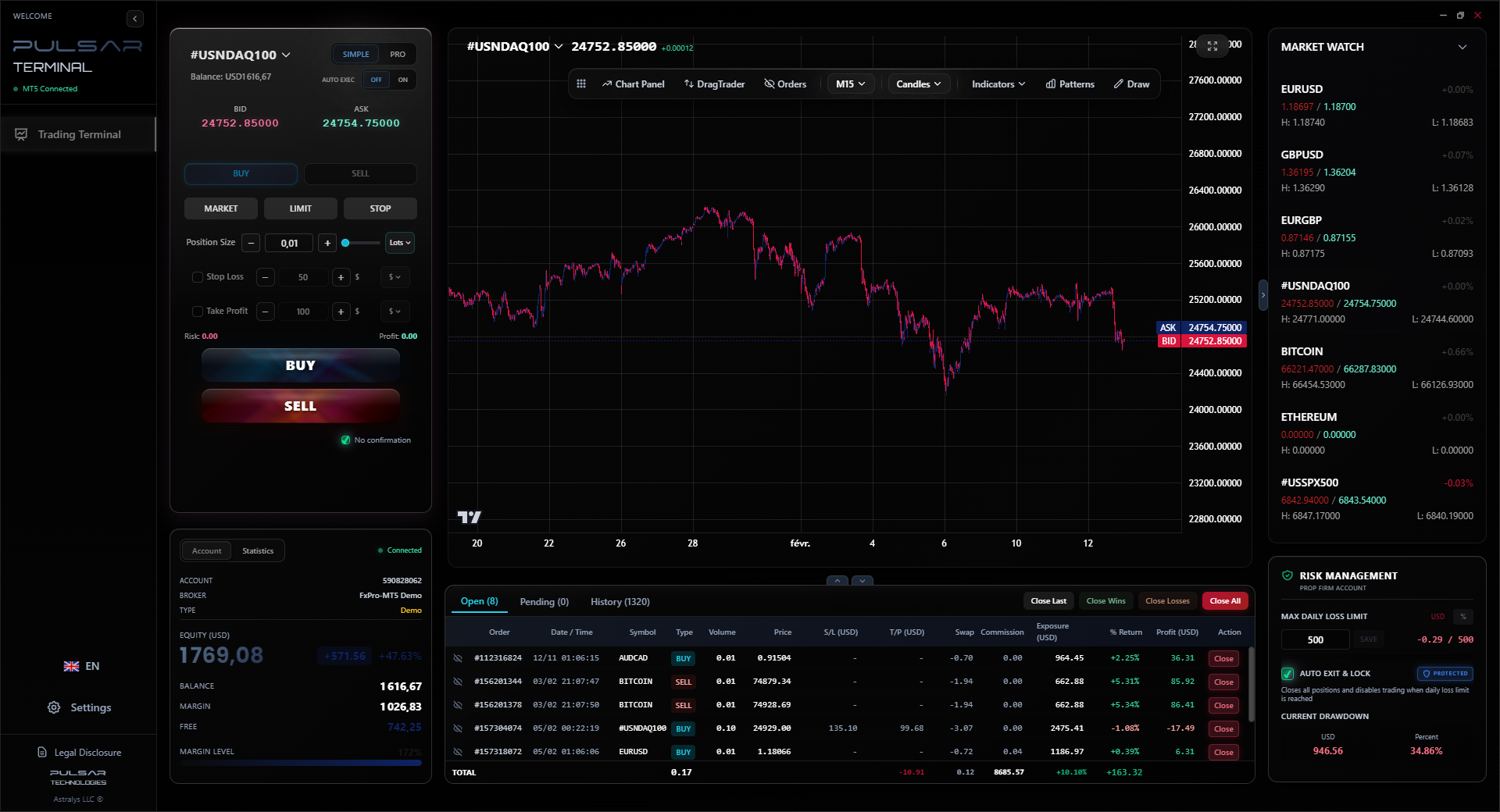
Managing multiple trades and their protective stops manually is stressful and error-prone; a tool like Pulsar Terminal automates this on MT5, letting you set multi-level take-profits and trailing stops with one click.
Pulsar Terminal
Alat MT5 all-in-one: order drag-and-drop, multi-TP/SL, trailing stop, grid trading, Volume Profile, dan perlindungan prop firm. Digunakan 1.000+ trader setiap hari.
Secure trading means being secure from SARS, too. Your trading profits are taxable income. Period. Getting this wrong can unravel all your hard work.
Keep Impeccable Records: Your broker will give you statements. Download them monthly. I keep a simple spreadsheet: Date, Pair, Entry, Exit, P/L in Rands. I also note the ZAR/USD exchange rate on the day of each trade for accurate conversion.
How It's Taxed: It's not capital gains tax for a typical retail trader, it's income tax. Your net profit (total profits minus total losses, minus allowable expenses) gets added to your other income for the year. You can deduct certain expenses like data fees, platform subscription costs (if any), and a portion of home office costs if you trade professionally.
A Painful Lesson: A trading friend didn't keep records in 2019. He had a great year and made about R200k in profit. When tax season came, he had to manually reconstruct a year of trades from fragmented emails and screenshots. It took him 40 hours of panic. He now uses a dedicated software, but even a basic spreadsheet is a million times better than nothing.
Think of your trade log as part of your security system. It's the audit trail that proves what you've done and protects you from future headaches.
💡 Tips Winston
Your trading journal is your black box flight recorder. When your account crashes, it's the only thing that will tell you what really went wrong.
“If it sounds too good to be true in any other part of life, it's definitely too good to be true in forex. Your greatest asset is your skepticism.”
Getting money in and out safely is its own challenge, thanks to our exchange controls.
Funding Your Account: Most brokers accept Visa/Mastercard, bank wire, and sometimes e-wallets like PayPal. Funding in ZAR is best if available - it avoids immediate conversion fees. Brokers like Khwezi Trade specialize in this. For international brokers, you'll likely fund in USD or EUR.
The SARB Allowance: You use your annual R10 million foreign capital allowance to send money offshore to a trading account. Keep your broker's confirmation and your bank's transfer slip as proof of the investment.
The New Withdrawal Hurdle (Post-Oct 2025): This is critical. The SARB now requires banks to check your tax status before sending South African-source income (like trading profits from an international broker) back to you. When you withdraw profits, your bank may ask for a SARS Tax Compliance Status Approval for International Transfer (TCS-AIT PIN). This proves you're tax-compliant.
Plan for This: Don't wait until you need the money. If you have profits offshore, start the process of getting your tax compliance status in order with SARS well before you initiate a large withdrawal. This new rule is a major headache for traders, but it's the reality of secure forex trading in SA now. Being prepared is part of the game.
Security is a checklist. Here’s yours before you place your first real trade.
- Broker: FSCA-regulated (verified on the register). Client funds segregated. Offers MT4/MT5.
- Account Size: Start with money you can afford to lose completely. R5,000-R10,000 is a common, sensible starting point for learning.
- Risk Rule: Written down. "I will never risk more than 1% of my account on a single trade."
- Strategy: Tested on demo for at least 2-3 months. You have clear rules for entry, exit (SL & TP), and what you'll do if the trade goes sideways.
- Tools: You know how to set SL/TP orders. You have a position size calculator bookmarked.
- Record Keeping: Your spreadsheet or journal is set up and ready to go from day one.
- Mindset: You understand that preserving capital is job #1. Making profits is job #2.
Secure forex trading isn't a destination you reach. It's a daily practice. You'll have to choose the secure, boring path over the exciting, risky one a hundred times. But in a game where most people lose, being the careful, disciplined, and secure trader is your biggest edge. Now go build your fortress.
FAQ
Q1Is forex trading legal in South Africa?
Yes, it's completely legal, but only if you trade through a broker that is licensed by the Financial Sector Conduct Authority (FSCA). Trading through unregulated offshore platforms is risky and may violate exchange control laws.
Q2What is the safest broker for a beginner in South Africa?
There's no single 'safest,' but look for a broker with a strong, long-standing FSCA license, a user-friendly platform like MetaTrader, and a local presence. Brokers like AvaTrade (FSP 45984) or Khwezi Trade (a local OTC provider) are good starting points due to their clear regulatory standing and local currency support.
Q3How much money do I need to start trading forex securely?
You can start with as little as R500-R2000 with some brokers. However, for true security and proper risk management, I'd recommend a minimum of R5,000. This allows you to trade sensible position sizes without over-leveraging a tiny account, which is a major cause of early blowouts.
Q4Can I use my R10 million foreign investment allowance for trading?
Yes, you can. Sending funds to a regulated international broker for trading falls under this allowance. You must use an authorized dealer (your bank) and declare it as a foreign investment. Keep all documentation for SARS and for when you repatriate profits.
Q5Do I pay tax on my forex trading profits?
Absolutely. Profits are considered income and are taxable by SARS. You must declare your net profit (profits minus losses and allowable expenses) in your annual tax return. Failure to do so can result in penalties, interest, and audits.
Q6What's more important for security: a good broker or a good strategy?
It's not an either/or. It's a hierarchy. A regulated broker is your foundational security - without it, nothing else is safe. Then, a disciplined strategy with strict risk management (like using a 1% rule and stop-losses) is your personal layer of security. You need both.
Q7Why is my use limited to 30:1 with FSCA brokers?
This is a protective rule, not a restriction. Before 2021, brokers offered 100:1, 200:1, even 500:1. This allowed traders to wipe out accounts with tiny market moves. The 30:1 cap forces you to use more capital, which encourages more thoughtful position sizing and reduces the speed at which you can lose money. It's there to help you.
Pelajaran Prof. Winston
Poin Penting:
- ✓Verify your broker's FSP number on the FSCA register. Every time.
- ✓Never risk more than 1% of your account on a single trade.
- ✓Set your stop-loss immediately, not 'later'.
- ✓Keep a detailed trade log for taxes from day one.
- ✓Plan for SARS' new TCS-AIT PIN requirement before withdrawing profits.
Seberapa bermanfaat artikel ini?
Klik bintang untuk menilai
Wawasan Trading Mingguan
Analisis & strategi mingguan gratis. Tanpa spam.
Tentang Penulis
David van der Merwe
Trader Pasar Berkembang
Trader berbasis Johannesburg dengan 11 tahun di mata uang pasar berkembang. Spesialis pasangan ZAR, trading berregulasi FSCA, dan analisis pasar Afrika Selatan.
Komentar
Peringatan Risiko
Perdagangan instrumen keuangan mengandung risiko signifikan dan mungkin tidak cocok untuk semua investor. Kinerja masa lalu tidak menjamin hasil di masa depan. Konten ini hanya untuk tujuan edukasi dan tidak boleh dianggap sebagai nasihat investasi. Selalu lakukan riset Anda sendiri sebelum trading.
Anda mungkin juga suka

Cara Trading Forex Sukses: 7 Prinsip dari Trader Profesional
Cara trading forex sukses dengan 7 prinsip trader pro: manajemen modal, disiplin, journal trading, backtest. Data nyata, bukan janji profit palsu.
Jam Trading Forex Terbaik untuk Trader Indonesia: Panduan Lengkap dengan Tabel Waktu
Panduan jam trading forex untuk trader Indonesia. Tabel 4 sesi dunia, jam emas 20:00-00:00, sesi mana yang harus dihindari. Data akurat + tips dari trader berpengalaman.
Top 5 Sàn Forex Uy Tín Nhất 2026: Review Jujur dari Trader Indonesia
Top 5 sàn forex uy tín 2026 untuk trader Indonesia. Review jujur: spread, deposit, withdraw, dukungan lokal. Exness, XM, IC Markets & lebih.
Dapatkan Pulsar Terminal
Semua kalkulator ini terintegrasi dalam Pulsar Terminal dengan data real-time dari akun MT5 Anda.
Dapatkan Pulsar Terminal