


Here's a brutal truth most South African traders learn the hard way: trading forex through Standard Bank's official platforms will cost you roughly 2-4.5% right off the bat in exchange rate margins alone.

David van der Merwe
Trader Pasar Berkembang ·  South Africa
☕ 11 mnt baca
Yang akan Anda pelajari:
- 1Standard Bank's Platforms and the Real Trading Hours
- 2The Real Cost Breakdown: Fees That Eat Your Profits
- 3Why Banks Are Terrible for Active Trading (A Mentor's Rant)
- 4The Real South African Forex Market: Hours, Sessions, and Volatility
- 5How to Actually Trade Forex from South Africa: A Practical Path
- 6So When *Should* You Use Standard Bank's Forex Services?
- 7Common Mistakes South African Traders Make (And How to Avoid Them)
Here's a brutal truth most South African traders learn the hard way: trading forex through Standard Bank's official platforms will cost you roughly 2-4.5% right off the bat in exchange rate margins alone. That's not a typo. While their 'Webtrader' platform follows global market hours, the real story isn't about when you can trade, but how much they charge you for the privilege. I've seen too many new traders bleed capital on bank platforms before realizing they're playing a rigged game. Let's break down exactly what Standard Bank offers, the punishing fees, and why you should almost never use your retail bank account for active forex trading.
Standard Bank offers two main avenues for currency exposure: their FX Spot Trading on Webtrader and their 24/7 forex service for corporate clients. For you, the retail trader, it's the Webtrader that's relevant.
Their stated hours are Monday 5:00 AM Sydney time until Friday 5:00 PM New York time. Converting that to SAST, it roughly lines up with the global forex market's 24/5 schedule: opening around 10:00 PM Sunday SAST and closing around midnight Friday SAST. So yes, technically, you can trade during all major sessions - the Asian, European, and US overlaps.
But here's the catch nobody at the branch will tell you: you're not getting direct market access. You're trading against Standard Bank's own quoted prices, which include their massive margin. You're a customer, not a trader. The platform is built for simplicity, not speed or competitive pricing. I tried placing a few test trades on a demo account years ago. The execution was slow, the spreads were horrific, and the charting tools were a joke compared to a dedicated platform like MT5. It's like trying to win a Formula 1 race in a family sedan.

Warning: Don't confuse Standard Bank's '24/7 forex service' with 24/7 trading for you. That service is for managing currency risk in emerging markets, aimed at businesses. As a retail client, you're locked into their specific Webtrader hours and structure.
This is where the dream of bank trading dies. Let's talk numbers, because this is what lost me R2,300 in my early days before I wised up.
The Exchange Rate Margin (The Silent Killer)
Standard Bank adds a margin of 2% to 4.5% on the exchange rate for international payments. For trading, the principle is similar. If the EUR/USD mid-market rate is 1.0850, their quoted rate to you might be adjusted by a similar percentage. On a R10,000 trade, a 3% margin is R300 gone before your trade even moves. In the real forex market with a proper broker, you're dealing with spreads often below 1 pip (0.01%). On that same R10,000 position, a 1-pip spread might cost you R7. Let that sink in.
Commission and Telegraphic Transfer Fees
Want to fund an account? Get ready for this menu of pain (2025/2026 pricing):
- Sending money abroad (SWIFT): 0.5% commission (min R151, max R690) + R108 'telecommunication fee' + that 2-4.5% margin.
- Receiving money: 0.43% (min R153, max R555) + R122 fee.
- Transfer between your own Standard Bank foreign currency accounts: €16, £14, $20, or R161.
I once made a $1,000 profit on a trade and needed to get it back to my ZAR account. Between the conversion margin and fees, nearly $80 vanished. It felt like a penalty for being successful.
Account Minimums and Dormancy Fees
Opening a dedicated Foreign Currency Account (FCA) with Standard Bank isn't for the faint-hearted. The minimum for an Optimum account is around $7,000 (roughly R132,000). They have other products with lower minimums, but you're still playing in their high-fee environment. Some of their investment products also have inactivity fees. Compare that to a broker like IC Markets or Pepperstone, where you can start a live account with R1,500.

Example: Sending R20,000 abroad via Standard Bank SWIFT.
- Commission (0.5%): R100 (meets the R151 minimum, so R151)
- Telecommunication Fee: R108
- Exchange Rate Margin (assuming 3%): R600 Total Estimated Cost: R859 That's 4.3% of your capital gone before it even reaches a trading account.
“Trading forex through Standard Bank will cost you 2-4.5% right off the bat in exchange rate margins alone.”
I need to be blunt. Using Standard Bank, FNB, Absa, or any major retail bank for active forex trading is one of the worst financial decisions you can make as a South African trader. Here’s why.
Banks are not brokers. Their primary business is taking deposits, giving loans, and making money on the spread between what they buy and sell currency for. Their 'trading' platforms are a side service designed to capture client flow and profit from it. They have zero incentive to give you tight spreads or fast execution because you're not their peer; you're their profit center.
Think about it. A real forex broker like Exness or XM makes money primarily from a small commission or a slightly marked-up spread. Their business depends on you trading actively and successfully. They provide tools - advanced charting, indicators like the RSI and MACD, one-click trading - to help you do that. A bank's platform is an afterthought. It's clunky, slow, and offers none of the analytical depth you need for strategies like scalping or swing trading.
Also,, the use is different. Under FSCA rules, retail brokers offer up to 30:1. I don't even know what use Standard Bank offers on Webtrader, because it's buried and probably irrelevant given the other costs. The entire model is misaligned with the needs of a technical trader. You wouldn't use a spade to perform heart surgery. Don't use a bank platform to trade forex.

💡 Tips Winston
Your bank's job is to keep your money safe, not help you gamble it. They make a fortune on clients who confuse currency conversion with currency trading.
Let's reset and talk about how you should be trading. The global forex market operates 24 hours a day from 10:00 PM Sunday SAST to 11:00 PM Friday SAST. Your success depends on knowing which sessions matter for your strategy.
| Session | SAST Hours | Key Characteristics | Best For... |
|---|---|---|---|
| Asian (Tokyo) | 2:00 AM - 11:00 AM | Lower volatility, range-bound moves. JPY pairs active. | Beginners, testing strategies. |
| European (London) | 10:00 AM - 7:00 PM | High liquidity, major trends often start here. EUR, GBP pairs. | Most traders, especially for EUR/USD. |
| US (New York) | 4:00 PM - 11:00 PM | Extreme volatility, overlaps with Europe (2 PM - 11 PM SAST). USD pairs, news reactions. | Experienced traders, news traders. |
The Magic of the Overlap
That European/North American overlap from 2:00 PM to 11:00 PM SAST is your golden window. It's when over 70% of all daily forex volume trades. Spreads are at their tightest, and momentum is real. If you have a day job, this is perfect - you can trade after work. I've made most of my consistent profits during this window, focusing on clean breakouts on the 1-hour chart.
What About the ZAR?
If you want to trade the Rand, like USD/ZAR, liquidity is best during South African business hours (8 AM - 5 PM SAST) and during the London overlap. But be warned, ZAR pairs can be wild and are often influenced by local politics and load-shedding news. I treat them with more caution than majors.

Pro Tip: Don't trade the open or close of the Sunday/Monday session (10 PM-2 AM SAST). Spreads are wide, and price action is often erratic, reacting to weekend gaps. Let the market settle first.
“You're not getting direct market access with a bank. You're trading against their quoted prices, which include their massive profit margin.”
Forget the bank. Here's your step-by-step guide to getting set up properly.
1. Choose a Regulated Broker
You have two good options:
- FSCA-Regulated Local Broker: Your money stays in SA, dealing in ZAR, and you have direct recourse to the FSCA. Good for peace of mind.
- Top-Tier Foreign Broker: Many brokers regulated in Cyprus (CySEC), Australia (ASIC), or the UK (FCA) accept South African clients. They often have better technology and lower costs. Do your due diligence with our broker reviews.
2. Use the Right Platform
Download MetaTrader 5 (MT5) or cTrader. These are the industry standards. They offer professional charting, heaps of indicators, and automated trading. This is where real analysis happens.
3. Fund Your Account Smartly
Use a low-cost method. Many brokers offer local ZAR bank deposits or instant EFTs with little to no fee. Some support digital wallets. The goal is to get your capital to the broker for less than R50, not R850.
4. Start with a Demo, Then a Small Live Account
Practice on a demo for at least two months. Then, start live with an amount you can afford to lose - R1,500 to R5,000 is sensible. Use a position size calculator religiously to manage risk. Your first goal isn't to get rich; it's to not blow up your account. I started with R5,000 and my first ten trades were a nervous, humbling mess. But the cost of those lessons was minimal.
5. Understand the Rules
Remember the FSCA use cap of 30:1 for retail. Know that your profits are taxable income - keep a detailed trade journal. You can use your annual Single Discretionary Allowance (up to R1 million) to fund offshore accounts if needed.
💡 Tips Winston
The most important trading hour is the one you spend reviewing your journal, not the one you spend chasing pips in a thin market.
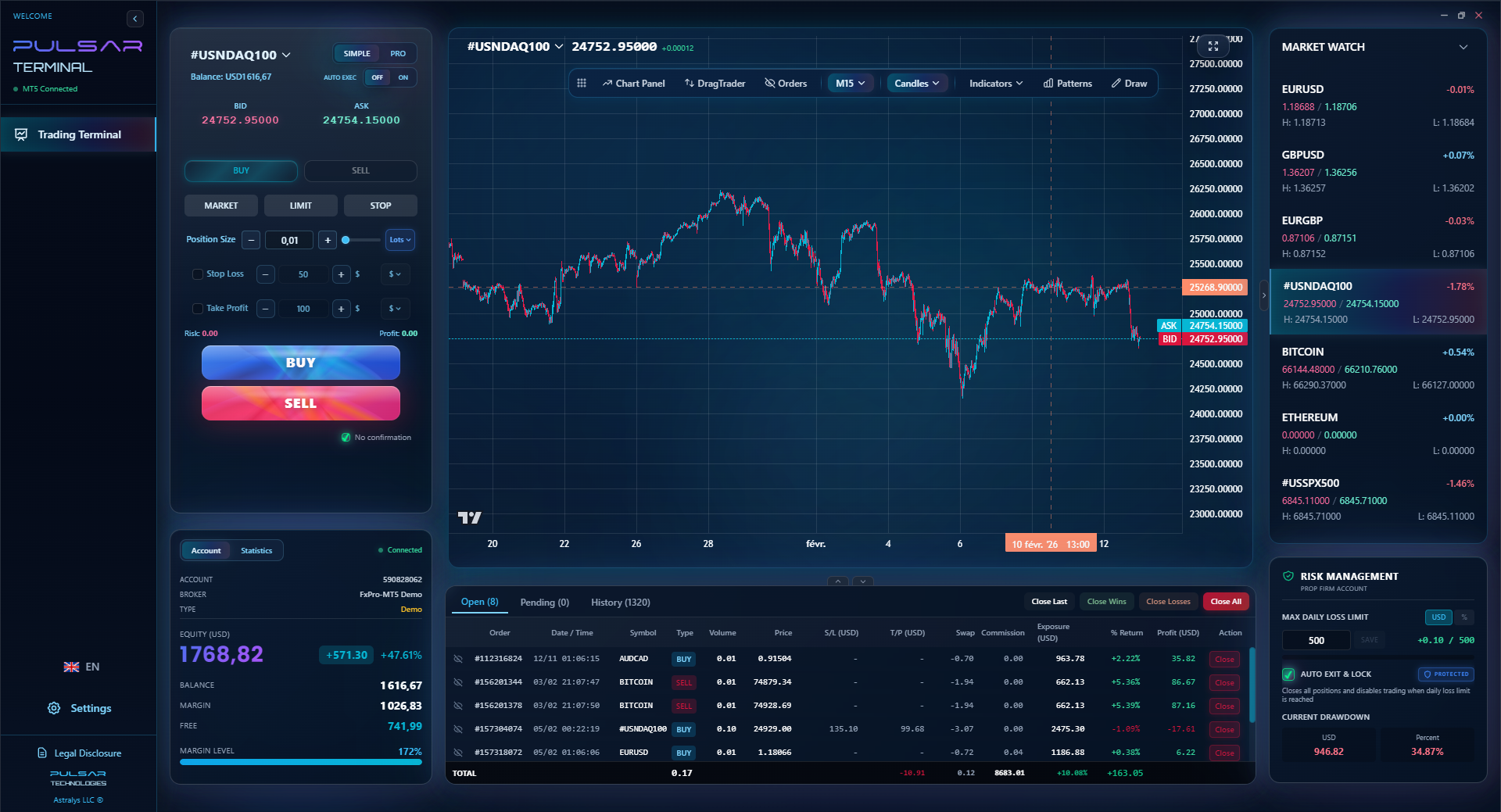
Once you're on a proper platform like MT5, tools like Pulsar Terminal supercharge it with drag-and-drop orders and multi-TP/SL management, turning complex trade plans into simple clicks.
Pulsar Terminal
Alat MT5 all-in-one: order drag-and-drop, multi-TP/SL, trailing stop, grid trading, Volume Profile, dan perlindungan prop firm. Digunakan 1.000+ trader setiap hari.
I'm not saying burn your Standard Bank card. They have a role, just not in active trading.
Use Standard Bank for:
- Converting large lump sums for emigration, property purchases, or international tuition fees. Even with the fees, for a one-time, large transaction, the convenience and security might be worth it.
- Holding foreign currency in a Foreign Currency Account (FCA) if you're a frequent traveler or have regular overseas expenses.
- The Shyft Wallet for small, online international purchases. The 2.5% card top-up fee is high, but it's convenient for subscriptions.
- Business transactions where you need to invoice or pay in USD/EUR/GBP.
Never Use Standard Bank for:
- Executing short-term speculative trades. The costs make it statistically impossible to win long-term.
- Funding your actual trading broker account. Use a cheaper direct transfer method offered by the broker.
- Getting market analysis or trading signals. They don't provide this, and if they did, I wouldn't trust it.
Keep your banking and trading completely separate. Have your salary go into your Standard Bank account. Have your trading capital with a dedicated broker. Never mix the two. It creates clean mental accounting and protects your daily living money from trading risks.
“Keep your banking and trading completely separate. It protects your daily living money from trading risks.”
I've mentored dozens of South African traders. Here are the classic errors I see, tied directly to misunderstandings about platforms and hours.
Mistake 1: Chasing the 24/7 Myth. Just because the market is open doesn't mean you should be trading. The Asian session can be dead for hours. New traders sit staring at the 5-minute chart, forcing trades out of boredom. Fix: Trade only during the high-probability London and New York overlaps. Have a life outside trading.
Mistake 2: Ignoring the True Cost of a Spread. On a bank platform, the spread is a monster. On a broker platform, it's a mosquito. But if you're a scalper taking 10 trades a day, even a 2-pip spread vs. a 0.5-pip spread will destroy your edge. Fix: Choose a broker known for low, raw spreads on the pairs you trade. Factor the spread into every single trade entry and exit calculation.
Mistake 3: Underestimating the Impact of SA Time. Major US news (like Non-Farm Payrolls) hits at 3:30 PM SAST. If you're not prepared, the volatility will shake you out of good positions or stop you out instantly. Fix: Use an economic calendar. If you can't be at your screen for high-impact news, either don't hold positions over the event or use wide stops.
Mistake 4: Using Too Much use. The 30:1 limit is there for a reason. At 30:1, a 3.33% move against you wipes your margin. On a volatile pair, that can happen in minutes. I once got cocky and used full use on a GBP/USD trade. A sudden spike triggered my stop-loss and hit me with a significant loss. It was a stupid, expensive lesson. Fix: Use 10:1 or less, especially when starting. A margin call is a professional embarrassment you can avoid.
FAQ
Q1Can I trade forex 24/7 with Standard Bank?
No. Their retail Webtrader platform operates during global market hours (approx. Sunday 10 PM SAST to Friday 11 PM SAST). Their '24/7 service' is for corporate currency risk management, not for you to trade at 3 AM on Saturday.
Q2What is the minimum amount to start forex trading in South Africa?
With a proper forex broker, you can start a micro account with as little as R70-R150. However, for serious practice with sensible position sizing, I recommend starting with at least R1,500-R5,000 in a live account after thorough demo trading.
Q3Are Standard Bank's forex trading fees tax deductible?
Potentially, yes. If you are trading as a business or with the intention of making a profit, expenses incurred in the production of income (like brokerage fees, platform fees, data costs) may be deductible. However, Standard Bank's high exchange rate margins are tricky to claim. Always consult a SARS-registered tax professional who understands trading.
Q4Is it legal to use international brokers like IC Markets or Pepperstone in South Africa?
Yes, it is legal for South African residents to open accounts with international brokers that accept SA clients. However, for stronger local protection, you may prefer an FSCA-regulated broker. Many top international brokers also hold FSCA licenses.
Q5What is the best time of day to trade forex in South Africa?
The best volatility and liquidity occur during the London and New York session overlap, from 2:00 PM to 11:00 PM SAST. This is when most major trends develop and spreads are tightest, making it ideal for most strategies.
Q6Does Standard Bank offer MetaTrader 4 or 5?
No. Standard Bank's retail offering is its proprietary Webtrader platform. It does not provide access to industry-standard platforms like MT4 or MT5 for speculative forex trading. This is a major limitation for technical analysis.
Q7How do I avoid the high fees when funding an international trading account?
Choose a broker that offers a local ZAR deposit option via a South African partner bank. This allows you to do a low-cost EFT or instant deposit in Rands, which the broker then converts internally at a far better rate than Standard Bank's SWIFT transfer with its 2-4.5% margin.
Pelajaran Prof. Winston
Poin Penting:
- ✓Bank forex fees of 2-4.5% make profitable trading statistically impossible.
- ✓Trade during the 2 PM - 11 PM SAST overlap for real liquidity.
- ✓Use a dedicated broker with MT5, not a bank's proprietary platform.
- ✓Start with a broker offering local ZAR deposits to avoid SWIFT fees.
- ✓use is a tool, not a strategy. Respect the FSCA's 30:1 limit.
Seberapa bermanfaat artikel ini?
Klik bintang untuk menilai
Wawasan Trading Mingguan
Analisis & strategi mingguan gratis. Tanpa spam.
Tentang Penulis
David van der Merwe
Trader Pasar Berkembang
Trader berbasis Johannesburg dengan 11 tahun di mata uang pasar berkembang. Spesialis pasangan ZAR, trading berregulasi FSCA, dan analisis pasar Afrika Selatan.
Komentar
Peringatan Risiko
Perdagangan instrumen keuangan mengandung risiko signifikan dan mungkin tidak cocok untuk semua investor. Kinerja masa lalu tidak menjamin hasil di masa depan. Konten ini hanya untuk tujuan edukasi dan tidak boleh dianggap sebagai nasihat investasi. Selalu lakukan riset Anda sendiri sebelum trading.
Anda mungkin juga suka

Cara Trading Forex Sukses: 7 Prinsip dari Trader Profesional
Cara trading forex sukses dengan 7 prinsip trader pro: manajemen modal, disiplin, journal trading, backtest. Data nyata, bukan janji profit palsu.
Jam Trading Forex Terbaik untuk Trader Indonesia: Panduan Lengkap dengan Tabel Waktu
Panduan jam trading forex untuk trader Indonesia. Tabel 4 sesi dunia, jam emas 20:00-00:00, sesi mana yang harus dihindari. Data akurat + tips dari trader berpengalaman.
Top 5 Sàn Forex Uy Tín Nhất 2026: Review Jujur dari Trader Indonesia
Top 5 sàn forex uy tín 2026 untuk trader Indonesia. Review jujur: spread, deposit, withdraw, dukungan lokal. Exness, XM, IC Markets & lebih.
Dapatkan Pulsar Terminal
Semua kalkulator ini terintegrasi dalam Pulsar Terminal dengan data real-time dari akun MT5 Anda.
Dapatkan Pulsar Terminal