


I lost R8,000 in a single afternoon back in 2015.

David van der Merwe
Trader Pasar Berkembang ·  South Africa
☕ 10 mnt baca
Yang akan Anda pelajari:
- 1Step 1: Get Your Head Right Before You Get Your Hands Dirty
- 2Step 2: Find a Broker You Can Actually Trust
- 3Step 3: Master Your Tools on a Demo Account
- 4Step 4: Find One Simple Strategy and Stick With It
- 5Step 5: Go Live with the Smallest Possible Size
- 6Step 6: Protect Your Capital Like Your Life Depends On It
- 7Step 7: Review, Adapt, and Keep Learning
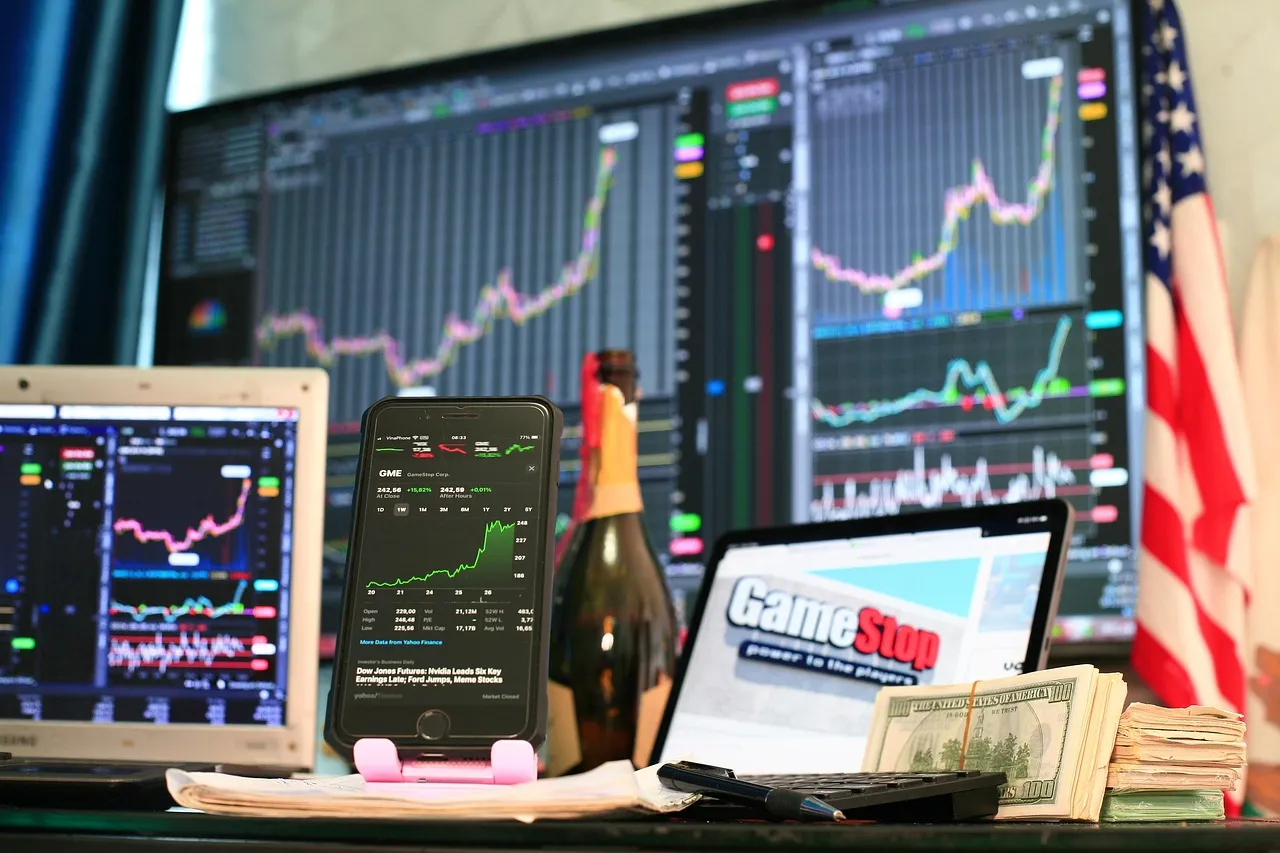
I lost R8,000 in a single afternoon back in 2015. I'd just opened an account with some flashy offshore broker, saw the USD/ZAR moving, and threw money at it with no plan. The spread was huge, my position was too big, and a sudden reversal wiped out a month's salary. That painful lesson taught me that trading isn't gambling - it's a process. If you want to know the real steps on how to trade forex, especially here in SA, you need to start with the right foundation. Let's walk through it together, the way I wish someone had shown me.
Before you even look at a chart, you need to understand what you're getting into. Forex is the market where currencies are traded. You're betting on the value of one currency against another, like the US Dollar versus the South African Rand (USD/ZAR).
It's not a get-rich-quick scheme. I've seen too many guys from Joburg to Cape Town blow their savings because they thought it was easy money. The global stats are brutal: something like 70-85% of retail traders lose money. In SA, with our volatile Rand, that number might not be any prettier.
Your biggest enemy won't be the market. It'll be you. Greed, fear, and impatience. I once held a losing EUR/ZAR trade for two weeks, hoping it would turn around, because I couldn't admit I was wrong. It cost me another 3%. You have to be brutally honest with yourself. Are you disciplined enough to follow a plan when you're down? Can you take a small profit without kicking yourself if it goes higher?

Warning: Don't fund a live account with money you can't afford to lose. Start by pretending that money is already gone. That mental shift changes everything.
This first step on how to trade forex is purely mental. Build the mindset of a risk manager first, a speculator second.

💡 Tips Winston
The market's job is to take your money. Your job is to not give it to them. Risk management isn't a tactic; it's the entire strategy.
This is non-negotiable. You must use a broker regulated by South Africa's Financial Sector Conduct Authority (FSCA). I learned this the hard way with my first loss. That offshore broker? When I tried to withdraw my remaining R2,000, it was a nightmare of delays and hidden fees.
An FSCA license means the broker has to follow local rules. They must segregate your client funds from their company money (so if they go bust, your capital is safer). They also have to offer negative balance protection on retail accounts, meaning you can't lose more than you deposited - a crucial safety net.
What to Look For in a Broker
Don't just go for the one with the slickest ads. Check their FSP number on the FSCA's website. Then, compare these practical points:
| Feature | What to Look For | Why It Matters for You |
|---|---|---|
| Spreads on USD/ZAR | Consistent spreads, not wildly widening during news. | This is your cost of trading. A 50-pip spread vs. a 15-pip spread kills your profit before you start. |
| Minimum Deposit | R500 - R2000 is common for a standard account. | You should start small. Avoid brokers demanding R10,000 upfront. |
| Platform | MT4 or MT5 support. | These are the industry standards. You'll find endless resources, indicators, and community support for them. |
| Local Payments | EFT, SID Instant EFT, FNB Pay. | You want to deposit and withdraw in Rands without crazy conversion fees. |
I've had good, reliable experiences with brokers like IC Markets and Pepperstone for their tight spreads and execution. But always, always verify their FSCA status first.

Pro Tip: Open a demo account with 2-3 different FSCA brokers. Test their platforms, see their spreads on the ZAR pairs you like, and practice executing trades. It's the best way to feel the difference.
“Your biggest enemy won't be the market. It'll be you.”
Now, the fun part. Download MT4 or MT5 from your chosen broker. Your demo account will be loaded with virtual money - usually R100,000 or more. This is your trading simulator. Do not skip this.
For the first month, your only job is to learn the platform. Place buy and sell orders on USD/ZAR. Learn how to set a stop-loss and take-profit. Click every button. Understand what a pip is on your screen. For USD/ZAR, a pip is typically R0.0001, but it's good to know how your platform displays it.
I spent my first demo month just making a mess. I placed trades based on 'gut feeling' and watched them fail. But because it was virtual money, the lesson was free. I learned how to use basic indicators like the RSI indicator and MACD indicator without the panic of real loss.

Example: On a demo, try this: Buy 0.1 lots of EUR/USD at 1.0850. Set a stop-loss at 1.0820 (30 pips risk). Set a take-profit at 1.0900 (50 pips target). Watch what happens. Get comfortable with the process of opening, managing, and closing a planned trade.
This step on how to trade forex is about building muscle memory. When you go live, you shouldn't be fumbling with the software. Your focus needs to be on the market, not on finding the sell button.
Here's where most new traders fail. They jump from YouTube strategy to TikTok tip, never mastering one. You don't need a complicated system. You need a simple, clear rule set that you can follow without hesitation.
Start with one currency pair. For us in SA, USD/ZAR is the obvious choice because you understand the local news that moves it. Your strategy should answer three questions:
- When do I ENTER a trade? (e.g., Price bounces off a key support level AND the RSI is below 30).
- Where do I place my STOP-LOSS? (e.g., 20 pips below the support level).
- Where do I take PROFIT? (e.g., At the next resistance level, giving a risk-to-reward of at least 1:2).
Back in 2018, I decided to only trade GBP/USD during the London open using a simple 1-hour chart breakout strategy. For 3 months on demo, then 3 months with tiny live sizes, I only did that. It was boring. But it worked because I became an expert in that one specific setup.
Test your strategy on your demo account for at least 100 trades. Keep a journal. Write down the entry, exit, reason, and how you felt. Was it a scalping strategy (quick in and out) or more like swing trading (holding for days)? The data doesn't lie. If after 100 trades you're not consistently profitable on demo, the strategy is flawed, or your discipline is.
Your strategy must include a position size calculator. Never wing it. If your account is R10,000, risking 1% per trade means you can only lose R100. Your stop-loss distance determines your lot size. This is the core of survival.
💡 Tips Winston
A demo account tells you if your strategy works. A live account tells you if *you* work. The difference is you.
“Your goal for the first 6 months of live trading is not to make money. Your goal is to not lose your initial capital.”
You've done the demo work. Your strategy shows promise. Now it's time for the real test. Fund your live account with an amount that, if lost, would annoy you but not ruin you. For most starters, that's between R5,000 and R10,000.
Here's the critical rule: Trade micro lots.
On MT4/MT5, a micro lot is 0.01. With USD/ZAR at around R18.50, a 1-pip move on a 0.01 lot is worth about R0.18. Yes, eighteen cents. That's where you start.
Your goal for the first 6 months of live trading is not to make money. Your goal is to not lose your initial capital. You are testing your psychology and your strategy under real pressure. That R100 you're risking per trade will feel like R10,000 when it's your own money.
I funded my first disciplined account with R7,000. My first 10 live trades were all 0.01 lots. I was sweating over R20 profits. But it taught me to respect the market. Gradually, as my confidence and consistency grew, I scaled up to 0.02, then 0.05 lots. This patience is what separates those who last from those who blow up.
Manage your use wisely. Just because your FSCA-regulated broker offers 1:500 doesn't mean you should use it. On a R10,000 account trading 0.01 lots, you're using minimal use anyway. High use is a shortcut to a margin call.
Risk management isn't one step, it's the entire game. All those steps on how to trade forex lead here. You can have a mediocre strategy but excellent risk management and survive. The reverse is never true.
Your non-negotiable rules:
- Risk Per Trade: Never risk more than 1-2% of your account on a single trade. Use a position size calculator for every entry.
- Stop-Loss Every Time: Every. Single. Trade. If you don't know where you're wrong, you have no business being in the market. A stop-loss is your life jacket.
- Daily/Weekly Loss Limit: Set a hard limit. For me, it's 5% of my account in a day. If I hit that, I shut down the platform and walk away. This prevents a bad day from becoming a catastrophic month.
Your trading journal is your most important tool. Mine is a simple spreadsheet. For every trade, I record:
- Pair (e.g., USD/ZAR)
- Entry/Exit Price
- Lot Size
- Stop-Loss and Take-Profit levels
- P&L in Rands
- Screenshot of the chart
- Reason for the trade (This is the golden column. Was it according to your plan? Or was it an emotional 'revenge' trade?)
- Emotion/Mistakes
Reviewing this weekly showed me my fatal flaw: I was great at finding entries, but I'd move my stop-loss further away when a trade went against me, turning a small R100 loss into a R400 loss. The journal exposed that cowardice. I had to fix it.
💡 Tips Winston
Your trading journal is a mirror. If you're afraid to look at it, you're afraid to see the trader you really are.

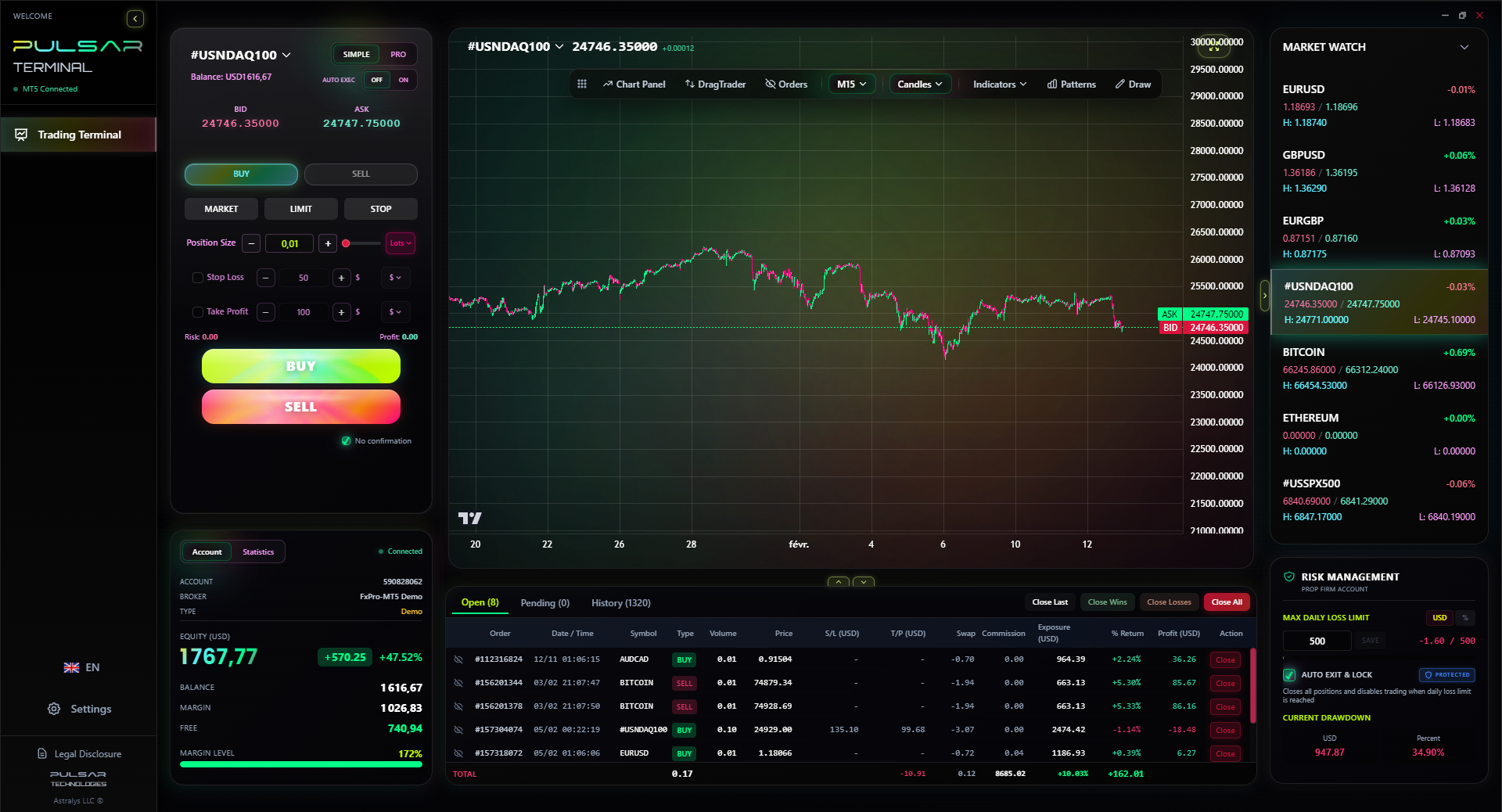
Once your strategy is solid, managing multiple trades and complex risk rules like trailing stops and breakeven levels manually can be a distraction; a tool like Pulsar Terminal automates these executions directly on your MT5 platform.
Pulsar Terminal
Alat MT5 all-in-one: order drag-and-drop, multi-TP/SL, trailing stop, grid trading, Volume Profile, dan perlindungan prop firm. Digunakan 1.000+ trader setiap hari.
“You can have a mediocre strategy but excellent risk management and survive. The reverse is never true.”
Trading is not a destination; it's a skill you constantly refine. The market changes. The USD/ZAR reacts differently to SARB announcements in a high-inflation environment versus a stable one.
Every weekend, I block out an hour to review my journal. I look for patterns:
- Am I consistently losing on a certain type of setup? Maybe stop trading that one.
- Am I closing profitable trades too early out of fear? Maybe I need to adjust my take-profit method or use a trailing stop.
This is where advanced tools can help, but only after you've mastered the basics. Once you're comfortable with manual trading, you might explore tools that help automate parts of your risk management, like setting multiple take-profit levels or moving your stop to breakeven automatically.
Keep learning about macroeconomics. Why did the Rand weaken today? Was it a SARB interest rate decision, political news, or global risk-off sentiment? Understanding the 'why' behind a move in your XAU/USD guide or EUR/USD guide pairs will make you a more informed trader, not just a chart reader.
Finally, connect with other serious traders. Find a community (not a signal-selling group) where you can discuss ideas and share journal reviews. Sometimes, another perspective can spot a blind spot you've missed for months.
FAQ
Q1What is the minimum amount I need to start trading forex in South Africa?
You can technically start with as little as R500 with some brokers, but I strongly advise starting with at least R5,000-R10,000. This isn't for trading big, it's for survival. A smaller account forces you to use excessive use or makes fees eat a huge percentage. With R10,000, risking 1% (R100) per trade allows you to trade micro lots (0.01) comfortably and withstand a string of losses without blowing up.
Q2Is forex trading taxable in South Africa?
Yes. SARS views forex trading profits as income if you're trading frequently (seen as a revenue-generating activity). Your profits are added to your other income and taxed at your marginal rate. Keep careful records of all your trades, deposits, and withdrawals. It's your responsibility to declare this income. I learned this the hard way and had to go back through a year of statements - it was a nightmare.
Q3Which currency pairs should a South African beginner trade?
Start with one major pair that doesn't involve the Rand, like EUR/USD. It has high liquidity, tight spreads, and tons of analysis available. This lets you focus on learning the craft without the extra volatility of the ZAR. Once you're consistent, then consider ZAR pairs like USD/ZAR. You'll understand the local drivers, but be warned, the spreads are wider and moves can be sharp.
Q4How many hours a day do I need to trade forex?
You don't need to sit screens all day. In fact, that often leads to overtrading. With a good swing trading strategy, you might only need 30-60 minutes at the end of the London or US session to analyze charts and set orders for the next day. When I started, I was glued to the screen for 8 hours and made terrible, impulsive decisions. Now, I often spend less than an hour actively managing trades.
Q5Can I trade forex with a full-time job in South Africa?
Absolutely. Most successful retail traders I know have day jobs. It forces discipline. You can't watch every tick, so you plan your trades in the evening or early morning. Use pending orders (buy limit, sell stop) to enter the market automatically when your price is hit. This is the essence of swing trading. Your job provides financial stability, which is the best psychological asset a trader can have.
Q6What's the biggest mistake new South African traders make?
Two things, tied for first: 1) Using way too much use because the broker offers it, turning a small move against them into a devastating loss. 2) Trading USD/ZAR or other ZAR pairs without accounting for the massive spread. They'll see a 50-pip move, jump in, but forget the 15-pip spread means the price needs to move 15 pips just for them to break even. They're starting the race 15 meters behind.
Pelajaran Prof. Winston
Poin Penting:
- ✓Trade only with FSCA-regulated brokers. Verify the FSP number.
- ✓Risk a maximum of 1-2% of your capital on any single trade.
- ✓Test any strategy for 100+ trades on demo before going live.
- ✓Start live trading with micro lots (0.01) to manage psychology.
- ✓Keep a detailed journal for every trade, including your emotion.
Seberapa bermanfaat artikel ini?
Klik bintang untuk menilai
Wawasan Trading Mingguan
Analisis & strategi mingguan gratis. Tanpa spam.
Tentang Penulis
David van der Merwe
Trader Pasar Berkembang
Trader berbasis Johannesburg dengan 11 tahun di mata uang pasar berkembang. Spesialis pasangan ZAR, trading berregulasi FSCA, dan analisis pasar Afrika Selatan.
Komentar
Peringatan Risiko
Perdagangan instrumen keuangan mengandung risiko signifikan dan mungkin tidak cocok untuk semua investor. Kinerja masa lalu tidak menjamin hasil di masa depan. Konten ini hanya untuk tujuan edukasi dan tidak boleh dianggap sebagai nasihat investasi. Selalu lakukan riset Anda sendiri sebelum trading.
Anda mungkin juga suka

Cara Trading Forex Sukses: 7 Prinsip dari Trader Profesional
Cara trading forex sukses dengan 7 prinsip trader pro: manajemen modal, disiplin, journal trading, backtest. Data nyata, bukan janji profit palsu.
Jam Trading Forex Terbaik untuk Trader Indonesia: Panduan Lengkap dengan Tabel Waktu
Panduan jam trading forex untuk trader Indonesia. Tabel 4 sesi dunia, jam emas 20:00-00:00, sesi mana yang harus dihindari. Data akurat + tips dari trader berpengalaman.
Top 5 Sàn Forex Uy Tín Nhất 2026: Review Jujur dari Trader Indonesia
Top 5 sàn forex uy tín 2026 untuk trader Indonesia. Review jujur: spread, deposit, withdraw, dukungan lokal. Exness, XM, IC Markets & lebih.
Dapatkan Pulsar Terminal
Semua kalkulator ini terintegrasi dalam Pulsar Terminal dengan data real-time dari akun MT5 Anda.
Dapatkan Pulsar Terminal