


You're probably asking yourself: should I be a scalper or a swing trader? The internet is full of gurus pushing one as the 'secret' to riches.

James Mitchell
Analis Trading Senior
☕ 13 mnt baca
Yang akan Anda pelajari:
You're probably asking yourself: should I be a scalper or a swing trader? The internet is full of gurus pushing one as the 'secret' to riches. I've done both for over a decade, and I'm here to give you the unvarnished truth. This isn't about which is better in theory. It's about which one you're statistically more likely to survive doing, given your account size, psychology, and the very real regulatory walls you'll hit in the US market.
Let's strip away the marketing fluff. These aren't just different timeframes; they're completely different lifestyles with their own rulebooks.
Swing trading is about catching the 'meat' of a price move over several days to weeks. You're not trying to pick tops and bottoms perfectly. You're identifying a trend or a range, getting in, and riding the wave until momentum shows signs of exhaustion. Your charts are usually 1-hour, 4-hour, or daily. You might check your positions a few times a day. The goal is fewer, higher-probability trades with wider profit targets. Think of it as a sniper.
Scalping is a completely different beast. You're in and out of the market in seconds to minutes, sometimes hundreds of times a day. You're hunting for tiny, consistent profits - often just a few pips or cents. Your world is the 1-minute or 5-minute chart, order flow, and the bid/ask spread. This is a volume game. Success isn't about huge wins; it's about winning more often than you lose and keeping losses microscopic. Think of it as a machine gunner.
The first, most critical filter isn't skill. It's the Pattern Day Trader (PDT) rule. If you're in the US and trading stocks or options in a margin account, this is the law. It says if you make four or more day trades in a five-business-day period, you're labeled a pattern day trader. That comes with a $25,000 minimum account balance requirement. No ifs, ands, or buts. Blow below that, and you're locked out of day trading for 90 days. This single rule makes traditional stock scalping a non-starter for most beginners. It's why many US scalpers focus on forex or futures, where the PDT rule doesn't apply.

Warning: Don't even think about trying to scalp stocks with a $2,000 account. The PDT rule will shut you down faster than you can say 'margin call.' Your broker isn't kidding around.
“Your first piece of analysis for any strategy should be: 'Is this even legal and practical for my account size in the USA?'”
This is where most people choose wrong. They pick a strategy based on potential profits, not personality fit. And it destroys them.
The Swing Trader's Mind
Swing trading requires immense patience. You'll place a trade and then watch it go against you for a day or two before it turns profitable. This is normal. You need the stomach to hold through drawdowns. The mental challenge is FOMO (fear of missing out). You'll see other stocks or currencies ripping higher while your position is dormant. You'll be tempted to jump ship. The lifestyle is more relaxed. You can have a normal job. You don't need to be glued to the screen from market open to close. The stress comes in bursts - usually around your planned exit times.
I learned this the hard way. In 2018, I had a perfect setup in Amazon (AMZN). I bought at $1,450, aiming for a swing to $1,600. Two days later, it dipped to $1,420. I got spooked by the red number and sold for a $30 loss. I then watched it rally to $1,620 over the next three weeks. I broke my own rules because I couldn't handle the short-term discomfort. That missed $150-per-share move still stings.
The Scalper's Mind
Scalping is a sprint. It demands hyper-focus, lightning-fast decisions, and emotional detachment. There's no room for hesitation or revenge trading. A single large loss can wipe out 50 small wins. The mental challenge is exhaustion and discipline decay. After your 50th trade of the day, will you still be carefully checking your position size calculator and respecting your stop? Most people won't.
The lifestyle is intense. You are tied to the screen during high-volume periods. You can't just walk away for an hour. It's mentally draining in a way swing trading isn't. But for the right person, it provides immediate feedback and constant action, which can be addictive (in both good and bad ways).

Pro Tip: Honestly ask yourself: Are you patient or impulsive? Do you like analysis or action? Your answer points directly to which style you're wired for. Forcing a square peg into a round hole is the fastest route to blowing up.

💡 Tips Winston
If you find yourself constantly checking a swing trade every 15 minutes, you've sized too large. The position should be small enough that you can forget about it for a few hours.
“Swing trading teaches you core skills without the psychological torture and cost bleed of scalping.”
Let's cut through the hype with data. These aren't promises; these are the statistical realities observed across millions of trades.
Swing Trading Metrics:
- Profit Target per Trade: 5-10% is a common, realistic goal for a good swing.
- Monthly/Annual Return: A consistently profitable swing trader might aim for 1-2% growth per month. That compounds to 12-24% annually, which is phenomenal. Anyone promising you more is selling a dream.
- Success Rate: It's brutal. Only about 10% of swing traders are consistently profitable over a year. The 90% fail because of poor risk management, not bad analysis.
Scalping Metrics:
- Profit Target per Trade: Tiny. We're talking 0.05% to 0.2%. In forex, that's 5 to 10 pips.
- Trade Frequency: This is the engine. Successful scalpers might execute 50 to 200+ trades in a single day.
- Success Rate: Surprisingly, the stats can be slightly better for disciplined scalpers. A 2025 survey found 34% of retail scalpers were consistently profitable over a year, with 28% breaking even. But note: 'consistent' here means grinding out tiny gains daily, not getting rich quick.
The biggest scalping killer? Costs. Let's do some math.
If you're scalping the E-mini S&P 500 futures (ES):
- Round-trip commission: ~$2.50
- Your profit target: 2 points ($100)
- Fees eat 2.5% of your profit immediately. Now imagine you're aiming for just 1 point ($50). Fees just jumped to 5%. Have a bit of slippage on entry or exit? There goes another $25. Suddenly, a winning trade feels mediocre, and a losing trade is a deep cut.
For forex scalpers, the spread is the enemy. If you're trading a pair with a 1.1 pip spread and aiming for a 5 pip profit, the market needs to move 6.1 pips in your favor just for you to break even. That's a 22% headwind before you even start. This is why scalpers obsess over brokers with raw spreads, like IC Markets or Pepperstone on their ECN accounts.
| Aspect | Swing Trading | Scalping |
|---|---|---|
| Holding Time | Days to Weeks | Seconds to Minutes |
| Trades Per Day | 0 - 2 | 50 - 200+ |
| Key Mental Trait | Patience | Discipline & Speed |
| Biggest Cost | Overnight Swap Fees | Commissions & Spreads |
| Main US Hurdle | Wash Sale Rule (taxes) | PDT Rule ($25k min) |
My own ledger shows this. In 2021, I dedicated a $10k sub-account to pure forex scalping on the EUR/USD. After 3 months and 1,842 trades, my net profit was $387. My total commissions and spreads paid? $2,911. I was right directionally more than 55% of the time, but the costs absolutely gutted my edge. I was working for the broker.
“Swing trading teaches you core skills without the psychological torture and cost bleed of scalping.”
The tools and entry techniques are worlds apart.
Swing Trading Setup
Your analysis is broader. You're looking at higher timeframes for trend direction, then drilling down to a 4-hour or 1-hour chart for a precise entry. Fundamental news matters (earnings reports, Fed meetings). You might use the MACD indicator on a daily chart to confirm trend momentum, or the RSI indicator to spot potential reversals from overbought/oversold conditions.
Your trade plan is critical:
- Entry: 'Buy if price pulls back to this support level and shows a bullish reversal candle.'
- Stop Loss: Placed logically beyond the support zone. You're risking 1-2% of your account.
- Take Profit: Set at the next major resistance level, giving you a risk-to-reward ratio of at least 1:2 or 1:3.
You set the orders and walk away. The work is in the analysis beforehand, not the execution.
Scalping Setup
Your screen is cluttered with noise you must ignore. You need a direct market access (DMA) broker for the fastest execution. Every millisecond counts. You're watching:
- Level 2 order book (for stocks/futures) or depth of market (for forex).
- Time & sales tape.
- A very fast chart, often with volume profile.
Your edge comes from understanding short-term supply and demand. You might buy when you see a large absorption of sell orders at a key price, expecting a bounce. Your stop loss is tiny - often just a few ticks away. Your profit target is equally small. You're playing a numbers game with a high win rate.
Execution is everything. You can't use a market order; the slippage will kill you. You're using limit orders to get in and out. This requires a platform that won't lag. This is where a dedicated tool for fast execution, like attaching a hotkey to a specific order size in your platform, becomes non-negotiable.

Example: A classic scalping entry on XAU/USD (Gold). Price is consolidating between $2340.50 and $2341.00. You see a cluster of buy orders stacking at $2340.60. You place a buy limit at $2340.65. Your stop is at $2340.40 (2.5 ticks). Your target is $2341.15 (5 ticks). You're risking $25 to make $50, and you're out in under a minute if it doesn't work.
💡 Tips Winston
For scalpers, your daily P&L is a vanity metric. Focus on your win rate and average win vs. average loss. A 60% win rate with a 1:0.8 reward-risk ratio is a losing strategy.
“A single large loss can wipe out 50 small wins. That's the scalper's eternal equation.”
If you're trading in the US, the government and your broker have rules that don't care about your brilliant strategy. Ignoring them will end your career.
The PDT Rule (Again, because it's that important): This is for margin accounts trading stocks or options. Four day trades in five days = Pattern Day Trader flag. You now need $25,000 in your account. Not $24,999. This pushes most aspiring stock scalpers into forex or futures, or forces them to use a cash account (which has its own settlement delays).
The Wash Sale Rule: A brutal tax regulation that swing traders must understand. It disallows claiming a tax loss if you buy a 'substantially identical' security within 30 days before or after the sale. Example: You sell Apple (AAPL) for a $1,000 loss on December 15th to claim the loss on your taxes. If you buy AAPL again on January 10th (within 30 days), the $1,000 loss is disallowed. It's added to the cost basis of your new purchase. This rule is designed to prevent you from gaming your taxes, but it's a nightmare for active traders who re-enter similar positions. You need serious tax software or an accountant.
use Limits: US regulators cap use for retail forex traders at 50:1 on major pairs (and lower on minors). For day trading stocks, it's 4:1 intraday. This is actually a good thing - it protects you from yourself. But it means you can't replicate the insane 500:1 use some offshore brokers offer, which is a blessing in disguise. That level of use is a one-way ticket to a margin call.
The takeaway? Your first piece of analysis for any strategy should be: 'Is this even legal and practical for my account size in the USA?'
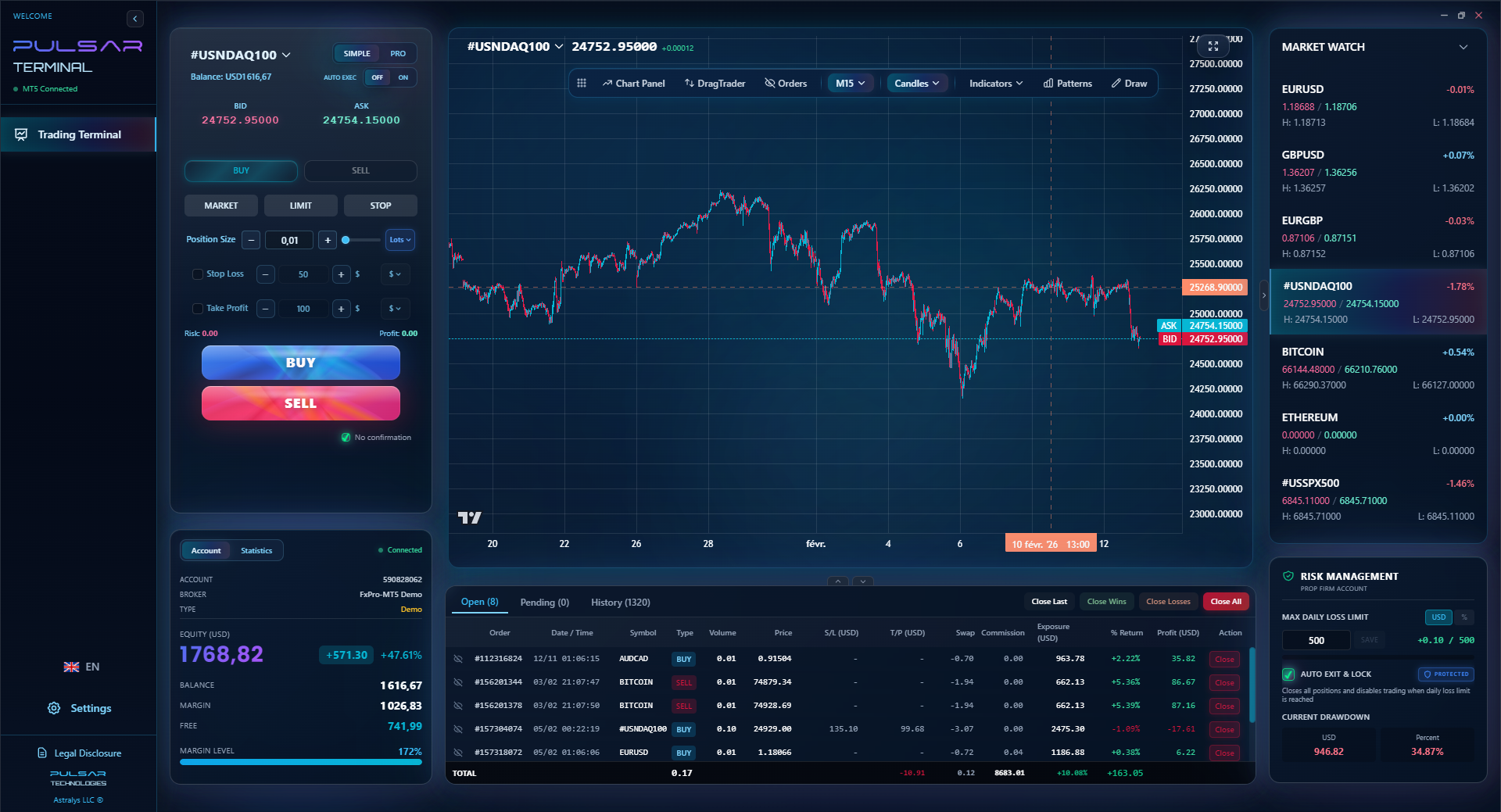
Managing multiple take-profit levels and a trailing stop on a fast-moving scalp is nearly impossible manually, which is where automation tools like Pulsar Terminal become essential.
Pulsar Terminal
Alat MT5 all-in-one: order drag-and-drop, multi-TP/SL, trailing stop, grid trading, Volume Profile, dan perlindungan prop firm. Digunakan 1.000+ trader setiap hari.
“A single large loss can wipe out 50 small wins. That's the scalper's eternal equation.”
Stop looking for the 'best' strategy. Look for the one that fits you. Answer these questions honestly.
Choose SWING TRADING if:
- Your trading account is under $25,000 and you want to trade US stocks.
- You have a full-time job and can't watch the markets all day.
- You are patient and analytical, not impulsive.
- You're comfortable being wrong for a few days to be right over a week.
- You want fewer transactions, which simplifies tracking for taxes.
Choose SCALPING if:
- You have at least $25,000 for a stock margin account, OR you're willing to trade forex/futures to avoid the PDT rule.
- You can dedicate focused, uninterrupted blocks of time (like the first 2 hours of the NY session).
- You have ice-water in your veins. No revenge trading, no hesitation.
- You are detail-oriented and obsessed with process and execution speed.
- You understand that technology (fast internet, a good PC, a reliable broker like Exness for forex or XM for metals) is part of your edge.
Here's my final, blunt advice: Start with swing trading. It's more forgiving. It teaches you core skills - trend analysis, risk management, patience - without the psychological torture and cost bleed of scalping. You can always transition to shorter timeframes later. Most who try scalping first blow up and quit before they ever learn how to read a daily chart.
Consider a hybrid approach. Use a core swing trading position for the main trend, and use a small portion of your capital for tactical scalping on pullbacks within that trend. This gives you the action without betting the farm.
💡 Tips Winston
The Wash Sale Rule isn't just for December. A loss in July that you 'wash' by re-entering in August pushes the tax benefit into the future. It complicates your bookkeeping year-round.
“The market doesn't care how smart you are. It only cares if you have enough money left to place the next trade.”
You've picked a path. Here's how not to screw it up in the first month.
For the New Swing Trader:
- Paper trade for a full market cycle. Don't just paper trade a bull market. See how your strategy holds up in a pullback or consolidation.
- Size tiny. Your first real trades should be 1/10th of your normal planned position size. You need to feel the emotion of real money without catastrophic risk.
- Journal relentlessly. For every trade, note: Why did I enter? What was my plan? Did I follow it? What did I feel when price went against me? This is more valuable than any indicator.
- The Pitfall: Adding to a losing position to 'average down.' This isn't investing; it's doubling down on a mistake. Your first loss is your best loss.
For the New Scalper:
- Master one setup on one instrument. Don't jump from the ES to gold to EUR/JPY. Pick the Nasdaq (NQ) or EUR/USD and learn its personality.
- Calculate your cost of doing business. Know your exact commission and average spread. If your average profit target is $50 and your costs are $5, you have a 10% hurdle. You need a win rate above 55% just to break even, before considering losses.
- Set a hard daily loss limit. And a hard daily trade limit. When you hit either, you're done. No 'one more trade' to get back.
- The Pitfall: Letting a small loss turn into a disaster because you didn't use a hard stop. Scalping without a stop is like driving blindfolded. You will crash.
Regardless of your choice, the common denominator for failure is ego and poor risk management. The market doesn't care how smart you are. It only cares if you have enough money left in your account to place the next trade.
FAQ
Q1Can I start scalping with $500 in the US?
Not with US stocks or options, due to the PDT rule's $25,000 minimum for pattern day traders. You could theoretically scalp forex or futures with $500, but it's extremely risky. Your position size would be so small that commissions/spreads would eat a huge percentage of any profit, and a single bad trade could wipe out a week's gains. It's an uphill battle not worth fighting.
Q2Which is more profitable, swing trading or scalping?
There's no universal answer. Profitability is about your skill edge and consistency, not the style. A top 1% scalper can out-earn an average swing trader, and vice-versa. However, swing trading often has a better profit-to-cost ratio (lower fees eating your gains) and is more accessible for those with smaller accounts and less time, which for most people makes it the more realistically profitable path.
Q3Do I need different brokers for swing trading vs. scalping?
Yes, your priorities differ. Scalpers need the absolute lowest spreads, fastest execution, and stable platforms (like cTrader or MT5 with a good VPS). Brokers like IC Markets or Pepperstone are built for this. Swing traders need reliable charting, good swap rates for overnight holds, and strong research tools. Many US-focused brokers like Thinkorswim or Interactive Brokers excel here. Some, like Interactive Brokers, do both well.
Q4How many hours a day does each style require?
Swing trading requires 1-2 hours of analysis a day, often done in the evening or before the open. You check in a few times to manage positions. Scalping requires intense focus for the entire session you're trading - 2 to 6 hours of uninterrupted screen time. You cannot step away. The time commitment is the biggest lifestyle differentiator.
Q5Is technical analysis different for each style?
Fundamentally, yes. Swing traders use higher timeframe indicators (daily MACD, weekly support) and care about trend structure. Scalpers focus on micro-structure: order flow, immediate supply/demand zones on the 1-min chart, and momentum indicators on very short settings. A pattern on a 4-hour chart is meaningless to a scalper.
Q6What's the biggest mistake beginners make in each?
Swing Traders: They move their stop loss further away when the trade goes against them, turning a small, planned loss into a catastrophic one. Scalpers: They remove their stop loss because 'it's just a few ticks, it'll come back.' It rarely does, and that's how you lose 10% of your account in 30 seconds.
Pelajaran Prof. Winston
Poin Penting:
- ✓The PDT rule makes US stock scalping a $25k+ game.
- ✓Costs consume 2-7% of a scalper's gross profits.
- ✓Only ~10% of swing traders are profitable yearly.
- ✓Patience fits swing trading; discipline fits scalping.
Seberapa bermanfaat artikel ini?
Klik bintang untuk menilai
Wawasan Trading Mingguan
Analisis & strategi mingguan gratis. Tanpa spam.
Tentang Penulis
James Mitchell
Analis Trading Senior
Berbasis di New York dengan lebih dari 9 tahun pengalaman trading. Fokus pada pasangan USD utama, tantangan prop firm, dan lanskap regulasi AS.
Komentar
Peringatan Risiko
Perdagangan instrumen keuangan mengandung risiko signifikan dan mungkin tidak cocok untuk semua investor. Kinerja masa lalu tidak menjamin hasil di masa depan. Konten ini hanya untuk tujuan edukasi dan tidak boleh dianggap sebagai nasihat investasi. Selalu lakukan riset Anda sendiri sebelum trading.
Anda mungkin juga suka

Cara Trading Forex Sukses: 7 Prinsip dari Trader Profesional
Cara trading forex sukses dengan 7 prinsip trader pro: manajemen modal, disiplin, journal trading, backtest. Data nyata, bukan janji profit palsu.
Jam Trading Forex Terbaik untuk Trader Indonesia: Panduan Lengkap dengan Tabel Waktu
Panduan jam trading forex untuk trader Indonesia. Tabel 4 sesi dunia, jam emas 20:00-00:00, sesi mana yang harus dihindari. Data akurat + tips dari trader berpengalaman.
Top 5 Sàn Forex Uy Tín Nhất 2026: Review Jujur dari Trader Indonesia
Top 5 sàn forex uy tín 2026 untuk trader Indonesia. Review jujur: spread, deposit, withdraw, dukungan lokal. Exness, XM, IC Markets & lebih.
Dapatkan Pulsar Terminal
Semua kalkulator ini terintegrasi dalam Pulsar Terminal dengan data real-time dari akun MT5 Anda.
Dapatkan Pulsar Terminal