


Here's a hard truth most new traders in Lagos or Abuja don't want to hear: over 75% of retail traders lose money, and a big part of that is picking the wrong currency pairs.

Olumide Adeyemi
Pelopor Trading Afrika Barat ·  Nigeria
☕ 9 mnt baca
Yang akan Anda pelajari:
Here's a hard truth most new traders in Lagos or Abuja don't want to hear: over 75% of retail traders lose money, and a big part of that is picking the wrong currency pairs. They chase exotic combos with wild swings, ignoring the steady workhorses that actually make consistent profits. I've been there, blowing up an account trading USD/ZAR because it 'moved more.' This guide isn't about flashy moves; it's about identifying the best forex pairs to trade for long-term survival and growth, specifically for our unique Nigerian context.
Think of it like this: you wouldn't use a Formula 1 car to navigate the potholes on Ojuelegba Road. You need the right vehicle for the terrain. In forex, the currency pair is your vehicle. Picking the wrong one means you're fighting against invisible costs and unpredictable liquidity from the start.
For us in Nigeria, there are three extra layers. First, the Naira's own volatility can indirectly affect how other pairs behave for you psychologically. Second, your broker's spreads on certain pairs can be wider here due to local payment processing. Third, your internet stability matters. You don't want to be scalping a fast-moving pair when your connection in Ikeja decides to take a five-minute break.
I learned this the expensive way. Early on, I was trading GBP/JPY because the daily ranges looked juicy. What I ignored was the spread, which was often 5-7 pips. I'd be down $70 on a standard lot before the trade even had a chance to breathe. That's a huge hill to climb every single time. Compare that to EUR/USD, where the spread on a good broker like IC Markets can be under 0.5 pips. The difference in your starting position is night and day.

Warning: A wide spread isn't just a cost; it's a headwind. On a short-term trade, it can completely invalidate your strategy before the market even moves.
These are the backbone. If you're starting out, you should live here for at least your first year. The 'Majors' all involve the US Dollar (USD) and are the most traded pairs in the world. That means tight spreads, massive liquidity (so your orders get filled fast at the price you want), and tons of free analysis available.
EUR/USD (The Euro vs. US Dollar): This is your best friend. It's the most traded pair globally. The spreads are razor-thin, often below 1 pip on standard accounts. The movement is generally smooth and predictable, following clear technical levels and major economic news from the US Federal Reserve and the European Central Bank. It's perfect for learning swing trading strategies.
USD/JPY (US Dollar vs. Japanese Yen): This is the 'risk sentiment' pair. When global investors are feeling brave, they sell the safe-haven Yen and buy riskier assets, often pushing USD/JPY up. When panic hits, they buy Yen, pushing the pair down. It respects technical levels like few others. Just watch out for intervention chatter from the Bank of Japan.
GBP/USD (British Pound vs. US Dollar): Also known as 'Cable.' It's liquid but can be a bit more volatile and 'spikey' than EUR/USD, especially around UK political news or Bank of England announcements. The spreads are still good. I find it reacts beautifully to classic support and resistance.
USD/CHF (US Dollar vs. Swiss Franc): The other classic safe-haven. It often moves inversely to EUR/USD. If you see EUR/USD rallying hard, check USD/CHF for a potential drop. It's less trendy than the others but offers very clean, range-bound movements for patient traders.

Example: Let's say you trade a standard lot (100,000 units) on EUR/USD. A 1-pip move equals a $10 profit or loss. If your broker's spread is 0.8 pips, you start the trade -$8. On USD/ZAR, a 50-pip move might equal $50, but if the spread is 150 pips, you start -$150. You're already in a deep hole.

💡 Tips Winston
The market's favorite pair is the one that hurts the most traders. Stick to the boring, liquid majors. Boring is profitable.
“Picking the wrong forex pair means you're fighting against invisible costs and unpredictable liquidity from the start.”
This is where it gets interesting for us. Commodity pairs are currencies from countries that are major exporters of raw materials. Their value is often tied to the price of that commodity.
USD/CAD (US Dollar vs. Canadian Dollar): Tied to oil prices. Canada is a huge oil exporter. When oil prices rise, CAD often strengthens (so USD/CAD goes down). As a Nigerian, you're already acutely aware of global oil price swings. You can use that local knowledge. If you see Brent Crude breaking a key level, USD/CAD might be setting up for a move.
AUD/USD (Australian Dollar vs. US Dollar): Tied to iron ore and coal prices, and general Chinese economic health. It's a 'risk-on' currency. When global growth looks good, AUD tends to rise.
NZD/USD (New Zealand Dollar vs. US Dollar): Tied to dairy prices. It's like AUD's little brother, often following similar patterns but with less liquidity.
Now, here's my personal rule: I treat these as secondary pairs. I might have one trade on EUR/USD as my core position, and then look at USD/CAD if I see a compelling setup driven by a clear oil price trend. I never make them my primary focus because their moves can be jerkier and more news-driven than the Majors.

Pro Tip: Set a Google News alert for 'OPEC meeting' or 'API crude oil stocks.' The news that moves oil will often give you a 12-24 hour heads-up on potential USD/CAD direction. I caught a 180-pip move on USD/CAD in 2023 simply because I saw the headline 'Saudi Arabia announces unilateral production cut' before the London session opened.
Crosses are major pairs that don't include the USD (like EUR/GBP). Exotics pair a major currency with one from a developing economy (like USD/ZAR or EUR/TRY).
EUR/GBP, EUR/CHF, GBP/JPY: These are the more liquid crosses. They can be great for diversification, but you must understand the dynamics of both central banks. GBP/JPY, in particular, is a favorite for carry trades and can have massive trending moves. The spreads are wider, and the volatility is higher. Not for beginners.
**USD/ZAR, USD/NGN? USD/NGN is the big one on our minds. Here's the blunt truth: trading the Naira on the international spot forex market as a retail trader is incredibly difficult and often a bad idea. The spreads are enormous (think 300-500 pips or more), the liquidity for outsiders is poor, and the price can be heavily influenced by CBN directives that you have no insight into. You're not trading a free market; you're trading a heavily managed price.
I tried it once years ago with a tiny position. The spread was 450 pips. I was immediately down a huge percentage. The price then moved 100 pips in my favor, and I was still deeply in the red because of that initial spread. It's a mug's game. Focus on the global majors where you have a fair playing field.
Warning: If a broker is offering you 'tight spreads' on USD/NGN, be very skeptical. Check the instrument details. You are likely trading a CFD on the Naira's value, not the actual interbank rate, and the costs are baked in elsewhere.
💡 Tips Winston
If you can't explain what fundamentally moves a currency pair in one sentence, you have no business trading it.
“I treat commodity pairs as secondary. I never make them my primary focus because their moves can be jerkier and more news-driven than the Majors.”
Your personality and schedule should dictate your pairs.
For the Scalper
You need speed and low cost. Your universe is basically EUR/USD, USD/JPY, and maybe GBP/USD during their most liquid sessions (London and New York overlap). You're fighting for 5-10 pips at a time, so a 2-pip spread on GBP/JPY will kill you. Stick to the tightest spreads possible. A broker like Pepperstone with Razor accounts is built for this. A proper scalping strategy lives and dies by the spread.
For the Swing Trader
You have more flexibility. You can trade all the Majors and the commodity pairs. You're holding for days or weeks, so a 3-pip spread on USD/CAD is negligible if you're aiming for a 200-pip move. This is my preferred style. I can analyze in the evenings after work in Lagos. I use the MACD indicator and daily chart support/resistance to find my spots on EUR/USD and USD/JPY.
For the Position Trader
You're looking at the big macroeconomic picture. You can hold for months. Here, the fundamental story of a pair is everything. Interest rate differentials, trade wars, long-term commodity cycles. AUD/USD and USD/CAD are excellent candidates for this style, as is GBP/USD if you have a strong view on the UK's long-term economic path.
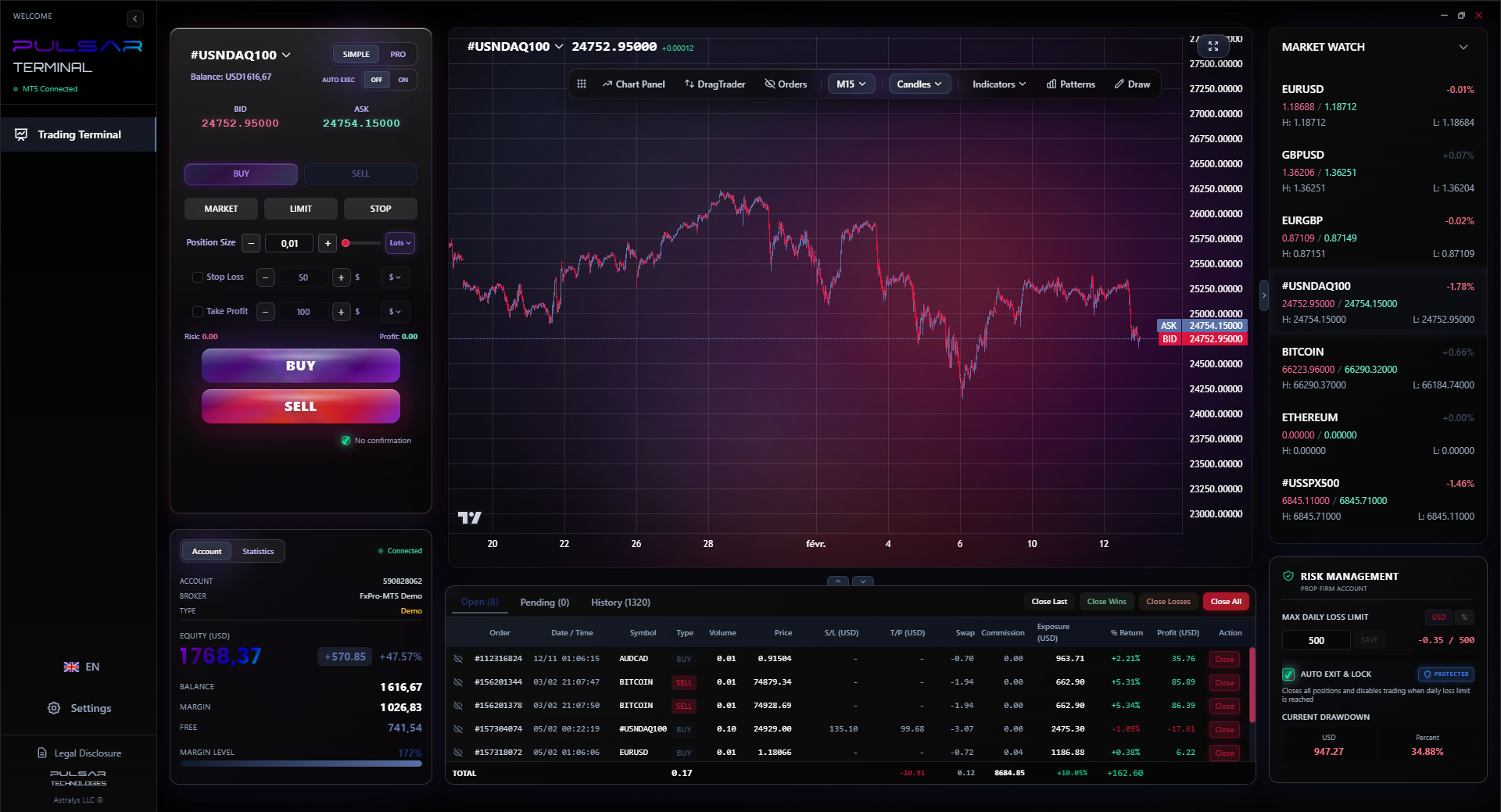
Managing multiple trades and setting precise stops on different pairs is complex, but tools like Pulsar Terminal automate this directly on your MT5 platform.
Pulsar Terminal
Alat MT5 all-in-one: order drag-and-drop, multi-TP/SL, trailing stop, grid trading, Volume Profile, dan perlindungan prop firm. Digunakan 1.000+ trader setiap hari.
Theory is one thing. Getting the trade on from Nigeria is another.
Broker Choice: This is critical. You need a broker that accepts Nigerian clients, offers reliable deposit/withdrawal methods (like direct bank transfer or local payment processors), and has stable servers. Regulated international brokers like XM or Exness are popular here for a reason. They've built the local infrastructure. Check their average spreads on the pairs you want to trade during the hours you will trade.
use: It's tempting to use the maximum 1:1000 or 1:2000 some brokers offer. Don't. For Majors, I rarely go above 1:30 for swing trades. High use on volatile pairs is a shortcut to a margin call. Remember, your profit target should be in pips, not a percentage of your account. Use a position size calculator every single time.
Taxes: Keep clean records. The 10% Capital Gains Tax on profits is real. Factor it into your net profitability calculations.
Internet: If your connection is unreliable, avoid styles that require constant monitoring. Stick to swing trading on higher timeframes (like the 4-hour or daily chart) where a 30-minute disconnection won't ruin you.
💡 Tips Winston
Your first 100 trades should be on one pair only. Mastery of one instrument is worth more than a superficial knowledge of twenty.
“Finding the best forex pairs to trade is about finding *your* pairs. The ones whose rhythm you understand.”
This is what's on my main screen right now. It changes with the market regime, but this is the core.
- EUR/USD: Always #1. My go-to for testing any new strategy or market condition. The EUR/USD guide dives deeper into its quirks.
- USD/JPY: For trading shifts in global risk appetite. The Bank of Japan's policy normalization is a multi-year story.
- USD/CAD: My sole commodity pair exposure. I trade it purely based on the technical structure on the daily chart and clear breaks in the oil price.
- XAU/USD (Gold): Not a forex pair, but a must-watch. It's the ultimate safe-haven and often moves inversely to the US Dollar. When USD is strong, gold often struggles, and vice versa. It's a great hedge or alternative. I have a separate XAU/USD guide on how I trade it.
I have charts for GBP/USD and AUD/USD, but they are secondary. I might take 2-3 trades a month on them if a perfect setup forms. I ignore the exotics completely. My focus is quality, not quantity.
Finding the best forex pairs to trade is about finding your pairs. The ones whose rhythm you understand, whose costs you can manage, and which fit your life in Nigeria. Start with EUR/USD. Master it. Then, and only then, consider expanding your universe. Consistency beats excitement every single time in this game.
FAQ
Q1What is the easiest forex pair to trade for a beginner in Nigeria?
Hands down, EUR/USD. It has the lowest spreads, the most predictable liquidity, and the most educational material available. It moves enough to be interesting but not so much that it will panic you out of a trade. Spend your first 6 months getting to know this one pair inside out.
Q2Can I profitably trade USD/NGN as a retail trader?
It's extremely difficult and generally not advisable. The spreads are prohibitively wide (often 300-500 pips), meaning the market has to make a massive move just for you to break even. The price is also heavily managed by the CBN, creating an uneven playing field. You're better off focusing on global majors where costs are lower and the market is more transparent.
Q3How much money do I need to start trading the best forex pairs?
You can open an account with as little as $10-$20. However, to trade properly with sensible risk management (e.g., risking 1-2% of your account per trade), a starting capital of $200-$500 is more realistic. This allows you to use sane position sizes on a standard lot (0.01 or 0.02 lots) without being forced to use dangerously high use.
Q4What time is best to trade forex from Nigeria?
The most volatile and liquid sessions are the London session (8 AM - 5 PM GMT, which is 9 AM - 6 PM Nigerian Time) and the overlap with the New York session (1 PM - 5 PM GMT / 2 PM - 6 PM Nigerian Time). This 4-hour overlap sees the highest volume and best trade setups, especially for pairs like EUR/USD and GBP/USD.
Q5Do I have to pay tax on my forex trading profits in Nigeria?
Yes. The Federal Inland Revenue Service (FIRS) considers forex trading profits as capital gains, which are subject to a 10% Capital Gains Tax. It is your responsibility to declare this income and pay the tax, regardless of whether your broker is local or international.
Q6Is high use good for trading major pairs?
No, it's usually a trap. High use (like 1:500 or 1:1000) amplifies losses as much as profits. For major pairs, which can still have 50-100 pip swings in a day, high use can wipe out your account quickly from a single bad trade. Use use conservatively (e.g., 1:10 to 1:30) to manage risk, not to maximize potential gain.
Q7Which indicator is best for trading EUR/USD?
There's no single 'best' indicator, as they are tools for context. For trend identification, I always start with the 50 and 200-period moving averages on the 4-hour chart. For momentum and potential reversals, I combine the MACD indicator with the RSI indicator. Price action (support/resistance levels) is still the most important 'indicator' of all.
Pelajaran Prof. Winston
Poin Penting:
- ✓EUR/USD is the foundation: lowest spread, highest liquidity.
- ✓Avoid exotic pairs like USD/NGN due to massive 300+ pip spreads.
- ✓Match your pair to your style: scalpers need tight spreads, swing traders need trends.
- ✓Use use under 1:30 for majors to survive daily volatility.
Seberapa bermanfaat artikel ini?
Klik bintang untuk menilai
Wawasan Trading Mingguan
Analisis & strategi mingguan gratis. Tanpa spam.
Tentang Penulis
Olumide Adeyemi
Pelopor Trading Afrika Barat
Salah satu edukator trading forex paling aktif di Nigeria. 8 tahun pengalaman trading dari Lagos. Spesialis strategi modal rendah dan tantangan prop firm untuk trader Afrika.
Komentar
Peringatan Risiko
Perdagangan instrumen keuangan mengandung risiko signifikan dan mungkin tidak cocok untuk semua investor. Kinerja masa lalu tidak menjamin hasil di masa depan. Konten ini hanya untuk tujuan edukasi dan tidak boleh dianggap sebagai nasihat investasi. Selalu lakukan riset Anda sendiri sebelum trading.
Anda mungkin juga suka

Cara Trading Forex Sukses: 7 Prinsip dari Trader Profesional
Cara trading forex sukses dengan 7 prinsip trader pro: manajemen modal, disiplin, journal trading, backtest. Data nyata, bukan janji profit palsu.
Jam Trading Forex Terbaik untuk Trader Indonesia: Panduan Lengkap dengan Tabel Waktu
Panduan jam trading forex untuk trader Indonesia. Tabel 4 sesi dunia, jam emas 20:00-00:00, sesi mana yang harus dihindari. Data akurat + tips dari trader berpengalaman.
Top 5 Sàn Forex Uy Tín Nhất 2026: Review Jujur dari Trader Indonesia
Top 5 sàn forex uy tín 2026 untuk trader Indonesia. Review jujur: spread, deposit, withdraw, dukungan lokal. Exness, XM, IC Markets & lebih.
Dapatkan Pulsar Terminal
Semua kalkulator ini terintegrasi dalam Pulsar Terminal dengan data real-time dari akun MT5 Anda.
Dapatkan Pulsar Terminal