


Let's be blunt: chasing the ghost stories of the world's richest forex traders is the fastest way to lose your own money.

Olumide Adeyemi
Pelopor Trading Afrika Barat ·  Nigeria
☕ 11 mnt baca
Yang akan Anda pelajari:
- 1The Myth vs. Reality of 'Legendary' Traders
- 2The Only Metric That Matters: Risk-Adjusted Return
- 3Habit 1: Ruthless Position Sizing (The Nigerian Context)
- 4Habit 2: Trading a Process, Not Predictions
- 5Habit 3: Emotional Accounting
- 6The Nigerian Trader's Practical Checklist (2026)
- 7Building Your Own Legacy (Not Following Someone Else's)
Let's be blunt: chasing the ghost stories of the world's richest forex traders is the fastest way to lose your own money. The 'top 10 forex traders in the world' lists you see online are filled with hedge fund managers, prop firm owners, and a few mythical retail figures whose real returns are impossible to verify. For a trader in Lagos or Port Harcourt, their billionaire status is about as relevant as the weather on Mars. This article isn't about worshipping ghosts. It's about dissecting the only thing that matters: the specific, repeatable habits and brutal risk management that separate survivors from the 90% who blow up. I'll show you what you can actually learn, and more importantly, what you should ignore.
When you google 'top 10 forex traders in the world,' you get a predictable cast. George Soros (broke the Bank of England), Stanley Druckenmiller (Soros's protégé), Bill Lipschutz (the 'Sultan of Currencies'), and a few others like Bruce Kovner and Paul Tudor Jones. Here's the inconvenient truth you need to swallow: none of them were retail forex traders like you and me.
They were (or are) macro hedge fund managers. They traded billions in institutional capital, with access to prime brokerage, interbank rates you'll never see, and fundamental information flows that are illegal for you to act on. Soros didn't short the pound using a standard lot on his XM review account. He orchestrated a coordinated, billion-dollar assault using use and political insight. Trying to copy his 'strategy' with your $500 account is like trying to win the Premier League by buying the same boots as Mo Salah.
Then there are the modern 'gurus' - the Instagram traders with rented Lamborghinis and fake profit screenshots. Their primary income isn't trading; it's selling you courses, signals, and the dream. I learned this the hard way early on. I paid $300 for a 'proven system' from a guy who claimed 80% win rates. It was just a convoluted mix of common indicators. I lost $1,200 trying to make it work before I realized I was the customer, not the markets.
The only useful figure from these lists is their relationship with loss. Stanley Druckenmiller's famous quote: 'I've learned many things from George Soros, but perhaps the most significant is that it's not whether you're right or wrong that's important, but how much money you make when you're right and how much you lose when you're wrong.' That's the golden nugget in a mountain of irrelevant detail.
Forget net worth. For you, the only ranking that counts is your own risk-adjusted return. A guy making 100% in a month but risking 50% of his account on each trade is a future statistic, not a genius.
Let's break down what sustainable performance actually looks like for a retail trader, especially with the 10% capital gains tax on gross profits here in Nigeria.
Realistic Return Expectations
A consistently profitable retail trader might target 10-30% per year on their risk capital. That's it. Anyone promising you monthly returns like that is lying. Why? Because consistent compounding at even 20% annually is world-class. If you start with 200,000 NGN and compound at 20% a year, in 10 years you'd have about 1.24 million NGN. It's solid growth, but it doesn't make for sexy YouTube thumbnails.

Example: Let's say you make a 15% return in a year on a 500,000 NGN account. That's 75,000 NGN profit. Your 10% capital gains tax is 7,500 NGN. Your net is 67,500 NGN. Now factor in spreads and any commissions. On a major pair like EUR/USD, if you're paying an average 1.2 pip spread, that cost adds up fast over dozens of trades. A position size calculator is essential to see how costs eat into your bottom line.
The Drawdown Killer
The traders who survive have maximum drawdowns (peak-to-trough loss) of less than 20%. Most blow up because they have a 30% drawdown, panic, and then triple their risk to 'make it back fast' - a guaranteed death spiral. I've been there. In 2019, after a 25% drawdown, I broke my own rules and placed a huge, emotional trade on GBP/JPY. I lost another 15% in an hour. It took me six months of disciplined swing trading just to get back to breakeven.

💡 Tips Winston
The 'top 10' traders all share one trait: they survived their first major drawdown without doubling down. Your goal isn't to avoid losses; it's to survive them.
“The money in your trading account is not for school fees; it is 'risk capital.' It is the cost of doing business.”
This is the master habit. Every name on any legitimate 'top 10 forex traders in the world' list has this ingrained. For you, it's not a suggestion; it's your lifeline, especially given our local challenges with funding accounts.
If you fund your account via a bank transfer that takes 3 days and costs 1,500 NGN in fees, you cannot afford to blow up. Your position size must protect your capital like it's the last you have.
The universal rule is to risk 1-2% of your account per trade. In Nigeria, I'd argue you start at 0.5% while you're learning. On a 100,000 NGN account, that's 500 NGN risk per trade.

Warning: High use is a trap, not a tool. A broker offering 1:1000 use isn't doing you a favor. It's giving you a rope to hang yourself. Just because you can open a 10-lot position with $100 doesn't mean you should. A 10-pip move against you would be a 100% loss. Use use to reduce margin hold, not to amplify position size beyond your risk limit.
Here’s how a proper position size works with a real pair:
- Account Balance: 300,000 NGN
- Risk per Trade: 1% = 3,000 NGN
- Trade Idea: Buy USD/NGN (or more likely, a major like USD/CAD).
- Entry: 1.3800, Stop Loss: 1.3750 (50 pips risk).
- Pip Value per Standard Lot: ~$10 (depends on quote currency).
- Your Risk in Pips: 50.
- Maximum Position Size: Risk Amount / (Pip Risk * Pip Value). You'd need to calculate this based on your broker's quote. This is where not understanding a pip definition will destroy you.
Most traders fail at this simple math. They think, 'This trade looks good, I'll use 20% of my balance.' That's not trading; it's gambling at the National Sports Stadium.
The gurus sell predictions. The pros trade processes. A process is a checklist that you follow regardless of how you 'feel' about the Euro that day.
Your process should answer these questions before you click buy:
- What's the setup? Is it a specific chart pattern, a support bounce, a moving average crossover? Be precise. 'It looks like it's going up' is not a setup.
- Where is my exact entry? Not a zone, a price.
- Where is my hard stop-loss? This is non-negotiable. It's based on the chart, not on how much money you're willing to lose. If your stop is wider than 2% of your account allows, you skip the trade. Period.
- Where is my take-profit? Based on a measured move or key resistance. Have a plan for partial profits. A tool that lets you set multiple TP levels automatically can remove emotion.
- What's the risk/reward ratio? Aim for at least 1:1.5. Risking 50 pips to make 50 is a tough game. Risking 50 to make 100 gives you a buffer.
I used to ignore my own stop-losses, thinking the market would 'come back.' It usually didn't. My worst single loss was on Gold (XAU/USD guide). I entered long at $1845, my stop was at $1835. Price dipped to $1837, I moved my stop to breakeven 'to be safe.' It then spiked down to $1820 without me. I was out, but not at my planned stop. I lost 25 pips, but the psychological damage of breaking my process was worse. A trailing stop or breakeven automation tool would have executed my plan without my interference.

Pro Tip: Your trading journal is your most important tool. Log every trade: the setup, the reason, the outcome, and most crucially, your emotional state. Did you feel greedy? Scared? Bored? After 100 trades, you'll see your real edge (or lack thereof).
💡 Tips Winston
In Nigeria, your most significant edge isn't a secret indicator. It's your ability to manage the friction: funding costs, tax calculations, and emotional pressure from volatile Naira rates. Master the friction, then the market.
“Aim to become the top 1 trader in your own trading journal, not a mythical top 10 in the world.”
This is the silent killer for Nigerian traders. We see a trade go 10 pips in our favor and immediately calculate the profit in Naira: 'That's 4,000 Naira!' We see a loss and think, 'That's my data bill for the month.' This anchors your decisions to personal expenses, not market structure.
You must de-personalize the money. The money in your trading account is not for school fees, not for a new generator. It is 'risk capital.' It is the cost of doing business. You must be mentally prepared to lose 100% of it (though your rules should prevent that).
How do you do this?
- Trade in Base Currency: If possible, think in USD or the quote currency of your main pair. A 50 pip loss on EUR/USD is $500 on a standard lot, not '200,000 Naira right now.'
- Weekly/Monthly Reviews: Don't check your P&L after every trade. It creates emotional whiplash. Review it at the end of the day or week, in the context of your plan.
- Separate Accounts: Have your living expense account totally separate. Your trading account is a business tool. When you take profits, withdraw them to your savings. Don't let them sit there to be re-risked.
The fear of a margin call is rooted in emotional accounting. You're not afraid of the margin call itself; you're afraid of what it represents - failure, lost money, shame. By treating your account as a business simulation, you take the sting out.
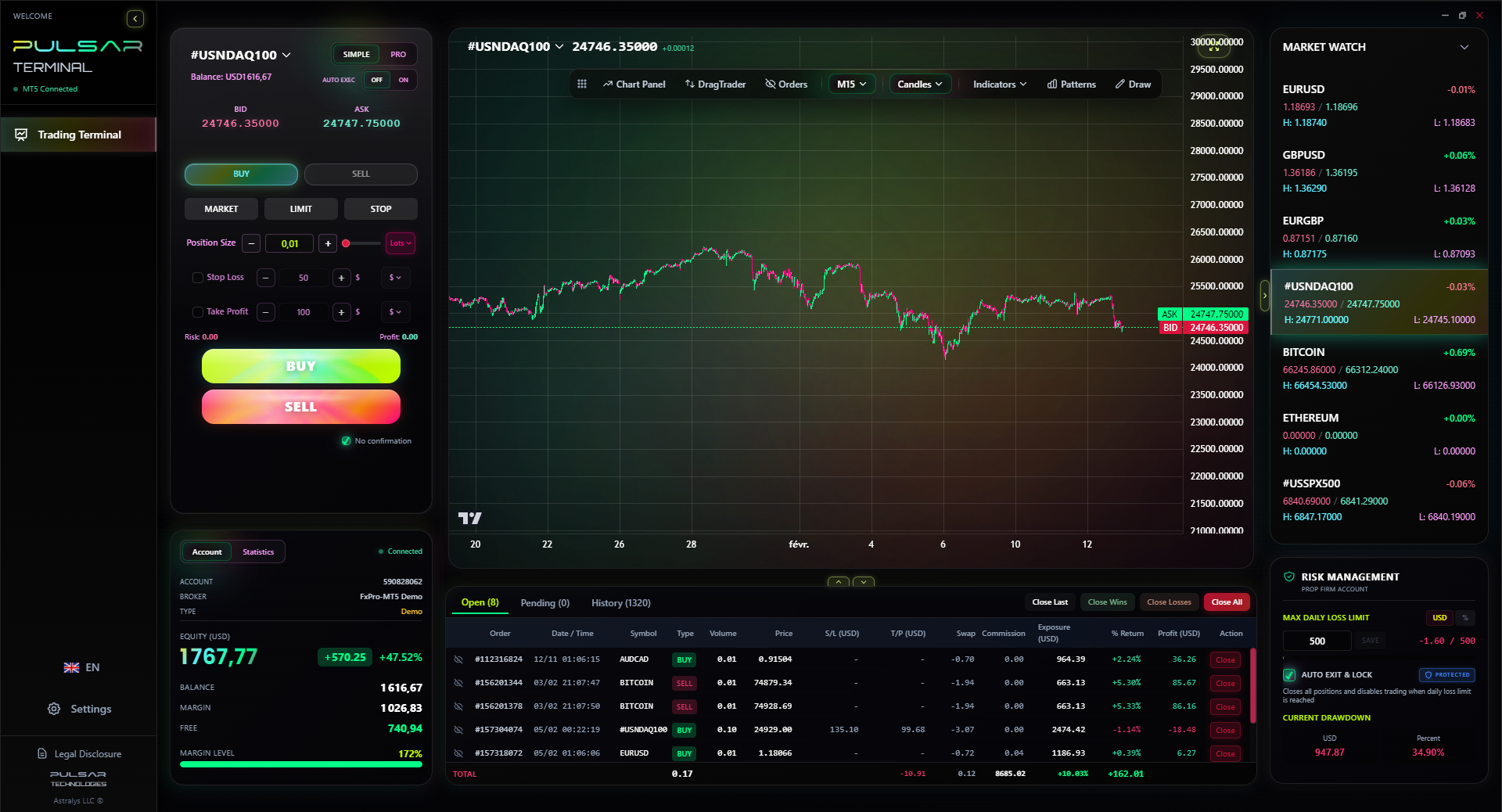
Sticking to a pre-defined process, like automated stop-loss and take-profit orders, is what separates professionals from gamblers, and tools like Pulsar Terminal build that discipline directly into your MT5 platform.
Pulsar Terminal
Alat MT5 all-in-one: order drag-and-drop, multi-TP/SL, trailing stop, grid trading, Volume Profile, dan perlindungan prop firm. Digunakan 1.000+ trader setiap hari.
Forget global legends. Here’s your actionable checklist, tailored for our market realities.
| What to Focus On | What to Ignore |
|---|---|
| Your own risk-adjusted return (e.g., 15% annual with max 15% drawdown) | The net worth of hedge fund billionaires |
| Costs: Spreads + Commissions + 10% Tax on gross profits | 'Commission-free' accounts that have huge spreads (calculate the real cost) |
| Funding Method: Choose reliable, low-cost options (some brokers with NGN accounts help) | Funding methods with high fees or long delays that pressure you to 'make it back' |
| Broker Regulation: Prefer brokers with strong int'l licenses (ASIC, FCA, CySEC) that accept Nigerians | Unregulated 'bucket shops' promising the moon |
| Platform Stability: MT4/MT5 during peak volatility (1:00 PM - 6:00 PM WAT) | Fancy platforms that crash when London opens |
| Your Trading Journal | Free signal channels on Telegram |
On Broker Choice: You need a broker that is stable, has fair costs, and processes withdrawals without hassle. Many Nigerians use brokers like Exness review or IC Markets review because they offer NGN accounts and local payment methods, which simplifies the money handling. But always verify their primary international regulation.
On Strategy: Find one that suits your time. If you have a 9-5, don't try scalping strategy. Look at higher timeframes for swing trading. Use indicators like the RSI indicator or MACD indicator to confirm trends, not to generate signals on their own.
💡 Tips Winston
If you can't explain your exact entry, stop, and profit-taking rules in one sentence before a trade, you don't have a plan. You have a hope.
“High use is a risk amplifier, not a capital solution. It's a rope to hang yourself.”
The end goal isn't to be on a future 'top 10 forex traders in the world' list. That's a fantasy. The goal is financial consistency and independence.
Start small. Your first target isn't profit; it's survival for 6 months without blowing up. Then, it's achieving three consecutive months of profitability. Then, six. These are the real milestones.
I have a friend here in Abuja who is the best trader I know personally. You'll never read about him. He's a civil engineer. For the past 5 years, he's averaged 22% per year on his trading capital. He uses a simple trend-following system on the 4-hour chart, risks 0.75% per trade, and has never had a monthly drawdown over 8%. He pays his 10% tax without complaint because he sees it as the cost of a legitimate secondary income. He is, in every practical sense, a world-class trader for his context.
That's the model. Not Soros, not the Instagram fake. The anonymous, disciplined, consistent trader who understands his numbers, respects the market, and lives to trade another day. Your legacy is a strong, stress-tested trading plan that works for you, in Nigeria, with your capital and your psychology. That's the only list worth being on.
Focus on becoming the top 1 trader in your own trading journal, not a mythical top 10 in the world. The former is achievable. The latter is a distraction sold to you by people who want your attention, or your subscription fee.
FAQ
Q1Is forex trading legal in Nigeria, and how am I taxed?
Yes, forex trading with your personal funds is legal. However, you are subject to a 10% Capital Gains Tax on all gross trading profits. This is your responsibility to declare and pay, regardless of whether your broker is local or international.
Q2Who is actually the richest forex trader in the world?
In terms of verifiable wealth from trading currencies, it's likely George Soros or Stanley Druckenmiller. But remember, they ran macro hedge funds. Their wealth came from managing billions in institutional capital, political connections, and complex derivatives, not from retail spot forex trading. Their 'strategies' are not replicable by an individual trader.
Q3What is a realistic monthly return for a retail forex trader in Nigeria?
Aim for consistency, not crazy percentages. A very good, consistent retail trader might average 1-3% per month on their risk capital. Anyone promising you 10%, 20%, or 50% per month is almost certainly running a scam. After the 10% tax and trading costs, a steady 2% monthly return compounded is exceptional.
Q4Should I use a high-use broker because I have a small account?
No. This is the most common mistake. High use (like 1:1000) is a risk amplifier, not a capital solution. It allows you to control a huge position with little money, meaning a tiny move against you can wipe you out. Use use conservatively (e.g., 1:10 or 1:20) to keep margin requirements low, but always control your position size based on your 1-2% risk rule.
Q5How do I choose a safe broker as a Nigerian?
Prioritize brokers with strong international regulation from authorities like ASIC (Australia), FCA (UK), or CySEC (EU). Many of these brokers accept Nigerian clients. Check if they offer Naira accounts or low-cost deposit/withdrawal methods. Read detailed, unbiased reviews (like our Pepperstone review) that discuss regulation, spreads, and platform stability.
Q6What's more important, a good strategy or good risk management?
Risk management, 100%. You can have a mediocre strategy with impeccable risk management and survive. You can have the 'best' strategy in the world with poor risk management and you will blow up. Risk management (position sizing, stop losses) protects you from yourself and from black swan events. Strategy just gives you a slight edge.
Pelajaran Prof. Winston
Poin Penting:
- ✓Risk a maximum of 1-2% of your account per trade.
- ✓Your 10% capital gains tax applies to gross profits.
- ✓Sustainable returns are 10-30% per year, not per month.
- ✓A process beats a prediction every single time.
Seberapa bermanfaat artikel ini?
Klik bintang untuk menilai
Wawasan Trading Mingguan
Analisis & strategi mingguan gratis. Tanpa spam.
Tentang Penulis
Olumide Adeyemi
Pelopor Trading Afrika Barat
Salah satu edukator trading forex paling aktif di Nigeria. 8 tahun pengalaman trading dari Lagos. Spesialis strategi modal rendah dan tantangan prop firm untuk trader Afrika.
Komentar
Peringatan Risiko
Perdagangan instrumen keuangan mengandung risiko signifikan dan mungkin tidak cocok untuk semua investor. Kinerja masa lalu tidak menjamin hasil di masa depan. Konten ini hanya untuk tujuan edukasi dan tidak boleh dianggap sebagai nasihat investasi. Selalu lakukan riset Anda sendiri sebelum trading.
Anda mungkin juga suka

Cara Trading Forex Sukses: 7 Prinsip dari Trader Profesional
Cara trading forex sukses dengan 7 prinsip trader pro: manajemen modal, disiplin, journal trading, backtest. Data nyata, bukan janji profit palsu.
Jam Trading Forex Terbaik untuk Trader Indonesia: Panduan Lengkap dengan Tabel Waktu
Panduan jam trading forex untuk trader Indonesia. Tabel 4 sesi dunia, jam emas 20:00-00:00, sesi mana yang harus dihindari. Data akurat + tips dari trader berpengalaman.
Top 5 Sàn Forex Uy Tín Nhất 2026: Review Jujur dari Trader Indonesia
Top 5 sàn forex uy tín 2026 untuk trader Indonesia. Review jujur: spread, deposit, withdraw, dukungan lokal. Exness, XM, IC Markets & lebih.
Dapatkan Pulsar Terminal
Semua kalkulator ini terintegrasi dalam Pulsar Terminal dengan data real-time dari akun MT5 Anda.
Dapatkan Pulsar Terminal