


I watched the EUR/ZAR chart on my screen, a client's transfer request open in another window.

David van der Merwe
Trader Pasar Berkembang ·  South Africa
☕ 8 mnt baca
Yang akan Anda pelajari:
- 1What 'Western Union Forex' Really Means (It's Not Trading)
- 2The Real Cost Breakdown: Fees, Rates, and Limits
- 3The South African Regulatory Maze: SARB, FICA, and FSCA
- 4Why Traders Blow Money on This (The Psychology)
- 5Legitimate Alternatives for South African Traders
- 6The Future: Digital Remittances and Stablecoins
I watched the EUR/ZAR chart on my screen, a client's transfer request open in another window. He wanted to send R25,000 to his son in Germany. The rate Western Union quoted him was 19.45. The interbank rate flashing on my trading terminal was 20.32. That 87-cent difference wasn't just a spread; it was a 4.3% haircut before the transfer fee even hit. This is the reality of 'Western Union forex' - a phrase that confuses newcomers and costs experienced people real money. It's not trading. It's an expensive necessity, and understanding the mechanics is the only way to not get fleeced.
Let's clear this up immediately. When South Africans search for 'Western Union forex,' they're usually looking for one of two things: a cheap way to convert and send money abroad, or a way to fund a trading account. Western Union provides the first, sort of, but is categorically not the second.
They are a global money transfer service, not a forex broker. You cannot open a margin account with them, you cannot speculate on EUR/USD price movements, and you certainly cannot use their platform for scalping strategy. The 'forex' part comes from the currency exchange that happens during the transfer. You give them Rands, they convert it to Euros at their rate, and send those Euros overseas.
The confusion is costly. I've had clients blow their initial trading capital by using services like this to move money to an international broker, losing 5% in fees and poor exchange rates before they even placed a trade. That's a hole you start in before the market even opens.

Warning: If you're trying to fund an account with a broker like IC Markets or Pepperstone, using a money transfer service is often the most expensive method. Most brokers offer local EFT or credit card deposits in ZAR with a better effective exchange rate.

💡 Tips Winston
A loss taken via a poor exchange rate is just as real as a loss taken in the market. Measure every financial move by its percentage cost.
“The 5% fee feels like a 'tax' for urgency. But in trading, a 5% headwind is catastrophic.”
Western Union makes money two ways: a stated transfer fee and a hidden exchange rate margin. The fee is the visible sting. The margin is the silent killer.
Let's use a real example from last month. A client needed to send €1,000 to Portugal. Here’s the math:
- Interbank Mid-Market Rate (EUR/ZAR): 20.15
- Western Union Offered Rate: 19.28
- Transfer Fee (via Absa Online): R150
Calculation: To get €1,000 at their rate of 19.28, you'd need R19,280. At the real market rate, you'd only need R20,150. The difference of R870 is the hidden margin. Add the R150 fee, and your total cost is R1,020.
That's a 5.06% cost on the transaction. You sent R20,150 worth of value but it cost you R21,170. For perspective, a typical forex broker's spread on a major pair like EUR/USD might be 0.6 pips, or about 0.006%. The difference in scale is staggering.
Sending Limits You Need to Know
South Africa has strict exchange controls. Western Union's limits are built around them:
- Per Transaction: ZAR 30,000
- Per Day: USD 8,000 equivalent
- Per Year: USD 62,000 equivalent
These aren't arbitrary. They're tied to your single discretionary allowance (R1 million per year) and the SARB's rules. If you're sending more than these amounts regularly for 'trading,' you're likely violating exchange control regulations, which is a serious offense.

Example: Sending R30,000 to the UK. Fee: R200. WU Rate (GBP/ZAR): 22.50. Market Rate: 23.60. Hidden Cost: R1,467 (22.50 vs 23.60 on R30k). Total Cost: R1,667. You lost 5.56% before the money arrived.
“Western Union's 4.5% margin isn't a spread; it's a silent tax on your capital.”
This is where it gets serious. Western Union doesn't set the rules; the South African Reserve Bank (SARB) does. Every transaction you make is monitored under the Financial Intelligence Centre Act (FICA).
You're not just a customer. You're a reporting entity. For any transfer over R19,999.99, details are sent to the Financial Intelligence Centre. They're looking for capital flight, money laundering, and terrorist financing. Trying to move trading profits back into South Africa through multiple small transfers to avoid reporting? That's called 'structuring,' and it will get your accounts frozen and flagged.
The Financial Sector Conduct Authority (FSCA) also has teeth. A 2025 High Court case confirmed they can penalize foreign companies impacting our markets. This regulatory wall exists for a reason: to protect the Rand. As a trader, you must work within it, not try to cleverly bypass it with retail money transfers.
Allowed vs. Not Allowed: You can typically send money for gifts, family support, or if you're a non-resident sending earnings. You generally cannot use Western Union to pay for overseas commercial services or goods. Funding an international business (like a prop trading account) falls into a very grey area that often doesn't comply with the service's intended use.
I learned this the hard way early on. I used a similar service to fund a small overseas account, thinking small amounts would fly under the radar. Three transfers in, my bank's compliance department called. It took a week of paperwork and explanations to unfreeze my local accounts. The hassle and risk far outweighed any perceived benefit.
💡 Tips Winston
Regulations aren't walls to climb; they're the rules of the game. The most successful traders learn the rulebook better than anyone else.
“You wouldn't accept a 5% bid-ask spread on gold, but you accept it here because it's wrapped in a familiar brand.”
I see this mistake constantly. It's not about math; it's about psychology and convenience blindness.
The 'Just Get It Done' Fallacy: When you need to move money, especially in an emergency or to seize a perceived market opportunity, you focus on speed, not cost. The 5% fee feels like a 'tax' for urgency. But in trading, a 5% headwind is catastrophic. If your swing trading strategy aims for 10% annual returns, you've just given away half your potential profit on the transfer alone.
Confusing Access with Efficiency: Because Western Union is everywhere - in Absa, Nedbank, at the corner shop - it feels like the official, safe channel. That perceived safety makes us less critical of the cost. We wouldn't accept a 5% bid-ask spread on XAU/USD, but we accept it here because it's wrapped in a familiar brand.
Ignoring Total Cost: People look at the R150 fee and think 'that's not bad.' They completely miss the R870 lost in the exchange rate. This is the same mental error as a trader only looking at commission and ignoring the spread. You must look at the total cost of the transaction, measured against the real mid-market rate.

Pro Tip: Before any transfer, check the live mid-market rate on a site like XE.com or your trading platform. Then get the quote from WU. The difference is your true cost. If it's over 2%, you're probably being ripped off. For larger amounts, a commercial forex broker will often beat this rate dramatically.
“You wouldn't accept a 5% bid-ask spread on gold, but you accept it here because it's wrapped in a familiar brand.”
So what should you do instead? It depends on your goal.
Goal 1: Sending Money Abroad for Personal Reasons (Family, etc.)
- Compare Fintechs: Use platforms like Wise (formerly TransferWise) or CurrencyFair. They typically show you the mid-market rate and charge a small, transparent fee. Their total cost is often 0.5%-1.5%, not 4-5%.
- Local Specialists: For SADC transfers, look at Mama Money or Mukuru. They're built for the African corridor and can be cheaper.
- Your Bank's Forex Desk: For large amounts (R100k+), call your bank's commercial forex division. You'll get a negotiated rate closer to interbank, though with more paperwork.
Goal 2: Funding an International Trading Account This is the big one. Most top-tier international brokers (Exness, XM, etc.) accept ZAR deposits.
- Deposit in ZAR: Use a local EFT or credit card deposit. The broker converts it at their corporate rate, which is almost always superior to Western Union's retail rate.
- Use a Specialist FX Broker: Open an account with a South African-licensed forex broker who can help international transfers as a regulated entity. They operate within the SARB framework.
- Never 'Structure' Transfers: Don't send R19,000 ten times to fund a R190,000 account. It's illegal, and you'll get caught. Use the formal channels.
Goal 3: Bringing Trading Profits Back to SA Plan this before you start trading. Work with your broker's support to understand their withdrawal process to South African bank accounts. The withdrawal will be converted back to ZAR. The key is consistency and using the broker's official banking channels, not retail money transfer services.
💡 Tips Winston
Convenience is the most expensive premium in finance. The easier a service is to use, the more critically you must examine its cost structure.
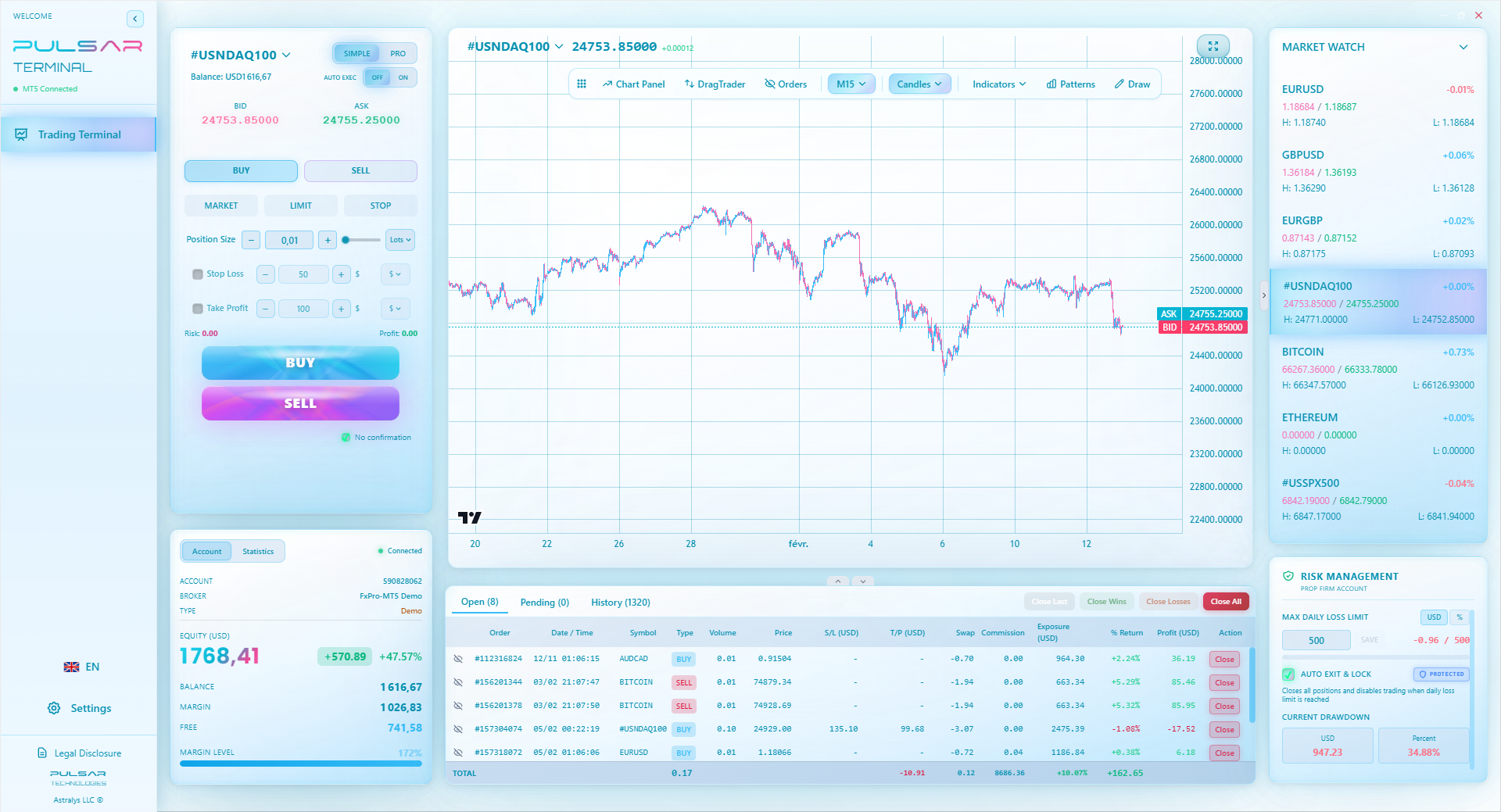
Managing multi-currency risk and calculating exact costs is complex, which is why tools like Pulsar Terminal, with its advanced position and risk management features, are essential for serious traders.
Pulsar Terminal
Alat MT5 all-in-one: order drag-and-drop, multi-TP/SL, trailing stop, grid trading, Volume Profile, dan perlindungan prop firm. Digunakan 1.000+ trader setiap hari.
“The technology that makes remittances cheaper could also simplify how you manage multi-currency trading capital.”
The landscape is shifting fast. Western Union knows their old model is under threat. Their partnership with Sasai Fintech for a co-branded app (launched March 2026) is a direct play for South Africa's digital users. It's about convenience, but the core cost issue may remain.
The more interesting development is their planned US Dollar Payment Token (USDPT), a stablecoin slated for 2026. This is a direct shot at the low-cost African remittance market dominated by crypto apps. If they can offer transfers via blockchain with minimal fees, it could disrupt their own expensive model.
For you, the trader, this is relevant. The rise of real-time payments (like PayShap) and blockchain is driving costs down across the board. Pressure from fintechs means traditional players will have to improve rates or die. The 4.5% margin of today might be 1.5% in three years.
Keep an eye on this space. The technology that makes remittances cheaper could also simplify how you manage multi-currency trading capital. But for now, the rule remains: always, always calculate the total cost in percentage terms. Don't let convenience rob your capital.
FAQ
Q1Can I use Western Union to fund my forex trading account?
Technically, you might find a broker that accepts it as a payment method, but it's one of the worst ways to do it. You'll pay a high Western Union fee and a poor exchange rate, losing 4-6% of your capital before you even trade. Always use your broker's direct ZAR deposit option if available.
Q2What is the maximum amount I can send via Western Union from South Africa?
The limit is ZAR 30,000 per transaction, up to USD 62,000 equivalent per calendar year. These limits are enforced to comply with South African exchange control regulations (your single discretionary allowance).
Q3Why is the Western Union exchange rate different from the rate on my trading platform?
Your trading platform shows a close approximation of the interbank rate. Western Union adds a markup (often 3-5%) to that rate to make their profit. This hidden margin is how they make most of their money, on top of the transfer fee.
Q4Is it legal to send money for trading purposes via Western Union?
It's a grey area that often violates the terms of service. Western Union's system is designed for personal remittances (gifts, family support), not commercial payments or capital transfers for investment. Using it for frequent trading-related transfers can trigger SARB and FICA compliance alerts at your bank.
Q5What's the cheapest way to send money overseas from South Africa?
For personal transfers, digital fintechs like Wise or CurrencyFair are typically cheapest, with total costs around 0.5%-1.5%. For larger amounts, a commercial forex quote from your bank can be competitive. Always compare the total amount of foreign currency received, not just the fee.
Q6How does Western Union's new stablecoin (USDPT) affect me?
If launched successfully in 2026, it could offer a faster, cheaper way to send value abroad using blockchain technology. For traders, it might eventually become a more efficient method to move funds, but it will still be subject to South African exchange controls and regulations.
Q7Can I get a better Western Union rate for a large transfer?
No. Western Union operates on fixed retail margins. Their rates are non-negotiable. For transfers over R100,000, you must use a commercial forex provider or your bank's forex desk, where you can negotiate a rate much closer to the interbank market.
Pelajaran Prof. Winston
Poin Penting:
- ✓Western Union 'forex' costs 4-6%, not the 0.6-pip spread you're used to.
- ✓SARB limits are R30k per transaction, USD 62k per year.
- ✓The hidden exchange rate margin is the real cost, not the transfer fee.
- ✓Use fintechs (Wise) for personal transfers; they're 3x cheaper.
- ✓Never use retail transfers to fund a trading account.
Seberapa bermanfaat artikel ini?
Klik bintang untuk menilai
Wawasan Trading Mingguan
Analisis & strategi mingguan gratis. Tanpa spam.
Tentang Penulis
David van der Merwe
Trader Pasar Berkembang
Trader berbasis Johannesburg dengan 11 tahun di mata uang pasar berkembang. Spesialis pasangan ZAR, trading berregulasi FSCA, dan analisis pasar Afrika Selatan.
Komentar
Peringatan Risiko
Perdagangan instrumen keuangan mengandung risiko signifikan dan mungkin tidak cocok untuk semua investor. Kinerja masa lalu tidak menjamin hasil di masa depan. Konten ini hanya untuk tujuan edukasi dan tidak boleh dianggap sebagai nasihat investasi. Selalu lakukan riset Anda sendiri sebelum trading.
Anda mungkin juga suka

Cara Trading Forex Sukses: 7 Prinsip dari Trader Profesional
Cara trading forex sukses dengan 7 prinsip trader pro: manajemen modal, disiplin, journal trading, backtest. Data nyata, bukan janji profit palsu.
Jam Trading Forex Terbaik untuk Trader Indonesia: Panduan Lengkap dengan Tabel Waktu
Panduan jam trading forex untuk trader Indonesia. Tabel 4 sesi dunia, jam emas 20:00-00:00, sesi mana yang harus dihindari. Data akurat + tips dari trader berpengalaman.
Top 5 Sàn Forex Uy Tín Nhất 2026: Review Jujur dari Trader Indonesia
Top 5 sàn forex uy tín 2026 untuk trader Indonesia. Review jujur: spread, deposit, withdraw, dukungan lokal. Exness, XM, IC Markets & lebih.
Dapatkan Pulsar Terminal
Semua kalkulator ini terintegrasi dalam Pulsar Terminal dengan data real-time dari akun MT5 Anda.
Dapatkan Pulsar Terminal