


Most people think forex trading is about staring at screens and getting rich quick.

David van der Merwe
Trader Pasar Berkembang ·  South Africa
☕ 11 mnt baca
Yang akan Anda pelajari:
- 1The Core Job: Speculation and Analysis
- 2A Day in the Life (South African Context)
- 3Tools of the Trade: Platforms and Charts
- 4Risk Management: The Real Job
- 5Costs, Fees, and South African Reality
- 6Legal, Tax, and Regulatory Framework
- 7Common Pitfalls and How to Avoid Them
- 8Getting Started: Practical First Steps
Most people think forex trading is about staring at screens and getting rich quick. The truth is, it's more like being a professional risk manager who occasionally places a bet. If you're in South Africa, you're also navigating a specific set of rules and a unique market. Let me cut through the noise and show you what the job actually involves, from the morning routine to the hard numbers you need to know.
At its heart, what forex traders do is speculate on currency prices. You're betting that one currency will get stronger or weaker against another. But calling it a 'bet' is selling the work short. The real job is the analysis that comes before you click 'buy' or 'sell'.
You'll spend most of your time not trading, but researching. This means looking at why the Rand might weaken against the Dollar (maybe due to local power cuts hitting business confidence), or why the Euro could rally (perhaps a shift in European Central Bank policy). You're connecting global economic dots.
There are two main schools of thought here. Fundamental analysis looks at the big picture: interest rates, inflation data like our CPI releases, political stability, and economic growth reports. Technical analysis focuses on the price charts themselves, using tools like the RSI indicator or MACD indicator to spot patterns and trends. Most of us use a mix of both.

Example: Let's say the US Federal Reserve hints at raising interest rates while the South African Reserve Bank (SARB) holds steady. Historically, money flows towards the higher-yielding currency. A trader analyzing this might look for an opportunity to go long on USD/ZAR (buy USD, sell ZAR). But they wouldn't just jump in. They'd check the chart for a good entry point, maybe after a pullback, and calculate their risk first.
The analysis is the homework. The trade is just handing in the assignment. And trust me, skipping the homework is a sure way to fail.

💡 Tips Winston
Your first R10,000 profit is not a sign of genius; it's a test. The market gives beginners 'beginner's luck' to lure them into risking more. Stay humble, stick to your 1% risk rule.
So, what does this actually look like for a trader sitting in Johannesburg or Cape Town? Your day is structured around market sessions and data releases.
Your morning might start around 7:00 AM SAST. You're not trading yet. You're catching up on what happened in the Asian session and preparing for the European open at 9:00 AM SAST. This means scanning news feeds, checking your charts, and reviewing any open positions. I always check the USD/ZAR and EUR/USD first thing, as they're my bread and butter.
The Key Times for Us
The overlap between the London and New York sessions (3:00 PM to 6:00 PM SAST) is often the most volatile period. That's when the big institutional volume hits. If you're into scalping strategy, this is your playground. For swing trading, you might just check in to manage stops.
Your week is also shaped by economic calendars. South African data like mining production, budget speeches, or SARB interest rate decisions can cause big moves in the Rand. I learned this the hard way early on. I was holding a GBP/ZAR trade during a surprise SARB announcement. I didn't have a stop-loss set tightly enough, and a 150-pip move against me happened in minutes. That was an expensive lesson in respecting local volatility.

Warning: Trading around major South African data releases is high-risk, high-reward. The spreads can widen massively, and slippage (where your order fills at a worse price than expected) is common. Either have a rock-solid strategy for news trading, or stay out until the volatility settles.
The end of your day involves review. What trades did you take? Why? What does your journal say? This reflection is where real growth happens. It's not glamorous, but it's what separates the consistent from the lucky.
“If I had to tell you the single most important thing forex traders do, it's this: they manage risk. Everything else is secondary.”
You can't do the job without the right tools. For most retail traders, this means a trading platform like MetaTrader 4 or 5 (MT4/MT5). It's where you'll live. You'll learn to read candlestick charts, draw trendlines, and apply indicators.
But here's a secret most beginners miss: more indicators don't mean better analysis. When I started, my chart looked like a rainbow spaghetti monster - I had 10 different indicators all saying conflicting things. I was paralyzed. Now, I might use two or three at most. Clean charts help you see the price action clearly.
Your broker's platform is also where you'll manage the practicalities: placing orders, setting stop-losses, and taking profits. Understanding the difference between a market order and a pending order is basic but critical. You also need to watch the spread definition, which is your immediate cost of trading. A broker like Tickmill might show a 0.1 pip spread on EUR/USD but charge a commission, while another might have a 1.6 pip spread with no commission. The all-in cost matters.
Finally, a trading journal is your most important tool. It doesn't need to be fancy - a simple spreadsheet works. Record your entry, exit, reason for the trade, and most importantly, your emotional state. You'll start to see your own patterns, both good and bad.
If I had to tell you the single most important thing forex traders do, it's this: they manage risk. Everything else is secondary. Profitable trading isn't about winning every trade; it's about losing small when you're wrong and winning bigger when you're right.
This starts with position sizing. Never risk more than 1-2% of your trading capital on a single trade. I use a simple position size calculator every single time. If my account is R20,000 and my stop-loss is 50 pips away on USD/ZAR, I calculate exactly how many lots I can trade to risk only R200 (1%). This isn't exciting, but it keeps you in the game.
Stop-loss orders are non-negotiable. They are your lifeline. A stop-loss is an order that automatically closes your trade at a predetermined loss level to prevent a bad trade from wiping you out. Not using one is like driving without a seatbelt.

Pro Tip: Your stop-loss should be based on your chart analysis, not on how much money you're willing to lose. Place it where the market would prove your trade idea wrong. If price hits that point, your analysis is invalid, and you should exit.
South Africa's FSCA use cap of 30:1 for retail clients is actually a blessing in disguise for new traders. It forces you to use less use, which means less risk of a catastrophic margin call. While offshore brokers like Exness might offer 1:2000, using that much is a recipe for instant ruin. I once got cocky with high use on a 'sure thing' gold trade. A small move against me wiped out 40% of my account. I never made that mistake again.
Risk management is boring. But it's the foundation everything else is built on.
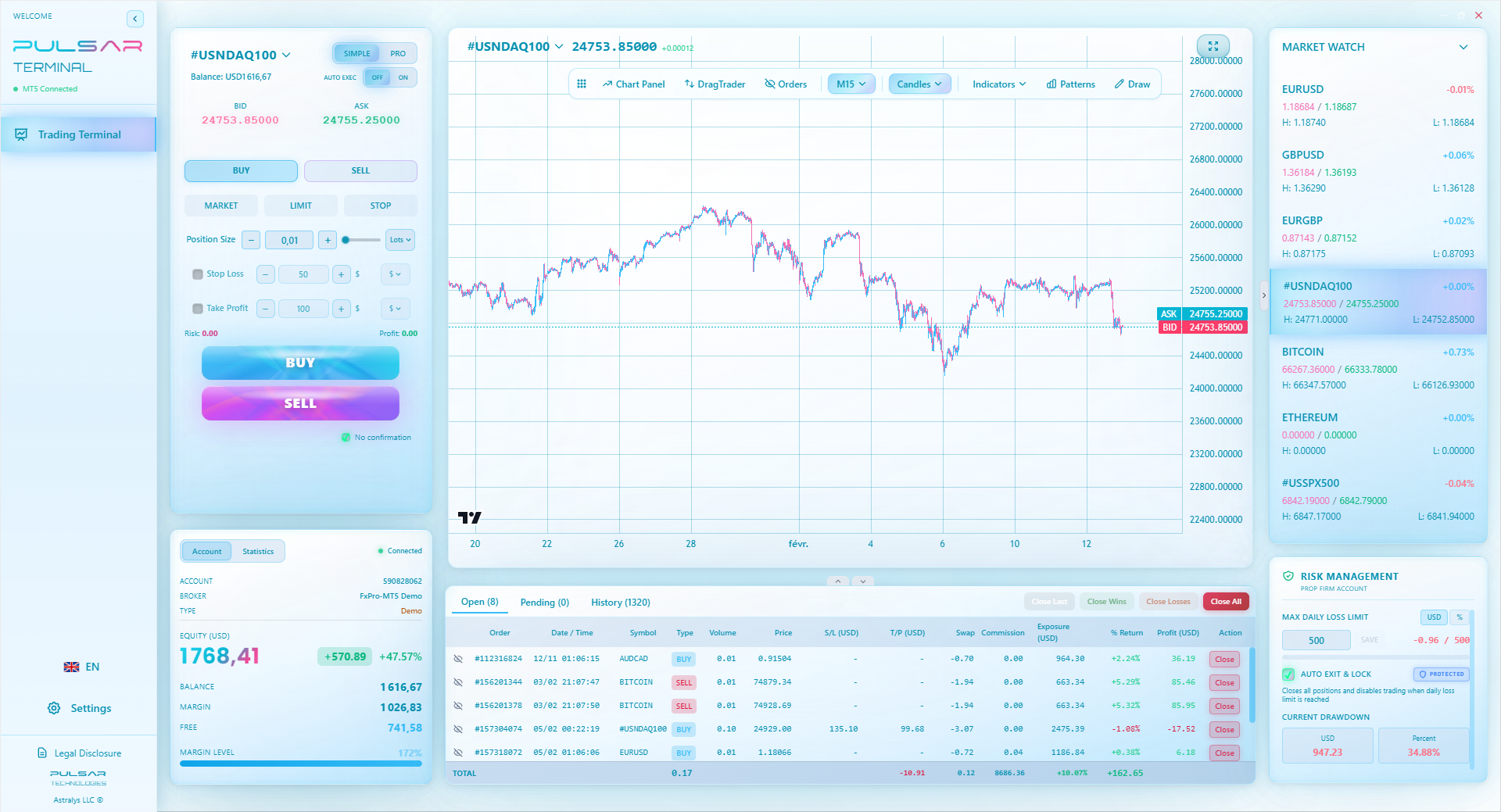
Managing complex trades and risk manually is tough; a tool like Pulsar Terminal automates trailing stops, breakeven orders, and multi-level take-profits directly on your MT5 chart.
Pulsar Terminal
Alat MT5 all-in-one: order drag-and-drop, multi-TP/SL, trailing stop, grid trading, Volume Profile, dan perlindungan prop firm. Digunakan 1.000+ trader setiap hari.
“Boredom is not a trading signal.”
Let's talk money, because what forex traders do involves constantly battling costs. Your profits are what's left after all fees are paid. Here’s the breakdown for a South African trader.
Spreads: This is the main cost. It's the difference between the buy and sell price. On a major pair like EUR/USD, you might pay 0.7 pips with a good broker. On USD/ZAR, expect wider spreads, often 15-30 pips or more, because it's less liquid. Every pip counts, so this is a key factor when choosing a broker like IC Markets or Pepperstone.
Commissions: Some brokers charge a commission per lot traded instead of (or on top of) a spread. It might be $3-$5 per standard lot per side. Do the math to compare total costs.
Swap Fees (Overnight Financing): If you hold a trade past the daily rollover time (usually 10 PM SAST), you'll pay or receive a swap fee based on the interest rate difference between the two currencies. Holding a ZAR-based pair can get expensive if you're on the wrong side of the rate differential.
Currency Conversion: If your trading account is in USD but you deposit in Rands, your broker will convert it, often at a 0.5-1% markup. The solution? Many brokers, including some local FSCA-regulated ones, offer ZAR-denominated accounts. This saves you that hidden fee.
The Bottom Line: Before you even make a profit, your trade needs to move enough to cover these costs. A scalper making 5-pip profits will be destroyed by a 3-pip spread. A swing trader can absorb higher costs. Know your numbers.
💡 Tips Winston
The USD/ZAR spread isn't a cost, it's a toll. You pay it to cross the bridge into the trade. If your strategy can't overcome a 25-pip toll, you're on the wrong bridge.
Trading in South Africa isn't a free-for-all. You operate within a clear legal framework designed to protect you (and the taxman).
The Financial Sector Conduct Authority (FSCA) is our main regulator. A legitimate broker must be licensed as a Financial Service Provider (FSP). Always check the FSP number on the FSCA website. This ensures they segregate client funds and follow fair practice rules. Brokers like AvaTrade and the local operations of XM operate under these rules.
Now, for the part everyone loves: tax. SARS sees forex trading profits as taxable income. You need to declare your net profit (profits minus losses and allowable expenses) on your annual tax return. The key is record-keeping. Log every trade, every deposit, every withdrawal. Your trading platform statements are your starting point, but a detailed journal is better.
There's a distinction between revenue (from frequent trading) and capital gains (from long-term investments), but for most active traders, it's treated as revenue. I'm not a tax advisor, but I can tell you this: get a professional who understands trading to help you with your first return. The peace of mind is worth the fee.
Also, remember the South African Reserve Bank's (SARB) exchange control rules. There's an annual single discretionary allowance for moving money offshore. If you're funding an international broker, stay within these limits to avoid headaches.
“Your stop-loss should be based on your chart analysis, not on how much money you're willing to lose.”
I've made most of these mistakes so you don't have to. Here’s what to watch for.
Overtrading: This is the urge to be in the market all the time. Boredom is not a trading signal. I had a week where I took 47 trades because 'something was always moving.' I ended the week down 8%. Quality over quantity.
Revenge Trading: After a loss, you immediately jump into another trade to win the money back. Emotion is driving, not analysis. This is how you dig a deep hole. After a loss, I now have a rule: I step away from the platform for at least an hour.
Ignoring the Trend: The classic saying is 'the trend is your friend.' Fighting against a strong trend in USD/ZAR or XAU/USD (gold) is a losing battle most of the time. Yes, you can try to pick tops and bottoms, but it's a specialist's game.
Neglecting a Trading Plan: Trading without a plan is gambling. Your plan should answer: What markets do I trade? What's my strategy? What's my risk per trade? When do I enter and exit? Write it down and stick to it.
Chasing 'Sure Things' and Guru Signals: If someone online has a '100% winning strategy,' they're lying. If they did, they wouldn't sell it for R500 a month. Develop your own edge through study and practice. Your greatest asset is your own disciplined mind.
Feeling overwhelmed? Good. That means you're taking it seriously. Here's a sane path forward.
- Educate Yourself First: Don't deposit a cent yet. Read articles, understand what a pip definition is, learn about risk. Use the free resources from reputable brokers.
- Open a Demo Account: This is a practice account with virtual money. Every major broker offers one. Trade on it for at least 2-3 months. Treat it like real money. Your goal isn't to double it; your goal is to not blow it up and to practice your process.
- Develop and Test a Simple Strategy: Start with one or two currency pairs, like EUR/USD and USD/ZAR. Test a basic strategy on your demo account. Does it work over 50+ trades?
- Choose a Regulated Broker: Once you're consistently profitable on demo (key word: consistently), look for an FSCA-regulated broker that offers ZAR accounts and low costs. Compare their real spreads on the pairs you want to trade.
- Start Small for Real: When you go live, start with the smallest possible amount. Your first goal is to preserve capital, not to make a fortune. The market will test your psychology in ways the demo account never could.
What forex traders do is a skill, and like any skill, it takes time to develop. There's no shortcut. But with the right mindset, a focus on risk, and a commitment to learning, it's a challenging and potentially rewarding endeavor. Just keep your expectations realistic, and always protect your capital first.
FAQ
Q1Is forex trading legal in South Africa?
Yes, it's completely legal. It's regulated by the Financial Sector Conduct Authority (FSCA). You must use an FSCA-licensed broker to ensure your funds are protected under South African law.
Q2How much money do I need to start forex trading in South Africa?
You can start with very little - some brokers allow deposits as low as R180 or $10. However, starting small is for learning. To trade seriously while properly managing risk, a more realistic starting capital is at least R10,000 to R20,000. This allows you to use sensible position sizes without over-leveraging.
Q3Do I pay tax on forex trading profits in South Africa?
Yes. Profits from trading are considered taxable income by SARS. You must declare your net profit (total profits minus losses and allowable trading expenses) on your annual income tax return. Keep careful records of all your trades.
Q4What is the best currency pair for South African beginners?
Start with major pairs that have low spreads and high liquidity, like EUR/USD. It's easier to analyze with lots of available information. While trading USD/ZAR is tempting, its wider spreads and sensitivity to local news make it trickier for a complete novice.
Q5Can I trade forex full-time in South Africa?
It's possible, but extremely difficult and not recommended when starting out. Most successful traders treat it as a part-time business for years before considering going full-time. You need a substantial, proven track record of profitability and a large enough trading capital to generate a liveable income while still adhering to strict risk management.
Q6What use can I use in South Africa?
The FSCA caps use for retail traders at 30:1 on major forex pairs when using a South African-regulated broker. Some international brokers may offer higher use (like 500:1), but using high use dramatically increases your risk of significant losses.
Q7How do I choose a forex broker in South Africa?
First, verify they are licensed by the FSCA (check their FSP number). Then, compare key factors: spreads and commissions on the pairs you'll trade, whether they offer a ZAR account to avoid conversion fees, the reliability of their trading platform (like MT4/MT5), and their customer support.
Pelajaran Prof. Winston
Poin Penting:
- ✓Spend 80% of your time analyzing, 20% trading.
- ✓Never risk more than 2% of capital on a single trade.
- ✓A ZAR account saves ~1% in hidden conversion fees.
- ✓The FSCA's 30:1 use cap protects you from yourself.
- ✓Log every trade for SARS and for your own improvement.
Seberapa bermanfaat artikel ini?
Klik bintang untuk menilai
Wawasan Trading Mingguan
Analisis & strategi mingguan gratis. Tanpa spam.
Tentang Penulis
David van der Merwe
Trader Pasar Berkembang
Trader berbasis Johannesburg dengan 11 tahun di mata uang pasar berkembang. Spesialis pasangan ZAR, trading berregulasi FSCA, dan analisis pasar Afrika Selatan.
Komentar
Peringatan Risiko
Perdagangan instrumen keuangan mengandung risiko signifikan dan mungkin tidak cocok untuk semua investor. Kinerja masa lalu tidak menjamin hasil di masa depan. Konten ini hanya untuk tujuan edukasi dan tidak boleh dianggap sebagai nasihat investasi. Selalu lakukan riset Anda sendiri sebelum trading.
Anda mungkin juga suka

Cara Trading Forex Sukses: 7 Prinsip dari Trader Profesional
Cara trading forex sukses dengan 7 prinsip trader pro: manajemen modal, disiplin, journal trading, backtest. Data nyata, bukan janji profit palsu.
Jam Trading Forex Terbaik untuk Trader Indonesia: Panduan Lengkap dengan Tabel Waktu
Panduan jam trading forex untuk trader Indonesia. Tabel 4 sesi dunia, jam emas 20:00-00:00, sesi mana yang harus dihindari. Data akurat + tips dari trader berpengalaman.
Top 5 Sàn Forex Uy Tín Nhất 2026: Review Jujur dari Trader Indonesia
Top 5 sàn forex uy tín 2026 untuk trader Indonesia. Review jujur: spread, deposit, withdraw, dukungan lokal. Exness, XM, IC Markets & lebih.
Dapatkan Pulsar Terminal
Semua kalkulator ini terintegrasi dalam Pulsar Terminal dengan data real-time dari akun MT5 Anda.
Dapatkan Pulsar Terminal