


Most new traders in Nigeria think a forex account is just a place to deposit money and start clicking buttons.

Olumide Adeyemi
Pelopor Trading Afrika Barat ·  Nigeria
☕ 10 mnt baca
Yang akan Anda pelajari:
- 1It's Not Just a Wallet: The Core Function of a Forex Account
- 2Standard, ECN, Cent: Picking Your Arena
- 3The Hidden Taxes: Spreads, Commissions, and Naira Conversions
- 4How to Vet a Broker in Nigeria: Regulation Isn't Enough
- 5Moving Your Money: The Practical Naira Guide
- 6Your Account as a Risk Management Tool
- 7The Demo Account Lie and How to Transition
Most new traders in Nigeria think a forex account is just a place to deposit money and start clicking buttons. They're wrong. It's the single most important piece of risk management infrastructure you'll ever set up. Get the type wrong, misunderstand the costs, or ignore the local regulations, and you're just donating your capital to the market. I've seen it happen a hundred times. Let's set the record straight on what a forex account really is and how to use it to survive.
Think of your forex account as your trading command center. It's not a savings account at GTBank. It's a specialized ledger held by a broker that tracks everything: your cash balance, your open positions, your profit and loss (P&L), and your available margin. Every time you buy or sell a currency pair like EUR/USD or GBP/NGN, the transaction is recorded and settled within this account.
The balance you see isn't static. It's dynamic, changing with every tick of the market. This is the first mental shift you need to make. That number on your screen is a scoreboard, and it's live. Your broker uses this account to calculate your buying power (margin) and to determine if you're in danger of a margin call. I learned this the hard way in 2015. I had a $5,000 account with a broker, saw a "balance" of $5,200, and thought I was up. I forgot I had an open loss on a gold trade. My equity - the real value - was actually $4,850. I was already losing and didn't realize it because I was looking at the wrong number.

Warning: Your account balance alone is meaningless. Always watch your Equity and Free Margin. Equity is Balance + Floating P/L. Free Margin is Equity minus Margin Used. If Free Margin hits zero, you get a margin call. It's that simple and that brutal.

💡 Tips Winston
Your first live account should be so small that losing it feels like a mild inconvenience, not a disaster. If the thought of losing the money keeps you up at night, the amount is too large.
Brokers offer different account types, and choosing the right one is like picking the right vehicle for a journey. Get it wrong, and the trip gets expensive or you crash.
The Standard Account (The Default)
This is the most common. The broker acts as the counterparty to your trades or aggregates them. Spreads are usually fixed or variable but include a markup. Execution is generally fast. This is fine for most beginners and intermediate traders, especially if you're doing swing trading on higher timeframes. The costs are baked into the spread.
The ECN/RAW Account (The Professional's Choice)
Here, your orders are routed directly to a network of liquidity providers (big banks, funds). Spreads are razor-thin, often just 0.1 pips on major pairs like EUR/USD. But you pay a separate commission per trade. This is cost-effective for high-volume traders, like those doing a scalping strategy. The math is key: if your strategy involves 20 trades a day, a $7 round-turn commission adds up to $140 daily. You need the tighter spread to offset that.
The Cent Account (The Training Wheels)
A cent account values one US dollar as 100 cents. So, a $100 deposit becomes 10,000 cent units. This lets you trade micro lot sizes with real money, but tiny risk. It's brilliant for practice. A 50-pip loss on a 0.01 standard lot is $5. On a cent account, it might be 50 cents. I forced every one of my mentoring students to start here for three months. The ones who skipped it to trade "real money" on standard accounts blew up within six weeks, 100% of the time.
| Account Type | Best For | Key Cost Model | Risk Profile |
|---|---|---|---|
| Standard | Beginners, Swing Traders | Wider Spread, No Commission | Medium-High |
| ECN/Raw | Scalpers, High-Volume Traders | Tight Spread + Commission | High (use) |
| Cent | Absolute Beginners, Strategy Testing | Wider Spread, No Commission | Very Low |

Pro Tip: Don't get seduced by "zero spread" accounts. Nothing is free. The cost is in the commission or in terrible slippage. Always calculate the total cost of a round-turn trade (spread + commission) before choosing.
“Your forex account isn't for making money first. It's for surviving.”
This is where Nigerian traders get slaughtered. You think you're paying just the spread? Think again.
First, the spread. This is the difference between the buy (ask) and sell (bid) price. On a standard account with a broker like XM or Exness, the spread on EUR/USD might be 1.7 pips during London session. On a $10,000 (1 mini lot) trade, that's a $17 cost to enter. You're down $17 before the market even moves.
Second, commissions. ECN accounts charge this. It might be $3.50 per $100,000 traded (per side). So a round-turn trade on one standard lot costs $7. If you're trading 0.1 lots, it's $0.70. Seems small, but it adds up fast.
Now, the Nigerian special: currency conversion fees. You fund your account in Naira. The broker converts it to USD (or EUR) at their rate, which always includes a fee. When you withdraw, they convert back, taking another cut. I once deposited ₦500,000. The broker's USD/NGN rate was 10 naira worse than the official market rate. That was a silent ₦10,000 loss (about $12 at the time) before I placed a single trade. Always check the conversion rate on your deposit/withdrawal receipt.
Finally, inactivity fees. Some brokers charge you if you don't trade for 3-6 months. Read the terms.

Example: You deposit ₦300,000 at a rate of ₦1,450/$. You get ~$206.90. The interbank rate was ₦1,440/$. The hidden fee is ₦300,000/1440 - 206.90 = $208.33 - $206.90 = a $1.43 loss on deposit alone. That's one micro trade's profit gone.
Everyone screams 'regulation!' Yes, it's vital. Look for brokers licensed by the Cyprus SEC (CySEC), the UK's FCA, or Australia's ASIC. These offer some client fund protection. But for a Nigerian, that's only half the story.
Local Presence Matters: Does the broker have a local office or support team that understands Zenith Bank transfers or GTB issues? When your withdrawal is stuck, speaking to someone in Lagos who knows what a 'NIP failure' is can save you days of stress. Brokers like Exness and IC Markets have strong local support channels.
Deposit/Withdrawal Methods: Can you fund directly with Naira via bank transfer, card, or local e-wallets like Opay or Moniepoint? What are the limits and processing times? A broker with instant Naira deposits via USSD is a game-changer for managing margin calls quickly.
use Offered: International regulators cap use at 1:30 for majors. Some offshore brokers offer 1:500 or 1:1000. This is a double-edged sword. It can amplify tiny gains, but it will absolutely destroy your account faster if your position size is wrong. I never use more than 1:50, even if 1:500 is available.
Platform & Tools: Do they offer MetaTrader 4/5, which is the industry standard? Is their server latency good from Nigeria? Test their demo. A half-second delay can kill a scalping strategy. Also, check if they allow tools like Pulsar Terminal or other trade management add-ons if you plan to use advanced order types.
💡 Tips Winston
The spread is a toll gate you pay on every trade. Before you enter, know exactly what that toll costs in your local currency. If it's more than 10% of your target profit, find a better route or don't take the trip.
“The minimum deposit isn't the question you should ask. Ask, 'What is the minimum I can afford to lose while learning?'”
This is the most nerve-wracking part. You've made profit, now you want your money back in your Nigerian bank account. Here's the process, stripped down.
Funding:
- Log into your broker's client portal.
- Choose 'Deposit' and select 'Local Bank Transfer' or 'Naira Deposit'.
- You'll get broker's local Nigerian bank details (often with a sub-account number for you).
- Make the transfer from your bank app. Crucially, use the exact reference number provided.
- Funds typically reflect in 15 minutes to 2 hours. If it's delayed, contact support with your proof of payment.
Withdrawing:
- Request withdrawal in your client area. You can usually request in USD or Naira.
- If withdrawing in Naira, the broker will convert at their rate and send Naira to your bank account.
- The money usually arrives in 1-3 business days.
The Reality Check: Withdrawals are always scrutinized more than deposits. Brokers will ask for verification documents (ID, utility bill) before your first withdrawal. Have them ready. Also, your Nigerian bank might call you to confirm the source of the foreign currency inflow. Be prepared to explain it's trading profit from a regulated broker. Keep all your trading statements and broker receipts.
I had a ₦2.8 million withdrawal held up by my bank for two weeks in 2020 because they didn't understand the source. The broker had sent the funds, but my bank's compliance team was suspicious. A phone call and emailed statements from the broker resolved it. The lesson: maintain impeccable records.
This is the heart of it. Your forex account isn't for making money first. It's for surviving. You manage risk through the account settings and your own discipline.
use Setting: This is your biggest risk dial. In your account settings, you can often lower your use. If you have a $1,000 account, using 1:500 use means you can control $500,000. That's insane. I recommend setting it to 1:30 or 1:50 max in your account dashboard. It forces discipline.
Margin Monitor: Your trading platform shows 'Margin Level' as a percentage. Margin Level = (Equity / Used Margin) * 100. If this falls below 100%, you're using more margin than your equity covers, and you'll get a margin call. If it falls below the broker's stop-out level (often 50%), they start closing your worst trades automatically. Watch this number like a hawk. A good rule is to never let your Margin Level go below 300%.
Using a Position Size Calculator: This is non-negotiable. You tell it your account balance, risk percentage per trade (I risk 1%), your stop-loss distance in pips, and it tells you the exact lot size to trade. This single tool, used religiously, will do more for your longevity than any indicator. I once ignored my own calculator on a XAU/USD trade because I was 'sure.' I risked 5% instead of 1%. The trade went against me, and I lost a week's profit in 4 hours. Never again.
Segregated Accounts: A quality broker holds client funds in segregated accounts at top-tier banks. This means your money is separate from the broker's operating funds. If the broker goes bankrupt (rare with regulated ones), your funds should be protected. Always confirm this is the case.
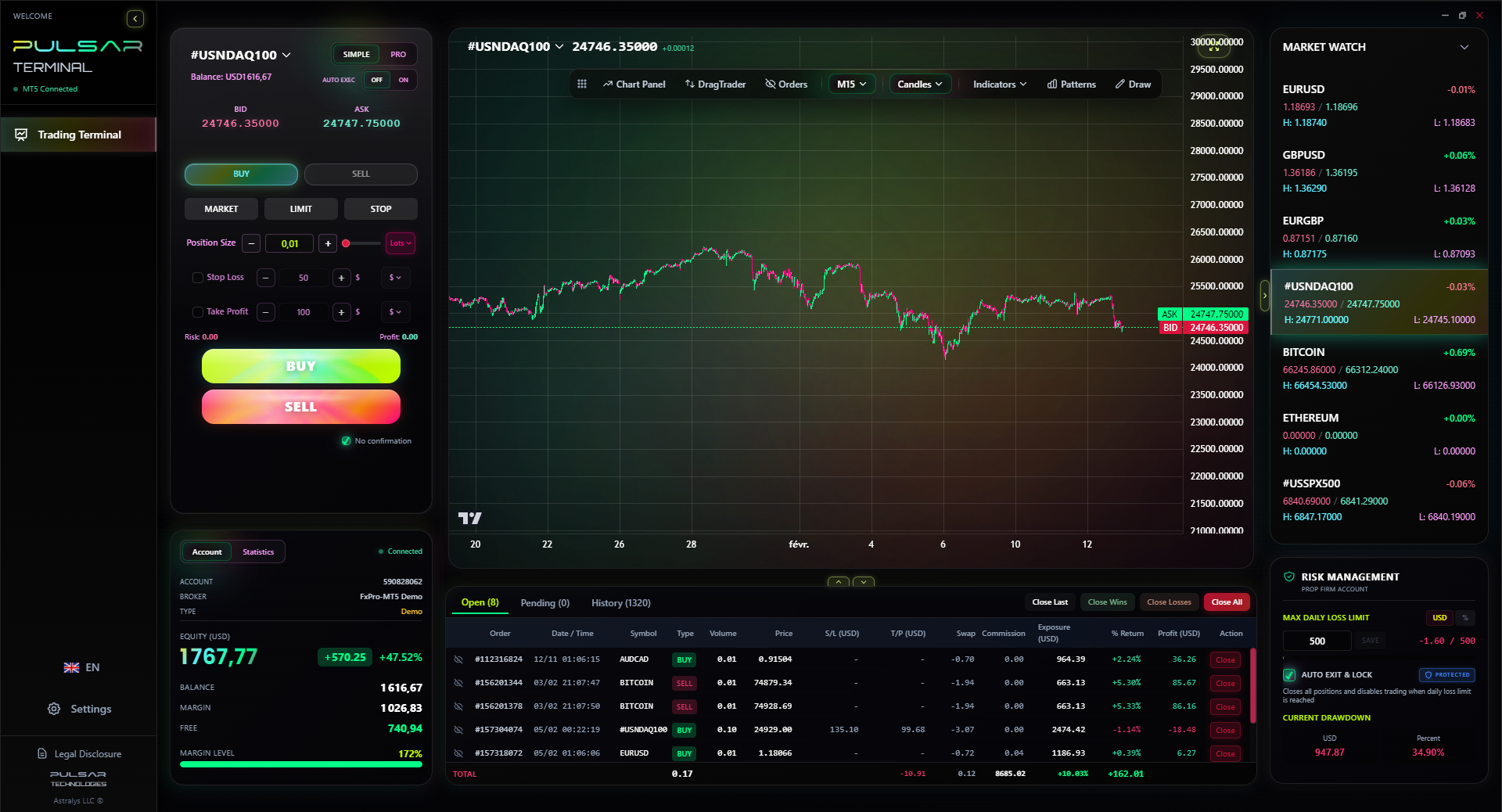
Managing risk manually is hard; tools like Pulsar Terminal automate advanced stop-loss and take-profit orders directly on your MT5 platform, turning your account settings into an active risk manager.
Pulsar Terminal
Alat MT5 all-in-one: order drag-and-drop, multi-TP/SL, trailing stop, grid trading, Volume Profile, dan perlindungan prop firm. Digunakan 1.000+ trader setiap hari.
“Demo accounts are essential, but they lie to you. They don't simulate the gut-churning fear of losing real money.”
Demo accounts are essential, but they lie to you. They give you perfect, slippage-free execution on fictional $50,000 balances. They don't simulate the heart-pounding, gut-churning fear of losing real money. The psychology is completely different.
Use a demo account for three things only:
- Learning the platform's buttons.
- Testing a strategy's mechanics (e.g., where do I place the stop?).
- Getting a feel for market hours.
Do NOT use it to build false confidence. I've seen traders make 100% in a demo month, then lose their real account in a week.
The Right Way to Transition:
- Open a Cent Account with a small amount of real money (e.g., ₦10,000). This is now 'live' psychologically, but the risk is tiny.
- Trade your strategy there for at least two months. You need to see how your emotions react to a string of three losses.
- If you are consistently profitable in the cent account (after all costs), then and only then, fund a standard account with money you can afford to lose completely.
Start small. Your first goal on a live account is not to make 20% a month. Your first goal is to survive for 6 months without blowing up. That's a win. Everything else comes after.
💡 Tips Winston
A demo account proves you can click buttons. A cent account proves you can handle emotions. Only a tracked, journaled performance in a cent account proves you might have a viable edge.
FAQ
Q1What is the minimum amount to open a forex account in Nigeria?
It varies by broker. For standard accounts, it can be as low as $10 (about ₦15,000) with some international brokers, or as high as $100. For cent accounts, you can often start with $1 (₦1,500) or less. The minimum isn't the question you should ask. Ask, 'What is the minimum I can afford to lose while learning?' That's your starting amount.
Q2Can I open a forex account with Naira?
Yes, most brokers catering to Nigerians allow you to deposit directly in Naira. They handle the conversion to USD or EUR internally. However, always check the exchange rate they use, as it often includes a hidden fee that's worse than the official market rate.
Q3Which forex account type is best for beginners in Nigeria?
Start with a Cent Account. No debate. It lets you trade with real money psychology but with micro stakes. Once you have 2-3 months of consistent, profitable results there (tracked in a journal), consider moving a small amount to a Standard account. Avoid ECN accounts initially due to the commission structure.
Q4Is forex trading legal in Nigeria?
Trading forex with international, offshore brokers is a common practice. The Central Bank of Nigeria (CBN) regulates the official forex market but does not license international retail forex brokers. You are responsible for ensuring your broker is regulated by a reputable foreign authority (like CySEC, FCA, ASIC). There is no Nigerian 'SEC' license for these brokers.
Q5How do I know if my broker is safe?
Check their regulatory license number on the regulator's official website. Look for segregated client funds. Read independent reviews (like ours on Exness or Pepperstone). See how long they've been in business. Finally, test their customer support with a difficult question before you deposit.
Q6What's the difference between account balance and equity?
Balance is your cash after all closed trades. Equity is your Balance plus the current profit or loss from your open positions. Equity is your real-time net worth in the account. If you have a losing trade open, your Equity is less than your Balance. This is the most critical number on your screen.
Q7How fast can I withdraw profits to my Nigerian bank?
Typically 1-3 business days after the broker processes the request. The first withdrawal is always slower due to verification. The speed also depends on your bank's processing time. Have your broker's proof of payment ready in case your bank queries the transaction.
Pelajaran Prof. Winston
Poin Penting:
- ✓A forex account is a risk ledger, not a bank account.
- ✓Always choose account type based on your strategy volume, not ads.
- ✓The real cost includes spread, commission, and hidden FX fees.
- ✓Start with a Cent Account to learn real-money psychology.
Seberapa bermanfaat artikel ini?
Klik bintang untuk menilai
Wawasan Trading Mingguan
Analisis & strategi mingguan gratis. Tanpa spam.
Tentang Penulis
Olumide Adeyemi
Pelopor Trading Afrika Barat
Salah satu edukator trading forex paling aktif di Nigeria. 8 tahun pengalaman trading dari Lagos. Spesialis strategi modal rendah dan tantangan prop firm untuk trader Afrika.
Komentar
Peringatan Risiko
Perdagangan instrumen keuangan mengandung risiko signifikan dan mungkin tidak cocok untuk semua investor. Kinerja masa lalu tidak menjamin hasil di masa depan. Konten ini hanya untuk tujuan edukasi dan tidak boleh dianggap sebagai nasihat investasi. Selalu lakukan riset Anda sendiri sebelum trading.
Anda mungkin juga suka

Cara Trading Forex Sukses: 7 Prinsip dari Trader Profesional
Cara trading forex sukses dengan 7 prinsip trader pro: manajemen modal, disiplin, journal trading, backtest. Data nyata, bukan janji profit palsu.
Jam Trading Forex Terbaik untuk Trader Indonesia: Panduan Lengkap dengan Tabel Waktu
Panduan jam trading forex untuk trader Indonesia. Tabel 4 sesi dunia, jam emas 20:00-00:00, sesi mana yang harus dihindari. Data akurat + tips dari trader berpengalaman.
Top 5 Sàn Forex Uy Tín Nhất 2026: Review Jujur dari Trader Indonesia
Top 5 sàn forex uy tín 2026 untuk trader Indonesia. Review jujur: spread, deposit, withdraw, dukungan lokal. Exness, XM, IC Markets & lebih.
Dapatkan Pulsar Terminal
Semua kalkulator ini terintegrasi dalam Pulsar Terminal dengan data real-time dari akun MT5 Anda.
Dapatkan Pulsar Terminal