


Here's a brutal truth most new traders in South Africa learn the hard way: 90% of your success isn't about picking the right direction for EUR/USD.

David van der Merwe
Trader Pasar Berkembang ·  South Africa
☕ 11 mnt baca
Yang akan Anda pelajari:
- 1Free Margin: Your Trading Account's Oxygen
- 2The Math: A Real South African Rand Example
- 3margin-call-stop-out
- 4South African Rules: Your use Cage
- 5How to Manage It: A Tactical Guide
- 6Classic South African Trader Mistakes (I've Made Them All)
- 7Brokers, Platforms, and Tools That Help
- 8For the Experienced: Margin and Strategy
Here's a brutal truth most new traders in South Africa learn the hard way: 90% of your success isn't about picking the right direction for EUR/USD. It's about managing your free margin. I've seen more accounts blown from ignoring this one number than from any bad trade idea. In a market where the FSCA caps your use at 30:1, understanding your usable capital isn't just smart, it's the difference between staying in the game and getting a margin call that empties your account.
Let's cut through the broker jargon. Your free margin is the money in your account that's actually yours to use. It's not tied up in any open trade. Think of it like the cash in your wallet versus the cash you've already put down as a deposit on a car. The deposit is locked in (that's your 'used margin'). The cash in your wallet? That's your free margin.
It's calculated with a simple, critical formula: Equity - Used Margin = Free Margin.
Your equity is your current account balance plus or minus any unrealized profit or loss from open trades. Used margin is the collateral your broker holds to keep your leveraged positions open. What's left over is your lifeline. This is the capital you can use to open new positions or, more importantly, to absorb losses from your current ones without hitting a margin call. If your free margin hits zero, you're done. The broker will start closing your trades to protect their money.

Warning: Never confuse free margin with your account balance. Your balance doesn't account for floating losses. I learned this early on with a USD/ZAR trade. My balance was R20,000, but I had a floating loss of R8,000 on a big position. My equity was R12,000. My free margin was almost gone, but my balance screen lied to me, making me think I was fine. I wasn't.
Let's use real numbers. You deposit R10,000 with an FSCA-regulated broker offering 30:1 use on majors.
Scenario: You buy 1 standard lot (100,000 units) of EUR/USD.
- Margin Required: At 30:1, the margin is about 3.33% of the trade size. For a R1,650,000 notional value (approx. 100,000 EUR), your used margin is roughly R55,000. Wait, that's more than your deposit! This is where use confusion happens. The broker only requires margin on the controlled amount, not the full notional. For a retail account, the calculation is based on the lot size and the pair. For 1 lot at 30:1, the used margin is more like $3,333 USD. Let's say that's R60,000 ZAR at the current rate.
- Your Equity starts at R10,000 (your balance).
- Your Used Margin is R60,000.
- Your Free Margin? R10,000 - R60,000 = -R50,000.
You can't open this trade. You don't have enough equity. This is the broker's platform stopping you from doing something stupid.
Realistic Scenario: You buy 0.1 lots (a mini lot).
- Used Margin is now ~R6,000.
- Equity: R10,000.
- Free Margin: R10,000 - R6,000 = R4,000.
Now you're live. If the trade moves against you by R1,000, your equity drops to R9,000. Your free margin is now R9,000 - R6,000 = R3,000. You can see the cushion shrinking in real-time. This is the number you watch, not just the flashing P&L on your trade. Always use a position size calculator before entering. Guessing will wreck you.

💡 Tips Winston
Your free margin is your strategic reserve. If a general wouldn't march his army into battle with no reserves, don't trade your account with none.
“Free margin isn't just a number; it's your permission slip to stay in the game.”
This is where the rubber meets the road. A margin call is not a polite phone call. It's an automated warning that your account is in the danger zone. A stop-out is the broker's system automatically closing your trades to prevent a negative balance.
How It Works in South Africa
Most local brokers have a clear policy. Let's say your broker has a Margin Call Level at 40% and a Stop-Out Level at 20%.
Margin Level is another key metric: (Equity / Used Margin) x 100.
Back to our example: You have R10,000 equity and R6,000 used margin. Your Margin Level is (10,000 / 6,000) * 100 = 167%. You're safe.
Your EUR/USD trade goes south. Your equity drops to R3,000.
- New Margin Level: (3,000 / 6,000) * 100 = 50%. You're still above the 40% margin call level. You're sweating, but no alert yet.
It gets worse. Equity drops to R2,500.
- Margin Level: (2,500 / 6,000) * 100 = 41.7%. Boom. Margin Call. Your platform will flash warnings. You need to deposit more funds or close some positions immediately to raise your margin level.
If you do nothing and equity falls to R1,500:
- Margin Level: (1,500 / 6,000) * 100 = 25%. This is below the 20% stop-out level? Not yet. At exactly 20% (equity of R1,200), the broker's system will start closing your largest losing position to free up margin. This happens in milliseconds. You have no control. I've had this happen during a ZAR flash crash. One second I had positions, the next they were gone at the worst possible price.

Pro Tip: Never let your account get near the margin call level. If your margin level falls below 100%, it means your floating losses have eaten all your free margin. You are one bad tick away from a forced closure. Treat 100% as your personal red line.
The FSCA isn't trying to spoil your fun. They're trying to stop you from blowing up your life savings in three seconds. Their use caps are your first layer of free margin protection.
- Retail Clients: Max 30:1 on major forex pairs like EUR/USD. For minors and exotics, it's lower (20:1 or 10:1). This directly limits how much used margin you need per trade, preserving your free margin.
- Professional Clients: Can apply for higher use, up to 1:400 with some international brokers like Exness or IC Markets. But qualifying isn't easy. You need significant trading experience (size and frequency), a large portfolio (over R8.5 million), and you have to know what you're doing. It's a double-edged sword. More use means smaller used margin per trade, which sounds good. But it also means your losses multiply faster, vaporizing your free margin at an alarming rate.
The other big rule is segregated accounts. Your money is held separately from the broker's money. This doesn't affect your free margin calculation, but it means if the broker goes under, your R10,000 deposit (and thus your free margin base) is theoretically safer. Always check for FSCA licensing. Don't just trust an '.co.za' website.
“Managing free margin is 90% of the battle. Picking direction is the easy part.”
Managing free margin is active work. It's not a set-and-forget.
1. Position Size is Everything. This is rule number one, two, and three. Using too large a position for your account is the fastest way to strangle your free margin. A good rule of thumb for aggressive risk management: never use more than 5% of your equity as used margin for all your open trades combined. On a R10,000 account, that's R500. That feels tiny, I know. But it keeps you in the game.
2. Use Stop-Losses Religiously. A stop-loss defines your maximum loss on a trade before you even enter. This lets you calculate the worst-case scenario for your free margin. No stop-loss means a losing trade can keep consuming free margin indefinitely.
3. Monitor Margin Level, Not Just Free Margin. The Margin Level percentage gives you a quicker health check. Is it above 500%? You're very safe. Is it dipping toward 150%? Time to reassess your open risk.
4. Factor in All Costs. Your used margin isn't the only thing eating your equity. Remember:
- Overnight Swap Fees: These are deducted/added daily. A long-term trade holding the wrong currency pair can slowly bleed your equity.
- Spread Costs: The spread is the cost of entry. On a 1.3 pip spread for USD/ZAR, you're down R130 immediately on a 1 lot trade. That comes straight off your equity.
5. Have a Cushion. If you need R6,000 in used margin for your trades, don't start with R10,000 equity. Start with R15,000 or R20,000. The extra free margin is your buffer against market noise and your own psychological errors.

Example: I once set up a scalping strategy on USD/ZAR. My plan used 0.5 lots per trade. I calculated my used margin, my stop-loss, and thought I had R2,000 of free margin as buffer. I forgot to account for the wider spreads during the London open. My first three trades all lost the spread immediately on entry. That was R450 gone from my equity before the price even moved. My free margin buffer was 22% smaller than I'd planned. The strategy failed because my margin math was lazy.
💡 Tips Winston
The market's job is to test your lowest margin level. It will find it. Make sure you know what it is before the market does.
Mistake 1: Chasing the 'ZAR Rocket' with No Margin Left. You see USD/ZAR moving fast. You have one trade open, using 70% of your margin. You see another 'sure thing' and force another trade in. Your free margin is now R500. The market reverses slightly against both positions. Margin call. Both trades get liquidated. You lose on two fronts because you had no dry powder.
Mistake 2: Ignoring Correlation. You go long on EUR/USD and long on GBP/USD. They often move together. You think you have two separate trades, but your broker's margin system might not give you a discount for correlated pairs. You've doubled your used margin on one bet. A move against you will wipe out free margin twice as fast.
Mistake 3: Over-leveraging on 'Safe' Gold. XAU/USD (Gold) is popular here. But it's volatile and often has higher margin requirements. Using the same lot size as you would for EUR/USD can lock up more margin, leaving you with less free margin than you expected.
Mistake 4: Not Accounting for Withdrawals. You have R15,000 equity, R5,000 used margin. Free margin is R10,000. You withdraw R8,000. Your equity is now R7,000. But your used margin is still R5,000! Your free margin just crashed to R2,000, and your margin level is now a dangerous 140%. A small adverse move could trigger a call.
“A margin call is the market's way of telling you your math was wrong.”
Your trading platform is your cockpit. You need clear gauges for your margin metrics.
MetaTrader 4/5: The 'Terminal' window shows Equity, Margin, Free Margin, and Margin Level clearly. This is non-negotiable. Keep it open.
Broker Comparisons:
- IC Markets & Pepperstone: Great for raw spreads (as low as 0.0 pips on majors) and clear margin reporting. Their platforms show real-time margin projections. Pepperstone in particular has excellent educational content on margin.
- XM & Exness: Good for ZAR accounts and smaller deposits. XM offers a lot of flexibility for micro-lot trading, which is crucial for building an account while carefully managing free margin.
- Local FSCA Brokers (e.g., IG SA): They enforce the 30:1 cap upfront, which simplifies your calculations. No temptation of crazy use.
Advanced Tools: This is where tech can save you. Manual margin management is tough when you have multiple trades. A tool that can automatically move stop-losses to breakeven or trail them locks in profit and, critically, frees up margin as the trade moves in your favor. Managing a multi-trade portfolio by hand is how mistakes happen.
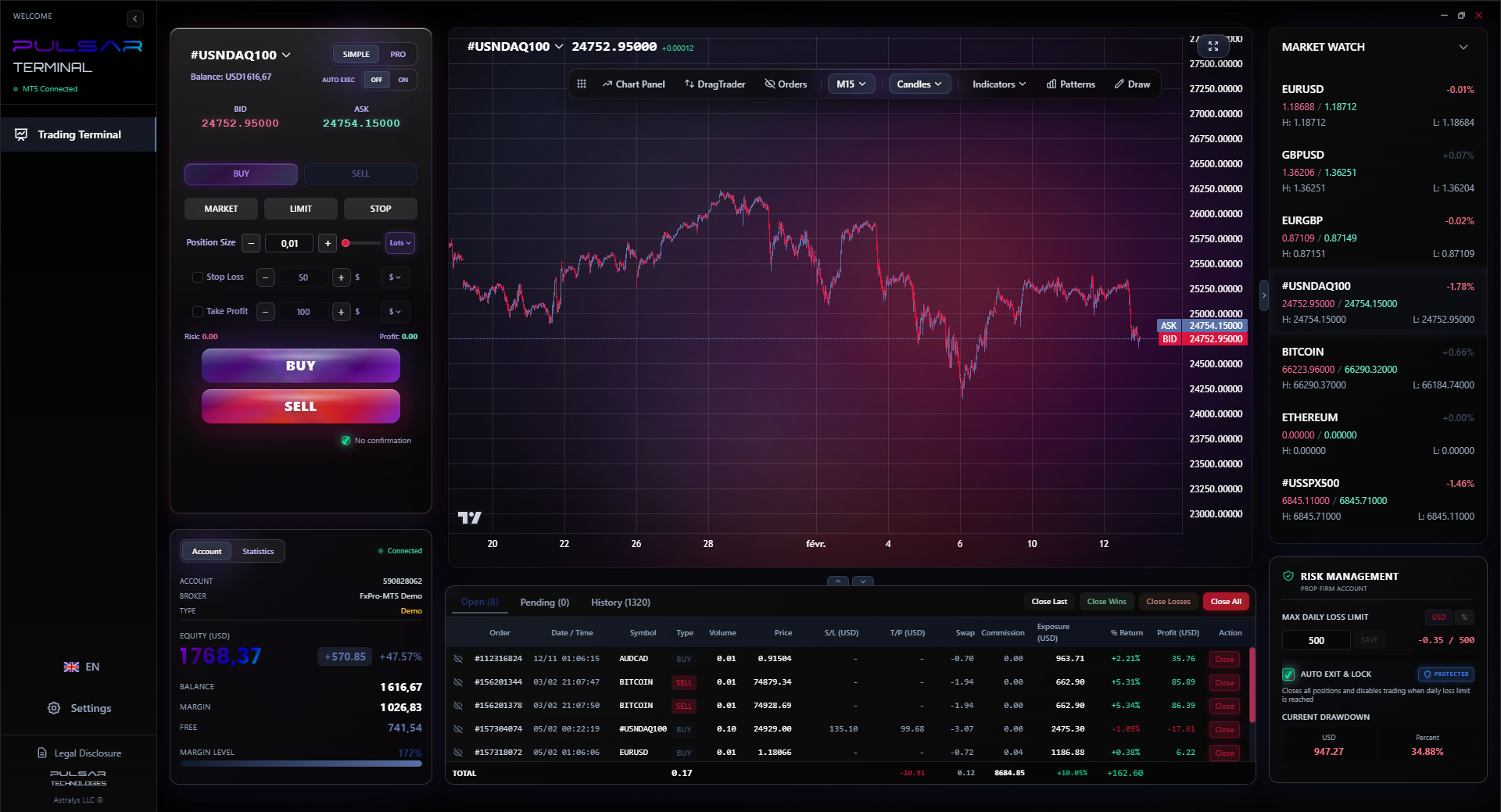
Manually managing stop-losses and margin for multiple trades is a headache; Pulsar Terminal automates trailing stops and breakeven orders directly on MT5, helping you lock in profit and protect your free margin automatically.
Pulsar Terminal
Alat MT5 all-in-one: order drag-and-drop, multi-TP/SL, trailing stop, grid trading, Volume Profile, dan perlindungan prop firm. Digunakan 1.000+ trader setiap hari.
When you graduate from single trades to running a portfolio or a specific strategy, free margin management becomes a strategic exercise.
Hedging: Some brokers offer hedging (holding buy and sell positions on the same pair). This doesn't magically free up margin. Both positions require their own margin collateral, tying up your capital. It's a costly way to be indecisive.
Portfolio Margin: This is for the pros. A sophisticated broker's system might recognize that your long EUR/USD and short GBP/USD position is a correlated spread trade and apply a reduced net margin requirement. This increases your effective free margin. Don't expect this on a standard retail account.
Strategy-Specific Management:
- Scalping: High frequency, small profits. Your used margin is constantly being locked and released. Your free margin will fluctuate wildly. You need a huge buffer to avoid being stopped out by a temporary drawdown on 3-4 simultaneous trades.
- Swing Trading: Fewer trades, held longer. Your used margin is committed for days or weeks. Your free margin is static unless you add funds. You must calculate your maximum drawdown across all swing positions and ensure your free margin can survive it.
The core principle never changes: Free margin is your strategic reserve. Running it to zero means your strategy has no room for error, and the market always, eventually, delivers error.
FAQ
Q1Is free margin the same as profit?
No, absolutely not. Free margin is available capital. Profit (or loss) is the change in your equity. You can have a R5,000 profit on an open trade, which increases your equity and thus your free margin. But that profit isn't 'free' until you close the trade and realize it. Until then, it's just a number that can vanish.
Q2What happens if my free margin goes negative?
You can't have negative free margin. The broker's platform won't let you open a new trade that would cause it. If your existing trades lose so much money that your equity falls below your used margin, your free margin is zero and your margin level is below 100%. You'll get a margin call and then a stop-out before free margin itself goes negative.
Q3How much free margin should I have?
There's no perfect number, but a good rule is to never let your Margin Level fall below 200%. This means your equity is at least double your used margin. It gives you a massive buffer. For new traders, I'd say keep it above 500%. It feels conservative, but it lets you sleep at night.
Q4Does a wider spread affect my free margin?
Yes, the moment you open a trade. The spread is the cost of entry. If you buy EUR/USD, you buy at the higher ask price. If you sold immediately, you'd sell at the lower bid price. That difference is a loss. This loss is deducted from your equity immediately, which reduces your free margin right from the start.
Q5Can I increase my free margin without depositing more money?
Yes, in two ways: 1) Close a profitable trade. This realizes the profit, adding it to your balance/equity. 2) Close a losing trade. This realizes the loss, which hurts, but it also releases the used margin that was locked up, increasing your free margin. Sometimes cutting a loser is necessary to free up margin for a better opportunity.
Q6Do all brokers in South Africa have the same margin call rules?
No. The FSCA sets use limits, but the specific Margin Call and Stop-Out levels (like 40% and 20%) are set by the broker. You must check your broker's specific policy in their terms and conditions. It's usually under 'Margin Requirements' or 'Liquidation Policy'. Never trade without knowing these numbers.
Pelajaran Prof. Winston
Poin Penting:
- ✓Free Margin = Equity - Used Margin. Memorize it.
- ✓Never let your Margin Level fall below 100%.
- ✓FSCA's 30:1 use is a protective cage, not a limit.
- ✓Position size controls your used margin. Control your size.
Seberapa bermanfaat artikel ini?
Klik bintang untuk menilai
Wawasan Trading Mingguan
Analisis & strategi mingguan gratis. Tanpa spam.
Tentang Penulis
David van der Merwe
Trader Pasar Berkembang
Trader berbasis Johannesburg dengan 11 tahun di mata uang pasar berkembang. Spesialis pasangan ZAR, trading berregulasi FSCA, dan analisis pasar Afrika Selatan.
Komentar
Peringatan Risiko
Perdagangan instrumen keuangan mengandung risiko signifikan dan mungkin tidak cocok untuk semua investor. Kinerja masa lalu tidak menjamin hasil di masa depan. Konten ini hanya untuk tujuan edukasi dan tidak boleh dianggap sebagai nasihat investasi. Selalu lakukan riset Anda sendiri sebelum trading.
Anda mungkin juga suka

Cara Trading Forex Sukses: 7 Prinsip dari Trader Profesional
Cara trading forex sukses dengan 7 prinsip trader pro: manajemen modal, disiplin, journal trading, backtest. Data nyata, bukan janji profit palsu.
Jam Trading Forex Terbaik untuk Trader Indonesia: Panduan Lengkap dengan Tabel Waktu
Panduan jam trading forex untuk trader Indonesia. Tabel 4 sesi dunia, jam emas 20:00-00:00, sesi mana yang harus dihindari. Data akurat + tips dari trader berpengalaman.
Top 5 Sàn Forex Uy Tín Nhất 2026: Review Jujur dari Trader Indonesia
Top 5 sàn forex uy tín 2026 untuk trader Indonesia. Review jujur: spread, deposit, withdraw, dukungan lokal. Exness, XM, IC Markets & lebih.
Dapatkan Pulsar Terminal
Semua kalkulator ini terintegrasi dalam Pulsar Terminal dengan data real-time dari akun MT5 Anda.
Dapatkan Pulsar Terminal