


Most traders in Nigeria think market structure is just drawing lines on a chart.

Olumide Adeyemi
Pelopor Trading Afrika Barat ·  Nigeria
☕ 13 mnt baca
Yang akan Anda pelajari:
- 1Market Structure Isn't What You Think It Is
- 2The Three States of the Market: Uptrend, Downtrend, and Range
- 3Why Nigerian Traders Consistently Misread Structure
- 4How to Actually Spot and Trade Structure: A Live Chart Walkthrough
- 5Merging Theory with Nigerian Broker Reality
- 6Beyond the Basics: Order Blocks & Fair Value Gaps
- 7The Top 3 Structural Pitfalls (And How to Fix Them)
- 8Your Weekly Structure Analysis Routine
Most traders in Nigeria think market structure is just drawing lines on a chart. They're wrong, and that's why they lose money. The real story is about understanding the invisible auction happening behind every candlestick - who's in control, who's getting squeezed, and where the real pain points are. I've seen too many guys in Lagos and Abuja focus on fancy indicators while completely missing the market's basic grammar. Let's set the record straight. Understanding what is market structure forex is the single most important skill you can develop, especially when trading with the Naira's unique volatility.
Forget the textbook definitions for a second. In practical terms, market structure is the story of price rejection and acceptance. It's the footprint left behind after buyers and sellers fight it out.
Think of it like this: price doesn't move in a random walk. It moves from one area of consensus (a high or low where everyone agreed to stop) to the next. Your job is to map those points of agreement.
The core components are simple:
- Swing Highs & Lows: These are the turning points. A swing high is where price rose, then got rejected and fell. A swing low is where it fell, found buyers, and bounced.
- Market Structure Shift (MSS): This is the key event. It happens when price breaks a previous swing high in a downtrend (or a swing low in an uptrend). This is the market telling you, "The old trend is likely over." It's not a guarantee, but it's a major warning sign.

Warning: A common mistake is labeling every little wiggle as a swing point. On a 1-hour chart, you need a clear rejection over several candles. If you're over-drawing, you're creating noise, not analysis.
I learned this the hard way in 2018. I was short on GBP/JPY, convinced the downtrend was strong. Price made a lower low, then rallied back and took out the previous swing high. I ignored it, thinking it was just a pullback. That 'pullback' turned into a 400-pip rally against me. I didn't respect the market structure shift. That trade cost me $1,200. The chart was screaming the trend had changed, and I was deaf to it because I was married to my indicator signals.
This is the foundation. Everything else - supply and demand, order blocks - is built on this simple framework of highs and lows. If you want to move beyond basic scalping strategy and into more nuanced swing trading, this is your entry point.

💡 Tips Winston
The market's memory is about 3-5 swing points long. Don't clutter your chart with ancient history. Focus on the most recent high, the most recent low, and the ones immediately preceding them. That's where the current battle is.
The market is always in one of three conditions. Your trading approach should change completely depending on which one you're in.
Bullish Market Structure (Uptrend)
This is defined by a simple pattern: Higher Highs (HH) and Higher Lows (HL). Price makes a peak (HH), pulls back to a point that's above the previous pullback low (HL), then pushes to a new high. Your bias should be to buy, especially near those higher low areas. The trend is considered intact until price breaks below the most recent significant higher low.
Bearish Market Structure (Downtrend)
The opposite: Lower Highs (LH) and Lower Lows (LL). Price makes a low, rallies to a point lower than the last rally high (LH), then falls to a new low. Your bias is to sell, particularly on tests of those lower high areas. I find bearish structures often break down faster than bullish ones - fear is a stronger emotion than greed.
Ranging or Sideways Market Structure
This is where most retail traders get chopped up. Here, you see Equal Highs (EH) and Equal Lows (EL). Price oscillates between a clear resistance top and a support bottom without making new extremes. In this environment, trend-following strategies will fail. You need to buy low and sell high, or use breakout strategies waiting for the range to fail.
| Market State | Defining Pattern | Trader Bias | Key Risk |
|---|---|---|---|
| Uptrend | HH & HL | Buy on Pullbacks | False break of HL |
| Downtrend | LH & LL | Sell on Rallies | False break of LH |
| Range | EH & EL | Fade Extremes | Breakout Fakeout |
Here's a Nigerian-specific angle: major Naira pairs (like USD/NGN on broker platforms) can spend long periods in artificial-looking ranges due to CBN intervention, then explode violently when pressure builds. That range isn't a time to relax; it's a time to watch for accumulation. A broker like XM or Exness, which offers these pairs, will show you this structure clearly.
“Market structure is the story of price rejection and acceptance, the footprint left after buyers and sellers fight it out.”
Our environment sets us up to fail if we're not careful. It's not just about knowledge; it's about the unique pressures we face.
First, internet instability. You're analyzing a 4-hour chart to spot a key swing low, your network drops, and by the time you're back, price has ripped through your intended entry and you're chasing. This leads to entering trades at terrible points in the structure, often right at a swing high instead of a low. I've missed countless optimal entries in Lagos because of 'network issues.' The solution? Use platforms with reliable mobile apps and set alerts. Don't try to catch every move.
Second, the search for 'quick money' ignores the patience structure requires. A proper swing high needs time to form. But when you're pressured to make money fast (and we all feel it), you start trading 1-minute charts where noise dominates structure. The spread definition becomes your enemy on these tiny timeframes, eating into profits from what should be good structural trades.
Third, relying on 'signals' from unregulated groups. These signal sellers often point to entries with no regard for the larger market structure. "Buy EUR/USD here!" they say, when the chart is clearly showing a lower high on the daily frame. You're buying into a bearish rally. Until the ISA 2025 is fully enforced, this remains a massive risk. Always do your own structural analysis.
Finally, high use misuse. Brokers like HFM or Exness offer up to 1:2000. When you use that kind of use, a minor move against you - even from a valid structural level - can cause a margin call before the market has a chance to respect that level. You were technically right on structure, but your position size blew you up. I never use more than 1:50 on major pairs now, no matter what the broker offers. It's the only way to survive the volatility around key structural breaks.
Let's make this concrete. I'll use a recent example from Gold (XAU/USD), a popular instrument here.
- Identify the Obvious: Pull up a daily chart. Don't start on lower timeframes; you'll get lost. Look left. In early 2026, Gold was in a clear uptrend: a series of HH and HL.
- Mark the Key Levels: I mark the last significant swing low before a major move up. Let's say that low was at $2150. I also mark the last swing high at $2220.
- Watch for the Break: Price eventually peaks at $2250 (a new HH), then starts falling. The critical moment is when it approaches that old $2150 swing low. This is a make-or-break level.
- The Decision Point: If price bounces strongly off $2150, forming a bullish reversal candle, the uptrend structure (HH & HL) is still valid. That's a potential buy. If it slices cleanly through $2150 and closes below it on the daily, that's a Market Structure Shift (MSS). The uptrend is likely broken. Any long positions should be closed, and you start looking for rallies to sell.

Example: In this scenario, if price breaks $2150, your new bias is bearish. You'd then wait for price to rally back up to retest $2150 from below (old support becomes new resistance). That retest, if it shows rejection (like a pin bar or bearish engulfing), is a high-probability short entry based on the new structure.
I used this exact setup on the XAU/USD guide pair in Q1 2026. The break of a key HL came after a fakeout above a HH. I entered short on the retest, placed a stop loss above the recent swing high, and rode it down for about 85 pips. The profit wasn't from a magic indicator; it was from reading the shift in auction control. Tools like the RSI indicator or MACD indicator can help confirm momentum at these breaks, but they should not lead your analysis.
💡 Tips Winston
A true Market Structure Shift requires energy. Look for a strong, decisive candle to close beyond the key level. A slow grind or a wick that barely scratches it is often a trap. Patience in confirmation saves capital.
“You were technically right on structure, but your position size blew you up. I never use more than 1:50 use.”
Your brilliant structural analysis means nothing if your broker's execution or fees sabotage it. Here’s how to align the two.
Spreads & Slippage: You identify a perfect entry at a swing low of 1.0850 on EUR/USD. But if your broker's spread on the standard account is 2 pips, your real entry is 1.0852. If price reverses off that level by just 3 pips, you're in a losing trade even though you were 'right.' This is why choosing a broker with tight, consistent spreads is non-negotiable for structure trading. Brokers like IC Markets or Pepperstone with raw spread ECN accounts (where you pay a commission but get spreads near 0.0) are built for this style. That $6-$7 commission per lot is a cheap price for accurate execution at critical levels.
Funding and Withdrawals: You spot a major structural setup. You need to fund your account to take the trade. If your local bank transfer to your broker takes 3 business days, the setup will be long gone. You need reliable, fast deposit methods. Using e-wallets like Neteller or Skrill, or local processors integrated with your broker, is essential. This is operational risk management.
use and Position Size: This is the killer. You see a MSS and a perfect retest. You get excited and put on a huge position using 1:500 use. A 10-pip stop loss (which is tight on a daily structure trade) could wipe out 5% of your account. Structure trades often need room to breathe. Use a position size calculator religiously. For a key daily swing level, your stop might need to be 30-50 pips away. With proper position sizing, that's manageable. With insane use, it's a catastrophe waiting to happen.
My rule: I size my position so that if I'm wrong on a clear structural break, I lose a maximum of 1% of my account. No exception. This single rule has saved me more times than any indicator.
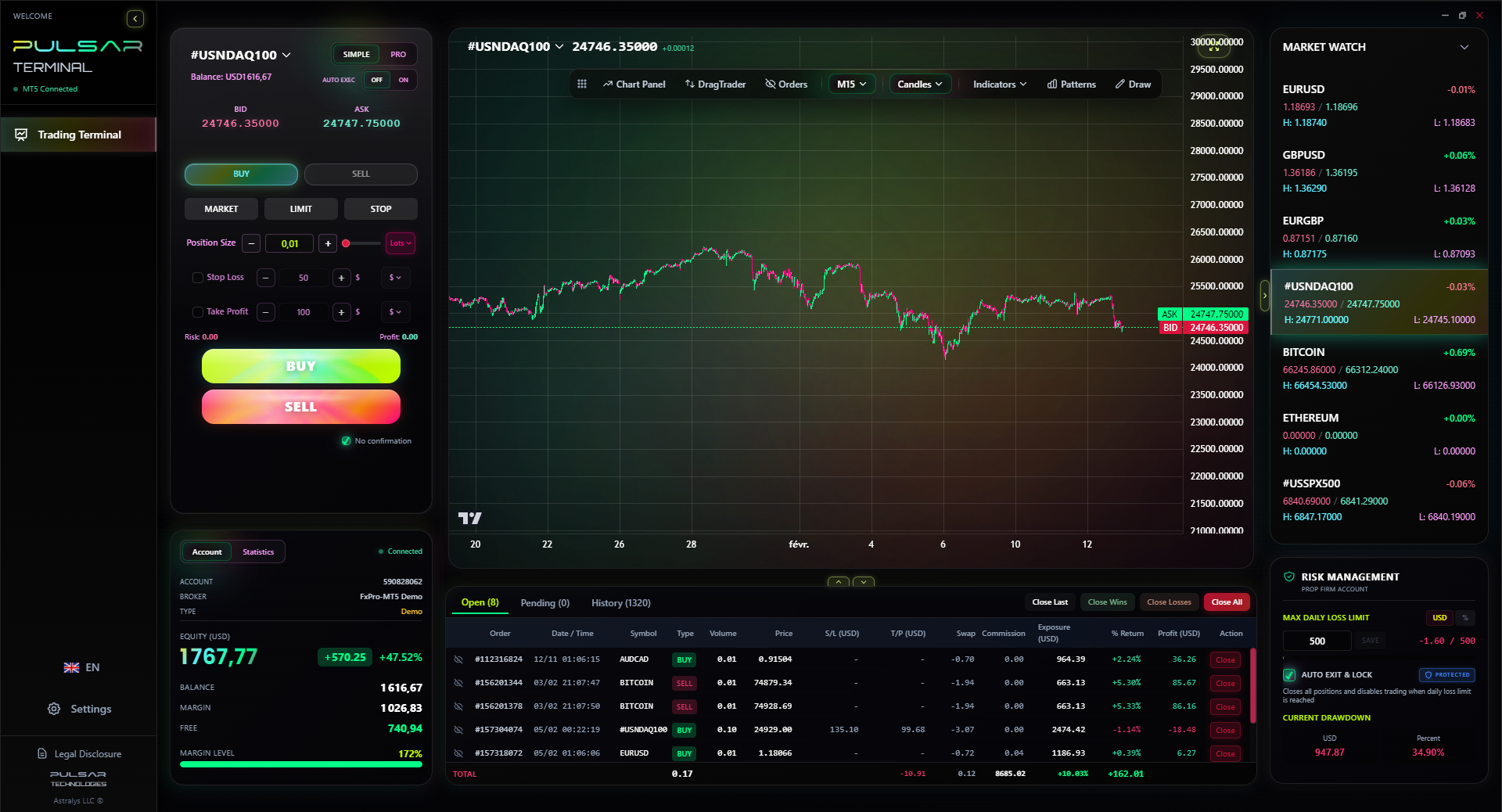
Managing multiple trades at key structural levels is complex, but tools like Pulsar Terminal let you set multi-level take-profits and trailing stops directly on your MT5 charts, automating your exit strategy so you can focus on finding the next setup.
Pulsar Terminal
Alat MT5 all-in-one: order drag-and-drop, multi-TP/SL, trailing stop, grid trading, Volume Profile, dan perlindungan prop firm. Digunakan 1.000+ trader setiap hari.
Once you're comfortable with HH/HL/LH/LL, you can start looking for the why behind the swings. These concepts aren't magic, just a deeper look at auction theory.
Order Blocks (OB): These are the candles just before a big, impulsive move. Think of them as the 'launch pad.' The market rallied 100 pips? Look at the 1-3 candles right before that rally started. That's a bullish order block. The theory is that large orders were filled there, and if price returns to that area, those same big players might add to their positions, causing another reaction. I use them as high-probability zones within the larger structure. For example, in an uptrend, I'd prefer to buy at a bullish OB near a HL than just anywhere.
Fair Value Gaps (FVG) / Imbalances: These are created by explosive moves. On a candlestick chart, it's a gap between the wick of one candle and the body of another. The market 'skipped' price here, leaving an imbalance. Price often returns to 'fill' this FVG later. It acts as a temporary support or resistance. They are excellent for refining entries or setting profit targets.

Pro Tip: Don't start with these. Master basic trend and range structure first. I spent 6 months chasing FVGs on the 5-minute chart before realizing I was missing the daily trend direction. These are filters for your trades, not the primary reason to trade.
These tools help you find better entries within the broader structure you've already identified. They answer the question, "The trend is up and we're at a HL, but where exactly should I place my buy limit?"
“The most powerful entries come on the retest of a broken level, not the initial break. The market loves to trap the crowd.”
After mentoring traders in Abuja and Port Harcourt, I see the same errors on repeat.
Pitfall 1: Trading Every Breakout. Not every break of a swing high/low is a true Market Structure Shift. Sometimes it's a stop hunt - a false break designed to liquidate traders before reversing. The market loves to trap the crowd.
- The Fix: Wait for a close beyond the level on your chosen timeframe (a 4H or Daily close is stronger than a 1H close). Then, wait for the retest. The most powerful entries come on the retest of the broken level, not the initial break.
Pitfall 2: Ignoring Higher Timeframe Structure. You see a perfect bearish structure on the 1-hour chart and go short. But the daily chart is in a raging bull trend with no sign of a break. You're fighting the tide.
- The Fix: Always check the next higher timeframe. My checklist: Daily for bias, 4H for structure, 1H for entry. If they don't align, I avoid the trade or take a much smaller position.
Pitfall 3: Overcomplicating with Too Many Lines. Your chart looks like a spiderweb. You've drawn every minor high and low from the last year. This creates analysis paralysis.
- The Fix: Clean your chart. Only mark the most recent and most significant swing points. The most recent swing high/low and the one before it are usually all you need. The market has a short memory. Use a tool that lets you save clean templates. This is where a disciplined platform setup is key.
💡 Tips Winston
Your first profit target should always be the opposite side of the structure you're trading. In an uptrend, your first TP is the next swing high. Take partial profit there and move your stop to breakeven. Let the rest run.
Knowledge without a system is useless. Here’s a simple routine to bake structure analysis into your trading week.
Sunday Night (Planning):
- Open your trading platform (MT4/MT5 or your broker's platform).
- Look at the Weekly and Daily charts for all pairs you follow. What's the big picture structure? Uptrend, downtrend, or range? Note the key weekly and daily swing levels.
- For example, if USD/NGN is in a range on the weekly between 1450 and 1550, note that. No trend trades until it breaks.
Daily (Before London Open):
- Check the 4-Hour chart. Has there been a break of the key daily levels you noted? Has a Market Structure Shift occurred?
- Identify the current structure on the 4H. Mark the most recent HH/HL or LH/LL.
- Based on this, what is your bias for the day? (e.g., "Daily is bullish, 4H is in a pullback to a HL area. Bias: Look for buys.")
Trade Execution:
- Use the 1-Hour or 30-minute chart to find your precise entry. Look for your entry signal (a pin bar, engulfing candle, etc.) at a key structural level (like that 4H HL).
- Set your stop loss beyond the relevant swing point. If buying at a HL, your stop goes below that HL.
- Set your take profit towards the next structural resistance (the previous HH).
This routine forces you to trade with the trend, respect key levels, and stops you from jumping into random noise. It turns the concept of what is market structure forex from theory into a repeatable, mechanical edge. Now, go look at a chart with fresh eyes. The market is talking. Your job is to learn its language.
FAQ
Q1Is forex trading legal in Nigeria, and who regulates it?
Yes, forex trading is legal for individuals in Nigeria. The key regulators are the Central Bank of Nigeria (CBN), which manages monetary policy, and the Securities and Exchange Commission (SEC). Crucially, the new Investments and Securities Act (ISA) 2025 now requires all online forex trading platforms to register with the SEC, which is a major step towards cleaning up the space and protecting traders.
Q2What is the most important part of market structure for a beginner?
Start with identifying Higher Highs/Higher Lows (uptrend) and Lower Highs/Lower Lows (downtrend) on the Daily and 4-Hour charts. Then, learn to spot a Market Structure Shift - when price breaks a prior swing low in an uptrend or a prior swing high in a downtrend. This one concept will keep you from holding onto losing trades in a trend that has already reversed.
Q3How do I fund my forex account from Nigeria?
You have several options: local bank transfers (can be slow), debit/credit cards (subject to CBN limits on international transactions), and e-wallets like Neteller and Skrill. Many brokers also integrate with local payment processors. For withdrawals, receiving funds internationally can be done via domiciliary accounts, Payoneer, or Wise. Always check your broker's specific supported methods.
Q4What's a good use level for trading based on market structure?
Much lower than you think. Even though brokers offer 1:1000, I recommend never exceeding 1:50 for major pairs when trading daily/4H structure. Structure trades need wider stops (30-50 pips) to be valid. High use with wide stops equals huge risk. Use a position size calculator to ensure a full stop loss only costs you 1% of your account.
Q5Do I have to pay tax on my forex trading profits in Nigeria?
Yes. The Federal Inland Revenue Service (FIRS) generally considers forex trading profits as subject to Capital Gains Tax, which is 10% of your gross profits. If you trade full-time, it may be considered business income. Keep clear records of all your trades, deposits, and withdrawals for tax purposes.
Q6Which brokers are best for Nigerian traders focusing on price action?
Look for brokers with tight, reliable spreads and good execution, as slippage can ruin a perfect structural entry. International brokers like IC Markets, Pepperstone, and XM are popular for their tight ECN spreads and MT4/MT5 platforms. Also consider brokers like HFM or Exness that offer Naira-denominated accounts and local payment methods, but always prioritize execution quality over just convenience.
Q7Can I trade the actual USD/NGN pair?
You cannot trade the official interbank rate as a retail trader. However, many international brokers offer USD/NGN as a CFD (Contract for Difference). Be aware that this is based on the broker's derived price and may have different liquidity and spreads than major pairs like EUR/USD. It can be very volatile around CBN news and policy changes.
Pelajaran Prof. Winston
Poin Penting:
- ✓Identify HH/HL for uptrends, LH/LL for downtrends.
- ✓A Market Structure Shift is your #1 trend reversal warning.
- ✓Always align your trade timeframe with the higher timeframe bias.
- ✓Size your position for a 1% max loss per trade, regardless of use.
- ✓Use tight-spread ECN brokers for accurate execution at key levels.
Seberapa bermanfaat artikel ini?
Klik bintang untuk menilai
Wawasan Trading Mingguan
Analisis & strategi mingguan gratis. Tanpa spam.
Tentang Penulis
Olumide Adeyemi
Pelopor Trading Afrika Barat
Salah satu edukator trading forex paling aktif di Nigeria. 8 tahun pengalaman trading dari Lagos. Spesialis strategi modal rendah dan tantangan prop firm untuk trader Afrika.
Komentar
Peringatan Risiko
Perdagangan instrumen keuangan mengandung risiko signifikan dan mungkin tidak cocok untuk semua investor. Kinerja masa lalu tidak menjamin hasil di masa depan. Konten ini hanya untuk tujuan edukasi dan tidak boleh dianggap sebagai nasihat investasi. Selalu lakukan riset Anda sendiri sebelum trading.
Anda mungkin juga suka

Cara Trading Forex Sukses: 7 Prinsip dari Trader Profesional
Cara trading forex sukses dengan 7 prinsip trader pro: manajemen modal, disiplin, journal trading, backtest. Data nyata, bukan janji profit palsu.
Jam Trading Forex Terbaik untuk Trader Indonesia: Panduan Lengkap dengan Tabel Waktu
Panduan jam trading forex untuk trader Indonesia. Tabel 4 sesi dunia, jam emas 20:00-00:00, sesi mana yang harus dihindari. Data akurat + tips dari trader berpengalaman.
Top 5 Sàn Forex Uy Tín Nhất 2026: Review Jujur dari Trader Indonesia
Top 5 sàn forex uy tín 2026 untuk trader Indonesia. Review jujur: spread, deposit, withdraw, dukungan lokal. Exness, XM, IC Markets & lebih.
Dapatkan Pulsar Terminal
Semua kalkulator ini terintegrasi dalam Pulsar Terminal dengan data real-time dari akun MT5 Anda.
Dapatkan Pulsar Terminal