


I was staring at my screen, my coffee gone cold.

David van der Merwe
Trader Pasar Berkembang ·  South Africa
☕ 10 mnt baca
Yang akan Anda pelajari:
- 1The Stop Out: Your Broker's Circuit Breaker
- 2The Math That Matters: Calculating Your Margin Level
- 3Local Rules: FSCA Regulations and Broker Specifics
- 4How to Avoid the Stop Out: A Trader's Action Plan
- 5Learning from My (Expensive) Mistakes
- 6Stop Out vs. Margin Call: Know the Difference
- 7Beyond the Basics: Advanced Risk Management for SA Traders
I was staring at my screen, my coffee gone cold. It was 3:15 PM on a Tuesday, and the USD/ZAR had just ripped through 18.85. My short position, opened at 18.72 with way too much size, was bleeding. The margin level on my platform ticked down: 45%... 42%... 38%. Then, in a blink, it hit 30%. A series of rapid ‘closing’ sounds chimed from my speakers. No confirmation box, no second chance. My broker’s system had just executed a stop out, liquidating my entire position at 18.91. The loss was locked in, my account balance halved. That’s not a margin call, friend. That’s the stop out. And if you trade with use in South Africa, it’s coming for you too if you’re not careful.
Let's cut through the jargon. A stop out is your broker's automated safety net - or more accurately, their guillotine. It's the point where they decide you've lost enough of their money (the margin they lent you) and they forcibly close your trades to prevent your account from going into a negative balance. You don't get a phone call. You don't get a polite email. The system just does it. Think of it as the final, non-negotiable stage of a margin call. A margin call is a warning; a stop out is the execution.
The math is simple but brutal. Your broker sets a specific margin level percentage, usually between 20% and 50%. When your account's equity (your current balance including floating profits/losses) divided by your used margin (the collateral you've put up for your open trades) hits that percentage, the axe falls. They start closing your worst-performing positions first until your margin level climbs back above their threshold. It's a pure risk management mechanism for them, mandated by regulators like our own FSCA to protect the financial system (and their bottom line).

Warning: A stop out is not a strategy. It's a failure of strategy. If you're relying on your broker to close your trades, you've already lost control of your risk.

💡 Tips Winston
Your broker's stop-out level is the financial equivalent of a cliff edge. Your own stop-loss should be a comfortable chair 10 meters back from it. If you're ever close enough to see the edge, you've already made a critical error in position sizing.
You can't manage what you don't measure. Ignoring your margin level is like driving a bakkie with a blindfold on - you'll hit a pothole eventually. Here’s the formula you need to live by:
Margin Level (%) = (Equity / Used Margin) x 100
Let's make it real with South African Rand. Say you deposit R10,000 into your account. You decide to buy 1 standard lot (100,000 units) of USD/ZAR. With a use of 1:30 (the max for retail on majors under FSCA rules for beginners), your required margin is roughly R3,333. That's your Used Margin.
If the trade moves against you by 50 pips (about R500 loss), your Equity drops to R9,500.
Your Margin Level is now: (R9,500 / R3,333) x 100 = 285%. You're fine.
Now, let's say you got greedy and opened 3 lots with that same R10k. Your Used Margin is now ~R10,000. A 100-pip move against you (R1,000 loss per lot, so R3,000 total) drops your Equity to R7,000.
Margin Level: (R7,000 / R10,000) x 100 = 70%. You're now in the danger zone. Most platforms will show this in bright red. If your broker's stop-out level is 50%, you only have a 20% buffer before the automatic liquidation starts. This is why using a position size calculator isn't just advice; it's survival.
The Domino Effect of a Stop Out
The worst part? It often happens at the worst possible time. Markets get volatile, spreads widen, and your stop out can get executed at a much worse price than you expected. I learned this the hard way during a SARB interest rate announcement. My calculated stop-out point was at a 150-pip loss. Due to slippage, the actual closures averaged a 190-pip loss. That extra 40 pips per lot was pure, avoidable carnage.
“A stop out is not a strategy. It's a failure of strategy.”
Trading in South Africa isn't the wild west. The Financial Sector Conduct Authority (FSCA) has laid down the law to protect retail traders like us. Their use caps are your first line of defense against a rapid stop out. For beginners, you're capped at 1:30 on major pairs and 1:20 on minors. Experienced traders can apply for 1:100. This isn't to annoy you; it's to stop you from blowing up your account in five minutes.
All reputable brokers operating here, like IG or AvaTrade, must be licensed as Financial Service Providers (FSPs). This means they must segregate your client funds from their own - your money is safe if they go bust. They also must clearly disclose their stop-out levels. You can't complain you didn't know.
Here’s a quick look at how some popular brokers handle it (always check their latest website):
| Broker | Typical Stop-Out Level | FSCA Regulated? | Key Note for ZAR Traders |
|---|---|---|---|
| IG | 50% | Yes | Major global player, solid platform. |
| Tickmill | 30% | Yes (via SA subsidiary) | Low-cost, good for scalping. |
| Exness | Varies by account (e.g., 20% for Pro) | Yes | Offers ZAR accounts, very flexible use. |
| XM | 50% | Yes | Popular for bonuses and educational resources. |
The recent exit from the FATF grey list (Oct 2025) is good news - it means our financial regulations are being taken seriously globally. But it doesn't change the core rule: you are responsible for your own risk. The broker's stop-out level is just the final backstop.
Preventing a stop out is 100% in your control. It's about discipline, not genius. Here’s what I do now, after that costly USD/ZAR lesson.
1. Trade with Proper Capital. Starting with R500 is a joke. You'll be over-leveraged by your second trade. A realistic minimum for sensible swing trading is R5,000-R20,000. This gives you room to breathe and use sane position sizes.
2. The 1% Rule is Your Bible. Never risk more than 1% of your account equity on a single trade. On a R10,000 account, that's R100. If your stop-loss is 50 pips away on USD/ZAR, your position size must be small enough that a 50-pip loss equals R100. This single habit builds a fortress between you and a stop out.
3. Monitor Your Margin Level Religiously. I keep my platform's terminal window open at all times. If my aggregate margin level dips below 200%, I'm reviewing all open trades. Below 100%, I'm not opening anything new. I treat 50% (the common stop-out level) as a cliff edge I should never see.
4. Use Stop-Losses on EVERY Trade. This is non-negotiable. Your stop-loss is your designated exit point based on your strategy. The broker's stop out is a chaotic, emergency exit. One is planned, the other is panic. Setting a stop-loss also reduces your used margin, which directly improves your margin level.

Pro Tip: When trading volatile pairs like USD/ZAR or exotic crosses, use a wider stop-loss but a proportionally smaller position size. This keeps your monetary risk (that 1%) the same while giving the trade room to move without getting whipsawed. It's better to be stopped out less often by your own logic than more often by the market's noise.
💡 Tips Winston
I calculate my maximum position size *before* I even look at the chart for a setup. If the potential reward doesn't justify risking my predefined 1%, I skip the trade. No exception. This discipline has saved me from more stop outs than any indicator ever could.
“Preventing a stop out is 100% in your control. It's about discipline, not genius.”
Theory is cheap. Let me show you where real money was made and lost.
The Bad (My USD/ZAR Stop Out):
- Account: R50,000
- Trade: Short USD/ZAR at 18.72. Convinced the Rand would strengthen.
- Mistake: Used 5 lots. Used Margin = ~R16,600. Risked over 6% of my account.
- Stop-Loss: None. I was "confident."
- What Happened: US inflation data surprised to the upside. USD/ZAR spiked. My margin level plummeted from 300% to 30% in under an hour. Stop out triggered. Positions closed at an average of 18.91.
- Loss: 190 pips x 5 lots = R9,500 loss. A 19% account drawdown in one trade. It took me three months of disciplined trading to claw that back.
The Good (A Managed Gold Trade):
- Account: R100,000
- Trade: Long XAU/USD (Gold) at $1,820.
- Plan: 1.5 lots. Used Margin = $1,200 (approx. R22,000). Risk: 1% of account (R1,000). Stop-Loss set at $1,810 ($10 risk per lot x 1.5 lots = $15 = ~R270). Far below my risk cap.
- What Happened: Gold rallied to $1,850. I took partial profits at $1,840. My margin level never fell below 450%. Even if it reversed all the way to my stop, my loss was predefined and survivable.
The difference? In the second trade, the broker's stop-out mechanism was irrelevant. I was in control. My own stop-loss would have closed the trade long before my margin level became a concern. That's the goal.
Traders use these terms interchangeably, but they're different stages of the same crisis.
Margin Call: This is the warning shot. It's when your broker's system alerts you that your margin level has fallen below a certain threshold (often 100%). It's saying, "Hey, your account is low on available funds to cover your positions. You might want to add money or close some trades." Some brokers send an email or SMS. With others, it's just a notification in your platform. You still have time to act.
Stop Out: This is the forced liquidation. The warning period is over. Your margin level has hit the critical, pre-defined level (e.g., 30%). The broker's system now automatically starts closing your positions to bring your margin level back up. Your input is no longer required or accepted.
In South Africa, with many brokers using the MT4/MT5 platform, you'll see your "Margin Level" figure in the Terminal window. Watch it like a hawk. If it's falling, you're approaching the margin call zone. If it's plummeting, you're seconds from a stop out. Understanding this distinction is the difference between having a chance to save a trade and watching it get automatically slaughtered.
“The difference between a stop-loss and a stop out is the difference between a planned retreat and a chaotic rout.”
Once you've mastered position sizing and stop-losses, you can layer in more sophisticated tools. These aren't to increase risk, but to manage it more dynamically.
Trailing Stop-Losses: This is a personal favourite for trend-following trades. Instead of a static stop-loss, it moves up (for a long trade) as the price moves in your favour, locking in profits. It protects you from giving back all your gains if the trend suddenly reverses. The key is to set the trailing distance wide enough so normal market noise doesn't kick you out.
Correlation Awareness: This is a big one South African traders miss. If you're long USD/ZAR, and you also decide to go long on a USD-based mining stock CFD, you're doubling down on the same dollar-strength bet. If the dollar weakens, both positions will lose money simultaneously, crushing your equity and margin level twice as fast. Diversify your exposures, not just your instruments.
Volatility Adjustments: The USD/ZAR can be a sleepy 50-pip range day or a wild 300-pip monster. Before you enter, check the recent Average True Range (ATR). If volatility is high, widen your stop-loss and reduce your position size accordingly. Your RSI indicator or MACD indicator might give you a signal, but your position size should be dictated by the current market noise.
Finally, always have a worst-case scenario plan. Ask yourself: "If every open trade I have hits its stop-loss at the same time, what will my account balance be?" If the answer scares you, reduce your positions now. A stop out is what happens when you avoid asking that question.
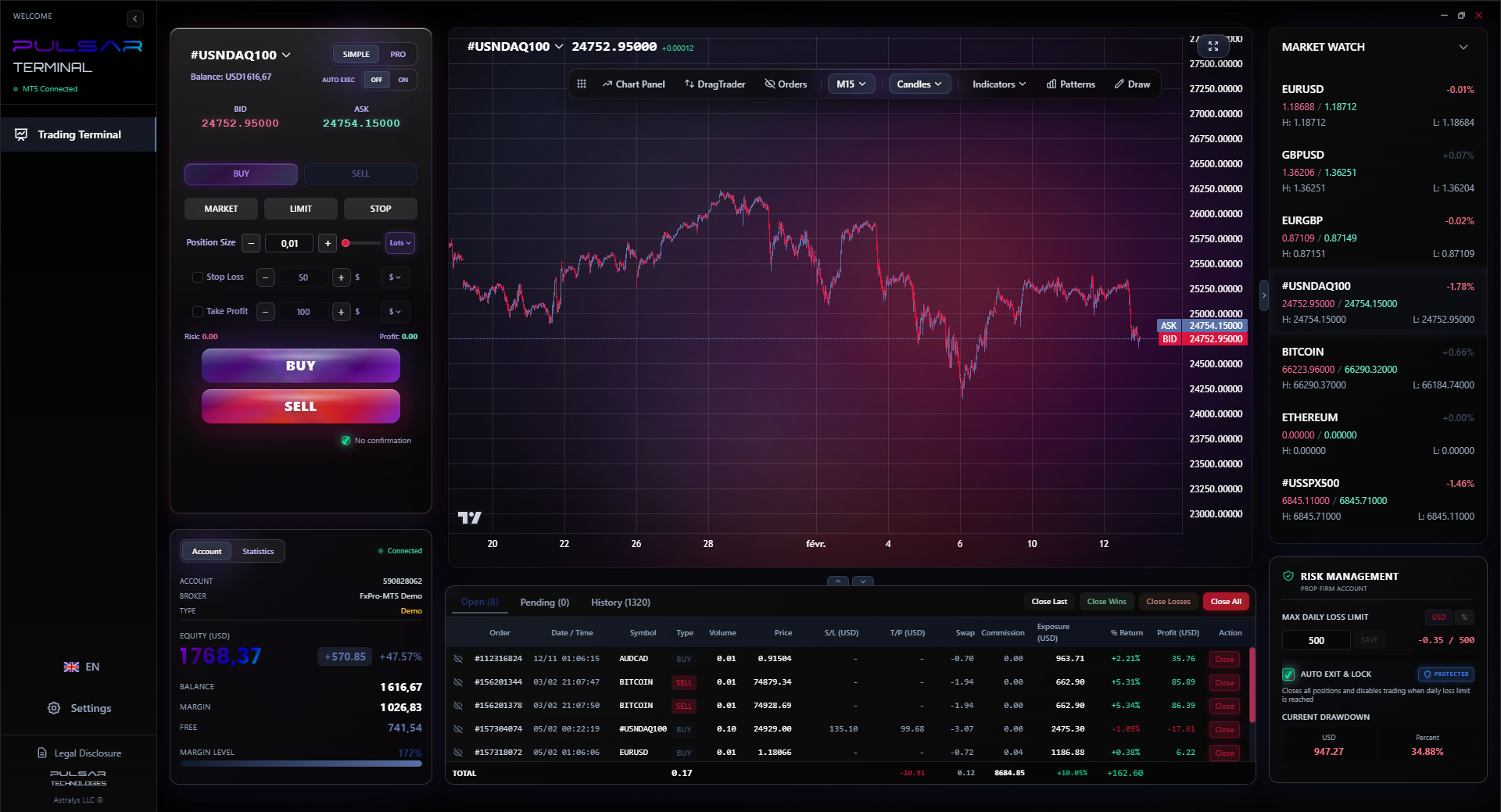
Managing multiple trades and their stop-losses manually is how you miss a margin call. Pulsar Terminal lets you set and automate trailing stops, breakeven moves, and multi-level exits directly on MT5, so your risk management runs itself.
Pulsar Terminal
Alat MT5 all-in-one: order drag-and-drop, multi-TP/SL, trailing stop, grid trading, Volume Profile, dan perlindungan prop firm. Digunakan 1.000+ trader setiap hari.
FAQ
Q1What is a typical stop-out level for South African forex brokers?
Most FSCA-regulated brokers in South Africa set their stop-out level between 20% and 50%. For example, IG and XM often use 50%, while Tickmill might use 30%, and Exness can go as low as 20% for professional accounts. You must check your specific broker's terms before you fund your account.
Q2Can I get my trades back after a stop out?
No. Once the broker's system triggers a stop out and closes your positions, those trades are finished. The losses are realized and permanently reflected in your account balance. You cannot 'reopen' them at the closed price. This is why prevention is everything.
Q3Does a stop out affect my credit score in South Africa?
Directly, no. A forex trading account is not a credit facility like a loan or credit card. However, if you funded your account via a credit card and the stop out causes you to default on that card's payment, then that default would affect your credit score. The trading loss itself is not reported to credit bureaus.
Q4What happens if my account goes negative after a stop out?
Under FSCA rules and with reputable brokers that offer negative balance protection, you should not lose more than your deposited funds. The stop-out mechanism is designed to prevent a negative balance. If, due to extreme slippage, your account briefly goes negative, a good broker will absorb that loss and reset your balance to zero. Always confirm your broker has this policy.
Q5Is a higher or lower stop-out level better?
It depends on your strategy. A lower stop-out level (like 20%) gives your trades more 'room' before the broker intervenes, which can be good for high-volatility strategies. However, it also means your account equity can fall much further before the safety net engages. A higher level (like 50%) is more conservative and protects your capital sooner. Neither is inherently better; you must match it to your personal risk tolerance and trade management.
Q6Can I change my broker's stop-out level?
Absolutely not. The stop-out level is a non-negotiable part of the broker's risk management and regulatory compliance. You cannot request a higher or lower level. Your only control is over your own trading: your position size, your stop-losses, and the amount of margin you use.
Pelajaran Prof. Winston
Poin Penting:
- ✓A stop out is an automatic, forced liquidation by your broker.
- ✓It triggers when your Margin Level hits a pre-set % (often 20-50%).
- ✓Always risk a maximum of 1% of your account per trade.
- ✓Your own stop-loss must always be closer than your broker's stop out.
Seberapa bermanfaat artikel ini?
Klik bintang untuk menilai
Wawasan Trading Mingguan
Analisis & strategi mingguan gratis. Tanpa spam.
Tentang Penulis
David van der Merwe
Trader Pasar Berkembang
Trader berbasis Johannesburg dengan 11 tahun di mata uang pasar berkembang. Spesialis pasangan ZAR, trading berregulasi FSCA, dan analisis pasar Afrika Selatan.
Komentar
Peringatan Risiko
Perdagangan instrumen keuangan mengandung risiko signifikan dan mungkin tidak cocok untuk semua investor. Kinerja masa lalu tidak menjamin hasil di masa depan. Konten ini hanya untuk tujuan edukasi dan tidak boleh dianggap sebagai nasihat investasi. Selalu lakukan riset Anda sendiri sebelum trading.
Anda mungkin juga suka

Cara Trading Forex Sukses: 7 Prinsip dari Trader Profesional
Cara trading forex sukses dengan 7 prinsip trader pro: manajemen modal, disiplin, journal trading, backtest. Data nyata, bukan janji profit palsu.
Jam Trading Forex Terbaik untuk Trader Indonesia: Panduan Lengkap dengan Tabel Waktu
Panduan jam trading forex untuk trader Indonesia. Tabel 4 sesi dunia, jam emas 20:00-00:00, sesi mana yang harus dihindari. Data akurat + tips dari trader berpengalaman.
Top 5 Sàn Forex Uy Tín Nhất 2026: Review Jujur dari Trader Indonesia
Top 5 sàn forex uy tín 2026 untuk trader Indonesia. Review jujur: spread, deposit, withdraw, dukungan lokal. Exness, XM, IC Markets & lebih.
Dapatkan Pulsar Terminal
Semua kalkulator ini terintegrasi dalam Pulsar Terminal dengan data real-time dari akun MT5 Anda.
Dapatkan Pulsar Terminal