


You're staring at the charts, finger hovering over the mouse.

David van der Merwe
Trader Pasar Berkembang ·  South Africa
☕ 11 mnt baca
Yang akan Anda pelajari:
- 1The Basic Rule Most Traders Get Wrong
- 2Two Ways to Find Your Entry: The Engine and the Map
- 3The South African Context: Timing, Taxes, and the ZAR
- 4Building Your Personal Trigger System
- 5When NOT to Trade: The Avoid List
- 6Putting It All Together: A Real Trade Walkthrough
- 7Common Pitfalls and How to Dodge Them
You're staring at the charts, finger hovering over the mouse. The price is moving, your heart is racing, and the question screams in your head: 'Do I buy now, or do I sell?' Getting this single decision wrong is why most South African traders blow their accounts within months. I've been there. I've clicked that button out of fear, greed, or plain confusion and watched my capital evaporate. This isn't about finding a magic signal. It's about building a system so you know, with cold clarity, exactly when do you buy or sell in forex trading.
Let's strip it back to absolute basics. When you look at a pair like EUR/USD, you're betting on the relationship between two currencies. If you think the Euro will get stronger against the US Dollar, you buy (go long). If you think the Euro will weaken against the Dollar, you sell (go short).
That's the simple part. The complex part is that most new traders do this backwards. They see the price going up and think 'I must buy!' That's chasing. They see it dropping and panic-sell. That's capitulation. Your job isn't to react to price. It's to anticipate where price is likely to go next based on evidence, not emotion.
I learned this the hard way in 2015 trading USD/ZAR. The pair was in a strong uptrend (Dollar strengthening). I saw a sharp pullback and thought, 'Great! The Rand is recovering, time to buy ZAR.' I sold USD/ZAR. The 'pullback' was just a tiny blip. The trend resumed instantly, and I was stopped out for a 2.5% loss on my account in minutes. I was wrong because I fought the clear trend based on a hope, not a plan. I didn't have a rule for when to buy or sell; I had an impulse.

Warning: Never confuse a price moving in a direction with a valid reason to enter a trade. A rising price is not a 'buy signal' on its own. It's just a fact.

💡 Tips Winston
Your first loss is often your smallest. The moment you try to 'save' a trade by moving your stop, you've switched from trading to gambling.
To know when to act, you need a method. There are two primary ones, and the best traders use a blend of both.
Fundamental Analysis: The Economic Engine
This tells you why a currency might move. You're looking at interest rates (set by the SARB for the Rand), inflation data (CPI), employment numbers, and political stability. If the South African Reserve Bank hikes rates while the US Federal Reserve holds, all else being equal, the ZAR should strengthen against the USD. That's a fundamental reason to consider buying USD/ZAR (selling the pair) or buying a ZAR cross like EUR/ZAR.
But fundamentals are slow. The market often 'prices in' expectations before the news hits. Relying solely on this is like knowing a storm is coming but having no idea when it will arrive.
Technical Analysis: The Price Map
This tells you when the move might happen. You're reading the chart's history to find patterns, support/resistance levels, and momentum clues. It's the language of price action. Tools like the RSI indicator can show overbought or oversold conditions. The MACD indicator can help confirm trend changes.
Here's the synthesis: Fundamentals give you the bias (I think the Dollar will get stronger). Technicals give you the trigger (I will sell EUR/USD when it breaks below this key support level on the 4-hour chart). Without the technical trigger, you're just guessing on timing.

Example: In early 2024, USD/ZAR was trading around 18.50. SARB was holding rates high, but US inflation was hotter than expected. The fundamental bias was for a stronger Dollar. Technically, the pair broke above a consolidation zone at 18.80. That break was the technical trigger to buy USD/ZAR. A trader using both would have caught a move to over 19.00.
“Knowing when to stay out is more important than knowing when to get in. Preserving capital is job number one.”
Trading from South Africa isn't the same as trading from London or New York. Our location, our currency, and our rules create unique edges and pitfalls.
Trading Sessions (SAST): The market is open 24/5, but liquidity and volatility peak when major financial centers overlap. For us, the sweet spot is the London-New York overlap from 3:00 PM to 7:00 PM SAST. This is when you'll see the cleanest, strongest moves on pairs like EUR/USD and GBP/USD. The Asian session (2:00 AM - 11:00 AM SAST) is quieter, but can be good for scalping strategies on certain pairs.
Trading the Rand: Pairs like USD/ZAR, EUR/ZAR, and GBP/ZAR are incredibly volatile. The spread (the cost of entry) is much wider - often 50-100 pips or more - compared to 0.8 pips on EUR/USD. This means your trade starts significantly in the red. You need a much larger price movement just to break even. I treat ZAR pairs like handling nitroglycerin. My position size is always half of what I'd use on a major pair. A good position size calculator is non-negotiable here.
The Tax Man Cometh: This is critical. SARS does not view frequent forex trading as a capital gains activity. Your profits are considered ordinary income and taxed at your marginal rate (up to 45%). You must keep careful records of every trade, deposit, and withdrawal. I use a simple spreadsheet: date, pair, entry/exit, profit/loss in ZAR. Come tax season, it's a lifesaver. A loss on your trades can be deducted against other income, but you must have the proof.
Regulation & Your Money: Only use brokers regulated by the Financial Sector Conduct Authority (FSCA). This ensures client money segregation and a use cap of 30:1 for retail traders (which is a good thing - it saves you from yourself). Brokers like Exness or IC Markets have FSCA-regulated entities. Don't be tempted by offshore entities offering 1000:1 use; it's a shortcut to a margin call.
A 'trigger' is a specific, unambiguous condition that tells you to execute. It removes hesitation. Here’s a simple framework you can adapt.
For a Buy (Long) Trigger:
- Trend Context: The price is above its key moving average (e.g., 200-period EMA) on the daily chart. Uptrend confirmed.
- Pullback Location: Price has pulled back to a previously identified support level or a key Fibonacci retracement level (like the 50% or 61.8% level).
- Momentum Signal: The pullback shows signs of exhaustion. This could be a bullish candlestick pattern (like a hammer or engulfing bar) forming right at the support level, or the RSI indicator dipping near 30 and starting to curl back up.
- Entry: You place a buy order as price breaks the high of that bullish candlestick pattern.
For a Sell (Short) Trigger:
- Trend Context: Price is below its key moving average on the daily chart. Downtrend confirmed.
- Retracement Location: Price has rallied back up to a strong resistance level or a key Fibonacci level.
- Momentum Signal: The rally stalls. A bearish candlestick pattern (shooting star, bearish engulfing) forms, or the RSI touches 70 and turns down.
- Entry: You place a sell order as price breaks the low of that bearish candle.
This is just a template. The key is that every single one of those conditions must be met before you even think about clicking. No condition missing, no 'maybe this time.'

Pro Tip: Backtest this. Don't use real money. Go back on your MT4/MT5 chart, scroll back 6 months, and practice spotting these setups. Mark where you would have entered and exited. You'll quickly see if your trigger system has an edge, or if you're just seeing ghosts.
💡 Tips Winston
If you can't write down your exact entry reason, stop-loss level, and profit target before you click, you don't have a trade. You have a guess.
“Your initial stop-loss is sacred. It is based on your chart analysis, not on your pain tolerance.”
Knowing when to stay out is more important than knowing when to get in. Preserving capital is job number one.
1. Major Economic News Events: When SARB announces interest rates, or the US releases Non-Farm Payrolls, the market can gap 50 pips in a millisecond. Your stop-loss won't protect you; you'll get filled at the next available price, which could be a disaster. I don't trade 15 minutes before or after a high-impact news release. The potential reward isn't worth the existential risk.
2. Low Liquidity Periods: Late Friday night SAST (after New York closes) and Sunday evening when the market reopens. Spreads widen dramatically, and price can be jerked around by a single large order. It's not real movement, it's market mechanics. Wait for the London open.
3. When You're Emotionally Compromised: You just had a big loss. You're angry. You're overtired. You're distracted by personal stuff. Your judgment is impaired. Close the platform. I have a rule: two consecutive losses, and I'm done for the day. No arguing. It prevents the revenge trading spiral.
4. When the Chart is a Mess: Sometimes there's just no clear trend. Price is chopping sideways in a tight range with no discernible structure. This is the market's way of saying 'I'm resting.' Don't try to force a swing trading setup out of chaos. Wait for the breakout with volume.
I learned #4 trading GBP/JPY, a notoriously volatile pair. It was in a 60-pip range for hours. I got bored and tried to scalp the tiny moves. I got whipsawed three times in a row, paying the spread each time, for a net loss of 1.8%. I paid for entertainment, not a trade.
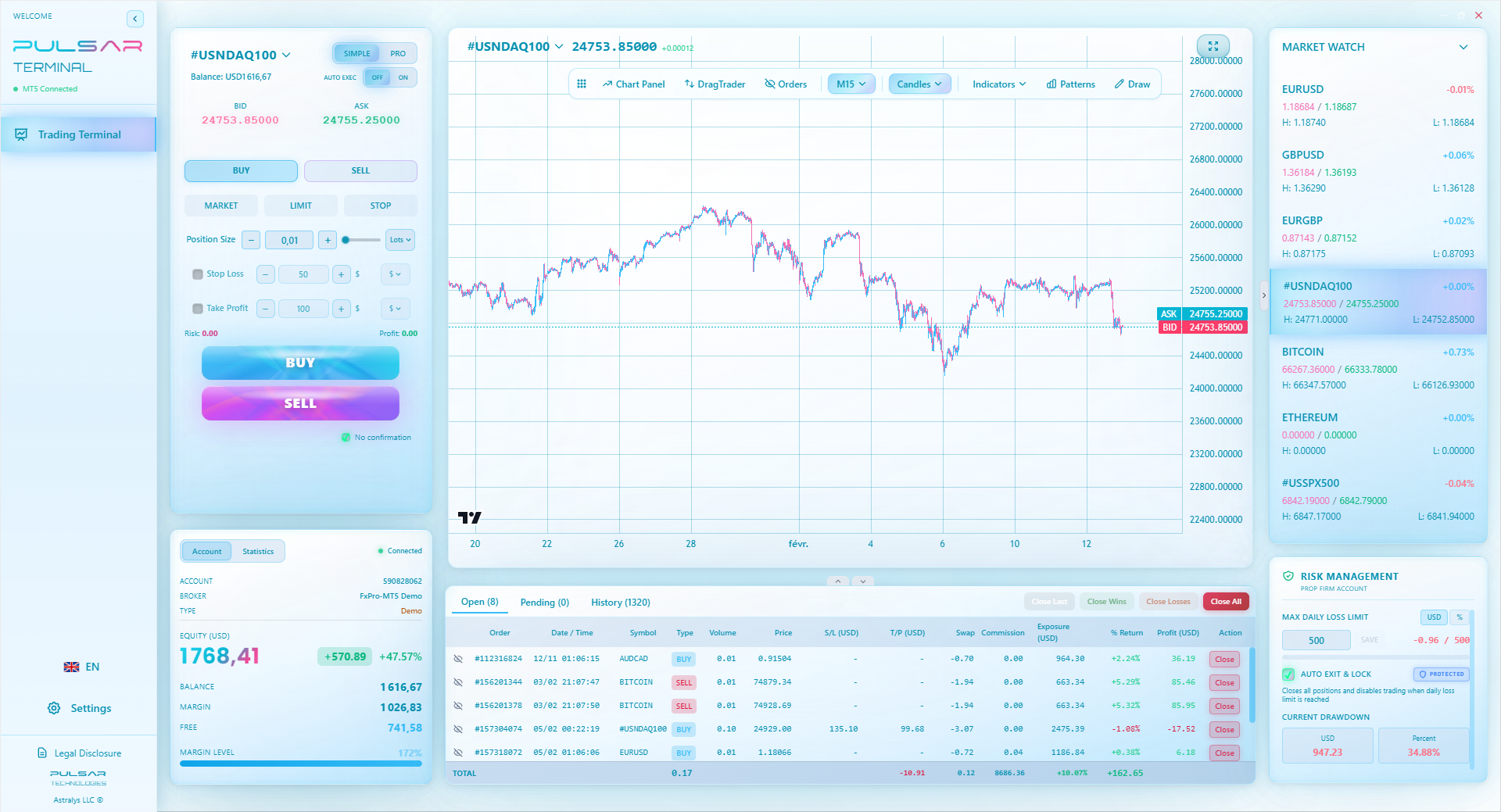
Managing multiple take-profit levels and moving stops to breakeven manually is stressful and error-prone; Pulsar Terminal automates this directly on your MT5 chart with drag-and-drop ease.
Pulsar Terminal
Alat MT5 all-in-one: order drag-and-drop, multi-TP/SL, trailing stop, grid trading, Volume Profile, dan perlindungan prop firm. Digunakan 1.000+ trader setiap hari.
Let me show you how this works in practice with a trade I took on EUR/USD in Q1 2024.
Step 1: The Bias (Fundamental). The ECB was sounding more dovish than the Fed. Bias: Potential Euro weakness / Dollar strength. So, I'm looking for a sell setup.
Step 2: The Chart (Technical). On the daily chart, EUR/USD was below its 200-day EMA (downtrend context). It had rallied up to a key resistance zone at 1.0950, which was also a previous support-turned-resistance area.
Step 3: The Trigger. On the 4-hour chart, as price touched 1.0950, it formed a clear bearish pin bar (a shooting star) candle. The RSI on the 4-hour chart was hitting 65 and curling over. My trigger conditions were met: downtrend context + resistance test + bearish rejection signal.
Step 4: The Execution. I placed a sell limit order at 1.0945 (just below the pin bar's low). My stop-loss was placed at 1.0985, 40 pips above my entry, protecting me if the resistance broke. My first take-profit target was set at 1.0850, a 95-pip move, giving me a risk-to-reward ratio of nearly 1:2.4.
Step 5: The Management. The trade triggered. Price moved down smoothly. I moved my stop-loss to breakeven when price had moved 40 pips in my favor (protecting the trade). It hit my first target. I could have taken partial profit here and trailed the rest.
The Result: Entry: 1.0945. Exit at TP1: 1.0850. Profit: 95 pips. On a standard lot, that's $950. On a 0.1 lot, it's $95. The key was that every step was planned before I entered. I knew when do you buy or sell in forex trading for this specific setup because I had defined it in advance.
💡 Tips Winston
The market's job is to make you feel wrong. It will test your stop-loss before riding in your direction. If your analysis is sound, hold the line.
“A rising price is not a 'buy signal' on its own. It's just a fact.”
Let's be blunt about where you'll likely fail, so you can see it coming.
Pitfall 1: Over-trading. This is the #1 account killer. You take a good trade, it wins. You feel like a genius. You then take 3 more mediocre trades because you're 'in the zone.' You give back all your profits and more. The Dodge: Set a daily or weekly maximum number of trades. Mine is 3 high-quality setups per week. That's it.
Pitfall 2: Moving Your Stop-Loss. You get into a trade, it goes against you. Instead of accepting the small, planned loss, you move your stop-loss further away, 'giving it room to breathe.' This turns a 1% loss into a 5% or 10% disaster. The Dodge: Your initial stop-loss is sacred. It is based on your chart analysis, not on your pain tolerance. Once set, it is not moved further away. Ever.
Pitfall 3: Adding to a Losing Trade (Averaging Down). This is a special kind of hell. Your buy trade is down. You think, 'It's even cheaper now, I'll buy more to lower my average entry.' You're not trading anymore; you're praying for a bounce to save you. The Dodge: It is forbidden. You only add to a trade that is already in profit, proving your thesis was correct.
Pitfall 4: Ignoring the Spread. Especially on exotics like ZAR pairs, a 80-pip spread means you need an 80-pip move just to break even. Choppy markets will eat you alive. The Dodge: Factor the spread into your risk. If your profit target is only 100 pips away and the spread is 80, your trade has almost no edge. Don't take it.
FAQ
Q1What is the best time of day to trade forex in South Africa?
The most active and liquid time is the London-New York overlap, from 3:00 PM to 7:00 PM SAST. This is when you'll find the strongest trends and best opportunities on major pairs like EUR/USD and GBP/USD.
Q2Is forex trading taxable in South Africa?
Yes. SARS treats profits from frequent trading as ordinary income, taxed at your marginal tax rate (which can be up to 45%). It is not treated as capital gains. You must keep detailed records of all trades for your tax return.
Q3Should I trade USD/ZAR as a beginner?
Generally, no. USD/ZAR and other Rand pairs are highly volatile with very wide spreads. This makes them riskier and more expensive to trade. It's better to learn on major pairs like EUR/USD where spreads are tight and price action is cleaner, before moving to ZAR pairs.
Q4How much use should I use as a South African trader?
Use far less than you're allowed. The FSCA retail limit is 30:1, but that's still very high. I rarely use more than 10:1. High use magnifies both profits and losses, and it's losses that destroy accounts. Start low.
Q5What's more important, fundamental or technical analysis?
For most retail traders, technical analysis provides the precise entry and exit triggers. Fundamentals provide the broader context and bias. You need to understand both, but your daily execution will rely heavily on your technical plan.
Q6How do I know if a broker is legit in South Africa?
Check the FSCA's website for their Financial Services Provider (FSP) number. Regulated brokers like Pepperstone or XM will have a clear FSCA registration. Never deposit with an unregulated entity.
Pelajaran Prof. Winston
Poin Penting:
- ✓Define your entry trigger before you see a moving price.
- ✓Trade major pairs first; avoid volatile ZAR pairs as a beginner.
- ✓Use use under 10:1, regardless of the 30:1 FSCA limit.
- ✓SARS taxes trading profits as income - keep careful records.
- ✓The London-New York overlap (3-7 PM SAST) offers the best conditions.
Seberapa bermanfaat artikel ini?
Klik bintang untuk menilai
Wawasan Trading Mingguan
Analisis & strategi mingguan gratis. Tanpa spam.
Tentang Penulis
David van der Merwe
Trader Pasar Berkembang
Trader berbasis Johannesburg dengan 11 tahun di mata uang pasar berkembang. Spesialis pasangan ZAR, trading berregulasi FSCA, dan analisis pasar Afrika Selatan.
Komentar
Peringatan Risiko
Perdagangan instrumen keuangan mengandung risiko signifikan dan mungkin tidak cocok untuk semua investor. Kinerja masa lalu tidak menjamin hasil di masa depan. Konten ini hanya untuk tujuan edukasi dan tidak boleh dianggap sebagai nasihat investasi. Selalu lakukan riset Anda sendiri sebelum trading.
Anda mungkin juga suka

Cara Trading Forex Sukses: 7 Prinsip dari Trader Profesional
Cara trading forex sukses dengan 7 prinsip trader pro: manajemen modal, disiplin, journal trading, backtest. Data nyata, bukan janji profit palsu.
Jam Trading Forex Terbaik untuk Trader Indonesia: Panduan Lengkap dengan Tabel Waktu
Panduan jam trading forex untuk trader Indonesia. Tabel 4 sesi dunia, jam emas 20:00-00:00, sesi mana yang harus dihindari. Data akurat + tips dari trader berpengalaman.
Top 5 Sàn Forex Uy Tín Nhất 2026: Review Jujur dari Trader Indonesia
Top 5 sàn forex uy tín 2026 untuk trader Indonesia. Review jujur: spread, deposit, withdraw, dukungan lokal. Exness, XM, IC Markets & lebih.
Dapatkan Pulsar Terminal
Semua kalkulator ini terintegrasi dalam Pulsar Terminal dengan data real-time dari akun MT5 Anda.
Dapatkan Pulsar Terminal