


Every December, I see the same hopeful question from new traders: 'When does the forex market close for the holidays so I can take a break?' It's the wrong question, and asking it can cost you real money.

David van der Merwe
Trader Pasar Berkembang ·  South Africa
☕ 9 mnt baca
Yang akan Anda pelajari:
Every December, I see the same hopeful question from new traders: 'When does the forex market close for the holidays so I can take a break?' It's the wrong question, and asking it can cost you real money. The market doesn't close. It gets quiet, weird, and dangerous. For traders in South Africa, navigating the thin liquidity between Christmas and New Year isn't about finding opportunities, it's about protecting your capital from getting ambushed by wild price swings and broker shenanigans. Let's set the record straight on what actually happens and how you should trade it.
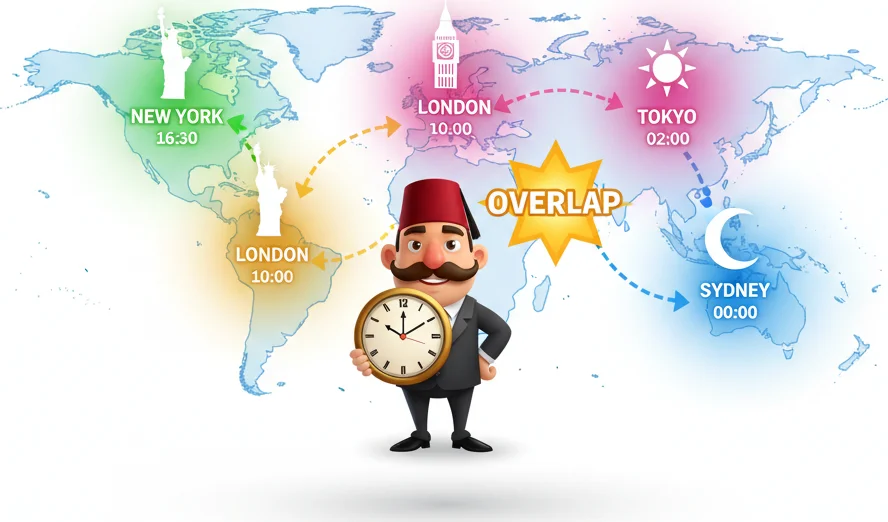
We're taught the forex market is open 24 hours a day, five days a week. That's technically true, but it's a gross oversimplification, especially in December. The market is a network of global trading sessions: Sydney, Tokyo, London, New York. When they're all humming, liquidity is deep. In late December, entire financial centers shut down. London closes early on the 24th and doesn't come back fully until after Boxing Day. New York goes quiet. What's left is a skeleton crew of traders and algorithms, and that's when the rules change.
Think of it like a busy highway (Jo'burg's N1 at 5 PM) suddenly emptying out. Fewer cars, but the ones that are left can swerve wildly without warning. The price you see on your MT5 platform might be the only price available, and the next one could be 20 pips away. This isn't theory. I learned this the hard way in 2018. I left a small stop-loss on a EUR/USD trade over Christmas, thinking 'it's quiet, what could happen?' A random, low-volume spike triggered my stop, took me out for a 15-pip loss, and the price immediately snapped back to where it was. The market didn't move. It just gulped because there was no depth.

Warning: The most dangerous time is often the first full trading day after New Year's. Liquidity is still returning, but pent-up orders from institutions can cause violent, trend-defining moves. Don't assume January 2nd is 'back to normal.'

💡 Tips Winston
Liquidity is your only friend. Trading in its absence is like boxing in a dark room: you're just swinging at ghosts and will eventually walk into a knockout punch.
“The market doesn't close in December. It gets quiet, weird, and dangerous.”
Your FSCA-regulated broker - like Exness, IC Markets, or XM - will publish a holiday schedule. They'll list the days and times when trading on certain instruments is 'closed.' This usually means metals, indices, and sometimes exotic pairs. For majors like EUR/USD, they'll say 'trading as normal.' This is where you need to read between the lines.
'Normal' in this context means 'technically possible to place an order.' It does not mean normal spreads, normal slippage, or normal execution speed. They are covering their regulatory duty to inform you, but they aren't highlighting that their liquidity providers have gone on holiday, leaving them to manage risk with wider buffers.
The Spread Widening You Can Expect
Let's talk numbers. On a normal Tuesday, the spread on EUR/USD might be 0.8 pips on a standard account. On December 26th at 2 PM South African time? I've seen it sit at 3-5 pips for hours. For a pair like GBP/JPY, it can blow out to 10-15 pips easily. This isn't the broker 'ripping you off' in a malicious sense; it's the true cost of transacting in a dead market. If your scalping strategy relies on 2-pip profits, you are mathematically guaranteed to lose in this environment. Your first trade of the day would need to cover a 5-pip spread before making a cent.

Example: You trade 1 standard lot (100,000 units) on USD/ZAR. A typical spread might be 80 pips (yes, it's a wide pair). In thin holiday liquidity, that could widen to 120 pips. Just to break even on that trade, the market needs to move 120 pips in your favor before you even think about profit. That's R10,000 of movement just to cover costs.

“Your stop-loss order is a bright, shiny target sitting on the broker's server in a thin market.”
Low volume doesn't mean low volatility. It often means higher, more erratic volatility. With a thin order book, a single market order from a small bank can shove price much further than it would on a normal day. This creates two huge risks for you.
First, stop-loss hunting becomes more prevalent. Your stop-loss order is a bright, shiny target sitting on the broker's server. In a normal market, it takes significant volume to hit it. In a thin market, a minor wave of orders can sweep through and trigger every stop in a zone before reversing. I've had this happen more than once. In December 2022, I watched GBP/USD spike down 25 pips in under a minute, take out a cluster of obvious stops below support, and then rally 40 pips. It was a classic holiday liquidity raid.
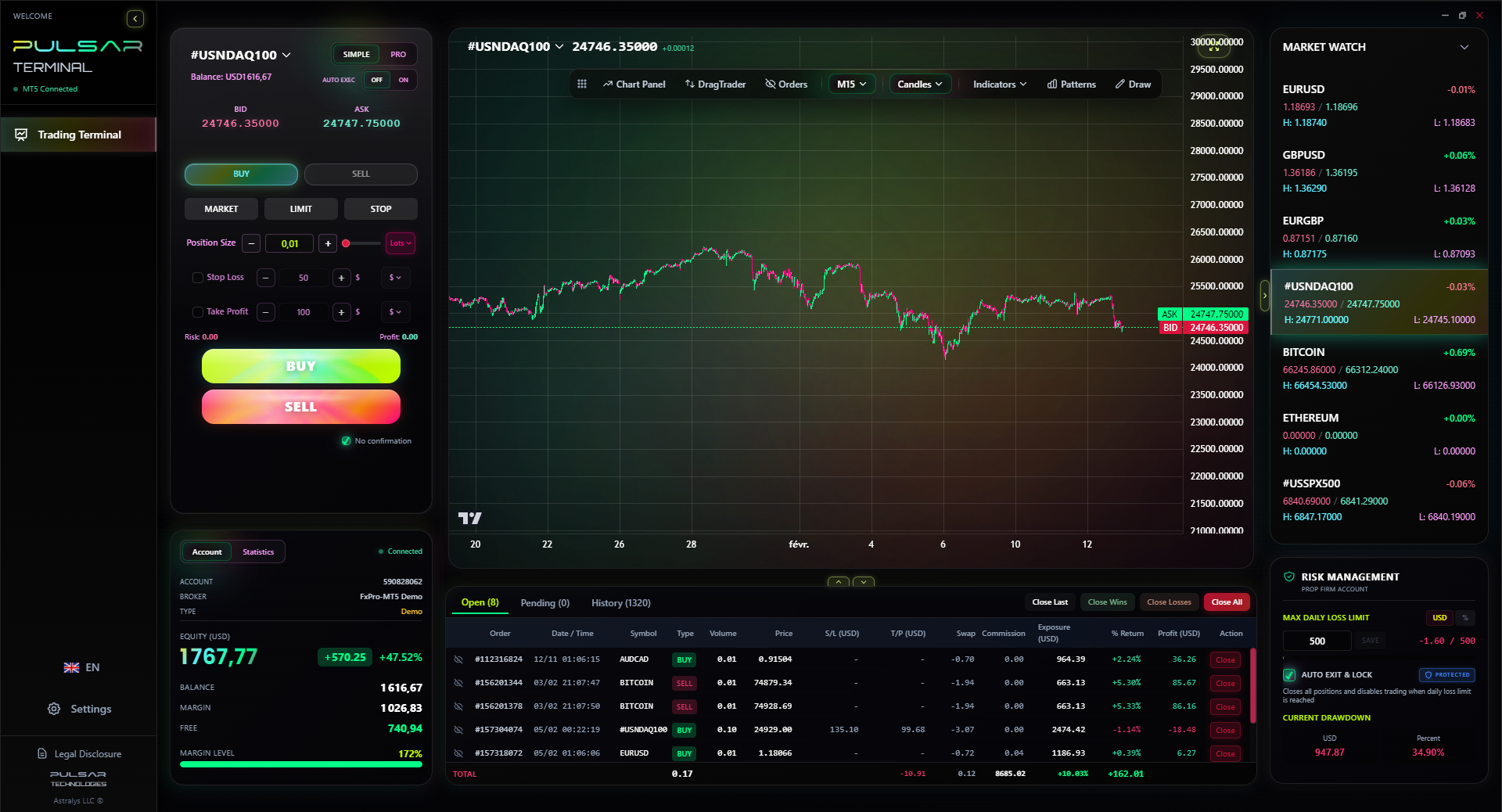
Second, slippage on entry and exit can be catastrophic. You might click 'buy' at 1.1050, but your order gets filled at 1.1057. That's 7 pips of negative slippage you owe before the trade even starts. This is especially brutal if you're trying to get in on a 'breakout' that turns out to be a fake move. Tools that help manage this risk, like a proper trailing stop or the ability to set multiple take-profit levels, become essential. A platform add-on like Pulsar Terminal that lets you drag and drop orders and set partial closures directly on the MT5 chart can save you from frantic clicking during these spikes.

When slippage and erratic stops are your biggest December risks, having precise, drag-and-drop order tools on your MT5 chart isn't a luxury, it's a necessity for survival.
Pulsar Terminal
Alat MT5 all-in-one: order drag-and-drop, multi-TP/SL, trailing stop, grid trading, Volume Profile, dan perlindungan prop firm. Digunakan 1.000+ trader setiap hari.
“Your stop-loss order is a bright, shiny target sitting on the broker's server in a thin market.”
So, do you just shut down your platform from mid-December to mid-January? Not necessarily. But you must shift your mindset from 'hunting' to 'managing.' Here's my personal checklist.
-
Reduce Position Size by at Least 50%. This is non-negotiable. If you normally risk 1% of your account per trade, risk 0.5% or 0.25%. The increased spread width and volatility mean your effective risk is already doubled. Use a position size calculator and input the wider spreads you're actually seeing.
-
Avoid Exotics and Stick to Majors. Pairs like USD/ZAR, EUR/ZAR, and GBP/ZAR can become incredibly illiquid. The spreads are already large; holiday trading makes them punitive. If you must trade, stick to EUR/USD, USD/JPY, and GBP/USD. Even these will be tricky.
-
Widen Your Stop-Losses. A tight 20-pip stop on EUR/USD is just offering yourself up as a sacrifice. Your stop needs to account for the increased normal volatility. If 20 pips is your norm, consider 40-50 pips. This means you must also reduce your lot size to keep your monetary risk the same.
-
Don't Trade Around Major Market Closes/Opens. Avoid the hour before and after the official close of the London or New York session on a holiday eve. This is when brokers are adjusting their systems and liquidity is at its absolute thinnest.
-
Consider This Your Research Period. This is the perfect time to backtest, plan your strategy for January, and review your year's trades. The best trade in December is often no trade at all.

Pro Tip: If you're in a prop firm challenge, December is notoriously dangerous. The thin markets can blow through your daily loss limit in one bad fill. Be hyper-aware of your broker's specific margin call and stop-out levels during this period, as they may be adjusted.
💡 Tips Winston
The spread is the toll for entering the market. In December, that toll becomes a ransom. If you wouldn't pay 5 times the normal price for bread, don't pay it for a pip.
“The discipline to not trade is a higher-level skill than knowing when to trade.”
Mark these periods on your calendar. South African Standard Time (SAST) is key here, as we're often trading after London has gone home.
- Christmas Eve (24 Dec): London typically closes early (around 2 PM SAST). New York closes at normal time (11 PM SAST). Expect volatility to drop off a cliff after London leaves.
- Christmas Day (25 Dec) & Boxing Day (26 Dec): Most global markets are closed. Forex is 'open' but utterly dead. Just don't.
- New Year's Eve (31 Dec): Similar to Christmas Eve. Early London close, quiet New York session. The last few hours of the year can see weird, low-volume moves as books are squared.
- New Year's Day (1 Jan): Global holiday. Markets closed.
The most critical period is the week between Christmas and New Year. This is the true liquidity desert. Also, remember that Monday, January 2nd (or the first weekday after New Year's) is a bank holiday in many countries, so full liquidity may not return until January 3rd.
For a trader in Cape Town or Durban, this means your most active overlap (London afternoon / SA evening) is completely gone. Your usual swing trading rhythm will be disrupted. Adjust your schedule accordingly, perhaps focusing only on the Asian session if you must trade.
“The discipline to not trade is a higher-level skill than knowing when to trade.”
This is the silent killer. You're on holiday, bored, checking your phone. You see EUR/USD make a 30-pip move in 15 minutes. 'It's starting!' you think. 'I'm missing the big January trend move!' So you jump in, often with a larger size because you're 'convinced.' This is how accounts get wrecked.
That 30-pip move might have been on a total volume of ten standard lots. There's no trend, no smart money, just a random fluctuation in an empty market. The moment you enter, it reverses because there's no follow-through. I've been this guy. In 2019, I chased a gold (XAU/USD) breakout on December 27th. Entered at $1512, it immediately stalled, and I spent my whole holiday stressed as it dribbled down to $1504 over two days before I finally cut it. I turned a relaxing break into a miserable watch.
The discipline to not trade is a higher-level skill than knowing when to trade. December tests that discipline mercilessly. Use the MACD indicator or RSI indicator on a 4-hour chart? They'll give you signals, but they're almost meaningless when volume is 90% below average. The machines are still printing crosses, but the market isn't there to validate them.

“December's low volume doesn't mean low volatility. It often means higher, more erratic volatility.”
The smart money uses December to get ready. Here’s a productive alternative plan:
-
Annual Review: Go through every trade from the past year. What was your win rate? Your average win vs. average loss? Which days of the week were you most profitable? Do this manually in a spreadsheet. It’s enlightening.
-
Broker & Tool Audit: Is your broker still competitive? Check their spreads on your main pairs against others like Pepperstone. Do you have the right tools? January's trends are where a tool with Volume Profile or advanced order management can really help you ride a move.
-
Strategy Refinement: Backtest your core strategy. Identify its maximum drawdown period. Plan your capital allocation for Q1. This is the work that separates professionals from hobbyists.
By the time January 3rd rolls around and the big players are back at their desks, you won't be scrambling. You'll be prepared, rested, and your account will be intact, ready to deploy capital in a market that actually makes sense. That's the real edge.
💡 Tips Winston
Your best trading tool in December is the 'Log Off' button. Use it. Preservation of capital is an active strategy, not a passive one.

FAQ
Q1Does the forex market completely close on Christmas Day?
No, it does not technically close. You can still log into your broker's platform and see prices moving. However, all major global financial centers are shut, so trading volume is minuscule, spreads are massively widened, and it is effectively 'closed' for any sensible trading purposes. Placing an order is possible, but it's highly inadvisable.
Q2As a South African trader, when should I completely avoid trading in December?
Mark these days: Christmas Day (25 Dec), Boxing Day (26 Dec), and New Year's Day (1 Jan). Also,, avoid the afternoons/evenings (SA time) on Christmas Eve and New Year's Eve after the London market closes early. The entire week between Christmas and New Year is a liquidity desert and best avoided.
Q3How much wider will spreads get on major pairs like EUR/USD?
While it varies by broker, expect spreads to widen by 3 to 5 times their normal width. A typical 0.8 pip spread can easily become 3-5 pips. For more volatile pairs or exotics like USD/ZAR, the widening can be even more extreme, adding significant cost to your trade before it even starts.
Q4Can I get better execution if I use an ECN broker in December?
An ECN/RAW account (which charges a commission but offers raw spreads) will typically show you the true market spread, which will still be very wide due to a lack of liquidity providers. You might avoid some broker markup, but you cannot avoid the fundamental lack of market depth. Slippage and erratic pricing are still major risks.
Q5Is the volatility in December good for scalping?
Absolutely not. It is the worst possible time for scalping. Scalping relies on tight spreads and predictable, liquid order books to capture small moves. December offers the opposite: wide spreads and unpredictable, choppy price action that will eat up your profits in costs and stopped-out trades.
Q6What is the single biggest mistake traders make in December?
Underestimating the impact of low liquidity. They trade their normal size with their normal stops, not realizing the market environment has fundamentally changed. This leads to being stopped out by meaningless noise and paying far more in transaction costs, eroding their account just before the new year.
Q7When does liquidity and normal trading fully return after New Year's?
Don't expect 'normal' conditions on January 2nd. Many institutions are still offline until the first full week of January. Liquidity usually returns progressively, with things feeling more stable by the second or third trading week of January. Ease back into your full trading size gradually.
Pelajaran Prof. Winston
Poin Penting:
- ✓Spreads widen 3-5x on major pairs in late December.
- ✓Reduce position size by at least 50% if you must trade.
- ✓Avoid all trading on Christmas, Boxing & New Year's Day.
- ✓The first week of January is not 'back to normal.'
- ✓Use the time for annual review, not for reckless trades.
Seberapa bermanfaat artikel ini?
Klik bintang untuk menilai
Wawasan Trading Mingguan
Analisis & strategi mingguan gratis. Tanpa spam.
Tentang Penulis
David van der Merwe
Trader Pasar Berkembang
Trader berbasis Johannesburg dengan 11 tahun di mata uang pasar berkembang. Spesialis pasangan ZAR, trading berregulasi FSCA, dan analisis pasar Afrika Selatan.
Komentar
Peringatan Risiko
Perdagangan instrumen keuangan mengandung risiko signifikan dan mungkin tidak cocok untuk semua investor. Kinerja masa lalu tidak menjamin hasil di masa depan. Konten ini hanya untuk tujuan edukasi dan tidak boleh dianggap sebagai nasihat investasi. Selalu lakukan riset Anda sendiri sebelum trading.
Anda mungkin juga suka

Cara Trading Forex Sukses: 7 Prinsip dari Trader Profesional
Cara trading forex sukses dengan 7 prinsip trader pro: manajemen modal, disiplin, journal trading, backtest. Data nyata, bukan janji profit palsu.
Jam Trading Forex Terbaik untuk Trader Indonesia: Panduan Lengkap dengan Tabel Waktu
Panduan jam trading forex untuk trader Indonesia. Tabel 4 sesi dunia, jam emas 20:00-00:00, sesi mana yang harus dihindari. Data akurat + tips dari trader berpengalaman.
Top 5 Sàn Forex Uy Tín Nhất 2026: Review Jujur dari Trader Indonesia
Top 5 sàn forex uy tín 2026 untuk trader Indonesia. Review jujur: spread, deposit, withdraw, dukungan lokal. Exness, XM, IC Markets & lebih.
Dapatkan Pulsar Terminal
Semua kalkulator ini terintegrasi dalam Pulsar Terminal dengan data real-time dari akun MT5 Anda.
Dapatkan Pulsar Terminal