


I was staring at my screen in 2015, watching the USD/ZAR spike from 12.85 to 13.40 in under an hour after a surprise SARB statement.

David van der Merwe
Trader Pasar Berkembang ·  South Africa
☕ 11 mnt baca
Yang akan Anda pelajari:
- 1From Barter to Bretton Woods: The Long Road to Modern Forex
- 2The Digital Revolution and the Birth of Retail Trading
- 3Forex in South Africa Today: Rules of the Game
- 4Why This History Matters for Your Trading (Right Now)
- 5Local Knowledge: Common Pitfalls for South African Traders
- 6Building a Modern Approach on an Ancient Foundation
I was staring at my screen in 2015, watching the USD/ZAR spike from 12.85 to 13.40 in under an hour after a surprise SARB statement. My small long position was obliterated. In that moment of pure, cold loss, a stupid question popped into my head: 'Who the hell invented this madness?' The truth is, nobody did. Forex wasn't invented; it evolved, and that evolution created the brutal, opportunity-rich playground we trade in today. Understanding that history isn't academic - it shows you why the market behaves the way it does and why most South African traders, myself included, learn the hard way.
Let's get one thing straight: forex trading wasn't some genius's 'Eureka!' moment. It's a 5,000-year-old story of human trade getting more complicated. It started in places like ancient Mesopotamia, where they'd weigh silver against barley. Fast forward to medieval Italian city-states like Florence, where the Medici family basically became the world's first investment bank, dealing in bills of exchange across borders. That was forex in a ledger book.
The first real global system was the Gold Standard in the 19th century. Your Rand, Pound, or Dollar was just a piece of paper you could exchange for a fixed amount of gold at the bank. Sounds stable, right? It was, until World War I blew the whole thing apart. Governments started printing money like crazy to fund the war, breaking the link between paper and gold. Stability was an illusion.
The next big chapter is where modern forex truly begins: the Bretton Woods Agreement in 1944. After WWII, the world's financial leaders got together and said, 'Never again.' They pegged all major currencies to the US Dollar, and the Dollar itself was pegged to gold at $35 an ounce. It was a controlled, fixed-rate system. For a while, it worked. But by the late 1960s, the US was spending heavily on the Vietnam War and social programs, flooding the world with dollars. Other countries started to doubt the US could actually back all those dollars with gold.

Example: Imagine you're a central bank in 1970. You hold $10 billion in reserves, believing you can swap it for gold at $35/oz. Then you see the US printing more and more. You start wondering if that promise is worth the paper it's printed on. That's exactly what happened.
So, who invented forex trading? Not a person, but a collapse. The Bretton Woods system fell apart because it was too rigid for a dynamic world. When President Nixon suspended the dollar's convertibility to gold in 1971 (the 'Nixon Shock'), he didn't invent forex. He unleashed it. Currencies were finally set free to float against each other based on pure supply and demand. The volatile, speculative, 24-hour market we know was born.

💡 Tips Winston
The market's greatest trick is making you think today is different. It's not. The same greed, fear, and herd mentality that moved ancient markets moves your screen now. Your edge is recognizing the old patterns in the new noise.
The 1970s gave us floating rates, but the market was still a club for giants: banks, multinational corporations, and governments. You needed a phone and a multi-million dollar line of credit to play. The real game-changer for people like you and me was technology.
In the 1980s, Reuters and other companies introduced computer-based trading systems like the Reuters Dealing system. It was primitive by today's standards, but it replaced the shouted phone calls with electronic quotes. This was the foundation. The 1990s saw the internet explode into homes. Suddenly, the infrastructure existed to pipe live prices from interbank systems to a retail broker's server, and then to your desktop.
This is the actual 'invention' of retail forex trading. Online brokers emerged, offering leveraged trading on platforms like MetaTrader. They acted as market makers, providing the liquidity and tight spreads that made it feasible for someone with a few hundred dollars to trade. The barrier to entry vanished. This wasn't just a technological shift; it was a philosophical one. Trading currencies was no longer just for financing international trade - it was a speculative asset class for the masses.
The South African Connection
South Africa was uniquely positioned for this. As a major financial hub on the continent with a deep and liquid currency (the ZAR), the infrastructure was there. When these online brokers looked to expand globally in the early 2000s, South Africa's sophisticated investor base was a prime target. I remember opening my first account in 2007 with a UK-based broker. Funding it from Johannesburg was a nightmare of international wire transfers. Now, with FSCA-regulated brokers like FP Markets or XM, you can deposit in Rands via EFT in hours. The entire environment matured around the retail trader.

Warning: This accessibility is a double-edged sword. The same technology that lets you trade also lets you blow up your account faster than ever. I learned this in 2011, placing a reckless scalping trade on EUR/USD during the European open. A 50-pip move against me hit in 90 seconds, wiping out a week's profits. The tool isn't to blame, but the ease of use can make you forget the underlying risk.
“The question isn't 'who invented forex?' It's 'how will I adapt to it today?'”
So, you're trading in a market shaped by ancient traders, failed gold standards, and digital innovation. In South Africa, there's another critical layer: the regulator. The Financial Sector Conduct Authority (FSCA) is the referee on this field, and ignoring them is a sure way to get red-carded.
The FSCA doesn't just hand out licenses. To get one, a broker needs a local company (Pty Ltd), a physical office, a resident Key Individual who's passed their exams, and must prove they have the financial muscle to operate. Crucially, they need specific permission to offer OTC derivatives like forex CFDs. This isn't a tick-box exercise. The FSCA has shut down unlicensed operators, and they're expanding their watch to include crypto.
Why does this matter to you? Because the broker you choose is your gateway to the market. An FSCA-licensed broker is obligated to segregate your client funds, provide clear risk warnings, and have a formal complaints process. When I deposited with an unregulated offshore broker early in my career (lured by a 1:1000 use offer), getting my money back for a disputed withdrawal was a six-month fight. With a local regulated entity, that process has clear rules.
The market itself is huge and growing. We're talking about a daily turnover of over $21 billion involving the ZAR. With an estimated 200,000+ active traders, you're part of one of the most vibrant forex communities in the emerging world. The projected growth to a $6.85 billion market by 2033 means more products, better technology, and fiercer competition among brokers, which usually benefits you with tighter spreads.
Here’s a snapshot of what you’re dealing with:
| Aspect | What It Means for You |
|---|---|
| Regulator | FSCA. Always check their FSP number on the broker's site. |
| Typical Minimum Deposit | Can be as low as $10 (or 150 ZAR) with brokers like FXTM. |
| Average EUR/USD Spread | From 0.0 pips (with commission) to 1.5 pips on standard accounts. |
| Popular Platforms | MT4, MT5, cTrader. Your scalping strategy lives or dies on these. |
| Key Local Payment Method | EFT (Electronic Funds Transfer) via your local bank. Fast and cheap. |
This regulated, tech-driven environment is the direct descendant of that long history. You're not trading in a vacuum; you're trading in a system.
You might think, 'Great history lesson, but my charts don't show ancient Mesopotamia.' You're wrong. This history encoded the market's DNA, and it explains the two biggest reasons traders fail.
First, the float. Since 1971, currencies have had no absolute anchor. Their value is a perpetual popularity contest driven by interest rates, geopolitics, and sentiment. This means trends can be powerful and sustained, but reversals can be violent and fundamental. Trading the ZAR? You're not just trading a currency; you're trading confidence in South Africa's political stability, commodity prices, and global risk appetite. A tool like the MACD indicator might show a nice crossover, but if the US Fed hints at a rate hike, your beautiful setup gets steamrolled. I ignored this in 2018, going long USD/ZAR on a technical breakout at 13.20. I didn't account for a sudden surge in gold prices (a SA export) boosting the Rand. I got stopped out at 12.95.
Second, the accessibility. The retail trading revolution put a weapon of mass financial destruction in your hands. use of 1:500 (offered by many brokers here) means a 0.2% move against you wipes out 100% of your margin. The ancient money changers risked their capital. You risk yours, magnified. This makes position sizing not just important, but existential. You must use a position size calculator for every single trade. Not doing so is the number one amateur move.

Pro Tip: The market's volatility isn't a bug; it's a feature born from the collapse of fixed systems. Your strategy must account for it. If you're a swing trader, your stop-losses need to be wider than you think to avoid being taken out by normal noise. If you're a scalper, you need to accept that some news events will create spreads so wide your platform freezes. Plan for it.
💡 Tips Winston
A 'pip' of profit feels the same whether it's in USD/ZAR or EUR/USD. But the path to getting it is wildly different. Trade the instrument that suits your psychology, not just your patriotism.
“Starting with a realistically sized account allows for proper risk management. Starting too small is a fast track to a margin call.”
Trading from South Africa comes with its own unique set of traps, born from our market's structure and psychology.
Pitfall 1: Chasing ZAR Pairs Exclusively. We're naturally drawn to USD/ZAR, EUR/ZAR. We follow the local news, we 'get it.' But the ZAR is an emerging market currency, prone to extreme volatility from local politics (think load-shedding headlines) and global risk-off flows. It can gap massively at the Sunday open. Diversifying into major pairs like EUR/USD or XAU/USD (Gold) gives you exposure to more stable, liquid markets. My portfolio was 80% ZAR pairs until 2020. A single failed SARB intervention trade cost me 30% of my account. Now, it's never more than 40%.
Pitfall 2: Misunderstanding Costs. 'Zero spread!' sounds amazing. But that's often on a 'Raw' account that charges a commission. You need to calculate the all-in cost. A 0.1 pip spread with a $3.50 per lot commission is different from a 0.8 pip spread with no commission. On a 1-lot trade in USD/ZAR, that difference can be several dollars. Always look at the effective spread.
Pitfall 3: Ignoring Swap Rates (Overnight Fees). If you hold a position past 10 PM SA time (the broker's rollover time), you pay or earn a swap. For ZAR pairs, this can be significant because of South Africa's relatively high interest rates. Going long USD/ZAR (earning the US rate, paying the SA rate) often has a large negative daily cost. I once held a USD/ZAR swing trade for three weeks, making a 200-pip profit. The swap fees ate up nearly 70 pips of that. I was profitable, but much less than my chart suggested.
Pitfall 4: Underestimating the Impact of JSE Hours. Major forex news often hits during the European and US sessions when the JSE is closed. Your local bank shares might be static, but your USD/ZAR position is going wild. You can't monitor it 24/7, so use pending orders and alerts religiously. A guaranteed stop-loss (if your broker offers it) might be worth the extra cost for peace of mind.
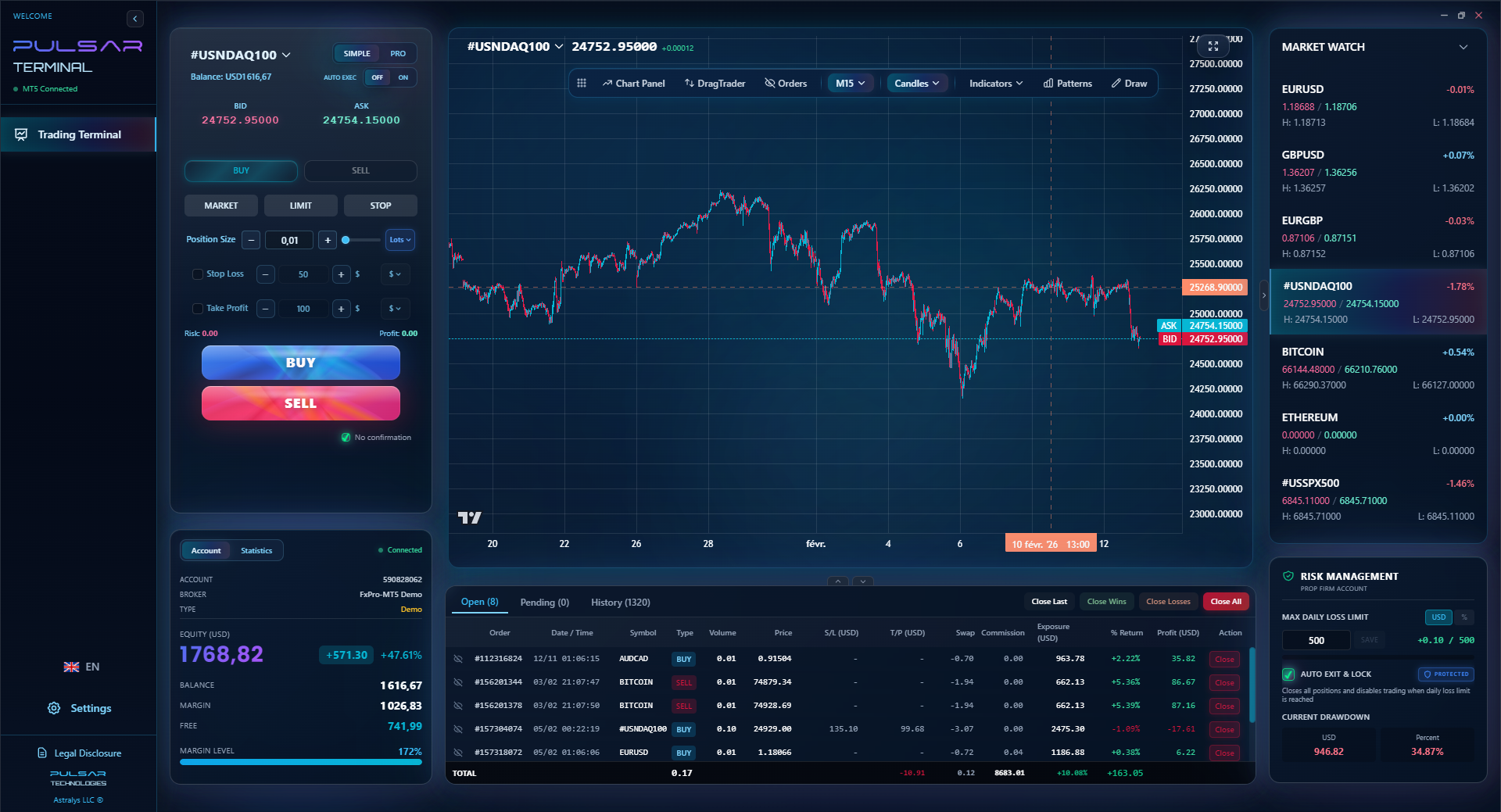
Managing the complex orders and risk required for modern forex, especially with volatile pairs like USD/ZAR, is far easier with a tool that lets you drag-and-drop multiple take-profits and set automated trailing stops directly on your MT5 chart.
Pulsar Terminal
Alat MT5 all-in-one: order drag-and-drop, multi-TP/SL, trailing stop, grid trading, Volume Profile, dan perlindungan prop firm. Digunakan 1.000+ trader setiap hari.
Knowing that forex is a constantly evolving beast, your job is to build a method that respects its history and its reality. This isn't about finding a holy grail indicator. It's about building a strong process.
Start with a rock-solid broker. Regulation is non-negotiable. Compare the real trading conditions of FSCA-licensed brokers like IC Markets, Pepperstone, or Exness. Look at their effective spreads on the pairs you trade, their deposit/withdrawal fees in ZAR, and the stability of their platform during high volatility.
Next, your edge must be in your process, not your prediction. This means:
- Risk-First Mindset: Decide what you're willing to lose before you decide what you might gain. Never risk more than 1-2% of your capital on a single trade.
- Journal Everything: Not just 'bought EUR/USD.' Log your reasoning, your emotional state, the economic calendar at the time. I review my journal every Sunday. The patterns of failure become painfully clear.
- Simplify Your Analysis: The market is complex; your strategy doesn't need to be. A few reliable tools, understood deeply, beat a chart cluttered with every indicator. I use price action, one or two moving averages, and the RSI indicator to spot divergences. That's it.
- Plan for All Outcomes: Have a clear entry, take-profit, and stop-loss level for every trade. More importantly, know what you'll do if the price goes sideways for days. Will you move to breakeven? Will you close it? Indecision is where losses grow.
The history of forex is a history of adaptation. The gold standard adapted to the Bretton Woods system, which adapted to free-floating rates, which adapted to digital trading. Your trading must have the same capacity to adapt. The strategy that worked in a trending ZAR market will fail in a ranging one. The mindset that got you through a winning streak will break during a drawdown. The question isn't 'who invented forex?' It's 'how will I adapt to it today?'
FAQ
Q1So, who actually invented forex trading?
No single person did. Forex trading evolved over thousands of years from simple barter. The modern market as we know it was created by the collapse of the Bretton Woods system in 1971, which allowed currencies to float freely, and the digital revolution of the 1990s, which made it accessible to retail traders.
Q2Is forex trading legal in South Africa?
Yes, absolutely. It is legal and regulated by the Financial Sector Conduct Authority (FSCA). You must trade with a broker that holds an FSCA Financial Services Provider (FSP) license with specific permission for OTC derivatives to ensure your funds are protected under South African law.
Q3What is the most traded currency pair involving the South African Rand?
By a massive margin, it's USD/ZAR. Approximately 95% of all Rand trading volume is against the US Dollar. It's the most liquid ZAR pair but also highly volatile, influenced by both US economic data and local South African factors.
Q4How much money do I need to start forex trading in South Africa?
Technically, very little. Some FSCA-regulated brokers have minimum deposits as low as $10 or 150 ZAR. However, starting with a realistically sized account (e.g., 10,000 ZAR or more) allows for proper risk management. Starting too small often leads to taking excessive use to see meaningful gains, which is a fast track to a margin call.
Q5What's the difference between a pip and a spread?
A pip is the standard unit of movement in a currency pair (usually 0.0001 for most pairs). The spread is the difference between the buy (ask) and sell (bid) price quoted by your broker, measured in pips. It's the broker's fee for facilitating the trade. A lower spread means a lower initial cost to enter the trade.
Q6Can I trade forex part-time from South Africa?
Yes, many successful traders do. The key is to trade longer timeframes (like 4-hour or daily charts) that don't require constant screen time. Avoid scalping or very short-term strategies if you have a day job. Use pending orders, stop-losses, and take-profits to manage positions while you're away, and focus on trading during the most liquid sessions that fit your schedule.
Q7Why is the South African forex market growing so fast?
Several factors: high interest rates attracting carry trade interest, South Africa's role as Africa's financial hub, increased technological adoption, and a growing population of tech-savvy individuals seeking alternative investments. The projected 6.58% annual growth reflects strong underlying demand.
Pelajaran Prof. Winston
Poin Penting:
- ✓No single inventor: Forex is a 5000-year evolution of trade.
- ✓1971 was the true birth: Floating rates created modern volatility.
- ✓The FSCA is your first line of defense: Only use licensed brokers.
- ✓ZAR pairs are volatile: Never make them more than 40% of your portfolio.
- ✓Calculate all-in costs: Spread + commission = your real fee.
- ✓Adapt or blow up: The market changes; your method must too.
Seberapa bermanfaat artikel ini?
Klik bintang untuk menilai
Wawasan Trading Mingguan
Analisis & strategi mingguan gratis. Tanpa spam.
Tentang Penulis
David van der Merwe
Trader Pasar Berkembang
Trader berbasis Johannesburg dengan 11 tahun di mata uang pasar berkembang. Spesialis pasangan ZAR, trading berregulasi FSCA, dan analisis pasar Afrika Selatan.
Komentar
Peringatan Risiko
Perdagangan instrumen keuangan mengandung risiko signifikan dan mungkin tidak cocok untuk semua investor. Kinerja masa lalu tidak menjamin hasil di masa depan. Konten ini hanya untuk tujuan edukasi dan tidak boleh dianggap sebagai nasihat investasi. Selalu lakukan riset Anda sendiri sebelum trading.
Anda mungkin juga suka

Cara Trading Forex Sukses: 7 Prinsip dari Trader Profesional
Cara trading forex sukses dengan 7 prinsip trader pro: manajemen modal, disiplin, journal trading, backtest. Data nyata, bukan janji profit palsu.
Jam Trading Forex Terbaik untuk Trader Indonesia: Panduan Lengkap dengan Tabel Waktu
Panduan jam trading forex untuk trader Indonesia. Tabel 4 sesi dunia, jam emas 20:00-00:00, sesi mana yang harus dihindari. Data akurat + tips dari trader berpengalaman.
Top 5 Sàn Forex Uy Tín Nhất 2026: Review Jujur dari Trader Indonesia
Top 5 sàn forex uy tín 2026 untuk trader Indonesia. Review jujur: spread, deposit, withdraw, dukungan lokal. Exness, XM, IC Markets & lebih.
Dapatkan Pulsar Terminal
Semua kalkulator ini terintegrasi dalam Pulsar Terminal dengan data real-time dari akun MT5 Anda.
Dapatkan Pulsar Terminal