


You've probably seen the ads.

David van der Merwe
Trader Pasar Berkembang ·  South Africa
☕ 8 mnt baca
Yang akan Anda pelajari:
You've probably seen the ads. The guy on the yacht, the mansion in Sandton, the claim of being 'South Africa's top forex trader.' Here's a hard truth: asking 'who is the best forex trader in South Africa' is the wrong question. It's a distraction. With an estimated 190,000 active traders here, the real answer isn't a name. It's a process. I spent years chasing that mythical figure, trying to copy their 'secrets,' only to blow up two accounts. The best trader isn't someone you follow; it's the disciplined, consistent version of yourself you build over time.
Let's get this out of the way. There is no official ranking, no governing body that crowns a champion. The 'best' trader today could be bankrupt in six months. I learned this the hard way in 2019. I found a local mentor who was crushing it on USD/ZAR. His Instagram was all luxury cars and penthouse views. I paid for his signals, copied his every move. For three months, I was up 42%. I felt like a genius. Then, a single rogue trade on a Turkish Lira pair - a currency he knew nothing about - wiped out his entire account, and mine alongside it. He vanished from social media. My R85,000 was gone.
That experience taught me that consistency over years, not months, is the only metric that matters. The traders who are genuinely successful aren't the loudest. They're the quiet professionals managing risk for pension funds or running proprietary trading desks. They don't have courses to sell. Their performance is measured in annual returns, not Instagram likes.

Warning: Anyone actively marketing themselves as the 'best' or 'number one' trader is almost certainly making more money from selling you a dream than from trading itself. Their business is your enrollment, not your education.
The South African market, regulated by the FSCA, is full of serious participants. The real 'best' traders are those who survive the volatility of the Rand, navigate load-shedding affecting their trading sessions, and still produce returns that outpace inflation year after year. They're defined by their risk management, not their biggest win.

💡 Tips Winston
The market doesn't know your name, your ego, or your yacht dreams. It only responds to your risk-adjusted decisions. Trade the chart, not your self-image.
“The 'best' trader today could be bankrupt in six months.”
So if not a person, what should you look at? The habits and frameworks of professional, sustainable trading. After my blow-up, I started interviewing fund managers and institutional traders. Their conversations never started with 'Which direction is the Euro going?'
Risk Management is Everything
Their first, middle, and last question is: 'What's my risk?' They define it before every trade. A common rule is risking no more than 1-2% of their capital on any single idea. I now use a position size calculator for every entry. It's boring. It's essential. It's the difference between a bad day and a terminal one.
The Business Mindset
They treat trading like a business. They have a written plan - a business plan for their trading. It outlines their strategy, their acceptable instruments (many pros stick to just 2-3 major pairs), their daily loss limits, and their profit goals. They know their monthly 'overheads' (drawdown) and their 'revenue targets' (returns).
Process Over Outcome
They are obsessed with their process, not their P&L on a given day. Did they follow their plan? Was their entry technically sound? Was their stop-loss logical? If they did everything right and still lost, that's a good trade. A win from a reckless gamble is a bad trade. This mindset shift took me years to internalize.

Pro Tip: Track your trades in a journal. Note your emotional state, the setup, and whether you followed your rules. After 100 trades, you won't be looking for a 'best trader' to follow. You'll have the data to become your own best analyst.
“Asking 'who is the best forex trader in South Africa' is the wrong question. It's a distraction.”
To build a sustainable operation, you need to understand the local landscape. Your costs and broker choice directly impact your ability to be 'the best' version of your trader self.
Regulation is Your Friend: Always use an FSCA-licensed broker. This ensures client money segregation and a recourse if things go wrong. Brokers like Exness and IC Markets have strong local FSCA presence. I made my first deposit with an unregulated offshore bucket shop. Getting my money back was impossible.
The Cost Structure:
| Cost Type | What It Is | Typical Range for ZAR Traders |
|---|---|---|
| Spread | Broker's fee built into price | 0.9 - 1.5 pips on EUR/USD is common |
| Commission | Direct fee per lot traded | $3 - $7 per standard lot (100k units) |
| Swap/Overnight | Fee for holding positions past 5pm NY time | Varies by pair; can be heavy on ZAR pairs |
| Currency Conversion | Cost to fund/withdraw in ZAR | 0.5% - 2% if not using a ZAR account |
Key Move: Open a ZAR-denominated account to avoid conversion fees. Also, understand that trading USD/ZAR or EUR/ZAR often has much wider spreads (think 50-150 pips) than majors like EUR/USD. That dramatically changes your risk per pip definition.
The Infrastructure Hurdle: Load-shedding is our unique market risk. A trade can't manage itself during a 4-hour outage. A UPS is a mandatory business expense, not an option. I once got stopped out on a winning gold trade because my internet died during stage 6. That was a R2,200 lesson in infrastructure.
💡 Tips Winston
Your trading journal is your most important indicator. If you're not reviewing your own decisions with brutal honesty, you're just gambling with a fancy charting package.
“A win from a reckless gamble is a bad trade.”
This is the practical part. How do you construct the machine that generates consistent results?
1. Find Your Edge (And Accept It's Small): An edge isn't a 'sure thing.' It's a slight statistical advantage. Maybe it's trading RSI indicator divergences on the 4-hour chart, or using MACD indicator crossovers on the daily. My edge is simple: I only trade the first 2 hours of the London session, focusing on breakouts from the Asian range. It works about 55% of the time. That's enough.
2. Define Your Style: Are you a scalping strategy artist, in and out for 5-10 pips? Or a swing trading patient hunter, holding for days? Your personality dictates this. I'm impatient. I tried swing trading and would sabotage my own trades. Scalping fit my brain better.
3. Technology as a Force Multiplier: This is where modern tools change the game. Manual trading is prone to emotional error. The best version of you uses technology to enforce discipline.

Example: Let's say your system requires moving your stop-loss to breakeven when a trade is 15 pips in profit. Doing this manually for 5 trades under pressure is hard. A tool that automates this rule ensures your plan is executed perfectly, every time. It removes the hesitation that turns winners into losers.
This automation is crucial for managing the psychological grind. It lets you focus on analysis, not on sweating over a mouse button when price is nearing your stop.
“A win from a reckless gamble is a bad trade.”
Here’s the raw truth they don’t put in the ads. Being consistently profitable is mentally exhausting. It’s lonely. You’ll have weeks of boring, break-even results. You’ll watch friends get lucky on meme stocks and question your whole process. This is where the search for an external 'best trader' is most dangerous - it’s a craving for validation.
I had a 14-trade losing streak once. Not a single winner. My rules were solid, the market was just in a choppy, directionless phase. My confidence was shattered. I broke my own rule and doubled my position size on trade #15, desperate to win back my losses. It lost too. That one emotional decision cost me 11% of my account. A margin call was suddenly a real possibility.
The pros have coaches, therapists, or strict routines to manage this. They take walks. They have mandatory stop-trading days after a big loss. Your psychology isn't a side note; it's your primary system. Building the 'best trader' within you is 30% strategy and 70% managing your own brain.
💡 Tips Winston
Automate your exit rules. Your future self, gripped by fear or greed, is your worst enemy. Use technology to protect you from yourself.
When the psychological pressure hits, having a tool that automatically executes your breakeven and trailing stop rules is what separates a disciplined plan from an emotional reaction.
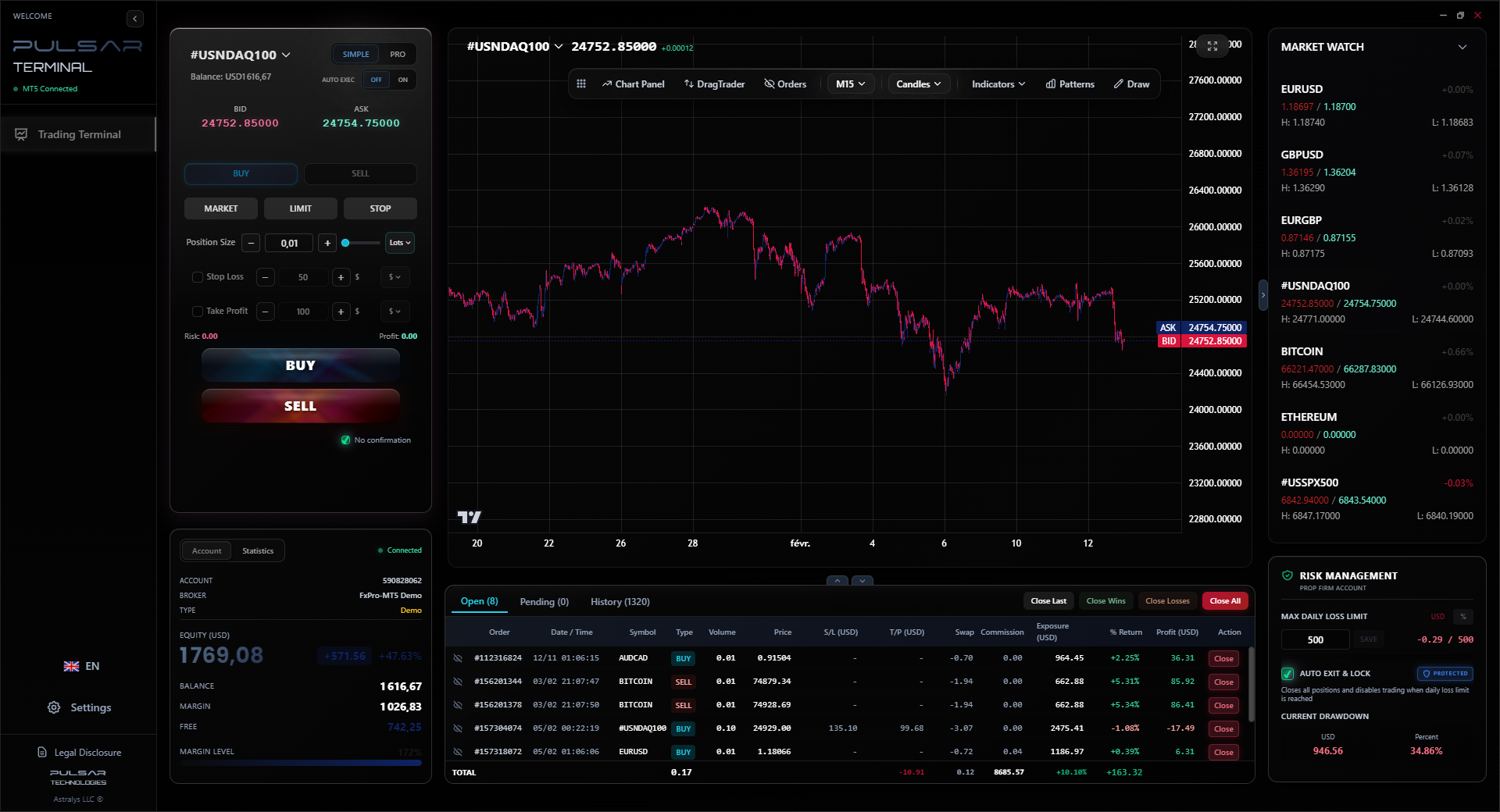
Pulsar Terminal
Alat MT5 all-in-one: order drag-and-drop, multi-TP/SL, trailing stop, grid trading, Volume Profile, dan perlindungan prop firm. Digunakan 1.000+ trader setiap hari.
“Being consistently profitable is mentally exhausting. It's lonely.”
So, who is the best forex trader in South Africa? It's the trader who has stopped looking for them.
Shift your metrics. Stop measuring yourself against phantom gurus. Measure yourself against these benchmarks:
- Survival: Have you preserved your capital for 12+ consecutive months?
- Adherence: Do you follow your trading plan >90% of the time? (A journal tells you this).
- Risk Discipline: Is your largest loss on a single trade within your pre-defined limit (e.g., 2%)?
- Continuous Learning: Are you systematically reviewing and refining your process?
My goal now isn't to be the best. It's to be a professional. That means my average monthly return is a humble but consistent 3-5%. Some months I'm down 2%. That's okay. The trajectory is up, the risk is controlled, and the business is sustainable.
Choose a reputable, FSCA-licensed broker like Pepperstone or XM to build your foundation. Master one instrument, maybe XAU/USD or EUR/USD, before adding others. Use every tool at your disposal to automate your discipline. The path isn't about finding a champion to worship. It's about putting in the lonely, careful work to become one.
FAQ
Q1Is there an official list of the best forex traders in South Africa?
No. There is no official ranking or regulatory body that publishes such a list. Any 'list' you see is marketing, often created by the people or companies featured on it to sell courses or signals.
Q2What should I look for in a successful trader to learn from?
Look for transparency over a multi-year track record (not just screenshots), a primary focus on risk management, and an emphasis on teaching process over giving signals. Be deeply skeptical of anyone showing a luxury lifestyle as proof of trading success.
Q3What is a realistic monthly return for a skilled retail trader in SA?
A consistent 3-8% per month is considered excellent and sustainable for a skilled retail trader. Anyone promising returns significantly higher than this, especially consistently, is almost certainly lying or taking insane risks that will eventually wipe out.
Q4How important is using an FSCA-regulated broker?
It is critical. FSCA regulation ensures client funds are segregated, provides legal recourse for disputes, and means the broker adheres to South African financial standards. Trading with an unregulated broker offers you no protection.
Q5Can I make a living trading forex in South Africa?
It is possible, but exceptionally difficult. It requires significant capital (most professionals suggest at least R500,000 to start), years of disciplined practice, and treating it as a full-time business with strict risk controls. Most successful 'full-time' traders have other income sources initially.
Q6What's the biggest mistake new SA traders make?
Chasing the idea of a 'best trader' or a secret system, instead of focusing on mastering the basics: position sizing, risk management, and their own psychology. They also often underestimate the impact of transaction costs (spreads, commissions) on their bottom line.
Pelajaran Prof. Winston
Poin Penting:
- ✓Consistency over 5 years beats 5 months of viral success.
- ✓Risk more than 2% per trade, and you're a tourist.
- ✓Your system must survive load-shedding and ZAR volatility.
- ✓Automate your exits to lock in discipline.
Seberapa bermanfaat artikel ini?
Klik bintang untuk menilai
Wawasan Trading Mingguan
Analisis & strategi mingguan gratis. Tanpa spam.
Tentang Penulis
David van der Merwe
Trader Pasar Berkembang
Trader berbasis Johannesburg dengan 11 tahun di mata uang pasar berkembang. Spesialis pasangan ZAR, trading berregulasi FSCA, dan analisis pasar Afrika Selatan.
Komentar
Peringatan Risiko
Perdagangan instrumen keuangan mengandung risiko signifikan dan mungkin tidak cocok untuk semua investor. Kinerja masa lalu tidak menjamin hasil di masa depan. Konten ini hanya untuk tujuan edukasi dan tidak boleh dianggap sebagai nasihat investasi. Selalu lakukan riset Anda sendiri sebelum trading.
Anda mungkin juga suka

Cara Trading Forex Sukses: 7 Prinsip dari Trader Profesional
Cara trading forex sukses dengan 7 prinsip trader pro: manajemen modal, disiplin, journal trading, backtest. Data nyata, bukan janji profit palsu.
Jam Trading Forex Terbaik untuk Trader Indonesia: Panduan Lengkap dengan Tabel Waktu
Panduan jam trading forex untuk trader Indonesia. Tabel 4 sesi dunia, jam emas 20:00-00:00, sesi mana yang harus dihindari. Data akurat + tips dari trader berpengalaman.
Top 5 Sàn Forex Uy Tín Nhất 2026: Review Jujur dari Trader Indonesia
Top 5 sàn forex uy tín 2026 untuk trader Indonesia. Review jujur: spread, deposit, withdraw, dukungan lokal. Exness, XM, IC Markets & lebih.
Dapatkan Pulsar Terminal
Semua kalkulator ini terintegrasi dalam Pulsar Terminal dengan data real-time dari akun MT5 Anda.
Dapatkan Pulsar Terminal